HCPCS Code B4168: Parenteral amino acid billing guide
HCPCS Code B4168: Official descriptor and solution specifications HCPCS Code B41...

Last Updated: Oct 15, 2026
G0163 is the HCPCS Level II code for a licensed nurse's (LPN or RN) skilled observation and assessment of a patient's condition, each 15 minutes. It applied when a change in the patient's condition needed skilled nursing personnel to evaluate possible treatment changes in the home health or hospice setting.
G0163 was deleted effective January 1, 2017, and is not billable for dates of service on or after that date. G0493 (RN) and G0494 (LPN or LVN) replaced it for observation and assessment, and both are billed per 15 minutes.
Let Pabau's smart automation suggest the right codes, reduce claim denials, and keep your practice compliant—effortlessly.
Automate repetitive tasks and focus on what matters most—your patients.
Reduce coding errors and ensure compliance with the latest regulations.
Clean claims, fewer denials, and faster reimbursements.
Powerful insights and reporting to help your practice thrive.
HIPAA compliant SOC 2 certified GDPR-compliant Trusted by 4,000+ clinics worldwide

HCPCS Code G0163 covered LPN or RN observation and assessment in the home health or hospice setting, billed per 15 minutes.
G0163 was deleted effective January 1, 2017, so it is not billable for dates of service on or after that date.
CMS replaced G0163 with G0493 (RN) and G0494 (LPN) for observation and assessment. G0299 and G0300 are separate codes for direct skilled nursing.
Historical claims keep the code that was active on the date of service, so pre-2017 G0163 claims are never recoded to the newer codes.
HCPCS Code G0163 is a deleted Level II code for skilled observation and assessment of a patient’s condition by an LPN or RN. It was billed each 15 minutes. It applied when a change in the patient’s condition needed skilled nursing personnel to evaluate treatment in the home health or hospice setting.
That descriptor anchors two billing concepts. The first is the provider type, which is LPN or RN only. The second is the trigger criterion: a change in the patient’s condition that demands skilled clinical judgment, beyond routine monitoring.
The code sat within the HCPCS Level II G-code series, which CMS maintains for procedures and services not captured by CPT codes. Many of those G-codes are reported under Medicare’s home health benefit. CMS deleted G0163 effective January 1, 2017.
Only licensed practical nurses (LPNs) and registered nurses (RNs) employed by or under contract with a Medicare-certified home health agency could bill this code. Home health aides, therapists, physicians, and non-licensed caregivers were explicitly excluded. CMS required the nurse to document why skilled observation was necessary. The patient’s condition had to have changed in a way a non-skilled person could not safely manage.
G0163 is a deleted HCPCS code, deleted effective January 1, 2017. It is not billable for dates of service on or after that date. The AAPC entry for G0163 lists it as deleted, in line with CMS’s annual process for retiring superseded G-codes.
G0163 covered one clinical scenario: a licensed nurse observing and assessing a patient whose condition had changed at home. CMS rules on what counts as “skilled” here are precise. The nurse’s presence must be clinically necessary, beyond merely convenient or precautionary.
Qualifying services under the G0163 framework involved subtle or ambiguous changes in the patient’s status. The nurse had to interpret the findings and decide whether the physician-ordered plan of care needed to change. Medical billing fundamentals explain why the skilled-versus-non-skilled line carries such weight. Medicare only covers services a non-professional caregiver cannot safely provide.
Routine check-ins that need no skilled clinical judgment are not billable under G0163 or its replacements. CMS consistently flags this distinction in audit findings. A nurse confirming that a stable patient takes medications as directed is making a supervisory visit. That is a different service from skilled observation and assessment.
Billing G0163 (or its active successors) for any of these non-skilled services is upcoding and creates audit risk. The medical billing compliance practices required under the Medicare home health benefit ask nurses to document the clinical finding that triggered the skilled observation. A note that only records that a visit occurred does not meet that bar.
G0163 was a time-based code billed in 15-minute increments. Each unit represented 15 minutes of skilled observation and assessment. Billing staff converted the nurse’s documented time into a unit count before claim submission. The replacement codes G0493 and G0494 use the same 15-minute unit.
The nurse’s clinical notes must record the start and end time of the observation period. Units billed beyond what the documentation supports are among the most common audit targets in home health skilled nursing claims. Only time spent in direct observation and assessment counted toward G0163 units. Travel time, documentation time, and non-clinical activities were excluded.
Document start and end times for every G0163-family visit in the nursing note itself, not only on the billing sheet. Auditors look for time entries in the clinical record first. A mismatch between the note and the claim is one of the most frequent denial triggers for skilled nursing home health codes.
Medicare covered G0163 under the home health benefit when the patient was homebound and a physician had signed an active plan of care. The code was paid through the Home Health Prospective Payment System (HH PPS) rather than the Medicare Physician Fee Schedule. Under HH PPS, agencies receive a bundled payment, so individual G-code units did not translate into line-item payments.
Because G0163 is deleted, the CMS Physician Fee Schedule lookup will not return an active payment rate for it. A claim submitted with G0163 for a current date of service will reject at the payer level before clinical review. Agencies needing current reimbursement rates should look up the active replacement codes G0493 and G0494 instead.
Agencies billing Medicare for skilled nursing should also confirm the patient meets the homebound criteria. The physician-ordered plan of care must explicitly authorize skilled nursing observation visits. Missing physician authorization is a separate denial reason from using a deleted code, and each one needs its own fix.
Insufficient documentation is one of the most common denial reasons for skilled nursing home health claims. For G0163, the medical record needed to establish four points: physician authorization, homebound status, a qualifying clinical change, and accurate time recording.
Home health agencies get the best results when these documentation checkpoints sit inside the nurse’s workflow, at the point of care. Retroactive documentation added after a denial is a red flag in post-payment audits.
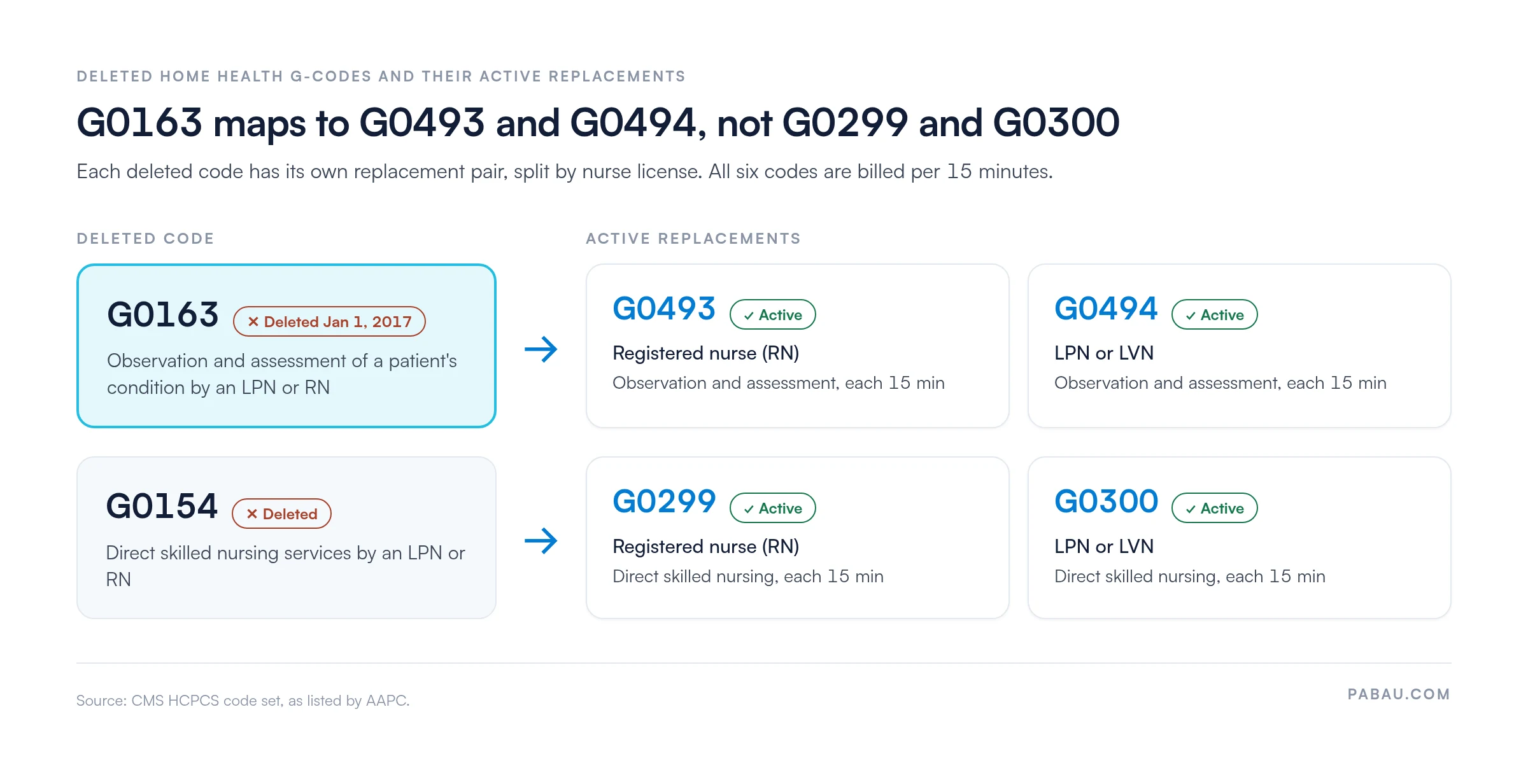
Several G-codes cover home health skilled nursing, and coders often confuse them. G0163 and G0154 are both deleted. G0163 was replaced by G0493 and G0494 for observation and assessment. G0154 was deleted effective January 1, 2016, and replaced by G0299 (RN) and G0300 (LPN) for direct skilled nursing, per Illinois HFS.
All six codes are billed per 15 minutes, so the time documentation built for G0163 carries straight over to G0493 and G0494. The pairing is where claims go wrong. The guide to denial codes explains how code transitions typically surface as claim rejections in the first billing cycle after a change.
G0493 and G0494 replaced G0163 for observation and assessment, effective January 1, 2017. Both are billed per 15 minutes, and the correct code depends on the nurse’s license level.
G0299 and G0300 are separate codes for direct skilled nursing by an RN and an LPN. Use them when the visit delivers direct skilled nursing care rather than observation and assessment of a changed condition. The map below shows which replacement pair belongs to which deleted code.
Historical records and retrospective audits follow a different rule. For dates of service when G0163 was active, the code remains valid. Do not recode historical claims to G0493 or G0494. Use the code that was active on the date of service. For current claims, update your superbill documentation to carry G0493 and G0494 in place of G0163.
Audit your billing system’s HCPCS master code file annually against the CMS HCPCS Annual Update files. Deleted codes that remain active in your billing software will generate clean-claim failures at submission. Schedule a code file review each October, when CMS releases preliminary updates for the following year.
Claims tied to HCPCS Code G0163 or its replacement codes deny for predictable reasons. Knowing the pattern lets billing staff build pre-submission checks instead of relying on appeals. The denial management workflows relevant to home health codes follow a consistent structure. Identify the denial category, trace it to a root cause, and fix the upstream process.
Most denials in the table above come down to a missing or mismatched detail. Catching them by hand means re-checking every claim against the patient record before it goes out. On a busy day, that check is easy to skip.
Pabau, the practice management platform we build, pre-fills each claim with patient and treatment details from the record, so staff don’t re-key them. Its claims software for practices runs validation checks for missing details, such as membership numbers and authorization codes, before a claim is submitted.
After submission, every claim shows its status as pending, submitted, processing, paid, or error, so a rejection surfaces the day it happens. US practices can also run real-time eligibility checks and post ERA remittances through the Claim.MD connection. Your coders still choose the code, and Pabau keeps the rest of the claim complete around it.

Pabau pre-fills claims from the patient record and checks for missing details before submission, so fewer claims come back for avoidable errors.

HCPCS Code G0163 has been off the code set since January 1, 2017, so the decision left for billing teams is which replacement to use. For observation and assessment, that means G0493 for an RN and G0494 for an LPN or LVN. Reaching for G0299 or G0300 reports a different service.
The eligibility rules carry forward unchanged: a condition change that needs skilled judgment, a licensed nurse, and a signed plan of care. Document those three points in the nursing note, keep time entries in the clinical record, and leave pre-2017 claims on the code that applied then.
If you want claims that arrive complete, with patient details pre-filled and missing fields flagged before submission, book a demo of Pabau.

Need a starting point for understanding HCPCS billing structure? Medical billing fundamentals explains how HCPCS codes fit into the claim lifecycle from encounter to payment.
Dealing with repeated claim rejections on home health codes? Denial management in healthcare covers how to categorize, track, and resolve denial patterns systematically.
Want to make sure your superbills reflect current active codes? Superbill documentation best practices outlines what to include and when to audit your code list for deletions and replacements.
HCPCS Code G0163 is a deleted Level II Medicare code for a licensed nurse’s (LPN or RN) skilled observation and assessment of a patient’s condition. It applied in the home health setting, billed in 15-minute increments, when a condition change required skilled nursing judgment. CMS deleted it effective January 1, 2017.
Yes. G0163 was deleted effective January 1, 2017, and a claim using it for a later date of service will be rejected. Claims for skilled nursing observation and assessment must use G0493 (RN) or G0494 (LPN/LVN) instead.
G0493 and G0494 replaced G0163. G0493 covers observation and assessment by a registered nurse (RN). G0494 covers the same service by a licensed practical or vocational nurse (LPN or LVN). Both are billed per 15 minutes.
G0163 was billed per 15-minute increment, not per visit. Each unit represented one 15-minute period of skilled observation and assessment. The nurse’s clinical note had to document start and end times to support the number of units on the claim. Its replacements G0493 and G0494 are also billed per 15 minutes.
Both G0163 and G0154 are deleted HCPCS codes that described LPN or RN services in the home health setting, billed per 15 minutes. G0154 covered direct skilled nursing services broadly. G0163 was specifically for observation and assessment after a change in the patient’s condition. G0163 was deleted effective January 1, 2017 and replaced by G0493 and G0494. G0154 was deleted effective January 1, 2016, and replaced by G0299 and G0300.
Start with a physician-signed plan of care that authorizes skilled nursing observation. The nursing notes must describe the condition change that triggered the visit and include homebound status language. They also need start and end times, plus a record of any clinical decisions or physician notifications. Missing any of these elements is a common denial trigger.