HCPCS Code G0163: Skilled nursing observation and assessment
What is HCPCS Code G0163? HCPCS Code G0163 is a deleted Level II code for skille...

Last Updated: Oct 15, 2026
93017 is the CPT code for the tracing component of a cardiovascular stress test, performed with treadmill or bicycle exercise or with pharmacological stress.
CPT code 93017 is the technical component of cardiovascular stress testing. It covers the tracing, the equipment, and the monitoring staff time, but not physician supervision or interpretation. Facilities bill it when the physician bills supervision (93016) and interpretation (93018) separately. Claiming 93017 with the global code 93015 is a hard NCCI bundle, and the claim rejects.
Let Pabau's smart automation suggest the right codes, reduce claim denials, and keep your practice compliant—effortlessly.
Automate repetitive tasks and focus on what matters most—your patients.
Reduce coding errors and ensure compliance with the latest regulations.
Clean claims, fewer denials, and faster reimbursements.
Powerful insights and reporting to help your practice thrive.
HIPAA compliant SOC 2 certified GDPR-compliant Trusted by 4,000+ clinics worldwide

CPT code 93017 covers the technical tracing component only: the equipment, the ECG monitoring, and the staff time during the test.
93017 and the global code 93015 cannot appear on the same claim, because NCCI treats that pairing as a hard bundle.
Modifier -TC does not belong on 93017, because the descriptor already limits the code to the technical component.
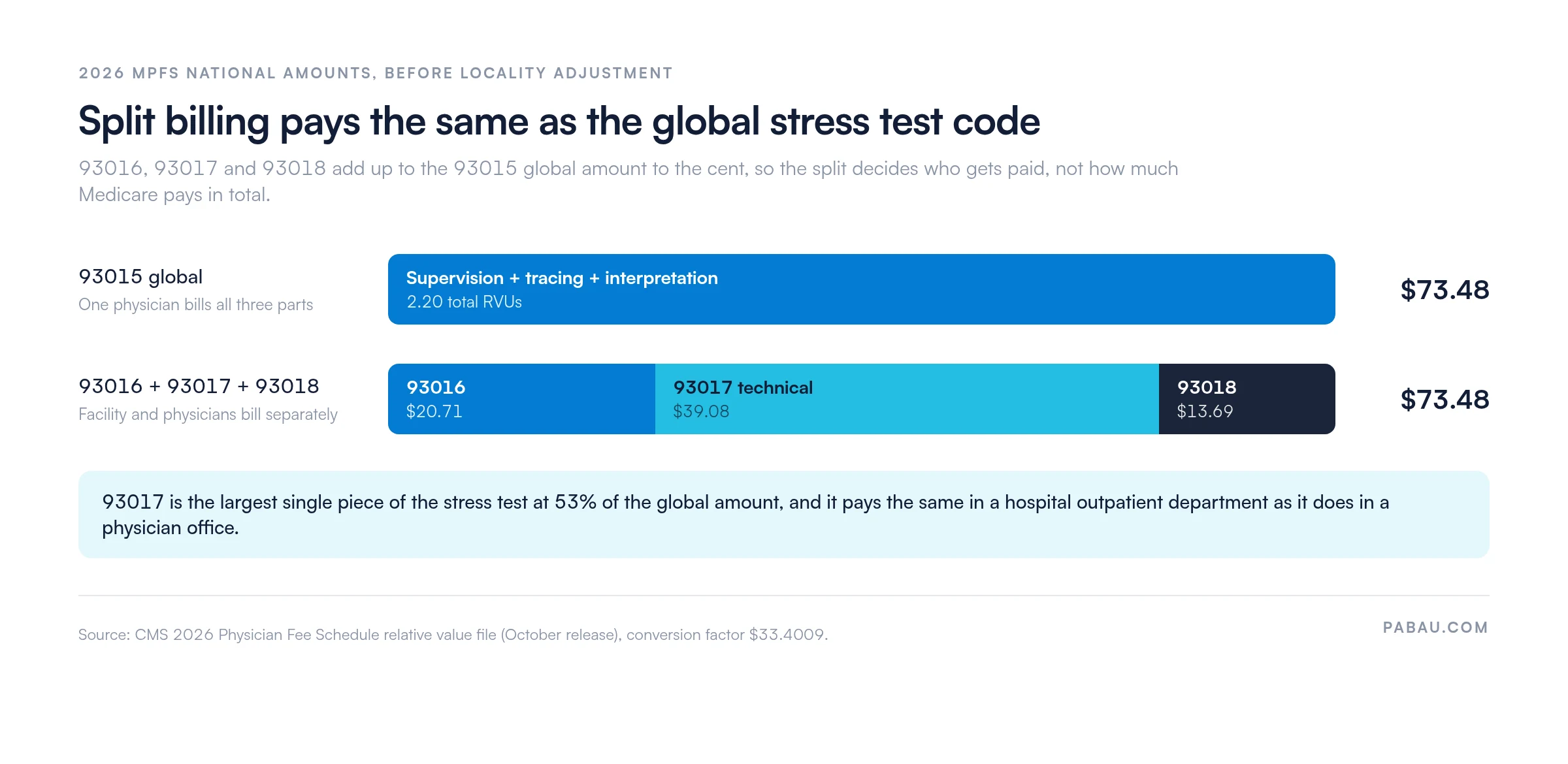
The 2026 Medicare national amount for 93017 is $39.08, and it is the same in a facility and in a physician office.
Pabau runs validation checks before a claim is sent, catching missing required details before they become rejections.
The American Medical Association (AMA) defines CPT code 93017 as follows. Cardiovascular stress test using maximal or submaximal treadmill or bicycle exercise, continuous electrocardiographic monitoring, and/or pharmacological stress; tracing only, without interpretation and report.
The phrase “tracing only” is the operative distinction. The code covers the physical production of the ECG tracing, the equipment, and the technical staff who operate and monitor it. It does not include the physician’s attendance and supervision during the test, or the written interpretation of findings.
93017 belongs to a four-code family inside the Cardiography subsection of CPT, which runs from 93000 to 93153. That subsection sits within the cardiovascular range, 92920 to 93799, in the Medicine section of the codebook. Reading the four codes together is what keeps a practice clear of both undercoding and NCCI bundling violations.
The mutual exclusivity rules are absolute, because 93015 bundles all three components into one line. Bill 93015 when one physician supervises and interprets in a non-facility setting. Bill 93016 for the supervision, 93017 for the tracing, and 93018 for the interpretation when the facility and the physician bill independently.
Knowing exactly what 93017 covers prevents both overbilling and underbilling when splitting the stress test across facility and professional claims.
Included under 93017:
Explicitly excluded from 93017:
Modifier -TC (technical component) does not belong on 93017. The descriptor already limits the code to the technical component, so the modifier adds nothing. Many payers read the redundant modifier as a billing error and respond with a rejection or a request for medical records review.
Medicare reimburses 93017 under the Medicare Physician Fee Schedule (MPFS). The MPFS national amount for 93017 is the same in facility and office settings. The place of service does not move that fee schedule payment. Hospital outpatient departments are paid separately under the Outpatient Prospective Payment System (OPPS).
Those three component amounts are worth setting side by side, because they answer the question practices usually ask next. Supervision (93016) pays $20.71 and interpretation (93018) pays $13.69 at 2026 national rates. Added to the $39.08 for 93017, they come to $73.48, which is the 93015 global amount to the cent.
Rates vary by geographic payment locality. Confirm the exact amount for your MAC jurisdiction with the CMS fee schedule lookup tool before you quote patients or build a charge master. These figures are 2026 MPFS national amounts and are updated annually.
Because 93017 pays the same in both settings, a short payment on this line is rarely a place of service problem. Compare your paid amounts against the MPFS rate for your locality each quarter. A variance of more than 15% usually points to the code, the modifier, or the locality on the claim.
Billing 93017 correctly depends on whether the facility and the interpreting physician are in the same organization or billing independently. Understanding medical billing fundamentals for component coding is the foundation for avoiding the most common claim errors on this code.
Pabau, the practice management platform we build, runs validation checks every time you go to send a claim. Its claims management software catches missing required details before they become rejections, which is where most cardiology rework starts.
Medicare and most commercial payers require a specific documentation set to support a 93017 claim. Missing any of these elements is one of the most direct paths to a post-payment audit finding or a retroactive denial.
Electronic submission through Claim.MD, Pabau’s US clearinghouse partner, carries the required header and detail-level fields on every cardiology claim before it reaches a payer. Claim.MD connects to thousands of US payers and generates professional CMS-1500 claims.
Medicare fee-for-service does not require prior authorization for 93017 when the clinical indication meets the coverage criteria in the applicable Local Coverage Determination (LCD). Confirm your MAC’s Local Coverage Determination (LCD) for the diagnoses that support medical necessity.
Commercial payers and Medicare Advantage plans operate differently. Completing insurance eligibility verification before you schedule the test confirms both the coverage and any prior authorization requirement.
93017 has a predictable denial profile. Most rejections fall into five categories, and pre-submission workflow checks prevent each one. Established denial management workflows for cardiology billing work through them in order.
For claims that have already denied, read the denial codes to tell a hard edit from a soft one. A hard edit needs a corrected claim. A soft edit can be overturned on appeal with supporting documentation. Clearinghouse reports returned with 93017 denials carry the CARC reason codes that pinpoint the category.
Medical necessity for cardiovascular stress testing rests on the documented clinical indication. The following ICD-10-CM codes are broadly accepted by Medicare and commercial payers for stress test billing. Verify acceptance against your own MAC LCD and payer contracts before you rely on one.
Always use the most specific ICD-10-CM code supported by the patient’s documented presentation. Unspecified codes like R07.9 are acceptable when specificity is genuinely unavailable, but payers may request supporting documentation more frequently for unspecified diagnoses.
93017 has a narrow modifier profile compared with many cardiology codes. Getting these rules right prevents the two most common modifier-related rejections on this code.
When cardiovascular stress testing is combined with nuclear myocardial perfusion imaging or stress echocardiography, the billing picture becomes more complex. AAPC coding guidance treats 93017 and the nuclear imaging codes (78451, 78452) as separately billable on the same day. They sit in distinct code families and describe distinct services.
The key distinctions for multi-modality stress studies:
Before billing 93017 alongside nuclear imaging codes, run a current NCCI edit check using CMS’s online tool. Bundling rules in the stress test/imaging code family are updated annually and an edit that was not active last year may be in effect now.
Most cardiology teams catch a 93017 problem after the remittance arrives. The claim goes out, and the payer bundles it against 93015 or questions the diagnosis. A biller then spends twenty minutes reconstructing an encounter from three weeks ago. The documentation that would have settled it sits in a different system from the claim.
Pabau keeps the stress test record and the claim in one place. The order, the diagnosis code, the protocol notes, and the tracing attach to the same patient record that the claim is built from. When you go to send the claim, Pabau runs validation checks in the background and flags the required details that are missing.
For a practice splitting the stress test across component codes, that matters at volume. Every subscription includes the full billing workflow, so a single-physician office and a multi-site cardiology group work from the same checks. Fewer claims come back, and the ones that do arrive with the chart already attached.

Pabau runs validation checks before every claim is sent, so your 93017 lines reach payers with the required details already in place.

93017 is a narrow code, and that is what makes it easy to get wrong. The decision to make once, not per claim, is whether your stress tests are billed globally or split across components. Settle that with the physicians who read the tracings, write it into the charge master, and the bundling denials stop arriving.
The trade-off worth remembering is that split billing pays no more than the global code. It exists so the facility and the physicians can be paid separately, and the practices that treat it that way argue with payers less. Pabau runs validation checks before a claim is sent, so missing details surface while the encounter is still fresh. Book a demo to see how cardiology billing runs when the chart and the claim live in one record.

Need to understand how clearinghouse submission works for cardiology claims? How medical claims clearinghouses process cardiology billing covers the end-to-end submission pathway from practice to payer.
Want a deeper guide to ERA and remittance for stress test claims? Electronic remittance advice in medical billing explains how to read ERA files and reconcile 93017 reimbursements against expected rates.
Billing a stress echocardiogram instead of a treadmill study? CPT code 93350 sets out the stress echo rules that replace the 93015 to 93018 family.
Managing denial patterns across your cardiology caseload? Medical billing compliance for cardiology practices covers the audit and documentation standards that support clean 93017 claims.
CPT code 93017 covers the technical component of cardiovascular stress testing. That means the continuous ECG monitoring, the tracing, the equipment, and the technical staff time during the test. It does not include physician supervision (93016) or the written interpretation and report (93018).
CPT 93015 is the global stress test code covering all components: supervision, tracing, and interpretation in one bill. CPT 93017 is the technical-only component, billed separately by the facility when the physician bills supervision (93016) and interpretation (93018) independently. They cannot be billed together on the same claim.
CPT 93017 is the technical component only. The code descriptor specifies “tracing only, without interpretation and report,” meaning no professional judgment or physician work is included. Modifier -TC should not be added because the code already designates the technical component by definition.
Medicare reimburses about $39 for CPT 93017 in both settings. The 2026 MPFS national amount is $39.08, before locality adjustment. Exact rates vary by geographic payment locality, so use the CMS fee schedule lookup tool to confirm the amount for your MAC jurisdiction.
Five denials account for most 93017 rejections. The first is bundling with 93015, which is an NCCI hard edit. The second is lack of medical necessity, when the ICD-10 diagnosis does not meet LCD criteria. The rest are a missing prior authorization, an incorrect place of service code, and a redundant -TC modifier. All five are preventable with pre-submission workflow validation.
Required documentation includes a signed physician order with the clinical indication and the ECG tracing stored in the patient record. You also need test protocol notes covering exercise duration and peak workload. Add an ICD-10-CM diagnosis code supported by the chart, plus technician credentials where the MAC requires them.
Nuclear myocardial perfusion imaging uses CPT codes 78451 (SPECT, single study) and 78452 (SPECT, multiple studies), which cover the imaging component. When nuclear imaging is added to cardiovascular stress testing, 93017 may be billed alongside 78452 for the ECG tracing component, as they cover distinct services. Verify current NCCI edits before billing both on the same claim, as edits in this area update annually.