HCPCS Code G0163: Skilled nursing observation and assessment
What is HCPCS Code G0163? HCPCS Code G0163 is a deleted Level II code for skille...

Last Updated: Oct 15, 2026
Billable Code
64454 is the CPT code for injection(s), anesthetic agent(s) and/or steroid; genicular nerve branches, including imaging guidance, when performed. It covers a genicular nerve block of one knee, done for pain relief or as a test before ablation. The code is reported as one unit per knee.
Most denials on this code trace back to documentation. Either the procedure note doesn't name the genicular branches injected, or the diagnosis code doesn't match a covered knee indication. The third common cause is imaging guidance billed separately, although the code already includes it.
Let Pabau's smart automation suggest the right codes, reduce claim denials, and keep your practice compliant—effortlessly.
Automate repetitive tasks and focus on what matters most—your patients.
Reduce coding errors and ensure compliance with the latest regulations.
Clean claims, fewer denials, and faster reimbursements.
Powerful insights and reporting to help your practice thrive.
HIPAA compliant SOC 2 certified GDPR-compliant Trusted by 4,000+ clinics worldwide

CPT code 64454 covers anesthetic and/or steroid injection into the genicular nerve branches of the knee, and no other nerve site.
The code expects the superolateral, superomedial, and inferomedial branches to be injected. Report fewer than three with modifier 52.
Use CPT 64455 for a Morton’s neuroma injection and 64450 for other peripheral nerves without a more specific code.
Imaging guidance is included in 64454, so never add 76942 or 77002 to the same claim.
Aetna’s CPB 0863 lists 64454 as experimental and investigational, so check payer policy before the procedure is booked.
Practice management software like Pabau can check code pairings and payer rules before submission, which cuts avoidable 64454 denials.
CPT code 64454 is described by the American Medical Association as: Injection(s), anesthetic agent(s) and/or steroid; genicular nerve branches, including imaging guidance, when performed. The code was new in CPT 2020 and sits in the 64400-64489 somatic nerve block range. It describes one procedure at one site: blocking the genicular nerve branches that carry pain signals from the knee.
Before 2020, genicular nerve blocks were reported with 64450, the catch-all peripheral nerve code. A charge sheet built before that change may still map the knee block to 64450, which is now the wrong code. CPT 64454 is the only correct choice for this injection.
CPT 64454 covers one procedure: a genicular nerve block of the knee, done for treatment or as a diagnostic test. Knowing its limits prevents both under-coding (using the less specific 64450) and over-coding (claiming 64454 for nerve sites outside its descriptor).
The genicular nerve block targets the superolateral, superomedial, and inferomedial genicular nerve branches that supply the knee joint. It is used for chronic knee pain from osteoarthritis and for persistent pain after knee replacement. Candidates usually cannot have surgery or have exhausted conservative options.
The physician places the needle beside each nerve branch at the bone surface, usually under fluoroscopic or ultrasound guidance. CPT guidelines expect all three branches to be injected. The code is reported once per knee, whatever the number of branches treated.
Many genicular blocks are done as a test before radiofrequency ablation. The physician injects local anesthetic alone and records how much the knee pain drops over the following hours. A strong response supports the later ablation, which is billed with CPT 64624, not 64454.
Record the pain scores before and after the block in the note. Payers reviewing a later 64624 claim often ask for that result first.
Miscoding 64454 for out-of-scope procedures is one of the most common denial triggers on this code. The following are explicitly outside the descriptor.
When the procedure does not fit any named nerve code, CPT 64999 (unlisted procedure, nervous system) is the fallback. Using it unnecessarily increases audit risk, so reserve it for services no named code describes. The table below maps each knee and nerve injection to the code it takes.
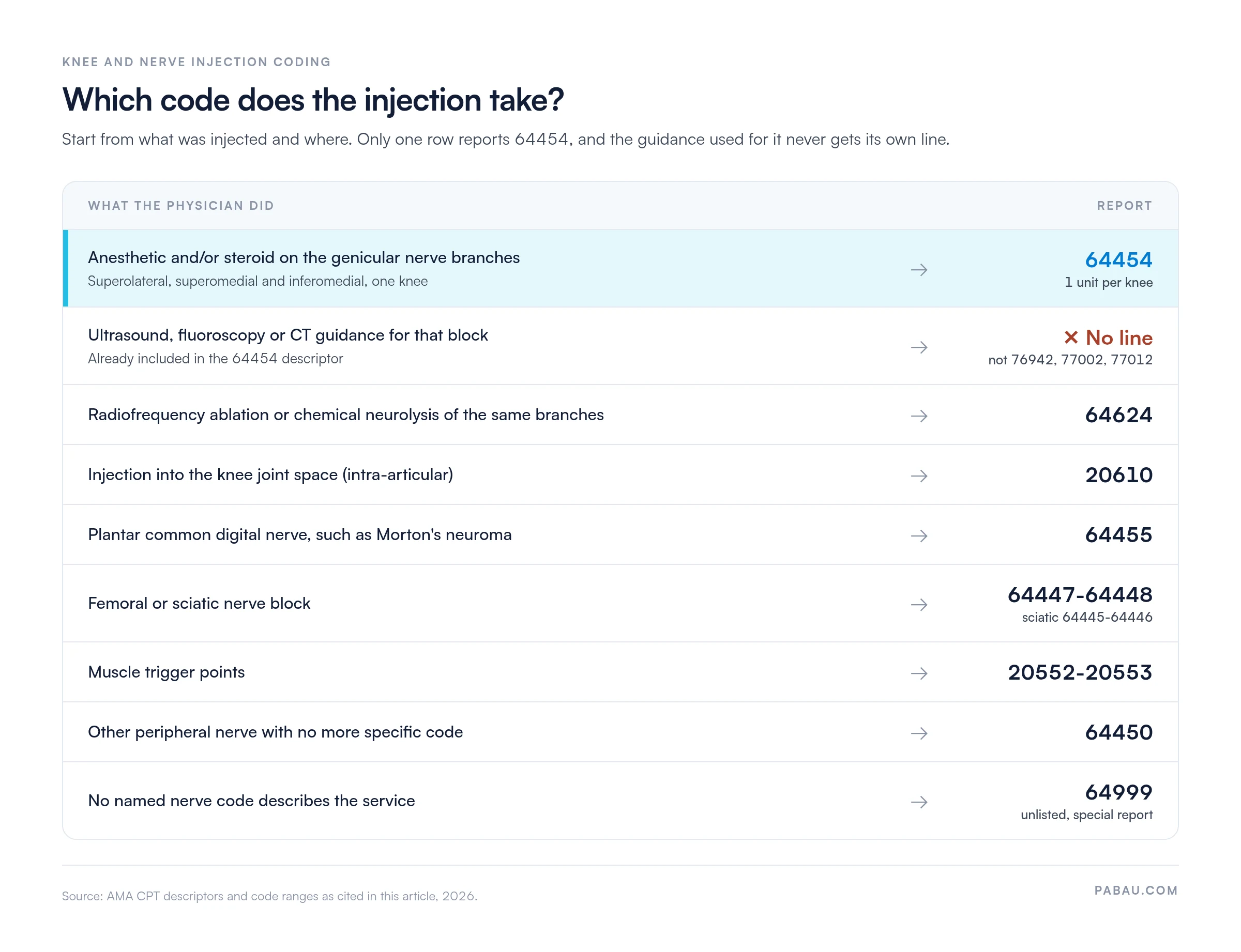
CPT 64450 covers injection into “other peripheral nerve or branch,” making it the default when no more specific code exists. CPT code 64454 is the more specific code and takes precedence when the procedure targets the genicular nerve branches. Using 64450 for a genicular block is a coding error.
If the documentation names the genicular nerve branches as the injection site, 64454 is required. Defaulting to 64450 for convenience is an improper code selection. According to the AAPC’s CPT code reference, more specific codes always take precedence over the “other” fallback when the clinical documentation supports them.
The same precedence rule applies at other sites. A sciatic nerve block has its own specific code, 64445, so 64450 is the wrong choice there too. Morton’s neuroma injections at the plantar common digital nerve are reported with 64455.
Selecting the correct peripheral nerve injection code means knowing the neighboring codes. The table below covers the codes coders most often compare against CPT 64454 in pain management and orthopedic settings.
The CPT 64454 descriptor states “including imaging guidance, when performed,” so guidance is part of the code. Ultrasound (76942), fluoroscopy (77002), and CT guidance (77012) are not reported separately. Medicare and most commercial payers deny them as bundling violations.
Guidance still belongs in the procedure note, even though it never appears on the claim. Name the modality and state that each needle position was confirmed on imaging. That record supports medical necessity if the claim is reviewed.
Check your charge capture rules. If your system adds a guidance code to every nerve block automatically, set an exception for 64454 so 76942 or 77002 never reaches the claim.
Thin documentation is the single biggest cause of 64454 claim denials. The procedure note must support every element of the code descriptor. A note that says “nerve block performed to the knee” is not enough. Payers expect the named nerve, the agent, and the clinical rationale.
Required elements for a defensible 64454 claim:
Pain management practices using practice management software like Pabau can build procedure templates that prompt clinicians for each required note element during the visit. With Pabau’s error-checked claims management, the claim is built from that same note. The branches and agent recorded at the bedside reach the claim line unchanged.
The diagnosis code paired to a 64454 claim must support medical necessity for a knee procedure. Payers cross-reference the ICD-10 code against their covered indication list. A diagnosis for the wrong knee, or one outside the knee, will trigger a denial.
Some payers require laterality-specific codes (right vs. left) rather than bilateral or unspecified variants. Check the payer’s local coverage determination (LCD) on the CMS ICD-10 codes page for covered diagnosis lists before submitting. A superbill that pairs each ICD-10 code with its CPT line catches mismatches before claims reach the payer.
Medicare pays about $235 for CPT 64454 in an office setting and about $73 in a facility in 2026, before geographic adjustment. Non-facility rates apply in an office, and facility rates apply in an ASC or hospital. The figures below come from the CMS 2026 relative value file (October release) at the $33.4009 conversion factor.
Rates change every January 1, so check the CMS Physician Fee Schedule lookup tool before you quote them.
Geographic Practice Cost Index (GPCI) adjustments move these figures up or down by practice location. High-cost urban markets typically pay above the national average, and rural areas pay below it. Commercial payers commonly set their fee schedules as a percentage of Medicare rates. That figure often ranges from 110% to 200%, depending on the plan and contract. The full data set sits in the CMS relative value files.
Correct modifier use is essential for CPT 64454 claims. It matters most when both knees are injected, or fewer than three branches, on the same date of service. Modifier errors rank among the top denial reasons for this code.
For practices with high nerve injection volumes, modifier rules belong at the claim-build stage. Catching a missing LT/RT modifier before submission takes seconds. Correcting it after a denial costs staff time and delays payment by weeks.
Coverage for CPT code 64454 varies sharply by payer, from conditional approval to no coverage at all. Before scheduling the procedure, verify coverage and authorization requirements with the specific plan.
CMS published Billing and Coding Article A57452 covering peripheral nerve blocks including 64454. Medicare generally requires documented failure of conservative treatment before approving genicular nerve blocks. Coverage is subject to LCDs that vary by MAC jurisdiction. Check the CMS Medicare Coverage Database for the LCD governing your specific MAC region.
Aetna Clinical Policy Bulletin 0863 lists genicular nerve block as experimental and investigational. It places CPT 64454 among the codes not covered for the indications in the bulletin, so no amount of documentation makes the claim payable. Aetna reviews its bulletins periodically, so confirm the current version before booking an Aetna patient.
BCBS Florida Medical Coverage Guideline MCG 02-61000-29 outlines nerve block injection coverage criteria. BCBS Florida typically requires documented conservative treatment failure (physical therapy, oral analgesics) before approving genicular nerve blocks. It may also limit injection frequency per plan year.
A real-time insurance eligibility check before each appointment confirms whether the patient’s plan covers 64454 and needs prior authorization. That check stops a procedure being performed and later denied for a missing authorization number.
Most 64454 denials are preventable. The following patterns account for the majority of rejections seen in pain management and orthopedic billing, based on common coder queries and payer edit patterns.
Tracking denials by CPT code separates systemic issues from one-off errors. Each denial comes back with a reason code, and the guide to medical billing denial codes explains how to read them. Grouping 64454 denials by those codes shows a pattern before it spreads across hundreds of claims.
A correctly performed genicular block still goes unpaid when the note or the claim build misses a detail. Practice management software with integrated billing puts the coding rules into the clinical workflow, so the detail is caught at the point of care.
For 64454, three capabilities matter most:
Pabau’s integration with the Claim.MD clearinghouse adds a pre-submission scrub. It checks each claim against payer-specific edits for over 4,000 US payers before it leaves the practice.
Denial reports broken down by CPT code show when 64454 denials cluster around one provider, payer, or missing note element. Reviewing them each quarter lets the billing team fix a pattern before the next batch of claims goes out. The same review supports medical billing compliance, which lowers audit risk as well as denial risk.
Run a quarterly denial audit filtered by CPT 64454. If more than 15% of claims for this code are denied, look at three causes first. They are missing branch names in the note, the wrong ICD-10 pairing, and a bundling edit on a guidance code. Start with documentation review before assuming the payer policy has changed.

Pabau’s integrated claims management tools help pain management and orthopedic practices validate code pairings, enforce modifier rules, and submit cleaner claims through the Claim.MD clearinghouse. See how it works for nerve injection billing.

CPT 64454 rarely goes wrong at code selection. It goes wrong in the procedure note and the claim build. If your charge sheet still maps knee blocks to 64450, or adds a guidance code automatically, change those two rules first. They take minutes to fix and remove the most avoidable denials on this code.
Then check payer policy before the block is booked, not after the claim comes back. Aetna won’t pay for it under CPB 0863, so a denial there says nothing about your documentation.
Book a demo to see how Pabau builds each 64454 claim from the procedure note and checks it before it reaches the payer.

Need to understand the broader clearinghouse workflow? How medical claims clearinghouses work explains the end-to-end submission path from practice to payer.
Tracking denial reasons across your CPT code mix? Denial codes in medical billing breaks down CARC and RARC codes so you can act on rejection data systematically.
Want to benchmark your billing compliance posture? Medical billing compliance essentials covers documentation standards, audit risk management, and payer policy review cycles.
Building a pre-submission checklist? What makes a clean claim lists the fields and edits a claim has to pass before the payer accepts it.
Injecting the knee joint instead of the nerves? CPT code 20610 covers major joint injection and aspiration, the code 64454 is most often confused with.
CPT code 64454 covers injection of anesthetic agent and/or steroid into the genicular nerve branches of the knee, with imaging guidance included. It does not cover other nerve sites, genicular nerve ablation (64624), Morton’s neuroma injections (64455), joint injections, or trigger point injections.
CPT 64454 is a site-specific code for genicular nerve injections of the knee. CPT 64450 is the general fallback for “other peripheral nerve or branch” without a more specific code. Using 64450 for a genicular block is a coding error.
No. The 64454 descriptor includes imaging guidance when performed, so ultrasound (76942) and fluoroscopic guidance (77002) are not billed separately. Document the guidance in the procedure note, but keep it off the claim.
Yes. Bilateral genicular nerve injections are reported with modifier 50, or on two separate lines with LT and RT modifiers, depending on the payer’s preferred format. Don’t report multiple units for the three branches of one knee. That is one unit, with a modifier showing laterality.
In 2026, Medicare pays about $235 for CPT 64454 in a non-facility setting and about $73 in a facility, at national rates before GPCI adjustment. Those figures come from 7.03 and 2.19 total RVUs. Verify current rates in the CMS Physician Fee Schedule lookup tool, as they update each January 1.
The most common reason is a procedure note that does not name the genicular branches injected. Others are an ICD-10 code missing from the payer’s covered list, a separately billed guidance code, or a missing prior authorization. An Aetna claim is denied because CPB 0863 does not cover the block.
CPT 64999 (unlisted procedure, nervous system) applies when the nerve injection performed does not fit the 64454 descriptor or any other named nerve code. Using 64999 requires a special report submitted with the claim explaining the procedure and its relationship to a comparable code for pricing. Use 64999 only when necessary. Unnecessary use increases audit risk and slows reimbursement.