CCSD code A2720: Proximal gastric vagotomy billing guide
What is CCSD code A2720? CCSD code A2720 is the procedure billing code assigned ...

Last Updated: Oct 8, 2026
64455 is the CPT code for injection(s), anesthetic agent(s) and/or steroid; plantar common digital nerve(s), e.g., Morton's neuroma. It covers anesthetic or steroid injection at the metatarsal interspace and is reported once per foot, however many interspaces are treated.
64450 is for other peripheral nerves, so use 64455 when the common plantar digital nerve is injected. A clean claim pairs it with a laterality-specific G57.6x diagnosis and an RT, LT, or 50 modifier. The CY2026 national Medicare rate is about $50.10 in the office.
Let Pabau's smart automation suggest the right codes, reduce claim denials, and keep your practice compliant—effortlessly.
Automate repetitive tasks and focus on what matters most—your patients.
Reduce coding errors and ensure compliance with the latest regulations.
Clean claims, fewer denials, and faster reimbursements.
Powerful insights and reporting to help your practice thrive.
HIPAA compliant SOC 2 certified GDPR-compliant Trusted by 4,000+ clinics worldwide

CPT code 64455 covers anesthetic and/or steroid injection of the plantar common digital nerve(s) at the metatarsal interspace.
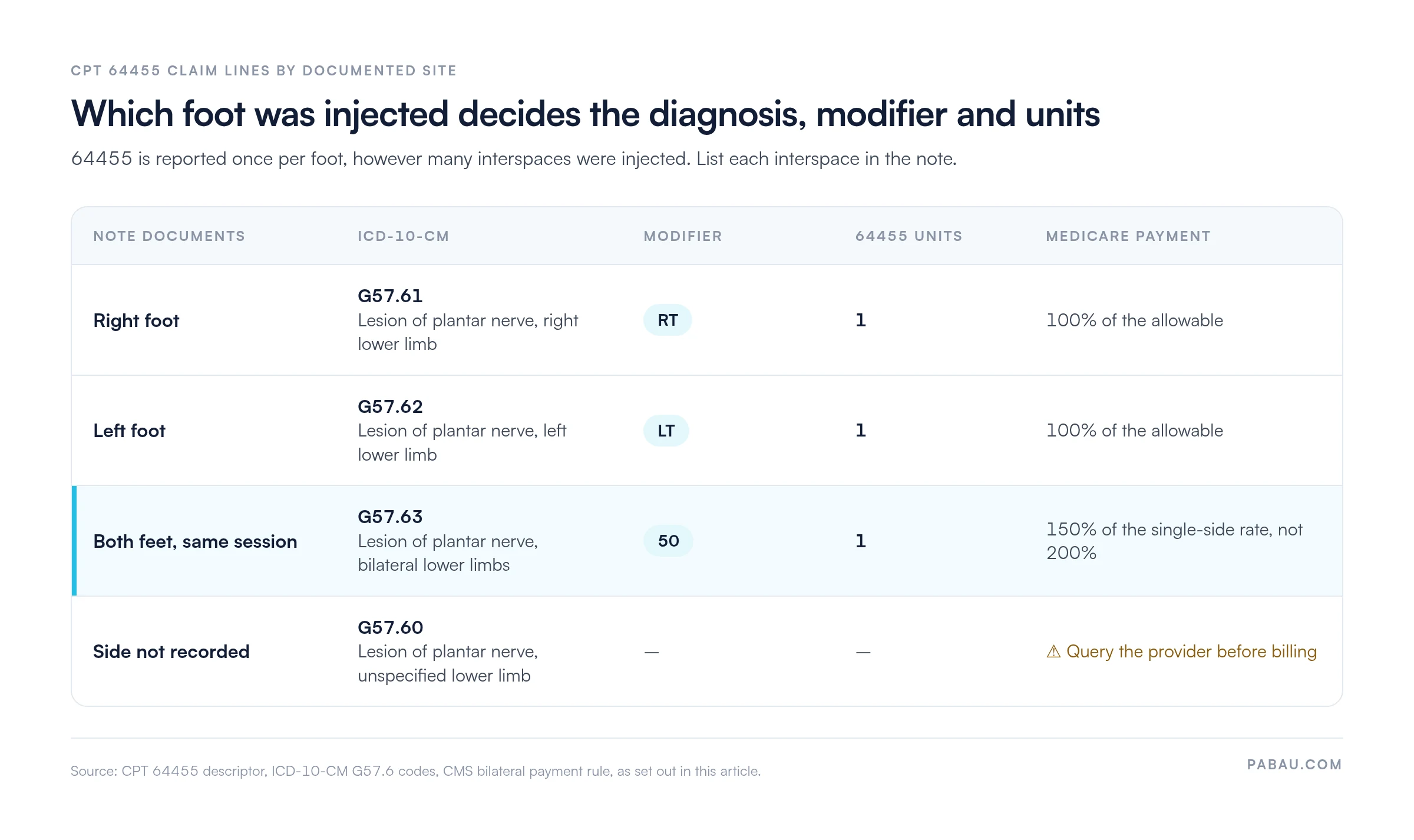
Pair it with a laterality-specific diagnosis: G57.61 for the right lower limb, G57.62 for the left, G57.63 for both.
Report 64455 once per foot, however many interspaces are injected, and list each interspace treated in the note.
Modifier 50 applies to bilateral injections, and Medicare pays 150% of the single-procedure rate rather than 200%.
Pabau, the practice management platform we build, submits and tracks claims through Claim.MD, while your team assigns the codes and modifiers.
CPT code 64455 is defined by the American Medical Association (AMA) as: Injection(s), anesthetic agent(s) and/or steroid; plantar common digital nerve(s), e.g., Morton’s neuroma. It is the specific code for this nerve within the 64400-64530 nerve block series. Use 64450 only for another peripheral nerve or branch not specifically described by another code in that series.
The procedure targets the plantar common digital nerve(s) at the metatarsal interspace, usually the third or second web space, where Morton’s neuroma most often develops. The clinician advances a needle to the affected interspace from the dorsal or plantar side. They then inject a local anesthetic such as bupivacaine, a corticosteroid such as triamcinolone, or both.
The injection takes under five minutes, but the note still has to name the nerve and the interspace to hold up on review. Key facts about the code:
Medical necessity for CPT 64455 needs a documented diagnosis tied to plantar nerve pathology. Payers use Local Coverage Determinations (LCDs) and their own policies to define which ICD-10-CM codes support coverage. The most common are shown below.
Always use the most specific code available. Submitting G57.60 when the procedure note documents a right-foot injection invites a denial and a medical necessity review. The laterality on the claim must match the injection site in the note.
The most common coding error for this injection is reporting CPT 64450 instead of CPT 64455. CPT 64450 is for other peripheral nerves, so use 64455 when the common plantar digital nerve is injected. Coders sometimes reach for 64450 as a catch-all when the note does not name the nerve.
The rule is simple. If the operative note names the plantar common digital nerve or describes a metatarsal interspace injection for Morton’s neuroma or interdigital neuritis, use 64455. Reserve 64450 for peripheral nerve injections with no more specific code in the 64400-64530 series.
CPT 64640 (destruction by neurolytic agent, other peripheral nerve or branch) is sometimes confused with 64455. The mix-up happens when a patient has had several failed steroid injections and the clinician moves to chemical neurolysis.
64455 is a temporary nerve block using anesthetic and/or steroid. Neurolysis destroys nerve tissue with an agent such as phenol or alcohol. Payers apply different coverage criteria, prior authorization rules, and global periods to it. Never report 64455 when a neurolytic agent was used, and never report a destruction code for a standard corticosteroid injection.
Before you submit a 64450 claim paired with G57.6x (Morton’s neuroma), check the procedure note. If it documents an injection of the plantar common digital nerve(s), correct the code to 64455 first.
Modifier selection drives payment accuracy for this code. The three scenarios coders meet most often are bilateral injections, laterality reporting, and several interspaces injected on the same foot.
On units, the plural “injection(s)” and “nerve(s)” in the descriptor settle the question. Report 64455 once per foot, however many interspaces are injected, and document each interspace treated. The grid below shows how the documented site sets the diagnosis, the modifier, and the units together.
Ultrasound guidance is not bundled into CPT 64455. When a clinician uses real-time ultrasound to guide needle placement, the imaging may be reported separately with CPT 76942. Fluoroscopic guidance uses CPT 77002 instead. Separate billing is only supported when specific documentation conditions are met.
The drug given during the injection is billed separately with an HCPCS Level II J-code. For superbill documentation to capture the J-code correctly, the note must record the drug name, concentration, and dose. Common agents and their codes are shown below.
Some payers, mainly Medicaid, require an NDC (11 digits in a 5-4-2 format) alongside the J-code. Where one is required, report the NDC of the vial actually used, because units and concentration vary by manufacturer.
Medicare pays for CPT code 64455 under the Medicare Physician Fee Schedule (MPFS), which is updated each year. The CY2026 national unadjusted figures below use the $33.4009 conversion factor, and your locality rate will differ. Check current rates in the CMS Physician Fee Schedule Look-Up Tool or the FastRVU 2026 RVU lookup.
These payment figures change with each annual conversion factor update. Geographic Adjustment Factors (GAFs) can move the locality rate 10-20% above or below the national figure. High-cost localities such as Manhattan or the San Francisco Bay Area typically pay well above the national rate.
Traditional Medicare generally does not require prior authorization for CPT 64455, though an applicable MAC LCD or Medicare Advantage policy may govern coverage criteria. Medicare Advantage plans vary and may require prior authorization even when traditional Medicare does not. Check each payer before the procedure date for elective injections.
A complete procedure note is the single biggest factor in avoiding a denial for CPT 64455. Payers and Medicare Administrative Contractors (MACs) look for these elements when they review claims or run audits.
Denial patterns for CPT 64455 repeat across payers. The table below maps the most common denial reasons to their root causes and prevention steps.
Good denial management workflows track every denial by reason, payer, and provider. That record shows whether a pattern is a documentation problem for the clinical team or a coding problem for the billing team. Each correction then goes to the people who can fix it.
Review medical billing denial codes to understand the remittance advice codes (CARCs) most likely to appear when a 64455 claim comes back.
After any CPT 64455 denial, pull the remittance advice and record the Claim Adjustment Reason Code (CARC). CARC 50 means the payer did not deem the service a medical necessity. CARC 97 means payment is included in the allowance for another service or procedure. Each CARC points to the part of the claim or documentation that needs the fix.
Many podiatry and pain management practices still code an injection on a paper superbill and then re-key it into a payer portal. Claim status gets chased by phone, so a denied 64455 claim can sit unnoticed for weeks.
In Pabau, the procedure note, the appointment, and the invoice sit on the same patient record. Your team assigns 64455, the RT, LT, or 50 modifier, and the G57.6x diagnosis from that note. Pabau then submits the claim electronically through Claim.MD and tracks its status.
The billing team sees a rejected or denied claim sooner and fixes it while the visit is still fresh. Routing claims through claims management software also keeps every submission and payer response in one place.

Pabau submits claims electronically through Claim.MD and tracks their status, while your team assigns the codes and modifiers. Denied claims surface sooner, so you get paid without the phone chasing.

Bill 64455 from the note, not from habit. When the note names the plantar common digital nerve, the code is 64455, reported once per foot with the matching G57.6x code and side modifier. Anything less specific in the note is the thing to fix before the claim goes out.
The trade-off is a little more detail in each procedure note in exchange for fewer reworked claims. A clean claim on the first pass is worth the extra line about the interspace. Book a demo to see how Pabau submits and tracks your podiatry injection claims through Claim.MD.

Need to understand what a clearinghouse does with your claims? Claim.MD clearinghouse overview explains how claims are submitted to payers and tracked after they leave the practice.
Want to reduce the time your team spends working denials? Revenue cycle management explained covers the end-to-end process from charge capture through payment posting.
Billing multiple injection codes in the same session? Medical billing fundamentals covers modifier stacking, bundling edits, and same-day procedure rules.
Billing the steroid as well as the injection? HCPCS code J3301 covers how triamcinolone acetonide is coded and counted in 10 mg units.
CPT code 64455 covers injection of anesthetic agent(s) and/or steroid into the plantar common digital nerve(s) at the metatarsal interspace. It is used mainly for Morton’s neuroma and interdigital neuritis. The drug is billed separately with the matching HCPCS J-code, such as J3301 for triamcinolone.
Report 64455 once per foot, however many interspaces are injected in the session. The descriptor uses the plural injection(s) and nerve(s), so several interspaces on one foot still count as one unit. Document each interspace treated in the procedure note.
Yes, when real-time ultrasound was used and the documentation supports it. The note must confirm real-time visualization, needle position, who interpreted the images, and that permanent images were stored. Report CPT 76942 separately alongside 64455. Some Medicare Advantage plans bundle imaging into the base code, so check the payer’s policy first.
The main supporting codes are G57.61 (lesion of plantar nerve, right lower limb), G57.62 (left lower limb), and G57.63 (bilateral lower limbs). G57.60 covers an unspecified lower limb and should be rare. G57.81 and G57.82 (other specified mononeuropathies of right or left lower limb) may be covered under the payer’s LCD.