



CCSD code G5100: Bypass of duodenum billing guide
CCSD code G5100 bills a bypass that leaves the duodenum in place CCSD code G5100...

Last Updated: Oct 16, 2026

CPT code 63685 covers insertion or replacement of a spinal neurostimulator pulse generator or receiver, including pocket creation and the connection to the electrode array.
Medicare pays the surgeon about $319 for CPT 63685 in 2026, while the facility collects between $27,486 and $31,526 on its own claim.
The AMA revised the descriptor for CPT 2024, so any reference still describing 63685 as direct or inductive coupling is out of date.
Most commercial payers require prior authorization and a documented trial success before approving CPT 63685. Missing that authorization is the leading denial reason.
Pabau’s claims management software attaches CPT 63685, its paired ICD-10 codes, and prior auth status to the patient record at the point of care.
CPT code 63685 covers the surgical insertion or replacement of a spinal neurostimulator pulse generator or receiver. The code includes creating the pocket that holds the device and connecting it to the electrode array already sitting in the epidural space.
It sits within the Surgery chapter of the AMA CPT code set, under Nervous System > Neurostimulators (Spinal).
The AMA revised this descriptor for the CPT 2024 code set. The current wording runs as follows. Insertion or replacement of spinal neurostimulator pulse generator or receiver, requiring pocket creation and connection between electrode array and pulse generator or receiver. The code applies to a new implant and to the replacement of an existing device.
Lead placement is not included. It is reported separately with 63650 for a percutaneous array or 63655 for a laminectomy paddle. Older references describe 63685 as direct or inductive coupling, and that wording left the code set in 2024. The cranial generator code, CPT code 61885, still carries that phrase.
Medicare pays about $319 for CPT 63685 in 2026, and that amount is the surgeon’s professional fee on its own. The code carries no office rate, because Medicare does not value 63685 in a non-facility setting.
Generator implants and replacements happen in a hospital or an ambulatory surgery center. The facility submits its own claim for the device and the overhead, which is why the physician side looks small. Verify current rates against the CMS Physician Fee Schedule lookup for your MAC jurisdiction.
These are national averages, and payment shifts with the geographic practice cost index (GPCI). Use FastRVU’s 2026 RVU lookup to calculate a location-adjusted allowed amount. The pulse generator itself is reported under HCPCS Level II supply codes by the facility, never by the physician.
That split is what makes 63685 easy to misread as a high-dollar physician code. The chart below puts the professional fee beside the two facility payments for the same case.
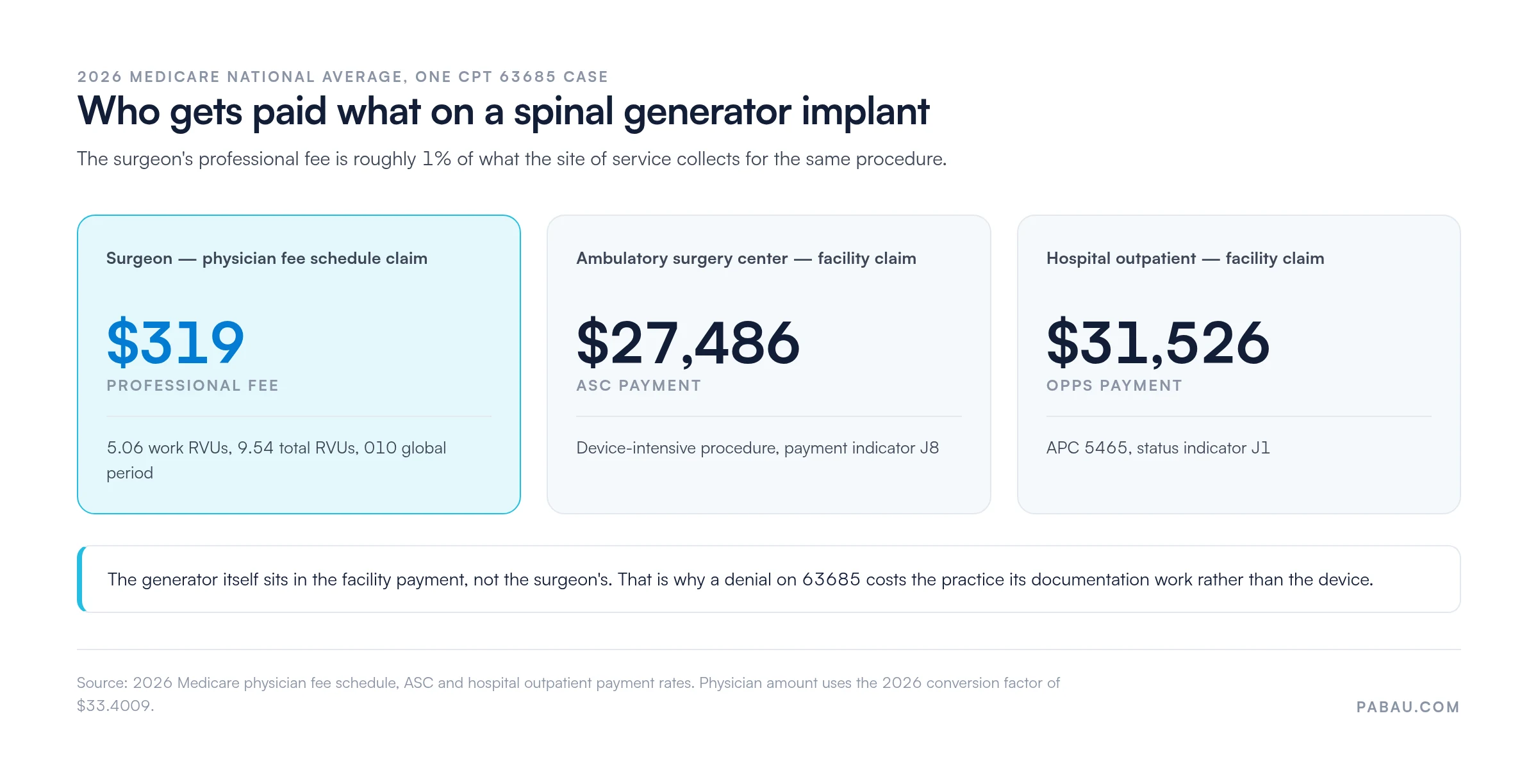
A denied 63685 claim costs the surgeon a modest fee. It costs the facility a five-figure one, and both turn on the same documentation.
Run an eligibility check before every CPT 63685 procedure. Confirming benefits and deductible status ahead of the date prevents billing surprises after service. It also cuts the balances a practice ends up writing off on a high-cost implant.
Payers scrutinize ICD-10 pairing on spinal neurostimulator claims closely. The diagnosis code must support medical necessity for the specific implant procedure. CMS retired ICD-10-CM M54.5 (low back pain) on October 1, 2021, at the start of FY2022. Its replacements M54.50, M54.51, and M54.59 are the billable subcategories, and the retired parent code will trigger a claim edit.
Approved diagnosis lists differ by contractor, so check the crosswalk that applies to your MAC before the claim goes out. Our ICD-10-CM codes library carries the pain and post-surgical families that most often support a 63685 claim.
CPT 63685 is a high-scrutiny code. Most Medicare Administrative Contractors (MACs) maintain Local Coverage Determinations (LCDs) governing when SCS procedures are covered. The criteria below reflect the general framework published in MAC LCDs (e.g. Novitas L38636); individual payer policies vary and must be confirmed before scheduling.
Prior authorization is required by most commercial payers for CPT 63685, and by some Medicare Advantage plans. Traditional Medicare fee-for-service does not require prior auth. It does require that every medical necessity criterion is met and documented.
Aetna’s Clinical Policy Bulletin 0194 and most major commercial policies ask for authorization twice. One approval covers the trial (63650 or 63655), the second covers the permanent implant. Treating the trial approval as cover for the implant is a common and expensive error.
Requirements differ by jurisdiction and plan type, so confirm them with each payer separately. A standard prior authorization form keeps the trial request and the implant request on one record, with both reference numbers in the same place.
Incomplete operative documentation is the second-leading denial reason for CPT code 63685 claims, behind missing prior authorization. Each element below must appear in the medical record and be available to the payer on request. A structured procedure template for SCS implants keeps each one in the same place and cuts audit exposure.
CPT 63685 is rarely billed in isolation. SCS procedures involve a family of codes covering lead placement, removal, revision, and device management. Understanding which codes can be billed alongside 63685 (and which are bundled) prevents NCCI edit denials.
Revising an existing system is coded differently from a first implant. When a percutaneous array is revised or replaced rather than newly placed, the surgeon reports CPT 63663.
Device management continues after the generator goes in, and it carries its own codes. CPT 95972 reports a complex programming session, where the provider adjusts more than three stimulation parameters.
The National Correct Coding Initiative (NCCI) governs how CPT 63685 interacts with companion codes. Violations of NCCI edits are a primary audit trigger for SCS claims. Review current NCCI tables quarterly, as edits are updated four times per year. A clean claim on an SCS case depends on getting these bundling relationships right before it leaves the practice.
SCS claims deny more often than average because they combine high dollar value, strict medical necessity criteria, and heavy documentation. A denial here lands on a case that took months of patient preparation to reach. Grouping denials by the reason code on the electronic remittance advice shows a billing team which failures repeat.
Audit every CPT 63685 denial each quarter, grouped by the CARC code on the remittance advice. Give each group an owner: the clinical documentation team for necessity denials, the billing team for auth and coding denials. That split is what stops the same denial recurring case after case.
A CPT 63685 case spreads its documentation across several encounters. Initial evaluation, psychological screening, trial placement, trial assessment, and permanent implant each produce records that have to reach the final claim.
Disconnected workflows are where SCS claims go wrong, with clinical notes in one system and billing in another. The trial outcome summary a payer asks for sits in a chart the biller cannot open.
Practice management software like Pabau closes that distance. Our claims management software attaches CPT 63685 to its paired ICD-10-CM codes and stores the trial and screening records against the same patient. It also flags prior authorization status before the procedure date.
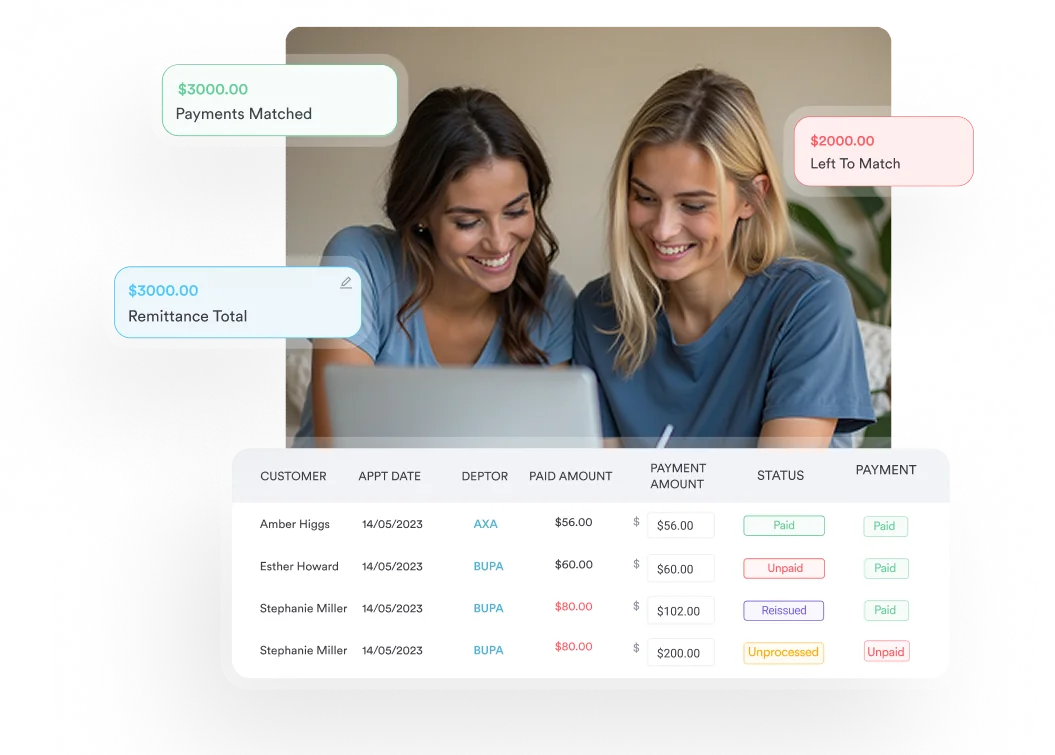
Claims go out electronically to more than 4,000 US payers, and denial codes come back into the same record. A biller reads the CARC code next to the operative note it relates to, rather than in a separate remittance portal.
Billing templates preconfigured for 63685 carry the default ICD-10 pairings and a documentation checklist. That matters most on a code a practice bills a handful of times a year, where nobody has the rules memorized. Fewer rework cycles means the fee arrives on the first submission rather than the third.
For groups running SCS cases across several providers or locations, centralized claim tracking earns its keep. Administrators get one view of where each case sits in the payment cycle.

Pabau attaches CPT codes, ICD-10 pairings, and prior auth tracking to spinal procedure records at the point of care. Claims then leave the practice clean the first time.

The money on a 63685 case is not where the code number suggests. The surgeon’s fee is modest and the facility’s claim is large, and both rest on the same trial records, screening report, and authorization number. On this code the documentation is the asset.
So build the checklist once and attach it to the procedure record, rather than reassembling it case by case. A missing psychological evaluation loses the surgeon a $319 fee. It also holds the facility’s five-figure claim behind the same absent page.
To see spinal procedure billing run inside one patient record, book a demo and we will walk a 63685 claim through from trial to remittance.

Need to understand how ERA denial data flows into your billing cycle? Electronic remittance advice explains how 835 remittance files carry denial reason codes back from payers.
Want to verify your claim submissions are reaching payers correctly? Medical claims clearinghouse covers how clearinghouse validation catches errors before they reach the payer.
Building a clean-claim process for high-complexity surgical codes? Clean claim submission outlines the requirements that determine whether a claim pays first time.
CPT code 63685 is the procedure code for surgical insertion or replacement of a spinal neurostimulator pulse generator or receiver. The AMA revised the descriptor for CPT 2024, so it now names the pocket creation and the connection to the electrode array. Lead placement is reported separately under 63650 or 63655.
The 2026 national average Medicare payment to the physician for CPT 63685 is about $319, from 5.06 work RVUs and 9.54 total RVUs. Medicare publishes no non-facility rate, because 63685 is not valued for an office setting. The facility bills separately, at roughly $27,486 in an ASC and $31,526 in a hospital outpatient department. Amounts vary by geographic practice cost index (GPCI), so confirm yours on the CMS Physician Fee Schedule lookup.
CPT 63650 covers percutaneous placement of the electrode lead array, the wire component of the SCS system. CPT 63685 covers insertion or replacement of the pulse generator or receiver, the battery and control unit. They describe different components of one system, and are frequently billed together when both go in during the same session.
Most commercial payers and Medicare Advantage plans require prior authorization for CPT 63685. Traditional Medicare fee-for-service does not require prior auth but enforces strict medical necessity criteria via MAC LCDs. Confirm authorization requirements with each specific payer before scheduling. Policies vary by plan, by jurisdiction, and by whether the patient is having a new implant or a generator replacement.
The most commonly paired ICD-10-CM codes are G89.29 (other chronic pain) and M96.1 (postlaminectomy syndrome, or failed back surgery syndrome). G90.50 (complex regional pain syndrome, unspecified) is also common. For low back pain, use M54.51 or M54.59, the subcategories that replaced the retired M54.5 on October 1, 2021. The code you pick must support the documented indication for SCS and align with your MAC LCD.
The leading denial reason is a missing prior authorization for the permanent implant, separate from the trial auth. Incomplete medical necessity documentation comes next, usually an absent trial outcome record or psychological evaluation. Coders also still submit the M54.5 code retired in October 2021. NCCI bundling edits then catch 63685 billed alongside 63663 or 63664 without modifier -59.
Required documentation starts with the operative report, naming the device, the pocket location, and the connection to the electrode array. You also need the trial outcome summary with pain scores and functional improvement, plus the conservative treatment history. Add the completed psychological screening, the prior authorization number, and current ICD-10-CM subcategory codes. Place-of-service documentation must match the operative facility. Every record has to be available if a payer audits the claim.



