CPT code 63688 is the procedure code for revision or removal of an implanted spinal neurostimulator pulse generator or receiver.
The descriptor limits it to generators with a detachable connection to the electrode array. Use it when the surgeon reopens the pocket to revise, reposition or remove the existing generator. For a new generator, including a battery replacement, report CPT 63685 instead.
The code sits in the 63650–63688 spinal neurostimulator family and carries a 10-day Medicare global period. This guide covers scope, adjacent codes, documentation, ICD-10 pairing, modifiers and 2026 payment. It closes with the denials that follow when coders confuse 63688 and 63685.
Key takeaways
CPT 63688 reports revision or removal of an existing spinal neurostimulator pulse generator or receiver, including pocket revision and repositioning.
Placing a new generator, including an end-of-life battery replacement, is CPT 63685 alone. Removal of the old device is not billed with 63688.
Lead work has its own codes: 63663 or 63664 for revision, and 63661 or 63662 for removal.
Medicare gives 63688 a 10-day global period and a 2026 national average payment of about $306.
Pabau, the practice management and billing software we build, keeps the operative note, prior authorization and claim in one patient record. The generator code then matches what the surgeon documented.
Found our content helpful?
CPT code 63688: Quick reference
The table below summarizes the key billing parameters for CPT code 63688. It draws on the American Medical Association’s CPT code set and the 2026 Medicare Physician Fee Schedule.
Parameter
Detail
Code
63688
Official descriptor
Revision or removal of implanted spinal neurostimulator pulse generator or receiver, with detachable connection to electrode array
Code family
63650–63688 (spinal neurostimulators)
Device component
Pulse generator or receiver in its subcutaneous pocket
Procedure type
Revision, repositioning or removal of the existing generator, with no new generator placed
Global period
10 days
2026 Medicare work RVU
4.24 (9.15 total RVUs)
2026 national average payment
About $306 national average (9.15 total RVUs), the same in facility and non-facility settings.
2026 hospital outpatient (OPPS)
APC 5461, status indicator J1
Prior authorization
Required by many commercial payers. Verify per plan.
Bilateral modifier (-50)
Not applicable. One generator in one pocket is reported once.
What CPT 63688 covers: Procedure description and scope
CPT 63688 describes surgery on the pulse generator or receiver of an existing spinal cord stimulator system. The surgeon reopens the subcutaneous pocket, then revises, repositions or removes the generator. The electrode array in the epidural space is not what this code reports.
Removing a generator and putting the same device back in is also 63688. NCCI policy reserves 63685 for placement of a new generator. Reinserting the original device therefore does not move the claim to 63685.
Clinical scenarios that support 63688:
Pocket revision: the surgeon reshapes or relocates the pocket because of pain over the device, skin thinning or erosion.
Generator migration: the device has moved or flipped in its pocket and needs surgical repositioning.
Removal without replacement: the surgeon explants the generator for pocket infection, loss of benefit or patient request. No new generator goes in.
Removal and reinsertion of the same generator: the original device goes back in. This follows a pocket washout, capsule excision or relocation.
Connection revision at the generator: the surgeon disconnects and reconnects the lead or extension at the generator header during pocket surgery.
The operative report must name the scenario and state whether a new generator went in. A note that says only “battery revision” leaves the coder guessing between 63688 and 63685, and payers deny that ambiguity.
What CPT 63688 does not cover
Each procedure below has its own code. Reporting 63688 in its place sends the claim back as a wrong-code denial.
A new generator, including end-of-life battery replacement (CPT 63685): report 63685 only. CPT 63685 already includes removal of the old generator. NCCI edits bar separate billing for it.
Initial generator insertion (CPT 63685): first-time placement with pocket creation and connection to the electrode array is 63685.
Electrode revision, including replacement (CPT 63663 or 63664): 63663 covers percutaneous arrays. 63664 covers plate or paddle electrodes placed via laminotomy or laminectomy.
Electrode removal (CPT 63661 or 63662): 63661 covers percutaneous arrays, and 63662 covers plate or paddle electrodes.
Electrode implantation (CPT 63650 or 63655): 63650 is percutaneous implantation of an epidural electrode array. It applies to trials and permanent leads alike. 63655 is laminectomy for implantation of plate or paddle electrodes.
Peripheral, sacral or gastric neurostimulator generators (CPT 64595): 63688 applies only to spinal cord stimulator systems.
How the procedure is performed: Clinical context for coders
Coders reviewing the operative report for a 63688 encounter should expect to see these steps documented in sequence.
Indication and device status: the note records why the generator needs surgery. Examples include interrogation results, pocket findings or an infection workup.
Pocket access: the surgeon opens the existing incision and frees the generator from its fibrous capsule.
Disconnection: the surgeon disconnects the lead or extension from the generator header.
Revision or removal: the surgeon revises, reshapes or relocates the pocket and reinserts the same generator. Otherwise, the surgeon removes the generator and places no new device.
Reconnection and closure: the surgeon reconnects a reinserted generator and checks impedances. The wound then closes in layers.
If the leads are also removed or revised, that work is a separate procedure with its own code. The note should describe the lead work and the generator work in separate passages. That way, each code has its own support.
CPT 63688 vs adjacent codes: Choosing the right code
The 63650–63688 family splits on two questions: which component the surgeon worked on, and whether a new device went in. Use the table below to see where each code fits.
CPT code
Procedure
Component
Type
63650
Percutaneous implantation of neurostimulator electrode array, epidural
Electrode (percutaneous)
Implantation, trial or permanent
63655
Laminectomy for implantation of neurostimulator electrodes, plate/paddle, epidural
Electrode (plate/paddle)
Implantation
63661
Removal of spinal neurostimulator electrode percutaneous array(s), including fluoroscopy, when performed
Electrode (percutaneous)
Removal
63662
Removal of spinal neurostimulator electrode plate/paddle(s) placed via laminotomy or laminectomy, including fluoroscopy, when performed
Electrode (plate/paddle)
Removal
63663
Revision including replacement, when performed, of spinal neurostimulator electrode percutaneous array(s), including fluoroscopy, when performed
Electrode (percutaneous)
Revision, including replacement
63664
Revision including replacement, when performed, of spinal neurostimulator electrode plate/paddle(s) placed via laminotomy or laminectomy, including fluoroscopy, when performed
Electrode (plate/paddle)
Revision, including replacement
63685
Insertion or replacement of spinal neurostimulator pulse generator or receiver, requiring pocket creation and connection between electrode array and pulse generator or receiver
Pulse generator or receiver
Insertion or replacement (new device)
63688
Revision or removal of implanted spinal neurostimulator pulse generator or receiver, with detachable connection to electrode array
Pulse generator or receiver
Revision or removal (no new device)
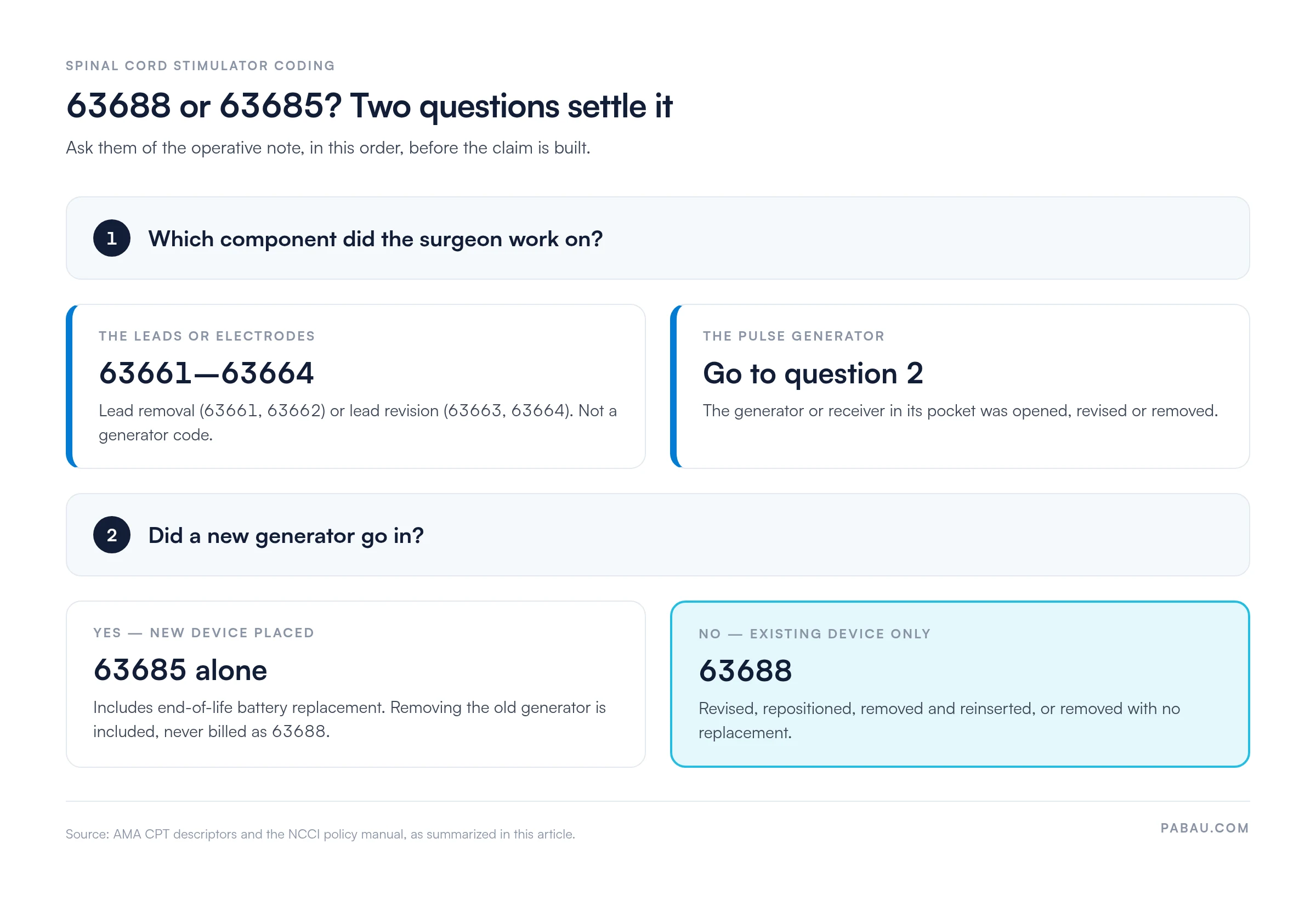
The 63685 vs 63688 decision rule: ask two questions of the operative note. First, did the surgeon work on the leads or on the generator? Lead work goes to 63661–63664, and generator work goes to 63685 or 63688. Second, did a new generator go in? If it did, report 63685 alone. If the surgeon revised, repositioned, reinserted or removed the existing generator, report 63688.
Settle which component was touched before asking about a new device, because lead work never reaches the generator codes. Rules follow the AMA CPT descriptors and the NCCI policy manual.
Billing CPT 63688 with other spinal cord stimulator codes
You can report CPT code 63688 with lead codes on the same date of service when the note documents distinct procedures. Never report it with 63685 for the same generator.
Code combination
Permissible same DOS?
Conditions / notes
63688 + 63685 (same generator)
No
A new generator in the same pocket is 63685 alone. Removal of the old device is included, and NCCI edits do not allow it to be coded separately.
63688 + 63661 or 63662
Yes, for full-system removal
Generator explant plus surgical removal of permanent leads. Document each removal and check current NCCI edits for the date of service.
63688 + 63663 or 63664
Yes, when both components are revised
Lead revision plus a separate generator or pocket revision. Under 2026 OPPS, the pair qualifies for a complexity adjustment to APC 5463 (with 63663) or 5464 (with 63664).
Always verify current NCCI edit tables before billing any code combination. The AAPC Codify CPT lookup includes edit indicators that flag which code pairs need a modifier. Practices using claims management software with built-in edit checking can catch these conflicts before the claim reaches the payer.
Documentation requirements for CPT 63688
The record for a 63688 encounter needs each element below before the claim goes out. Together they are what lets the encounter go out as a clean claim on first submission.
Indication for surgery: the specific generator or pocket problem, or the reason for explant. Examples include infection, erosion, migration or pocket pain.
What the surgeon did to the generator: revised, repositioned, removed and reinserted, or removed with no replacement. This line decides between 63688 and 63685.
Device identifiers: manufacturer, model and serial number of the generator removed or reinserted. Most payers expect this for billing compliance and for implant registries.
Lead status: whether the surgeon left the leads in place, capped, revised or removed them. That way, any lead code on the claim has its own support.
Infection workup, where relevant: cultures and infectious disease input. Aetna requires proof of infection eradication before a surgeon replaces a removed system.
Prior authorization reference: the authorization number belongs on the claim for any payer that requires one.
ICD-10 diagnosis code: a generator-specific complication or device-management code that matches the documented indication.
Signed operative note: the surgeon must dictate and authenticate the note before you submit the claim.
ICD-10 codes that support medical necessity for CPT 63688
A 63688 claim needs a diagnosis that explains why the generator, not the lead, needed surgery. Use the generator-specific complication codes below, with the underlying pain diagnosis reported alongside.
ICD-10-CM code
Description
Use when
T85.113A
Breakdown (mechanical) of implanted electronic neurostimulator, generator, initial encounter
Generator malfunction drives the revision or removal
T85.123A
Displacement of implanted electronic neurostimulator, generator, initial encounter
The generator has migrated or flipped in its pocket
T85.193A
Other mechanical complication of implanted electronic neurostimulator, generator, initial encounter
A mechanical problem other than breakdown or displacement, such as protrusion
T85.734A
Infection and inflammatory reaction due to implanted electronic neurostimulator, generator, initial encounter
Generator pocket infection
T85.890A
Other specified complication of nervous system prosthetic devices, implants and grafts, initial encounter
A specified complication that no mechanical or infection code captures
Z45.42
Encounter for adjustment and management of neurostimulator
Planned device management with no complication, such as elective removal
G89.29
Other chronic pain
Underlying indication, reported alongside the device code
G90.521 / G90.522 / G90.523 / G90.529
Complex regional pain syndrome I of right / left / bilateral / unspecified lower limb
Underlying indication for the stimulator system
Critical pairing rule: lead complication codes describe the wrong component on a 63688 claim. T85.112A, T85.122A and T85.192A name the spinal cord electrode, so they belong with lead codes such as 63663 or 63664. When the generator drives the surgery, use its generator counterpart instead.
Medicare and payer reimbursement for CPT 63688 in 2026
Medicare pays 63688 under the Physician Fee Schedule. For 2026 the code carries 4.24 work RVUs and 9.15 total RVUs. That works out to a national average of about $306 before geographic adjustment. That national average is the same in facility and non-facility settings. Use the CMS Physician Fee Schedule lookup tool for your locality. For the RVU components, use the FastRVU 2026 RVU lookup.
Medicare pays the hospital or surgery center separately from the surgeon. In 2026, 63688 maps to hospital outpatient APC 5461 at a national average of about $3,572. The ASC national average is about $2,003.
Medicare coverage: National Coverage Determination 160.7 governs spinal cord stimulation. Some MACs add local policy. Examples include Palmetto GBA (LCD L37632, billing article A56876) and Noridian JE (LCD L35136, article A57791).
10-day global period: the payment includes postoperative visits and routine wound care within 10 days of the procedure.
Aetna Clinical Policy Bulletin 0194: the policy lists 63688 among its covered codes. Aetna covers revision or replacement for lead malfunction. It also covers prior removal for infection with confirmed eradication, or a documented need for an MRI-compatible device.
Aetna generator replacement criteria: the patient must have had pain relief from the existing system. A manufacturer interrogation must document that the generator is at end of life or beyond repair.
Prior authorization: obtain it before surgery, not retroactively, and put the authorization number on the claim.
Modifiers for CPT 63688: When and how to append
Three modifiers come up regularly on 63688 claims, and one does not apply.
Modifier -78 (unplanned return to the OR during a global period): use it for a related complication. The complication must fall inside a prior procedure’s global period. A pocket hematoma or infection that sends the patient back to surgery is the typical case. Check every code from the original session. A paddle placed under 63655 carries a 90-day global, longer than the 10 days on 63685.
Modifier -79 (unrelated procedure during a global period): the generator surgery has no link to a prior procedure. That procedure is still in its global period.
Modifier -22 (increased procedural services): use it only when the work is substantially greater than usual. A dense capsule or extensive infected tissue is a typical example. The operative note must spell out the added work.
Modifier -50 (bilateral procedure): not applicable. 63688 describes one generator in one pocket, however many leads connect to it. Lead laterality does not change the generator code, so -50 has no role here.
Common denial reasons for CPT 63688 and how to avoid them
The six denials below are the predictable ones on a 63688 claim, and each can be caught before submission. A claim may still come back denied. In that case, our guide to denial codes and their fixes maps each payer reason code to its cause.
Replacement billed as revision: the claim shows 63688, but the operative note documents a new generator. That is 63685, and the payer denies the mismatch.
63688 and 63685 billed for the same generator: 63685 includes removal of the old device. As a result, the payer denies the 63688 line as bundled.
Missing or expired prior authorization: check insurance eligibility verification and authorization at scheduling. An authorization issued for a different code may not cover the procedure performed.
Medical necessity not shown: the note does not say why the pocket or generator needed surgery. For Aetna generator replacement, a missing interrogation record has the same effect.
Lead complication code on a generator claim: T85.192A or another electrode code paired with 63688 contradicts the procedure billed. Use the generator code that matches the note.
Global period conflict: the claim falls inside a prior procedure’s global period without -78 or -79. The payer then bundles it into that earlier payment.
Pro Tip
Run a pre-submission check on every 63688 claim. Confirm that no new generator was placed and that 63685 is not on the claim for the same device. Then check the authorization number, the generator-specific diagnosis code and any open global period.
How Pabau keeps 63688 documentation and claims in step
Generator claims go wrong when the coder works from a summary instead of the operative note. A dictated “battery revision” can mean a pocket revision or a new device. That one phrase decides between 63688 and 63685.
In Pabau, the clinical note and the claim sit in the same patient file. The coder reads what the surgeon recorded about the generator before choosing the code. Prior authorization details stay in the same record.
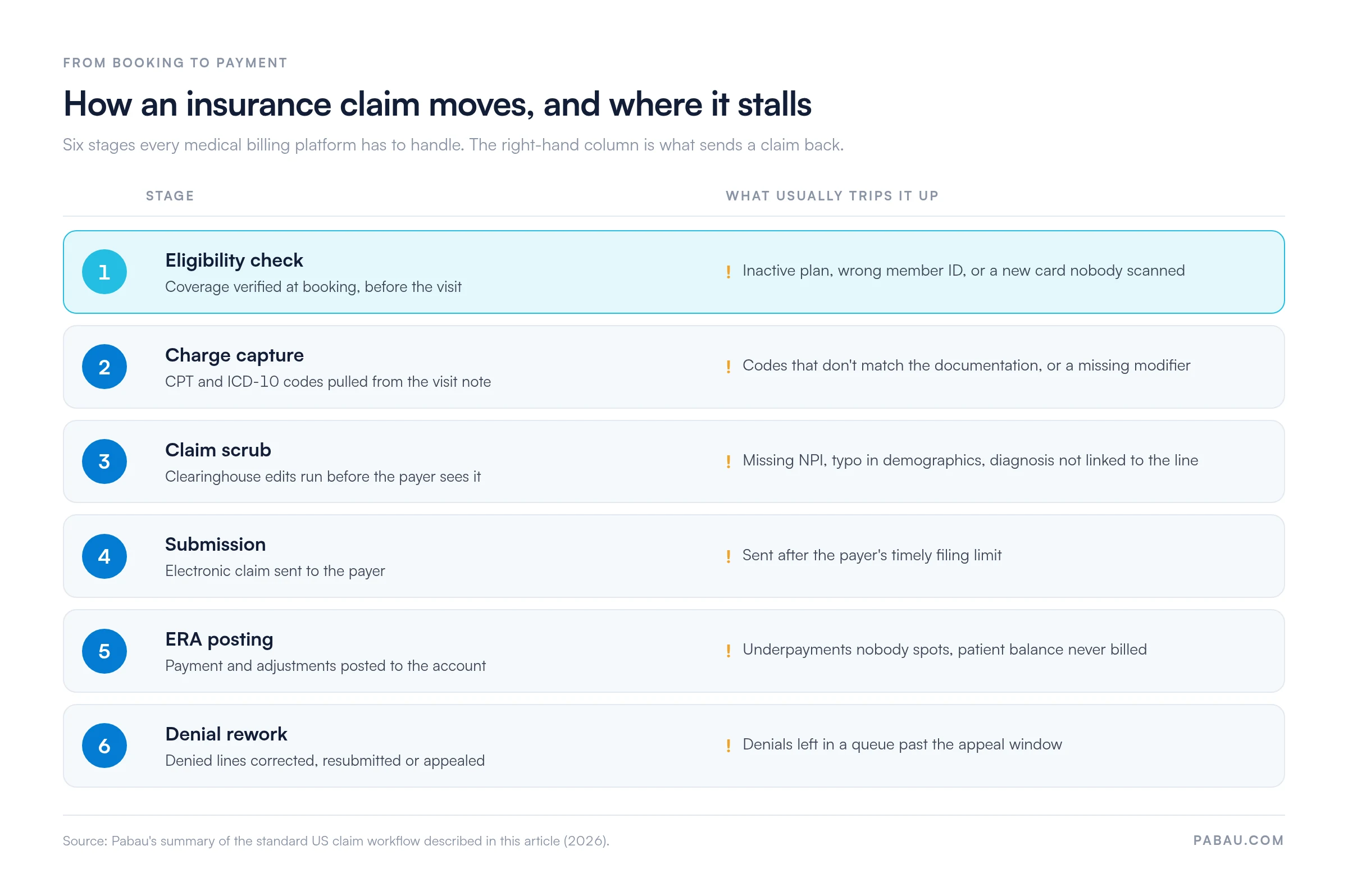
A 63688 claim passes the same six stages as any other, and checking generator versus lead at charge capture keeps it out of rework.
Claims go out electronically through Claim.MD, our US clearinghouse partner, and electronic remittance advice comes back into the same file. Your billing team sees a denial reason as soon as the payer posts it. The team can then correct the claim straight away.
Get neurostimulator generator claims right the first time
Pabau keeps the operative note, prior authorization and claim in one patient record, then routes claims through Claim.MD. See how it works for pain management and neurosurgery practices.
Coding 63688 comes down to one question about the generator: did a new one go in? If it did, the claim is 63685 alone. If the surgeon revised, repositioned, reinserted or removed the existing device, 63688 is the code.
Settle that from the operative note before you build the claim. Then pair it with a generator-specific diagnosis and a current authorization. Book a demo to see how Pabau keeps your neurostimulator claims matched to the operative record.
Continue your research
Placing a new generator instead?CPT code 63685 covers insertion or replacement of the pulse generator, including end-of-life battery swaps.
Revising the leads as well?CPT code 63663 covers revision of percutaneous electrode arrays, the lead-side counterpart to a generator revision.
Dealing with recurring claim denials?Denial codes in medical billing maps the most common CARC denial codes to their root causes and resolution steps.
Need to understand how clearinghouse submissions work?Medical claims clearinghouse overview explains how claims route from practice to payer and where edits are applied.
Want to see how Pabau handles revenue cycle workflows?Revenue cycle management explained covers the end-to-end billing workflow from eligibility check to payment posting.
Frequently asked questions
What does CPT code 63688 describe?
CPT code 63688 describes revision or removal of an implanted spinal neurostimulator pulse generator or receiver with a detachable connection to the electrode array. It covers pocket revision, repositioning, and removal of the existing generator. Placing a new generator is reported with 63685.
What is the difference between CPT codes 63685 and 63688?
CPT 63685 reports insertion or replacement of a spinal neurostimulator pulse generator, so a new device goes in. CPT 63688 reports revision or removal of the existing generator with no new device placed. Removing and reinserting the same generator is still 63688.
Does CPT 63688 take modifier -50 for bilateral procedures?
No. CPT 63688 describes one generator in one pocket, so the bilateral modifier does not apply. The number of leads connected to the generator does not change that. Use -78 or -79 when the surgery falls within a prior procedure’s global period.
What are common denial reasons for CPT 63688 claims?
Billing 63688 for a new generator, or with 63685 for the same device, is denied as a wrong code or as bundled. Payers also deny claims with missing prior authorization or an operative note that skips the indication. Lead complication codes on a generator claim and missing global period modifiers trigger denials too.
Can CPT 63688 be billed with CPT 63685 on the same date?
Not for the same generator. When the old generator is removed and a new one is placed, report 63685 only, because removal is included. NCCI edits do not allow the removal to be billed separately.
Which ICD-10 diagnosis codes support medical necessity for CPT 63688?
Generator complication codes carry the claim: T85.113A for breakdown, T85.123A for displacement, T85.193A for other mechanical problems and T85.734A for infection. Z45.42 fits planned device management without a complication. The underlying pain diagnosis, such as G89.29, is reported alongside.