CPT code 36600: Arterial puncture billing guide
CPT code 36600: definition and procedure overview CPT code 36600 is classified u...

Last Updated: Oct 15, 2026
63663 is the CPT code for revision including replacement, when performed, of spinal neurostimulator electrode percutaneous array(s), including fluoroscopy, when performed.
It applies when a surgeon repositions or replaces an existing percutaneous lead. Revision of a paddle electrode placed through laminotomy or laminectomy is reported with 63664 instead.
Let Pabau's smart automation suggest the right codes, reduce claim denials, and keep your practice compliant—effortlessly.
Automate repetitive tasks and focus on what matters most—your patients.
Reduce coding errors and ensure compliance with the latest regulations.
Clean claims, fewer denials, and faster reimbursements.
Powerful insights and reporting to help your practice thrive.
HIPAA compliant SOC 2 certified GDPR-compliant Trusted by 4,000+ clinics worldwide

CPT Code 63663 covers revision, including replacement, of a percutaneous spinal cord stimulator electrode array, with fluoroscopy included when performed.
A paddle electrode placed through laminotomy or laminectomy is revised under 63664, and removal alone is reported with 63661 or 63662.
Most commercial payers require prior authorization, and the approval must still be active on the date of service.
A revision inside the global period of a prior SCS procedure needs modifier -78 or -79, or the claim denies as bundled.
Pabau’s claims management software keeps the operative note and the claim in one record and submits claims through Claim.MD to thousands of US payers.
CPT Code 63663 describes “Revision including replacement, when performed, of spinal neurostimulator electrode percutaneous array(s), including fluoroscopy, when performed.” The American Medical Association maintains this code under the neurostimulator surgery section of the CPT code set.
The key distinction is the electrode type. CPT Code 63663 applies only to percutaneous arrays, the cylindrical leads placed through a needle into the epidural space. Revising a paddle electrode that was placed through laminotomy or laminectomy is reported with 63664 instead.
Revision is also different from removal. When the surgeon only takes a lead out, the removal codes apply: 63661 for a percutaneous array and 63662 for a paddle. Reporting the paddle code 63664 for a percutaneous lead revision overstates the work and is a common audit trigger.
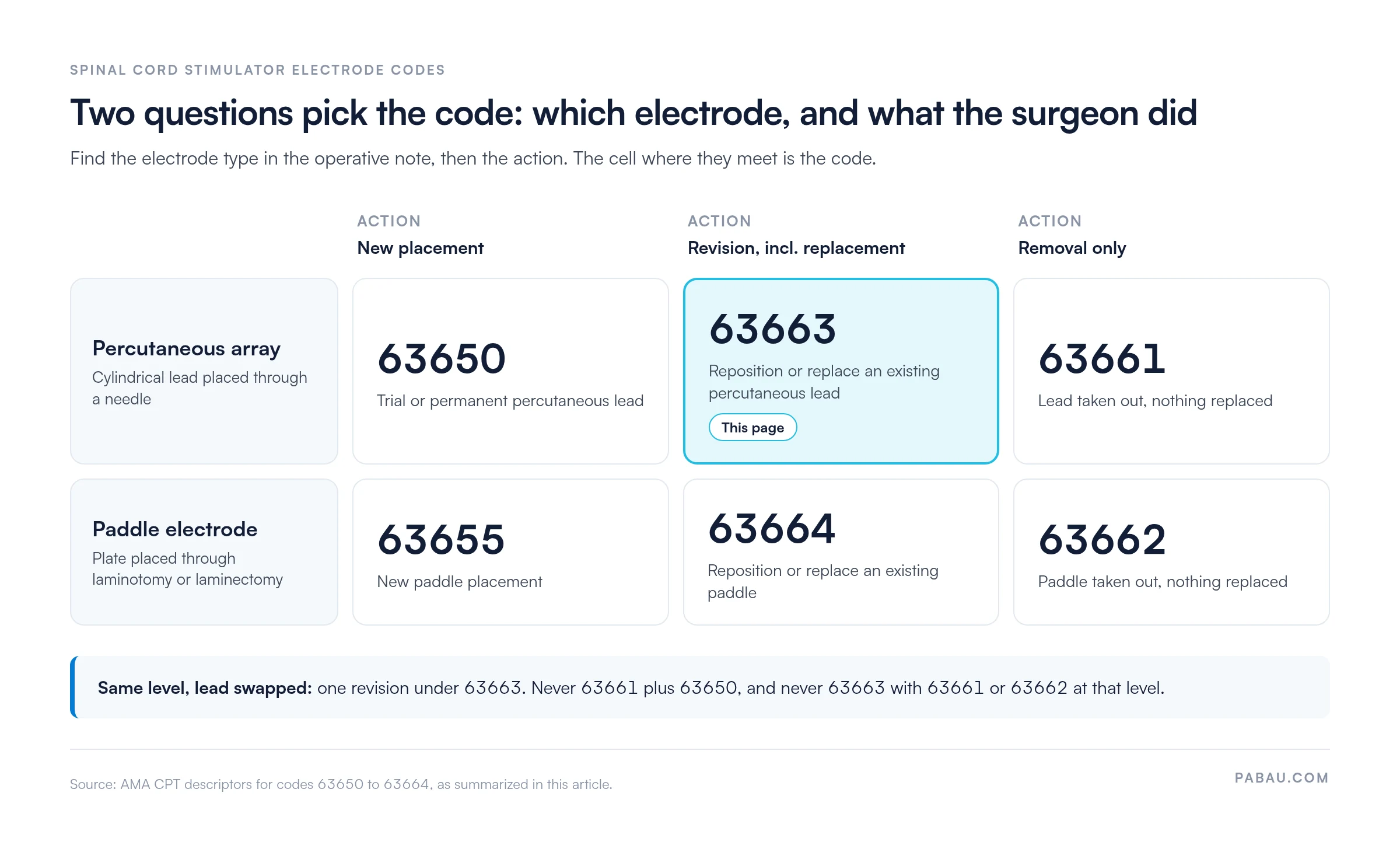
Put together, those two questions leave six possible codes, and the grid below shows where 63663 sits among them.
Revisions occur for several clinical reasons: lead migration away from the therapeutic target, lead fracture or malfunction, or inadequate pain coverage after the initial placement. The clinical indication must be documented before the code is valid.
Coders confirming the correct code need to verify specific steps in the operative report. A percutaneous lead revision under CPT Code 63663 typically follows this sequence:
The operative report should name the electrode as a percutaneous array, identify the spinal levels, and state whether the lead was repositioned or replaced. A note that says only “lead revision performed” leaves the coder unable to choose between 63663 and 63664.
The spinal cord stimulator code family (63650-63688) splits on two questions: which electrode type is involved, and what the surgeon did with it. Use this table as the decision reference. The AAPC Codify CPT lookup provides descriptor detail for each code alongside applicable modifiers.
The dividing line between 63663 and 63650 is intent. 63650 is a new percutaneous electrode placement, while 63663 revises an electrode the patient already has. If the surgeon replaces an existing permanent percutaneous lead, 63663 still applies, because the descriptor includes replacement.
CPT instructions also bar reporting 63663 with 63661 or 63662 for the same spinal level. Removing a temporary trial lead that was connected to an external generator is not reported with 63663 either.
Sometimes the operative note describes both electrode revision and pulse generator replacement on the same date. Review the NCCI edits for the 63663 and 63685 pair before submission. These codes may be reported together with the appropriate modifier, but bundling them incorrectly is a common source of recoupment requests.
Complete documentation before the claim goes out prevents the most expensive denials. The following documents must be in the chart before CPT Code 63663 is billed.
Medicare coverage for spinal cord stimulator procedures, including CPT Code 63663, is governed by LCD L35136 (Spinal Cord Stimulators for Chronic Pain). Contractors review this LCD to determine whether coverage criteria are met. Check the current version in the CMS Medicare Coverage Database before submitting claims, as LCDs are updated periodically.
Medicare covers CPT Code 63663 when LCD L35136 (Spinal Cord Stimulators for Chronic Pain) criteria are satisfied. The patient had a successful trial, the revision is medically necessary, and the prior authorization process is complete where the contractor requires it.
Site of service affects reimbursement. The same revision performed in a hospital outpatient department, an ambulatory surgery center (ASC), or an inpatient setting carries different facility and professional fee amounts. Coders and billers should always confirm the place-of-service code on the claim.
Practices that submit electronically through Claim.MD can send 63663 claims to thousands of US payers in CMS-1500 and 837P formats. Real-time eligibility verification confirms the patient’s coverage is active before the claim leaves the practice. The Claim.MD clearinghouse also returns 835 remittance files, so denial reasons are identified the same day the payer adjudicates.
Commercial payer policies add layers beyond Medicare. Cigna, BCBS Rhode Island, CareSource, and TMHP (Texas Medicaid) each publish specific coverage policies for SCS procedures. Key payer-specific considerations:
Current Medicare reimbursement amounts for CPT Code 63663 are available through the FastRVU 2026 RVU lookup tool, which reflects the current CMS Physician Fee Schedule. Dollar amounts change annually and vary by geographic locality, so always pull current figures rather than relying on prior-year data.
Modifier selection for CPT Code 63663 depends on the clinical circumstances. Incorrect modifier use is a leading audit trigger for SCS claims. The table below maps each common modifier to the scenario where it applies. Maintaining proper medical billing compliance documentation supports modifier choices during payer audits.
Modifier -78 is the most commonly misapplied modifier on 63663 claims. It is valid only when the same surgeon performed the prior SCS procedure and the revision falls within that procedure’s global period. The revision must also be directly related to the prior surgery. Using -78 when any of those conditions fails is incorrect and creates audit exposure.
NCCI (National Correct Coding Initiative) edits control which codes can be billed on the same date as CPT Code 63663. Checking the current edit pairs before submission prevents the most common bundling violations. The NCCI Policy Manual for Medicare Services is the authoritative reference, and the edits update quarterly.
The pairing coders meet most is a lead revision done alongside generator work under 63685.
Those checks go faster when the coder works from the full operative record. Claims management software that keeps the note and the claim together removes the step of transcribing procedure detail by hand.
Understanding common denial codes in medical billing helps billers catch problems before they reach the payer. For CPT Code 63663, the following denial patterns repeat most often across payers.
For each denial type, the appeal follows the same pattern. Document the specific problem the payer identified and gather the supporting clinical evidence. Then submit a corrected claim or formal appeal citing the applicable LCD or NCCI policy.
Structured denial management strategies track these patterns by denial code, so practices can see which submission errors repeat. A clean claim submission from the start avoids most of these loops.
CPT Code 63663 must be paired with ICD-10-CM codes that establish why the electrode revision was medically necessary. Device complication codes from category T85 are primary when the revision is due to hardware failure or lead migration. Pain codes are sequenced as secondary diagnoses.
The 7th character on T85 codes matters. “A” (initial encounter) applies the first time the patient is treated for that complication. “D” (subsequent encounter) applies to follow-up care after active treatment has started. Applying “A” to every revision claim, whatever the stage of care, is a 7th-character error that payers flag in audits.
Run the ICD-10 crosswalk before submitting 63663 claims. The device complication code (T85.192A or T85.192D) must be primary when the revision is driven by hardware failure or lead migration. Pain codes listed as primary without the device complication code often fail medical necessity screening. The payer cannot then confirm the revision was for equipment failure rather than inadequate coverage.
Most 63663 denials start with a claim built after the fact. The operative note sits in one system, and the coder works from a dictated summary that never states the electrode type. The problem only shows up when the remittance advice arrives weeks later.
In Pabau, the practice management and billing platform we build, the clinical record and the claim live in the same patient file. The electrode type, spinal levels, and revision reason are captured in the note itself. The claim is then built from that record rather than a second transcription.
Claims go out electronically through Claim.MD, our US clearinghouse partner, and the remittance comes back into the same file. Your billing team sees a denial reason the day the payer adjudicates and can work the appeal straight away.

Pabau keeps the operative note and the claim in one record, tracks prior authorization, and routes claims through Claim.MD to thousands of US payers. Book a demo to see how it works for pain management and neurosurgery practices.

Code selection on 63663 is settled when the surgeon dictates the operative note. If that note names a percutaneous array and says it was repositioned or replaced, the code follows from it. If it is vague, the claim drifts toward 63664, a removal code, or a denial.
Build one pre-service checklist per payer covering the electrode type, the trial record, and the authorization date, and every future SCS revision claim starts clean. Book a demo to see how Pabau keeps your neurostimulator claims accurate on first submission.

Need to understand how medical claims reach payers? Medical claims clearinghouse overview explains how clearinghouses route, validate, and track claims before and after adjudication.
Want to reduce the manual work in SCS billing submissions? 837 file format explained covers how electronic claim files are structured for payer submission.
Looking to verify patient eligibility before each SCS procedure? Insurance eligibility verification guide walks through real-time verification workflows for high-cost procedures.
Coding a paddle placement instead? CPT Code 63655 explains the laminectomy approach for a new plate or paddle electrode.
CPT Code 63663 is the billing code for revision, including replacement, of a percutaneous spinal neurostimulator electrode array, with fluoroscopy included when performed. It applies when an existing percutaneous lead is repositioned or swapped for a new one. Revision of a paddle electrode placed through laminotomy or laminectomy is reported with 63664.
CPT 63650 covers new percutaneous placement of an SCS electrode array, for a trial or a permanent system. CPT Code 63663 covers revision or replacement of a percutaneous array the patient already has. Both involve percutaneous leads, so the difference is the procedure stage: new placement versus revision.
Yes. Medicare covers CPT Code 63663 when the criteria in LCD L35136 (Spinal Cord Stimulators for Chronic Pain) are met. These include a documented successful SCS trial, medical necessity for the revision, and appropriate diagnosis coding. Prior authorization requirements vary by Medicare Administrative Contractor, so confirm with the relevant MAC before the procedure date.
For global period work, use -78 for a related return to the OR and -79 for an unrelated procedure. Other options are -62 (co-surgeons), -80 (assistant), and -22 (increased complexity). Modifier -78 is the most frequently misapplied. It requires the same surgeon, the same global period, and a documented link to the prior procedure.
Yes. CPT Code 63663 and 63685 may be billed on the same date when both procedures happen in the same session. That covers electrode revision plus generator insertion or replacement. Each procedure must be documented separately in the operative report. Verify current NCCI edit status before submission, as edits update quarterly.
The most common denial reasons are missing or expired prior authorization and an operative report that does not name the electrode type. Others are billing within the global period without a modifier and diagnosis codes that do not meet LCD L35136. Appeals succeed most often when an addendum confirms the percutaneous array and the supporting records are attached.