HCPCS Code G0163: Skilled nursing observation and assessment
What is HCPCS Code G0163? HCPCS Code G0163 is a deleted Level II code for skille...

Last Updated: Oct 15, 2026
95972 is the CPT code for electronic analysis of an implanted neurostimulator pulse generator or transmitter. It covers complex programming of a spinal cord or peripheral nerve system by a physician or other qualified health care professional.
"Complex" describes the session, not the device. AMA guidance sets the dividing line at the number of programming parameters adjusted during that encounter. One to three parameters is simple programming, reported with 95971. More than three is complex programming, reported with 95972. The same patient and the same generator can fall on either side of that line at different visits.
Let Pabau's smart automation suggest the right codes, reduce claim denials, and keep your practice compliant—effortlessly.
Automate repetitive tasks and focus on what matters most—your patients.
Reduce coding errors and ensure compliance with the latest regulations.
Clean claims, fewer denials, and faster reimbursements.
Powerful insights and reporting to help your practice thrive.
HIPAA compliant SOC 2 certified GDPR-compliant Trusted by 4,000+ clinics worldwide

CPT 95972 reports complex neurostimulator programming, meaning more than three parameters were adjusted in that session
The simple versus complex split depends on parameters changed at the visit, not on the implanted device’s channel count
The same patient and the same generator can bill 95971 at one visit and 95972 at the next
CMS Article A56876 treats 95970, 95971 and 95972 as not medically necessary more often than once every 30 days
Practice management software like Pabau links the parameter log to the claim, so the count reaches the payer
CPT code 95972 is the procedure code for electronic analysis of an implanted neurostimulator pulse generator. It covers complex programming of a spinal cord or peripheral nerve system.
The American Medical Association (AMA) maintains the CPT code set. Its rules put 95972 in play when a physician or other qualified health care professional (QHP) does both parts in one encounter.
“Complex” describes the programming session, not the implanted device. AMA guidance sets the dividing line at the number of programming parameters adjusted during that encounter. Adjust one to three parameters and the correct code is 95971. Adjust more than three and the correct code is 95972. The generator’s channel count does not decide it.
That distinction has a practical consequence. The same patient with the same implanted generator can legitimately bill 95971 at one visit and 95972 at the next. What changed is the work done at that session, not the hardware. Code selection comes from the programming record for that encounter, never from the original implant operative report.
The rule changed in 2019, which is why older guidance still circulates. Before then, 95972 was a time-based code covering the first hour, with 95973 for each additional 30 minutes. CPT deleted 95973 effective January 1, 2019 and rebuilt 95971 and 95972 around parameter counts instead.
The American Academy of Neurology’s transition guidance is explicit about it. The 2019 codes are reported based on the number of parameters reviewed.
The code applies to both intraoperative and subsequent outpatient programming. Payers treat those settings differently for documentation and bundling purposes, though the code itself does not change.
The table below shows the current AMA descriptor alongside a plain-language lay description. Use the lay version when explaining the service to administrators or payer representatives.
This is the whole code-selection decision, and it takes about ten seconds once the programming record is in front of you. AMA guidance is reproduced in current manufacturer reimbursement guides, including the Bioventus peripheral nerve stimulation guide.
Simple programming means adjusting one to three parameters. Complex programming means adjusting more than three.
The parameters that count are the ones named in the code descriptor itself:
One counting rule is easy to miss. AMA guidance is explicit that a single parameter adjusted two or more times during a programming session counts as one parameter. Iterating on amplitude six times while you chase paresthesia coverage is still one parameter, not six.
Older payer policies sometimes list the pre-2019 parameter set instead. That set names rate, pulse amplitude, pulse duration, pulse frequency, electrode contacts, and cycling.
It also names stimulation train duration, train spacing, number of programs, number of channels, alternating electrode polarities, and dose time. The threshold is the same either way. Count distinct parameters changed, then compare against three.
Every one of those visits could involve the same patient and the same multi-channel generator. The device never changed. The billable code did, because the work done at each session was different.
Build the parameter count into your note template as a numbered field. The clinician fills it in at the end of the session, so billing never has to reconstruct it. A progress note that reads “4 distinct parameters adjusted: amplitude, pulse width, contact group, frequency” defends 95972 on audit in one line. A note listing settings without a count forces an auditor to do the arithmetic, and auditors resolve ambiguity in the payer’s favor.
95972 vs 95971 is the most common code-selection question in neurostimulator billing. The difference is how many parameters were adjusted at that encounter. Billing 95971 after adjusting five parameters is under-coding. Billing 95972 after adjusting two is over-coding. Both create audit exposure.
All three codes cover spinal cord and peripheral nerve systems. None of them is tied to a device tier, a channel count, or a manufacturer. To confirm which one applies, read the programming record for that visit and count the distinct parameters adjusted.
CPT code 95972 sits within a family covering implantation, revision, and programming across different nerve targets. Coders in pain management and neurosurgery practices regularly encounter this full set.
Note the split in that table. Spinal cord, peripheral nerve, and cranial nerve programming all moved to parameter counts in 2019. Brain neurostimulator programming stayed on a time-based structure with 95983 and 95984. Coders who work across both sides of that line need two different mental models.
The generators behind those brain and cranial nerve systems go in under CPT 61885. That implant code covers deep brain stimulators and vagus nerve stimulators, so their programming never lands on 95972.
CPT 63650 is frequently billed during the trial period. Once a permanent device is implanted, 95971 and 95972 take over as the ongoing programming codes. These serve different claim lines and are not bundled under National Correct Coding Initiative (NCCI) edits when billed on separate dates of service.
Medicare reimburses CPT 95972 under the Medicare Physician Fee Schedule (MPFS). Rates differ between facility settings and non-facility settings such as a physician office. The CMS Physician Fee Schedule lookup tool gives the current year’s payment amounts by locality.
Set your expectations before you look the figure up. This is a modest-value code. The 2019 revision removed the hourly structure, so 95972 now pays roughly the same as a low-level office visit. Older time-based guidance implied several hundred dollars, and that no longer holds.
For comparison, 95971 pays $46.26 in the non-facility setting and $37.20 in the facility setting. The two codes sit closer together than the simple and complex labels suggest, as the chart below shows.
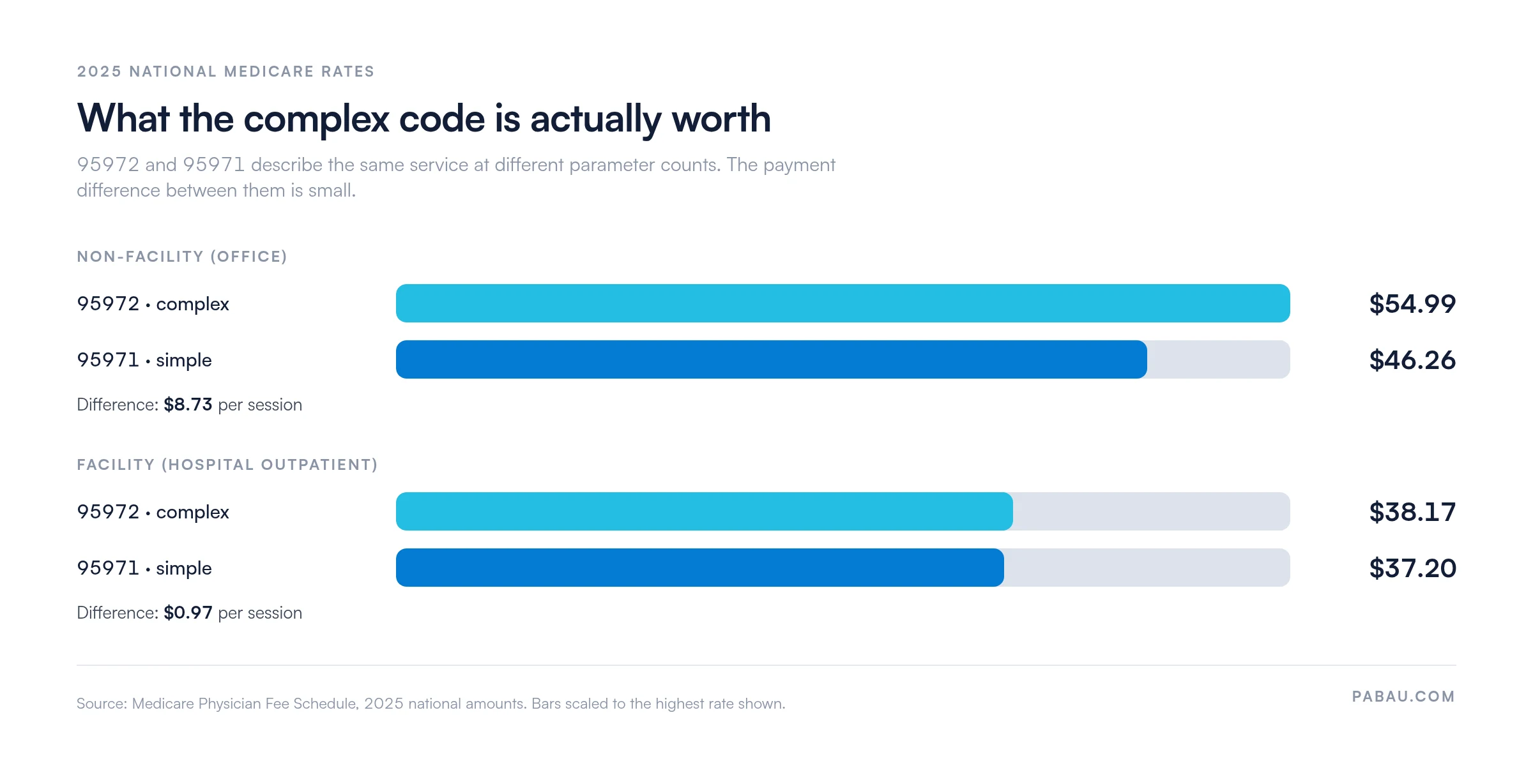
That difference matters for how you weigh audit risk. The upside of choosing the complex code is small. The downside of choosing it without a documented parameter count is a recoupment.
Apply the 2026 conversion factors to those RVUs and the indicative payment lands near $57 in the office and near $39 in a facility. Treat that as a planning figure only. CMS revises RVUs each year, and the 2026 final rule also introduced a 2.5% efficiency adjustment that changes work values for many codes.
Important: These are national averages. Actual payment varies by locality through the Geographic Practice Cost Index (GPCI). Always verify the current-year rate in the CMS MPFS search tool before quoting reimbursement to a physician.
Before billing 95972 in a facility setting, confirm whether your practice or the facility is billing the technical component. Physicians billing from a hospital outpatient department should use Place of Service 22 and expect the reduced facility rate. Billing with POS 11 when the service was performed in a hospital triggers a post-payment audit flag.
95972 needs fewer modifiers than most procedure codes, and the ones practices reach for are often the wrong ones. The table below covers the modifiers that actually apply.
The most common modifier error on this code is appending 59 to 95972 to get an E/M paid on the same date. That is the wrong placement and the wrong modifier. Modifier 25 belongs on the E/M line.
These guidelines apply to CPT code 95972 and to the broader spinal cord stimulator CPT code set. Following them heads off the most common pre-payment denials.
CMS Article A56876 and the American Society of Regional Anesthesia (ASRA) name the same primary cause of trouble on neurostimulator programming codes. Incomplete documentation is what drives claim denial and post-payment recoupment.
Since the code is now selected on parameter count, the parameter log is the single most important element in the note. The progress note must support clean claim submission by containing all of the following:
Verify insurance eligibility before each programming visit, so you know coverage is active and any required prior authorization is in place. Some commercial payers require separate authorization for each programming session after the initial post-implant period.
95972 ICD-10 pairing determines whether Medicare and most commercial payers approve the claim. The diagnosis code must reflect the chronic pain condition being treated by the stimulator. CMS Article A56876 lists the covered ICD-10-CM codes, and the table below captures the ones used most often.
Each of these sits in the wider ICD-10-CM diagnostic codes set, where the full descriptor and the coding notes for a diagnosis live. Check the descriptor there before you commit a code to the claim.
Note: Coverage for 95972 is determined by your local Medicare Administrative Contractor (MAC) through its LCD, such as L37632, and the paired billing article. Criteria vary by contractor. Always verify against the applicable article before billing. A non-covered diagnosis code is one of the leading causes of systematic denial on this code.
Payers audit 95972 claims at higher rates than most E/M codes because documentation requirements are specific and the code is easy to misapply. The following errors account for the majority of denials, based on ASRA guidance and CMS documentation standards.
Parameter-based code selection creates a specific workflow problem. The information that decides the code lives in the programmer output and in the clinician’s head. It has to survive the trip to the claim intact.
In many pain management and neurology practices it does not, because billing staff rebuild the encounter from a narrative note. Practice management software like Pabau keeps the documentation and the billing queue in one workflow, so the parameter count travels with the claim.
Pabau’s medical claims management connects clinical documentation directly to the billing queue. That removes the re-keying step that strips parameter detail before submission.
The platform integrates with Claim.MD, Pabau’s US clearinghouse partner, which handles claim validation, eligibility verification, and electronic remittance across thousands of US payers.
A 95972 claim with its parameter log and ICD-10 pairing is checked against payer rules before it reaches the clearinghouse. That catches errors which would otherwise surface as denials weeks later.
For practices managing recurring programming visits, the note template does most of the work. Pabau’s configurable clinical note templates can carry mandatory fields for each parameter changed, the total parameter count, and the physician attestation. That makes an incomplete 95972 claim much harder to submit by accident.
The Claim.MD integration also handles electronic remittance advice, the ERA and 835 files, so denial reasons post automatically against the original claim. Billing staff can then run appeals from the same platform, without toggling between a clearinghouse portal and a separate billing system.
Submitting electronic claims through an integrated clearinghouse is the baseline expectation for HIPAA-compliant 95972 billing. Practices still sending paper claims for neurostimulator programming face longer processing cycles and higher denial rates on administrative grounds alone.
Audit your last 20 CPT 95972 claims before your next billing cycle. Pull the progress notes alongside the remittances. Check each note for a parameter list with before and after values, a stated count above three, the ICD-10 code, and the physician attestation. Any paid claim missing that count is a pending audit risk. Update your documentation template before the next visit.

Pabau brings scheduling, clinical documentation, and claims submission into one platform. Your team captures every programming parameter correctly and submits clean 95972 claims without switching systems.

CPT code 95972 is simple to select once you stop looking at the device and start counting parameters. More than three adjusted in the session means 95972. One to three means 95971. None means 95970. The same patient can move between all three across a year of follow-ups.
The billing risk lives downstream, in whether that count reaches the payer. A parameter log with before and after values defends the code. A narrative note does not. That is settled by the note template long before the billing team sees the claim.
Pabau’s integrated claims management and Claim.MD connection give pain management and neurology practices one workflow from programming note to paid remittance. To see how it handles neurostimulator billing documentation in practice, book a demo with the Pabau team.

Need to understand how clearinghouse claim validation works? Claim.MD clearinghouse overview explains how payer-side edits catch errors before adjudication.
Want to reduce claim rejections across your billing workflow? Medical billing compliance guide covers the documentation and submission standards that keep claims clean.
Managing denied claims after remittance? Claim.MD vs Office Ally comparison helps practices choose a clearinghouse that fits their denial appeal and secondary claim workflows.
CPT code 95972 covers electronic analysis of an implanted spinal cord or peripheral nerve neurostimulator pulse generator. It also covers complex programming of that device by a physician or qualified health care professional. Complex means more than three programming parameters were adjusted during the session. The code excludes cranial nerve and brain neurostimulators, which have their own codes.
The difference is the number of programming parameters adjusted at that encounter. Adjusting one to three parameters is simple programming and is reported with 95971. Adjusting more than three is complex programming and is reported with 95972. The distinction has nothing to do with the implanted device’s channel count or model. The same patient and the same generator can bill 95971 at one visit and 95972 at the next.
More than three. Parameters that count include contact groups, interleaving, amplitude, pulse width, frequency, on/off cycling, and burst. The list continues with magnet mode, dose lockout, patient-selectable parameters, responsive neurostimulation, detection algorithms, closed-loop parameters, and passive parameters. A single parameter adjusted several times in one session still counts as one parameter. Repeated amplitude tweaks do not add up to a complex session.
No. CPT 95972 carried a “first hour” time component before 2019, paired with add-on code 95973 for each additional 30 minutes. Effective January 1, 2019, CPT deleted 95973 and rebuilt 95971 and 95972 around parameter counts instead. There is no time threshold on 95972 today, and it is reported once per programming session.
The most commonly covered ICD-10-CM codes include G89.29 (other chronic pain) and G89.28 (chronic postprocedural pain, including failed back surgery syndrome). G89.21 (chronic pain due to trauma) and M54.50 (low back pain, unspecified) are also common. Coverage is determined by your local MAC’s LCD and its billing article, so always verify against the applicable article, such as A56876, before billing.
The note needs a parameter log: each parameter adjusted, its value before and after, and the total number of distinct parameters changed. It also needs the chronic pain diagnosis, the device manufacturer and model, and the patient’s clinical response. Add the physician attestation where a technician operated the programmer, plus a medical necessity statement. A missing parameter count is the most common reason for post-payment recoupment on this code.
The 2025 national Medicare rate for CPT 95972 is $54.99 in the non-facility setting and $38.17 in the facility setting. Hospital outpatient departments are paid $91.79 under APC 5742. The code is not on the CMS ASC fee schedule. Rates vary by locality and change each year, so verify the current figure in the CMS Physician Fee Schedule lookup tool.
Yes, but not on the same date of service. Programming performed intraoperatively on the same date as the implant procedure is included in the surgical code and cannot be billed separately. Post-operative programming visits on separate dates are billable with 95971 or 95972, depending on how many parameters were adjusted at that visit.