HCPCS Code G0163: Skilled nursing observation and assessment
What is HCPCS Code G0163? HCPCS Code G0163 is a deleted Level II code for skille...

Last Updated: Oct 15, 2026
63655 is the CPT code for laminectomy for implantation of neurostimulator electrodes, plate/paddle, epidural. It applies to the open approach only, where a flat plate or paddle electrode sits in the epidural space.
Three mistakes drive most 63655 denials. The first is coding an open procedure that the surgeon actually performed percutaneously. The second is a chart with no evidence of a successful stimulation trial. The third is submitting before prior authorization comes back.
Let Pabau's smart automation suggest the right codes, reduce claim denials, and keep your practice compliant—effortlessly.
Automate repetitive tasks and focus on what matters most—your patients.
Reduce coding errors and ensure compliance with the latest regulations.
Clean claims, fewer denials, and faster reimbursements.
Powerful insights and reporting to help your practice thrive.
HIPAA compliant SOC 2 certified GDPR-compliant Trusted by 4,000+ clinics worldwide

CPT Code 63655 covers open laminectomy placement of a plate or paddle electrode, never percutaneous lead placement.
CPT 63685 covers the pulse generator at the same session. HCPCS L8699 is a catch-all supply code for a prosthetic implant not otherwise specified.
Medicare coverage runs through NCD 160.7, and most payers also require a documented successful SCS trial first.
An operative note that never states the surgical approach is the fastest route to a downcode.
Practice management software like Pabau structures the operative documentation and submits the claim electronically.
CPT Code 63655 describes “laminectomy for implantation of neurostimulator electrodes, plate/paddle, epidural.” The American Medical Association (AMA), which maintains the CPT code set, assigns 63655 exclusively to the open surgical approach.
That means a laminectomy or laminotomy is performed to access the epidural space. A flat paddle electrode array is then placed directly over the dorsal spinal cord.
This is the distinction that decides the code. If the surgeon used a needle-based percutaneous technique and placed a cylindrical lead, the correct code is 63650. The two techniques are not interchangeable, and selecting the wrong one is the most common coding error in spinal cord stimulator billing.
Revision is a separate question from placement. When the surgeon revises or replaces a percutaneous array already in the epidural space, the claim goes to 63663 rather than an implantation code.
CPT Code 63655 covers the open laminectomy approach; CPT Code 63650 covers the percutaneous approach using a Tuohy needle and cylindrical lead.
Choosing between them depends entirely on surgical technique, not on the patient’s diagnosis or the device brand. A surgeon who converts a planned percutaneous procedure to an open one intraoperatively should bill 63655, not 63650.
The operative note is the deciding document. It must state the approach (laminectomy or laminotomy), the electrode type (plate/paddle), and the epidural placement confirmation.
An operative note that omits any of these elements gives payers grounds to downcode to 63650 or deny outright. A strong billing workflow captures these details at the point of documentation, before the claim is submitted.
A complete SCS implant typically involves multiple codes billed on the same claim, and the choice starts with the approach in the operative note. CPT Code 63655 covers electrode placement only.
The pulse generator or receiver insertion is reported separately under 63685. HCPCS code L8699 reports a prosthetic implant not otherwise specified, which is a generic supply catch-all rather than an electrode-specific code.
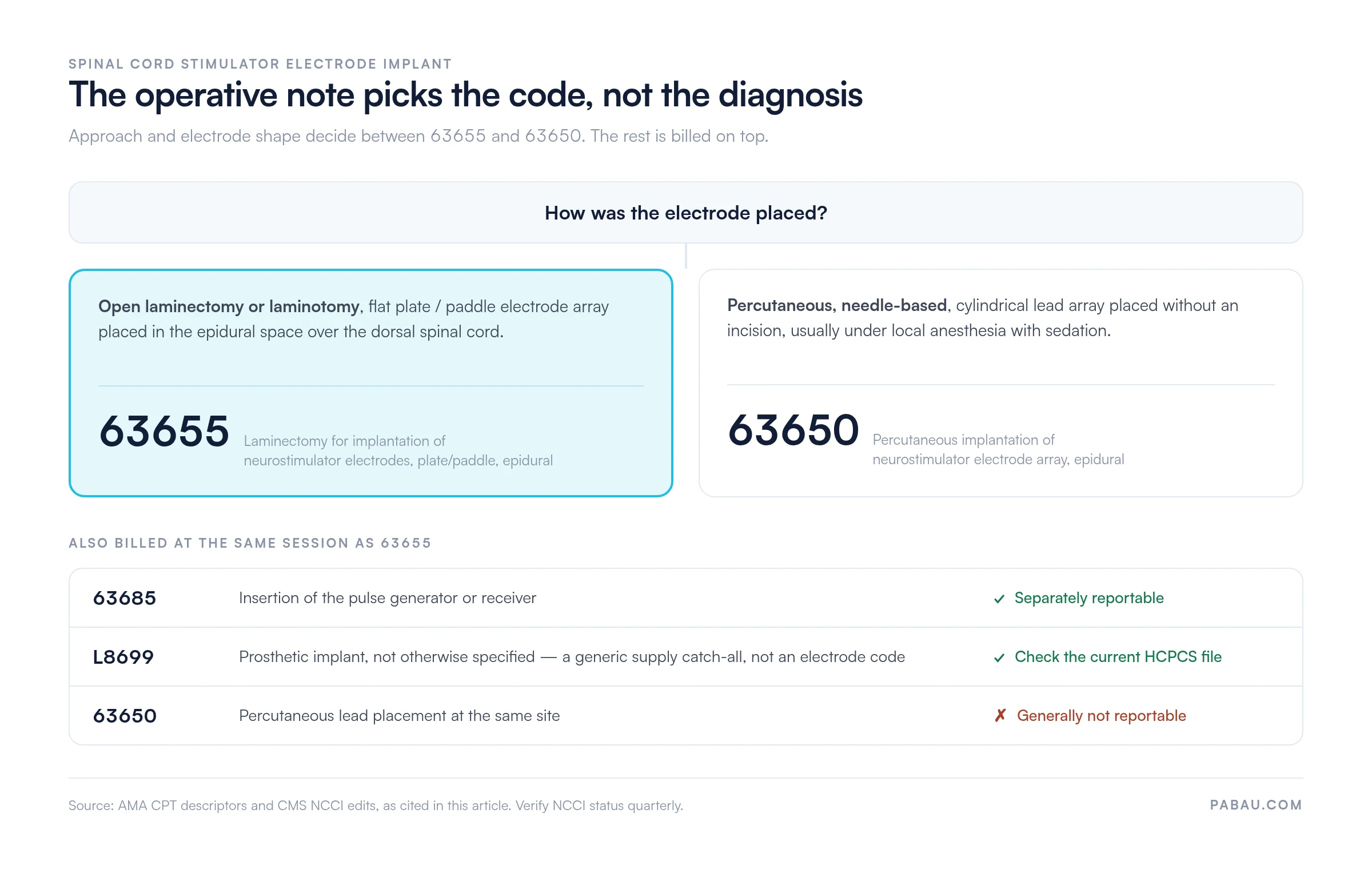
NCCI edits are updated quarterly by CMS, so bundling relationships between these codes can change. Verify the current edit status before submitting any combined claim. Automated edit checking during claim scrubbing catches an incompatible pair before submission rather than after denial.
The operative note and supporting chart must establish both medical necessity and technical accuracy. Missing a single required element is enough for a payer to deny or downcode the claim. Cleaner claims management catches the omission before the claim leaves the practice.
What the clinical record must include:
Keep all of the above in one structured record rather than scattered across separate notes. HIPAA retention rules keep the records supporting a claim on file for at least seven years. That matters when a high-value SCS implant is audited after payment.
Request payer-specific LCD documentation for each plan before the first 63655 claim. MAC LCDs frequently add requirements beyond NCD 160.7, including specific ICD-10 codes, minimum conservative treatment durations, and psychological screening formats. A one-time pre-auth template built around each payer’s LCD reduces denials across all future SCS claims.
Medicare coverage for spinal cord stimulators is governed by National Coverage Determination (NCD) 160.7, published by the Centers for Medicare and Medicaid Services (CMS). Under NCD 160.7, Medicare covers SCS for chronic intractable pain of the trunk or limbs. Conservative management must have failed, and the patient must have responded during a trial stimulation period.
The 2026 Medicare physician fee schedule (MPFS) rate for CPT Code 63655 reflects the open surgical complexity of the laminectomy approach. Verify current national and locality-adjusted rates through the CMS Physician Fee Schedule lookup tool, which is updated annually each January.
The FastRVU 2026 RVU lookup gives the work, practice expense, and malpractice RVU components for both settings. That split is what changes the payment when 63655 is performed in a hospital rather than an ASC.
Local Coverage Determinations (LCDs) issued by Medicare Administrative Contractors supplement NCD 160.7. LCDs vary by MAC jurisdiction and may add specific ICD-10 diagnosis code requirements, minimum trial duration standards, or extra documentation criteria.
Always check the applicable MAC LCD before submitting. Electronic remittance advice posts the denial reason within days, so an LCD problem surfaces while the appeal window is still open.
For a code this size, compare each payment against the expected MPFS rate and flag the variance. Underpayments on 63655 are worth appealing.
Prior authorization is required by nearly all payers for CPT Code 63655, including Medicare Advantage plans and commercial insurers. Traditional Medicare is the exception, since NCD 160.7 imposes no pre-authorization requirement of its own.
MAC-issued LCDs can still add review steps. Submit prior auth requests before scheduling surgery, not after. Verifying benefits at intake surfaces the authorization requirement well before the procedure date.
Typical prior authorization requirements across payer types:
Prior auth requirements vary by payer, plan year, and MAC jurisdiction. The descriptions above represent typical requirements and should not be treated as universal rules.
Confirm specific requirements directly with each payer before submitting authorization requests. Document every prior auth request, confirmation number, and clinical submission in the patient record.
CPT Code 63655 is a high-value surgical code that attracts close payer scrutiny. The most consistent denial patterns are predictable and preventable with the right documentation habits. A standing pre-submission review catches most of them before the claim leaves the practice.
Reading the denial code on the remittance advice tells the billing team where to route the appeal. A CO-4 denial means the procedure code is inconsistent with the modifier used, which points at a modifier problem. A CO-197 denial means prior authorization was never obtained. CO-57 is a different message: the payer has decided the information submitted does not support the level of service billed.
Applying the correct modifier on a 63655 claim affects both reimbursement and NCCI compliance. Incorrect modifier use, or omitting a required modifier, is among the top reasons neurostimulator claims fail on first submission.
All modifier guidance should be verified against current AMA CPT guidelines and CMS policy. Incorrect modifier application on high-value surgical codes creates both denial risk and potential compliance exposure. Review the AAPC Codify CPT lookup for modifier usage notes specific to the 63655 code family.
The ICD-10-CM diagnosis codes linked to a 63655 claim must align with the payer’s covered diagnosis list. Not all chronic pain diagnoses qualify under every MAC LCD. The table below covers the codes most frequently accepted and those most likely to attract additional documentation requests.
Verify the specific ICD-10 codes on your MAC’s current LCD before each claim. LCDs differ between Novitas, CGS, WPS, Noridian, and other MACs. A diagnosis that qualifies under one MAC may not qualify under another. Check the ICD-10-CM code reference to confirm a code is still active for the current fiscal year.
Flag M54.5 in your billing system as a deleted code. It was removed from ICD-10-CM effective FY2022, on October 1, 2021. Claims pairing M54.5 with 63655 will generate an automatic denial. Use M54.50 for unspecified low back pain, or M54.51 for vertebrogenic low back pain. Check that the replacement appears on your MAC’s LCD before submitting.
Most practices build the 63655 claim after the fact. The operative note sits in one system, the coder works from a dictated summary, and the statement of surgical approach never reaches the claim. The omission only shows up when the remittance advice arrives weeks later.
Pabau, our practice management software, keeps the clinical record and the claim in one place. Approach, electrode type, and epidural confirmation are captured in the note itself.
The claim is then built from that record rather than from a second transcription. Claims go out electronically through Claim.MD, our US clearinghouse partner, and the remittance comes back into the same patient file.
Your coder stops chasing the surgeon for a missing line, and fewer 63655 claims fail on a detail that was documented in the first place.

Pabau’s claims management captures the operative detail in the note itself, then submits and tracks the claim electronically. Your billing team catches errors before they become denials.

Code selection on 63655 is settled in the operating room, not in the billing office. If the operative note names the laminectomy, the paddle electrode, and the epidural placement, the rest of the claim follows from it. If it does not, no amount of appeal work recovers the difference.
Build the pre-service checklist once per payer, and the same three checks carry every future SCS claim: the approach, the trial, and the authorization. Book a demo to see how Pabau keeps your neurostimulator claims clean on first submission.

Need to understand how electronic claims reach payers? Medical claims clearinghouse guide explains how claims are scrubbed, transmitted, and reconciled before payment.
Tracking underpayments across your surgical code mix? What is revenue cycle management covers the end-to-end process from eligibility through payment posting.
Building a denial appeal workflow for high-value codes? Denial management in healthcare outlines the appeals process and how to structure denial tracking by reason code.
CPT Code 63655 covers laminectomy for implantation of a neurostimulator plate or paddle electrode in the epidural space. It is the open surgical approach to spinal cord stimulator electrode placement. Pulse generator insertion (63685) and percutaneous lead placement (63650) are billed separately.
CPT 63655 requires an open laminectomy and a flat plate or paddle electrode. CPT 63650 is percutaneous, using a needle and a cylindrical lead, with no incision. The operative note’s description of the approach decides which code applies. Selecting the wrong one is the most common coding error in SCS billing.
Medicare payment for CPT Code 63655 is set by the 2026 Medicare Physician Fee Schedule. Rates vary by geographic locality, and by whether the procedure is performed in a facility or non-facility setting. Verify current rates with the CMS Physician Fee Schedule lookup tool or FastRVU. MPFS rates update each January 1.
Yes. CPT 63685 covers insertion of the pulse generator or receiver. It is separately reportable when the generator goes in at the same session as the electrode. Apply modifier -51 to the secondary procedure. Verify the current NCCI edit status before submitting, since bundling edits are updated quarterly.
Five causes account for most 63655 denials. Prior authorization is missing. SCS trial documentation is absent or thin. The coder picked 63650 instead of 63655, or the reverse. The primary ICD-10 diagnosis is not covered in that MAC jurisdiction. The last is an NCCI bundling violation billed without a modifier to support it.
The correct modifier depends on the clinical scenario. Use -51 for multiple procedures at the same session, and -62 when two surgeons each perform a distinct component. Use -78 for a return to the OR for a related complication within the global period. Use -79 for an unrelated procedure in that same period, and -22 when significantly increased surgical work is documented.