CPT code 46255: Hemorrhoidectomy billing and coding guide
CPT code 46255 covers one column, inside and out CPT code 46255 reports a hemorr...

Last Updated: Oct 9, 2026
62362 is the CPT code for implanting or replacing a programmable pump for intrathecal or epidural drug infusion. It includes preparation of the pump, with or without programming. Its siblings split by device: 62360 is a subcutaneous reservoir and 62361 a non-programmable pump.
Pain management and neurosurgery practices report it for intrathecal baclofen pumps for severe spasticity and opioid pumps for intractable pain. Medicare covers both under NCD 280.14 once a trial dose has worked. Programming at implant is included, so 62367-62370 are kept for later refill and reprogramming visits.
Let Pabau's smart automation suggest the right codes, reduce claim denials, and keep your practice compliant—effortlessly.
Automate repetitive tasks and focus on what matters most—your patients.
Reduce coding errors and ensure compliance with the latest regulations.
Clean claims, fewer denials, and faster reimbursements.
Powerful insights and reporting to help your practice thrive.
HIPAA compliant SOC 2 certified GDPR-compliant Trusted by 4,000+ clinics worldwide

CPT 62362 reports implanting or replacing a programmable intrathecal or epidural drug pump, including pump preparation, with or without programming.
62360 is a subcutaneous reservoir and 62361 a non-programmable pump; 62362 is the programmable pump.
Medicare covers the implant under NCD 280.14 (Infusion Pumps) once a trial dose has worked, for both intractable pain and severe spasticity.
A new catheter is billed separately with 62350 or 62351, and 62367-62370 cover refill and reprogramming visits after implant day.
CPT code 62362 reports implantation or replacement of a device for intrathecal or epidural drug infusion, where the device is a programmable pump. The descriptor adds “including preparation of pump, with or without programming.” In the AMA’s CPT code set, it sits in the reservoir/pump implantation range, 62360-62370.
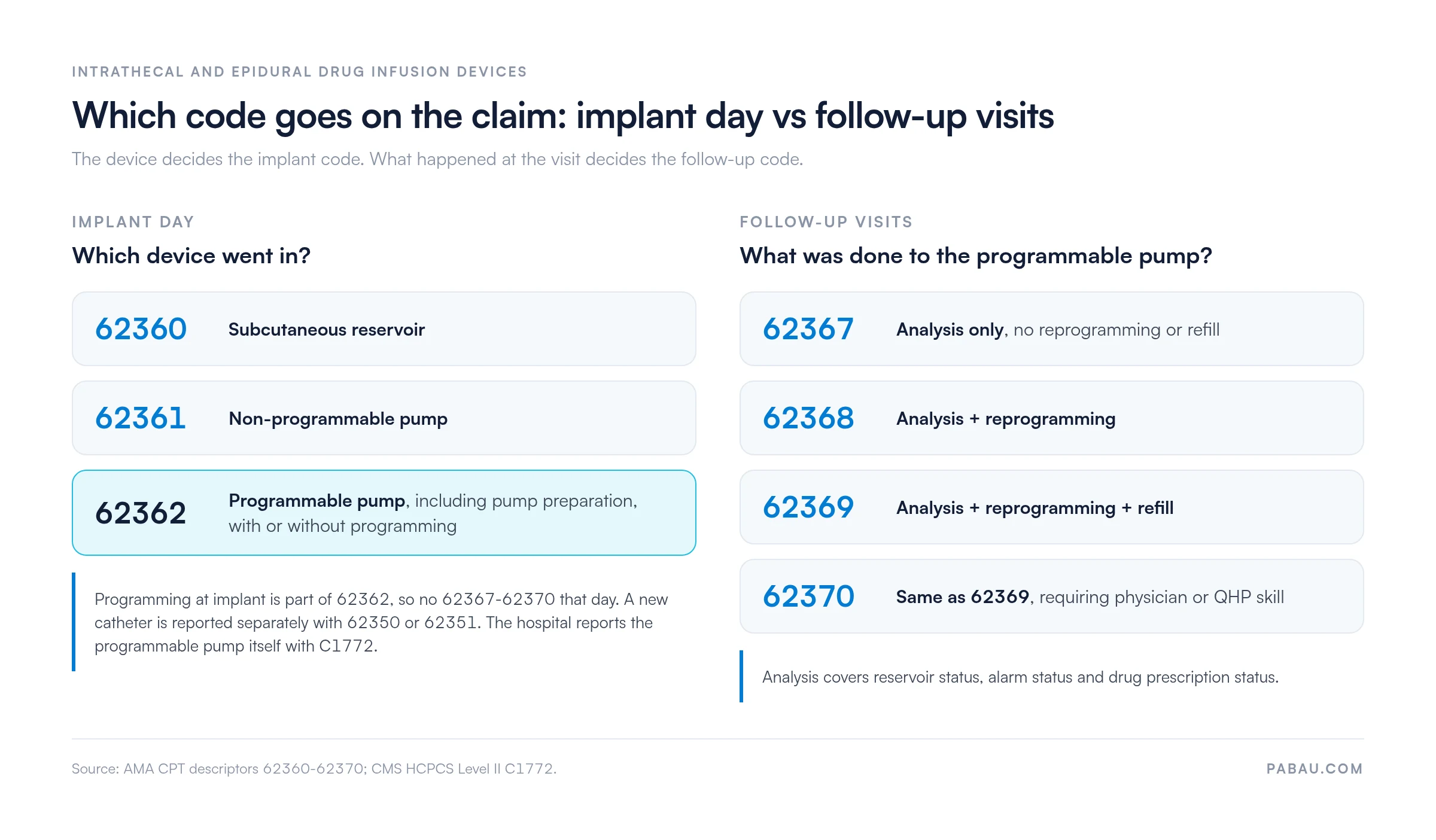
The three implant codes split by device type. Before you pick one, check the operative note for the pump model. Then match it to the table below, as with any code in our CPT code library.
Programming the pump at implant is part of 62362. That means 62367-62370 are not reported separately on the implant date. The Medtronic SynchroMed II is the programmable pump you will see most often under this code.
Getting the bundle right is where most coding errors on this procedure start. Here is the split.
Included in 62362:
Reported separately:
When the catheter goes in at the same session, 62350 and 62362 can both appear on the claim. Check the current NCCI procedure-to-procedure edits before you add a modifier, since they update every quarter.
Follow-up codes trip up coders more than the implant itself. The map below shows which code fits each visit.
CPT code 62362 is used for two clinical groups. Payers review them separately at prior authorization.
For pain, the pump delivers an opioid, typically morphine or hydromorphone, into the intrathecal space. Typical diagnoses include cancer pain with spinal involvement, failed back surgery syndrome and complex regional pain syndrome.
Under Medicare, less invasive treatment must have failed first. The patient also needs a life expectancy of at least three months and a successful temporary trial.
For spasticity, the pump delivers intrathecal baclofen. Common conditions are multiple sclerosis, spinal cord injury, cerebral palsy and acquired brain injury.
Medicare expects that noninvasive spasm control no longer works. The patient must also respond well to a trial intrathecal dose before implant.
Every 62362 claim needs a diagnosis the payer accepts for the indication. A clinically sound procedure is still denied when the linked code is not on the payer’s list.
Multiple sclerosis changed on October 1, 2025, when G35 was split into type-specific codes. An old G35 template in your system will now reject, so code to the documented type, or G35.D when the type is not recorded.
Payer lists still vary. Check the payer’s current policy before you submit, and avoid unspecified low back pain codes without documented failed conservative care.
A clean claim for 62362 rests on records from three points in the patient’s care. A missing piece at any point can mean a denial or a post-payment recoupment.
Before surgery, the record should show:
The operative note should record:
Medicare pays the physician under Part B and the hospital under the outpatient prospective payment system (OPPS). Coverage follows NCD 280.14 (Infusion Pumps).
The national coverage rules come down to four conditions:
Commercial payers publish their own medical policies on implantable pumps. Most mirror Medicare, but some add a psychological evaluation or a multidisciplinary review before approval.
Physician payment for 62362 depends on its relative value units, the conversion factor and your locality’s geographic index. Because the result changes by locality and year, look up your rate rather than relying on a national figure.
Pull current physician rates from the CMS Physician Fee Schedule Look-Up Tool, using your Medicare locality. Device C-code status can change each calendar year, so the facility should confirm C1772 before billing.
Run eligibility and confirm the authorization number before the implant date, not on the day of surgery. A 62362 claim filed without approval on file is one of the easiest denials to prevent.
Medicare Advantage plans and nearly all commercial payers require prior authorization for 62362. Traditional Medicare does not, but the record must still meet NCD 280.14.
Good billing compliance habits mean the packet is ready before the surgery date is set. A typical 62362 request includes:
Turnaround varies by payer, so request approval as soon as the trial result is documented. Always work from the payer’s current published policy, not last year’s version.
Here is how one claim moves. A patient with relapsing-remitting MS had a positive baclofen trial and is scheduled for a SynchroMed II implant.
Expensive devices, strict coverage rules and prior authorization make 62362 claims a common denial target. Strong denial management starts by fixing these causes before the claim leaves the practice.
Run these checks on every claim before it goes out:
Today, many pain practices build a 62362 claim by hand. Someone copies codes from the operative note and chases the authorization number by email. Then they key the claim into a separate clearinghouse portal.
Pabau, the practice management platform we build, removes most of that retyping. Its pain practice claims software fills the claim form from the patient record. It also checks required fields, such as the authorization number, before the claim can be sent.
Claims then go out through a medical claims clearinghouse connection to Claim.MD, with eligibility checks, claim-status tracking and remittance posting. The result is fewer bounced claims and less time spent on rework.

Pabau fills the claim from the patient record, checks required fields like authorization numbers, and sends it through Claim.MD with eligibility and remittance tracking.

CPT code 62362 rewards coders who read the device, not the procedure name. Confirm a programmable pump, keep programming codes off implant day, and code the diagnosis to its current subtype.
The bigger win sits upstream. Assemble the trial note and authorization before surgery is booked, and the claim is mostly written by the time the patient is discharged.
If you want that process to run from one record, Book a demo to see how Pabau handles pump-implant claims from trial to remittance.

Want to see how your 62362 claim travels to the payer? 837 electronic claim file guide explains how 837P files carry CPT codes, modifiers and diagnosis pointers through the clearinghouse.
Building a prior authorization packet for a pump implant? UnitedHealthcare prior authorization form gives you a ready-made form to request approval before you schedule surgery.
Reconciling the facility payment for the pump separately? Electronic remittance advice guide shows how to read an ERA line by line and match it to the claim.
Capturing every billable service from implant day? Medical superbill guide covers how to structure a superbill for high-cost procedure codes.
Enrolling with payers that cover implantable pumps? Insurance credentialing guide walks through enrollment with commercial payers step by step.
Yes. The descriptor covers implantation or replacement, so swapping a depleted programmable pump for a new one is reported with 62362. Code 62365 describes removing a previously implanted reservoir or pump.
The trial is a separate encounter on its own date. A single-shot lumbar trial is usually reported with 62322 or 62323, depending on imaging guidance. A trial through an indwelling catheter uses 62324-62327.
The drug is billed apart from 62362. Common codes are J0475 for baclofen 10 mg, J0476 for a 50 mcg baclofen trial dose, and J2274 for preservative-free morphine.
G35 stopped being valid on October 1, 2025. Use G35.A for relapsing-remitting MS, the G35.B or G35.C codes for progressive forms, or G35.D when the type is undocumented.