CPT code 62362: Programmable infusion pump billing guide
CPT code 62362 covers implanting or replacing a programmable drug pump CPT code ...

Last Updated: Oct 9, 2026
46255 is the CPT code for hemorrhoidectomy, internal and external, single column/group. The surgeon excises one hemorrhoid column, removing tissue above and below the dentate line in the same session. One detail decides the claim, and that's the column count.
If the operative note names two columns, the code becomes 46260. Add a fissurectomy or fistulectomy, and it moves to 46257 or 46258. A miscount either underpays the surgeon or invites an audit. The sections below follow the claim from operative note to payment, including the mistakes that stall it.
Let Pabau's smart automation suggest the right codes, reduce claim denials, and keep your practice compliant—effortlessly.
Automate repetitive tasks and focus on what matters most—your patients.
Reduce coding errors and ensure compliance with the latest regulations.
Clean claims, fewer denials, and faster reimbursements.
Powerful insights and reporting to help your practice thrive.
HIPAA compliant SOC 2 certified GDPR-compliant Trusted by 4,000+ clinics worldwide

CPT code 46255 reports excision of one hemorrhoid column or group, with its internal and external components removed together.
Two or more columns excised is 46260, so the operative note must name each column by position.
Adding a fissurectomy moves the claim to 46257, and adding a fistulectomy moves it to 46258.
The 2026 national Medicare rate is about $351 in a facility and $581 outside one, with a 90-day global period.
Most 46255 denials trace back to a column-count mismatch, a missing prior authorization, or anoscopy billed without a modifier.
CPT code 46255 reports a hemorrhoidectomy that removes one hemorrhoid column or group, with its internal and external parts. The official descriptor reads Hemorrhoidectomy, internal and external, single column/group. The AMA maintains it in the Surgery section, within the Anus subsection (46020-46999).
Hemorrhoids usually form in three primary columns: right anterior, right posterior, and left lateral. Excise one of them, with tissue above and below the dentate line, and the case is 46255. Excise two or more in the same session, and it becomes 46260.
Older references still describe this family as “simple” and “complex” hemorrhoidectomy. CPT retired that wording in 2010. Today, the column count decides the code, along with any fissurectomy or fistulectomy done in the same session.
So what does the surgeon actually do? A single-column hemorrhoidectomy follows a set sequence, and each step shows up in the operative report.
Either closure technique fits 46255, so the technique never changes the code. The number of excised columns in the note does.
The 46250-46262 series splits on two questions. How many columns were excised? Was a fissure or fistula treated in the same session? The grid below maps each answer pair to one code.
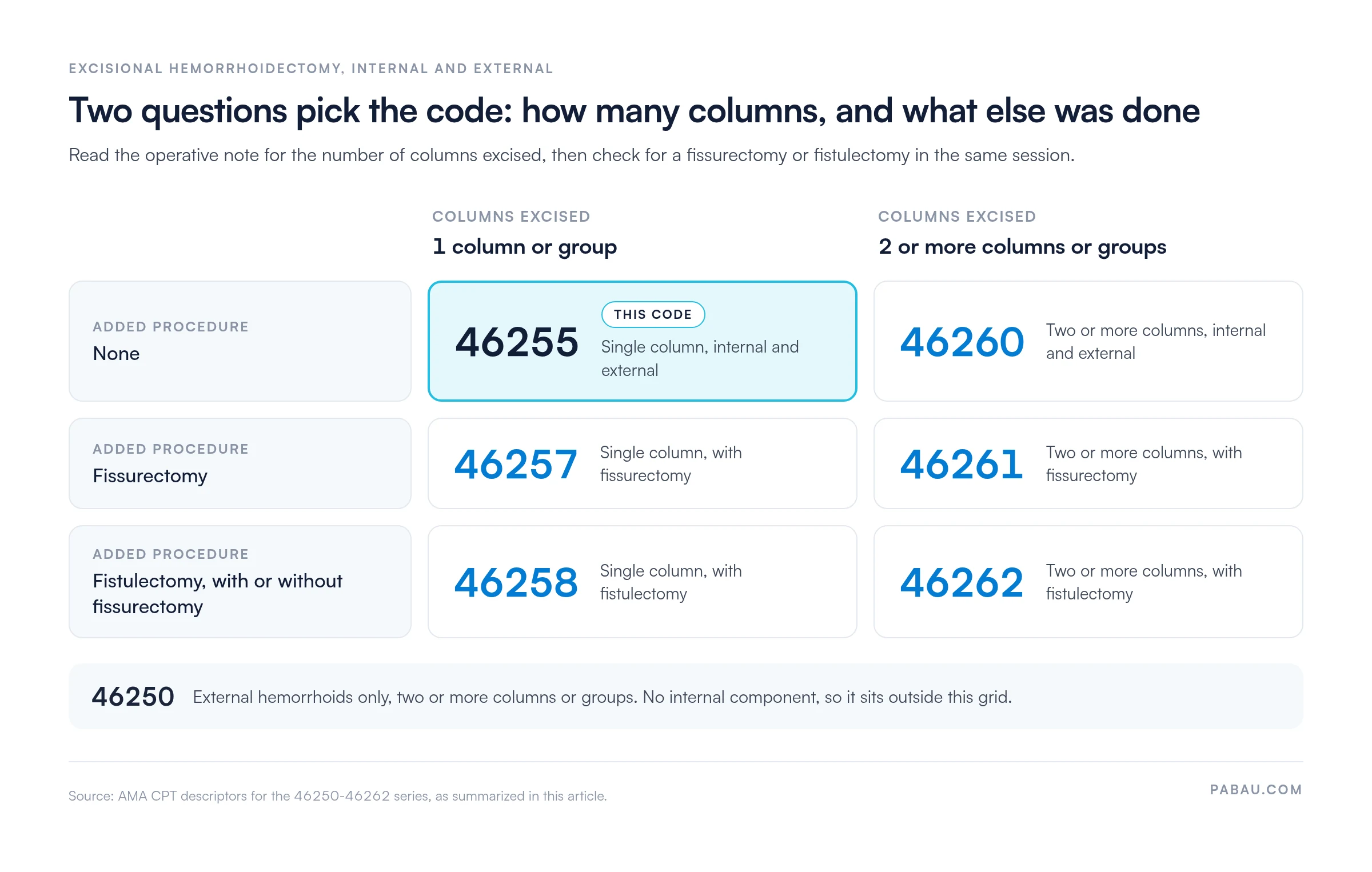
Here’s a worked example. The note reads “large right posterior column excised, internal and external components, pedicle ligated.” That is one column with both parts, so the code is 46255. If the same note also lists the left lateral column, the claim becomes 46260.
The table spells out each descriptor in the series for reference.
Getting the count wrong costs money either way. Billing 46255 for a two-column case underpays the surgeon. Billing 46260 when the note names one column is an overcode, and auditors spot it quickly.
Excision removes the hemorrhoid. Incision, by contrast, opens a thrombosed external hemorrhoid and evacuates the clot. Payers treat them as different procedures with different codes.
A 46255 claim on a chart that documents only incision and drainage is an overcode. The correct code is 46083, or 46320 when the thrombosed hemorrhoid was excised. Reviewers compare the note with the descriptor, so this mismatch is an easy audit finding.
Once the procedure code is settled, the diagnosis has to justify it. Medical necessity for 46255 rests on a K64 code. Surgery is typically indicated for grade III or IV hemorrhoids. Grade II qualifies after conservative and office-based treatment has failed.
Grade does not choose between 46255 and 46260. A grade IV case with one diseased column is still 46255. A grade III case with three columns is 46260. Always code the documented grade, because K64.9 (unspecified hemorrhoids) invites a records request when the chart states one.
Medicare sets payment for 46255 through the CMS Medicare Physician Fee Schedule. The figures below are 2026 national unadjusted values at the $33.4009 conversion factor.
Local payment varies with the geographic practice cost index (GPCI) for your Medicare Administrative Contractor (MAC) locality. Confirm current figures in the CMS lookup or an RVU lookup tool before you set fees.
The 90-day global period bundles routine post-operative visits into the 46255 payment. An evaluation and management (E/M) visit for an unrelated problem in that window takes modifier -24. An unrelated procedure takes modifier -79.
Pull 46255 values from the CMS Physician Fee Schedule lookup at the start of each calendar year. RVUs and the conversion factor both change annually, so last year’s estimate will not match this year’s allowable.
Prior authorization (PA) for 46255 isn’t universal. Still, it’s common enough that skipping the check leads to avoidable denials. That’s why the medical billing process for elective surgery usually starts with a payer-specific PA check.
A PA request should carry the K64 code, the grade, the duration of symptoms, and a summary of failed non-surgical treatment. If the payer denies the PA and surgery goes ahead anyway, expect the claim to be denied too.
With authorization settled, the claim itself starts to take shape. Here’s the path a typical 46255 claim takes, from booking to payment.
A vague note at step two holds up every later step. The coder has to query the surgeon first, and the claim waits for the answer.
A 46255 claim clears medical review when the operative report covers seven elements. Miss one, and you risk a records request or a denial.
A structured superbill keeps the CPT code, the grade, and the column count together at the point of service. For the wider claim lifecycle, see what makes a clean claim.
Even a perfect note can stumble on a missing modifier. Modifiers tell the payer that special circumstances affected the service. These five come up most often with 46255.
Modifiers only work inside the bundling rules. CMS maintains National Correct Coding Initiative (NCCI) edits, which govern the codes that may be billed with 46255. Breaking one is a fast route to a rejection. Claim Adjustment Reason Code (CARC) 97 on your electronic remittance advice is usually the first sign.
CMS updates the NCCI edit tables quarterly. Before treating a code pair as billable, check the current table at cms.gov. The AAPC Codify CPT lookup also shows active edits next to each code.
Check each quarterly NCCI release against your ten most-billed anorectal code pairs. A pair that paid in Q1 may be bundled by Q3. Catching the change early saves months of retroactive adjustments.
When a claim does come back, the reason usually falls into one of five groups. Good denial management sorts each one by root cause, beyond the payer’s response code. A list of medical billing denial codes helps coding teams resolve each type.
Before you submit, run through these six points. Each one maps to a denial in the table above.
Much of the rework on 46255 claims starts with retyping. A biller copies the CPT code, the K64 code, and the authorization number from the chart into a claim form. Each copy is another chance for a mismatch.
Pabau, the practice management platform we build, pre-fills the claim from the patient record instead. The CPT code attached to the service lands on the charge line. Diagnosis slots are seeded from the recorded problem list. Our claims management software also checks required fields, like the member ID and authorization number, before the claim can go.
In the US, claims go out through Claim.MD, with instant eligibility checks, claim-status tracking, and remittance posting. That leaves your billing team free to focus on the operative note and the column count.
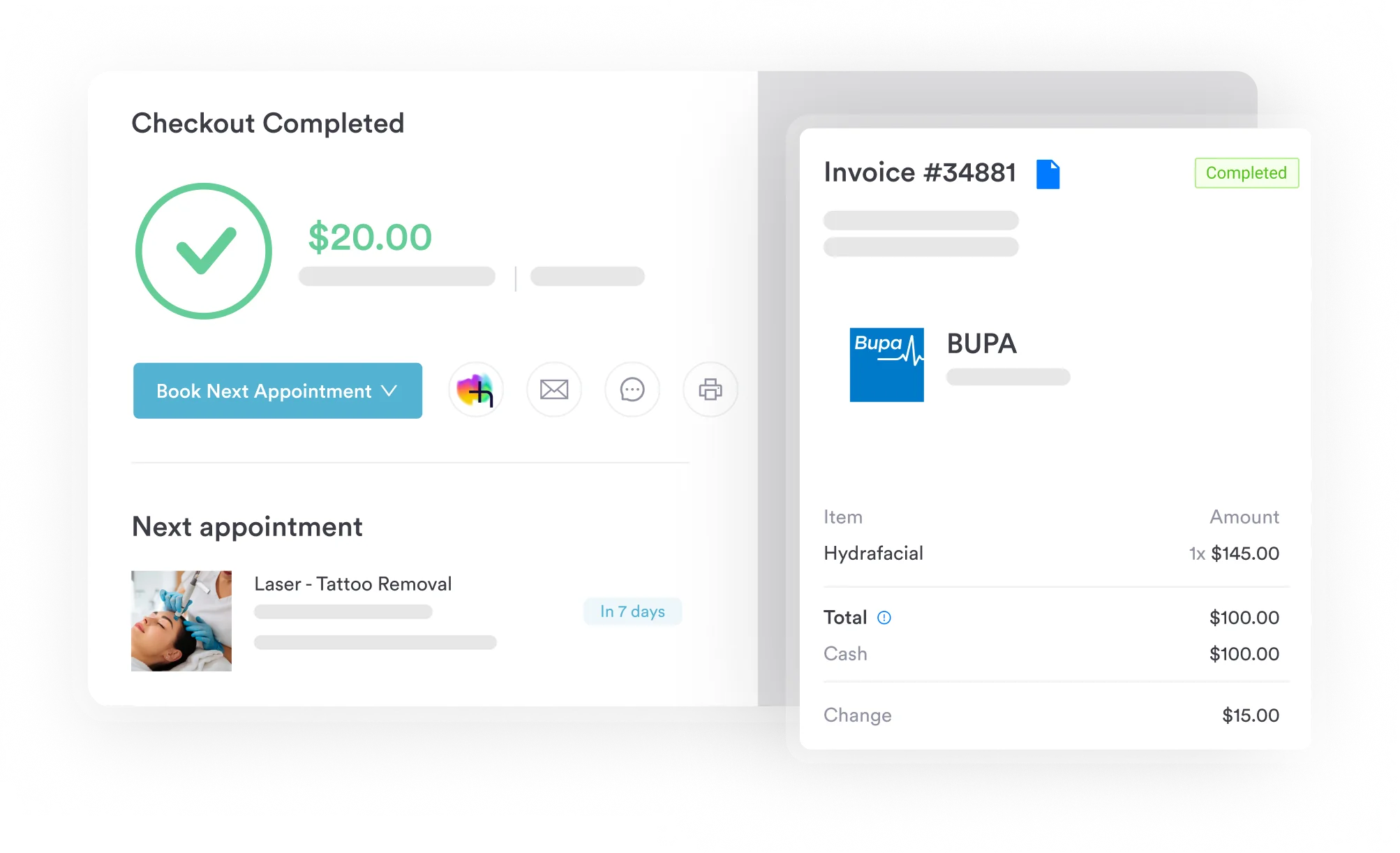

Pabau pre-fills each claim from the patient record, checks required fields before submission, and sends US claims through Claim.MD. See the workflow in a live demo.

The biggest win on 46255 sits upstream of billing. When every operative note names the excised columns by position, coders stop guessing and auditors stop asking.
So start with the note template, then pair it with a graded K64 code and a quarterly NCCI check. The cost is a few extra lines per report. That is far cheaper than reworking a single denied claim.
Book a demo to see how Pabau carries the code, grade, and authorization from the chart onto a clean hemorrhoidectomy claim.

Need to understand how claims flow from practice to payer? Medical claims clearinghouse guide explains how clearinghouses validate, scrub, and route claims before they reach Medicare or commercial payers.
Dealing with recurring denials across your anorectal billing? Claim.MD clearinghouse overview covers how real-time eligibility checks and ERA processing reduce denial rates at the clearinghouse level.
Want a structured approach to billing compliance? Medical billing compliance guide covers audit triggers, documentation standards, and payer-specific policy review cycles for surgical specialties.
Need the full hemorrhoid diagnosis range? ICD-10 codes for hemorrhoids walks through K64.0-K64.9, from first-degree disease to skin tags and unspecified codes.
A stapled procedure is reported with 46947, hemorrhoidopexy by stapling. The stapler removes a ring of tissue above the hemorrhoids and lifts them back into place. No column is excised, so 46255 never applies.
Rubber band ligation is 46221. Ligation by other methods, such as suture, is 46945 for one column and 46946 for two or more. Transanal hemorrhoidal dearterialization of two or more columns, with ultrasound guidance, is 46948.
Under Medicare, treating a complication that needs no return to the operating room is part of the global package. A return to the operating room for a related complication is billed with modifier -78.
No. The anesthesia provider reports anesthesia code 00902, for anorectal procedures, plus time units. CPT 46255 belongs to the surgeon’s claim only.