

HCPCS Code L0472: Hyperextension TLSO billing guide
HCPCS code L0472: Official descriptor and device definition HCPCS code L0472 des...

Last Updated: Nov 5, 2026
59412 is the CPT code for external cephalic version, with or without tocolysis. It reports one attempt to turn a breech or other non-vertex fetus head-down by hand through the abdomen, whether or not the version succeeds.
59412 sits outside the global obstetric packages 59400, 59510, 59610 and 59618, so it is billed as its own line. A clean claim pairs it with an O32 malpresentation code carrying the correct 7th character.
Let Pabau's smart automation suggest the right codes, reduce claim denials, and keep your practice compliant—effortlessly.
Automate repetitive tasks and focus on what matters most—your patients.
Reduce coding errors and ensure compliance with the latest regulations.
Clean claims, fewer denials, and faster reimbursements.
Powerful insights and reporting to help your practice thrive.
HIPAA compliant SOC 2 certified GDPR-compliant Trusted by 4,000+ clinics worldwide

CPT code 59412 covers external cephalic version (ECV) with or without tocolysis. It is not bundled into the global OB packages 59400, 59510, 59610 or 59618.
Documentation must include pre-procedure NST findings, gestational age confirmation, the tocolytic agent and dose, a procedure narrative and a post-procedure fetal heart rate check.
The primary ICD-10 pairing is O32.1XX0 for maternal care for breech presentation. Select the correct 7th-character extension for the fetus involved in a multiple gestation.
Pabau, the practice management platform we build, scrubs 59412 claims for missing or invalid details, stores prior authorizations as cases and checks eligibility through Claim.MD.
Whether 76942 can be billed beside 59412 depends on the current NCCI PTP edit and the payer, and it rarely fits an ECV.
CPT Code 59412 is the code for external cephalic version, and its official AMA descriptor reads External cephalic version, with or without tocolysis.
It sits in the Vaginal Delivery, Antepartum and Postpartum Care subsection of the Surgery chapter. One unit covers a single attempt, whether or not the version succeeds.
59412 is separately reportable from the global obstetric packages. The AMA’s CPT code set and CMS NCCI guidance keep ECV out of 59400 for vaginal delivery and 59510 for cesarean delivery. The same goes for the VBAC packages 59610 and 59618. A physician who has accepted global care can still bill 59412 as its own line item, on the delivery date or before it.
One unit of 59412 covers the whole ECV encounter. That includes the version attempt, ultrasound monitoring during the procedure, any tocolytic given to relax the uterus, and fetal heart rate monitoring before and after. The map below sorts each related service into one of three columns.
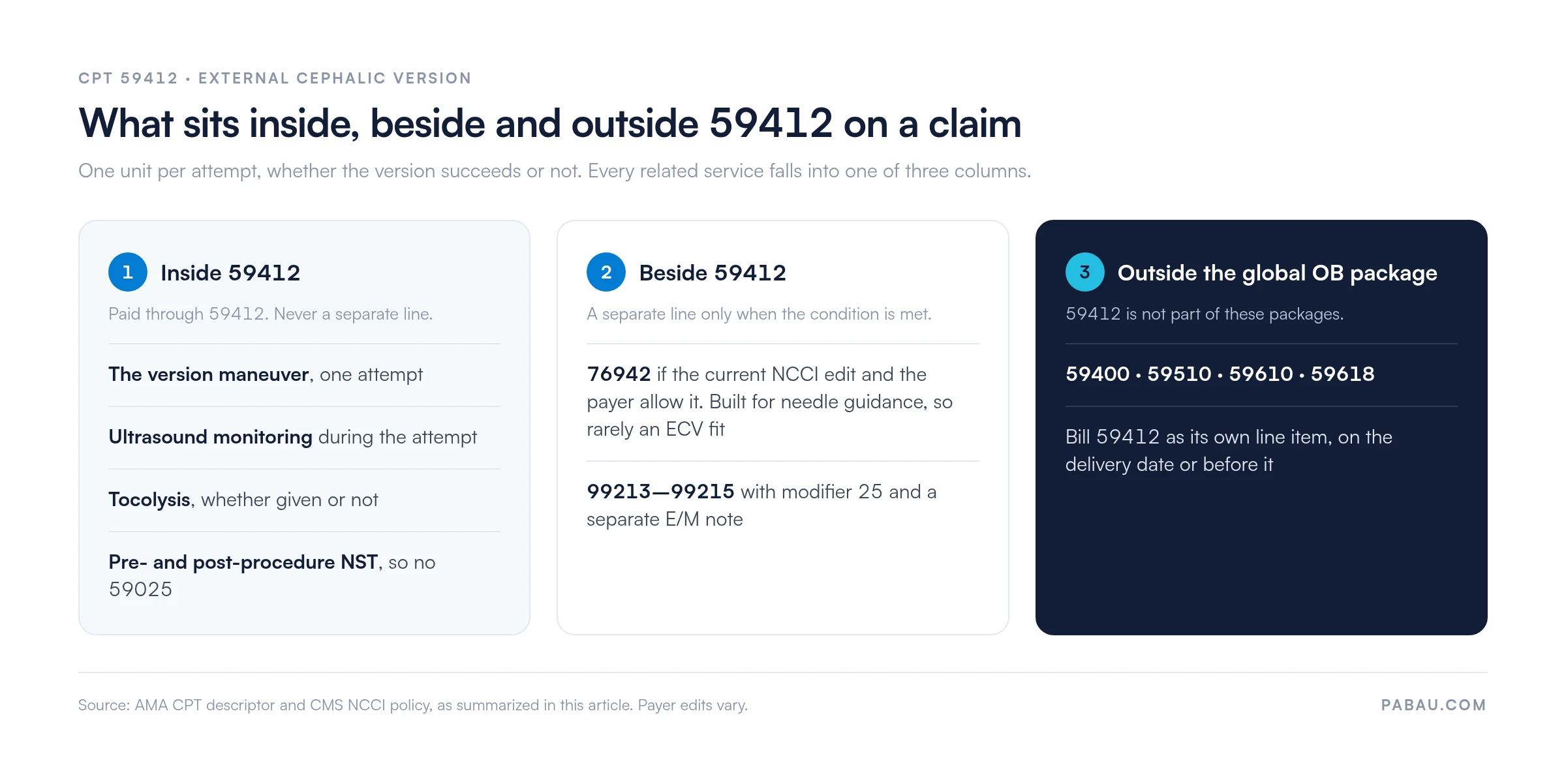
Included in 59412: The ECV maneuver, ultrasound guidance during the attempt, any tocolysis, and routine NST monitoring before and after.
Separately billable on the same date (payer policies vary):
Not covered by 59412: Amnioinfusion, internal fetal monitoring placement, or any subsequent delivery service. Those are coded and billed independently.
Before billing 76942 alongside CPT Code 59412, look up the pair in the current NCCI PTP table and read the payer’s own policy. The note must describe a needle-guided procedure, because routine ECV monitoring is already paid through 59412.
Thin documentation is a common cause of medical-necessity denials for 59412. The operative note must tell the whole clinical story, from the pre-procedure assessment to the outcome. Templated notes also invite post-payment audits.
A complete procedure note for CPT Code 59412 supports clean claim submission and must include all of the elements below. Missing an element can lead a payer to deny or reduce payment.
Pairing thorough documentation with medical billing compliance protocols reduces audit exposure. Practices should retain the complete tracing strips alongside the procedure note in the patient’s chart.
The ICD-10-CM code for a breech presentation that needs ECV comes from category O32, maternal care for malpresentation of fetus. The 7th character identifies the fetus only. Use 0 for a single gestation or an unspecified fetus. Use 1, 2 and so on for each fetus in a multiple gestation. The episode of care is not encoded, and a missing or wrong 7th character gets the claim rejected.
Confirm code extensions against the CDC/NCHS ICD-10-CM web tool before you finalize a code. The code set updates every October 1, so check the tabular list for the current fiscal year.
CPT 59412 covers the external cephalic version procedure. CPT 59414 covers delivery of the placenta by a provider who did not deliver the infant. The two codes describe different clinical situations, and they sit in the same CPT subsection.
CPT 76942 covers ultrasound guidance for needle placement, with imaging supervision and interpretation. Billers often consider it beside CPT Code 59412, but an ECV involves no needle, so the code rarely applies.
Bundling for this pair depends on the current NCCI procedure-to-procedure (PTP) edit and on each payer’s own claim edits. Check the pair in the current CMS NCCI PTP edits before you bill it. If you do report 76942, the note must show a separate needle-guided procedure, distinct from the monitoring already paid through 59412.
OB/GYN practices that bill 59412 regularly should keep a payer-specific crosswalk. It records each payer’s bundling logic before submission, so your team doesn’t learn it from a denial.
Review your 59412 and 76942 results by payer each quarter. If a plan denies the pair every time, stop billing 76942 to that payer and update your crosswalk.
Check the 2026 Medicare payment for CPT Code 59412 in the CMS Physician Fee Schedule lookup tool. The conversion factor changes every year, and the rate differs between facility and non-facility settings. The FastRVU 2026 RVU lookup breaks the code down into work, practice expense and malpractice RVUs.
Key reimbursement facts for 59412 billing teams:
Prior authorization rules for CPT 59412 vary by payer and change often. Many commercial plans ask for it, and a missing authorization is a common reason this code is denied.
When submitting a PA request for ECV, include these elements in the clinical justification:
Medicare does not typically require prior authorization for 59412, but commercial and Medicaid managed-care plans often do. Build the prior authorization process into scheduling rather than billing, so approval is confirmed before the encounter date.
Most CPT Code 59412 denials trace back to one of the five causes below. Read the reason code on the payer’s remittance first, then use our list of common denial codes to match it to a row.
A structured denial management workflow catches these patterns before they become write-offs. Tracking 59412 denial reasons by payer over a rolling 90 days surfaces systematic issues that cannot be spotted claim by claim.
Three modifier families come up with CPT Code 59412. Each one needs a note in the chart that justifies it.
OB/GYN practices billing CPT Code 59412 track four moving parts at once. The code sits outside the global package, and authorization rules differ by payer. The documentation checklist is long, and the O32 code needs the right 7th character. In a busy week, a manual process misses one of them and the claim comes back.
With Pabau’s error-checking claims management software, your billing team scrubs each 59412 claim for missing or invalid details before it goes out. Prior authorizations are stored as cases on the patient’s record, so the approval is on file when the claim is built.
Claims leave Pabau through its Claim.MD clearinghouse integration, which reaches thousands of US payers. It handles CMS-1500 electronic claims, real-time eligibility checks and ERA remittances. Your team can confirm coverage before the patient arrives for the ECV, rather than after a rejection.

Pabau scrubs each 59412 claim for missing or invalid details before submission and checks eligibility through Claim.MD. See how OB/GYN practices keep ECV claims clean from the first submission.

CPT Code 59412 looks simple, with one code for one attempt. The money is usually lost earlier, when an authorization goes unrequested, a note skips the NST, or an O32 code lacks its 7th character.
So move the checks upstream. Confirm eligibility and authorization when the ECV is booked, and build the note from the documentation checklist. Leave 76942 off the claim unless a needle procedure and the current NCCI edit support it.
To see those checks in one place, book a demo and follow an ECV claim from booking to remittance with our team.

Billing the delivery that follows a version? CPT code 59510 covers the global cesarean package and what it includes.
Coding a VBAC global package? CPT code 59618 explains when the attempted VBAC package applies.
Need a ready-made PA request? Medical prior authorization form gives you a template for the clinical justification payers ask for.
Need a full picture of what your clearinghouse does for OB claims? Medical claims clearinghouse guide explains how claim scrubbing catches common errors before they reach the payer.
Looking for the revenue cycle context behind obstetric billing? Revenue cycle management guide covers the process from eligibility checks to payment posting.
CPT code 59412 covers external cephalic version (ECV), where a clinician turns a breech fetus head-down by hand, with or without tocolysis. One unit covers a single attempt, ultrasound monitoring, any tocolytic given and fetal heart rate checks, whether or not the version succeeds.
CPT 59412 covers external cephalic version, performed antepartum. CPT 59414 covers delivery of the placenta by a provider who did not deliver the infant, usually in split care. They describe different clinical situations and should never be swapped.
No. CPT 59412 is separately reportable from all global obstetric packages, including 59400, 59510, 59610 and 59618. A physician who has accepted global care can still bill 59412 as a separate line item, on the delivery date or before it.
Yes, Medicare generally covers CPT 59412 when medical necessity criteria are met. Prior authorization is not typically required by Medicare for this code, though Medicare Administrative Contractors may publish local coverage determinations with additional clinical criteria. Verify your MAC’s LCD database before submitting.
Yes. The CPT descriptor reads “external cephalic version, with or without tocolysis” and does not require a successful outcome. Standard coding convention is to report the procedure performed regardless of result. Document “ECV attempted; fetus remained in breech position” and bill 59412 normally.
Generally, yes. Medi-Cal covers CPT 59412 when medical necessity is met. Confirm current policy, including any effective dates and encounter limits, in the Medi-Cal provider manual before you schedule the procedure.
The primary pairing is O32.1XX0, maternal care for breech presentation, for a single gestation or when the fetus is not specified. Use O32.1XX1 or O32.1XX2 when a specific fetus in a multiple gestation is breech, and O32.2XX0 for a transverse or oblique lie. Always include the 7th character, because a truncated O32.1 is rejected.



