CCSD code M0104: Kidney transplant, abnormal bladder guide
CCSD code M0104 turns on the state of the bladder Most kidney transplants end wi...

Last Updated: Nov 4, 2026
59618 is the CPT code for routine obstetric care including antepartum care, cesarean delivery, and postpartum care, following attempted vaginal delivery after previous cesarean delivery. It is the global package for a failed trial of labor after cesarean (TOLAC). A practice bills it when it gave the prenatal care, the cesarean and the postpartum care.
A successful VBAC bills as 59610 instead. If your practice performed only the cesarean, bill 59620, or 59622 when you also provided postpartum care. The AMA deletes 59618 for dates of service from January 1, 2027.
Let Pabau's smart automation suggest the right codes, reduce claim denials, and keep your practice compliant—effortlessly.
Automate repetitive tasks and focus on what matters most—your patients.
Reduce coding errors and ensure compliance with the latest regulations.
Clean claims, fewer denials, and faster reimbursements.
Powerful insights and reporting to help your practice thrive.
HIPAA compliant SOC 2 certified GDPR-compliant Trusted by 4,000+ clinics worldwide

CPT code 59618 is the global package for a cesarean delivery after an attempted VBAC, covering antepartum, delivery and postpartum care.
A successful VBAC never bills as 59618. It goes to 59610, 59612 or 59614.
After a failed trial of labor, choose 59618, 59620 or 59622 by the care your practice gave: full package, cesarean only, or cesarean plus postpartum.
Pair 59618 with a six-character O34.21- scar code, O66.41 for the failed attempt, a Z3A gestation code and a Z37 outcome code.
The AMA deletes 59618 for dates of service from January 1, 2027, so the code applies only through December 31, 2026.
CPT code 59618 is the global package for a patient with a prior cesarean who attempts vaginal delivery but delivers by cesarean. Here is the official descriptor from the American Medical Association (AMA).
Routine obstetric care including antepartum care, cesarean delivery, and postpartum care, following attempted vaginal delivery after previous cesarean delivery.
Put simply, it is the failed TOLAC (trial of labor after cesarean) package. One practice provides the prenatal visits, manages the trial of labor, performs the cesarean and sees the patient postpartum. The whole episode then goes out as one line.
The trial of labor is the trigger. A patient who plans a repeat cesarean and never labors bills under 59510, the routine cesarean family. A patient whose trial succeeds bills under 59610, the VBAC global package.
The global package pays once for three phases of care. Knowing which services sit inside it keeps antepartum visits from being billed twice and denied.
59618 assumes your practice provided the antepartum care. When the patient transferred in late, or left before delivery, split the episode by what each practice did.
Pair an antepartum code with the delivery-only codes, 59620 or 59622, and never with 59618. That pairing is exactly what National Correct Coding Initiative (NCCI) edits are built to catch.
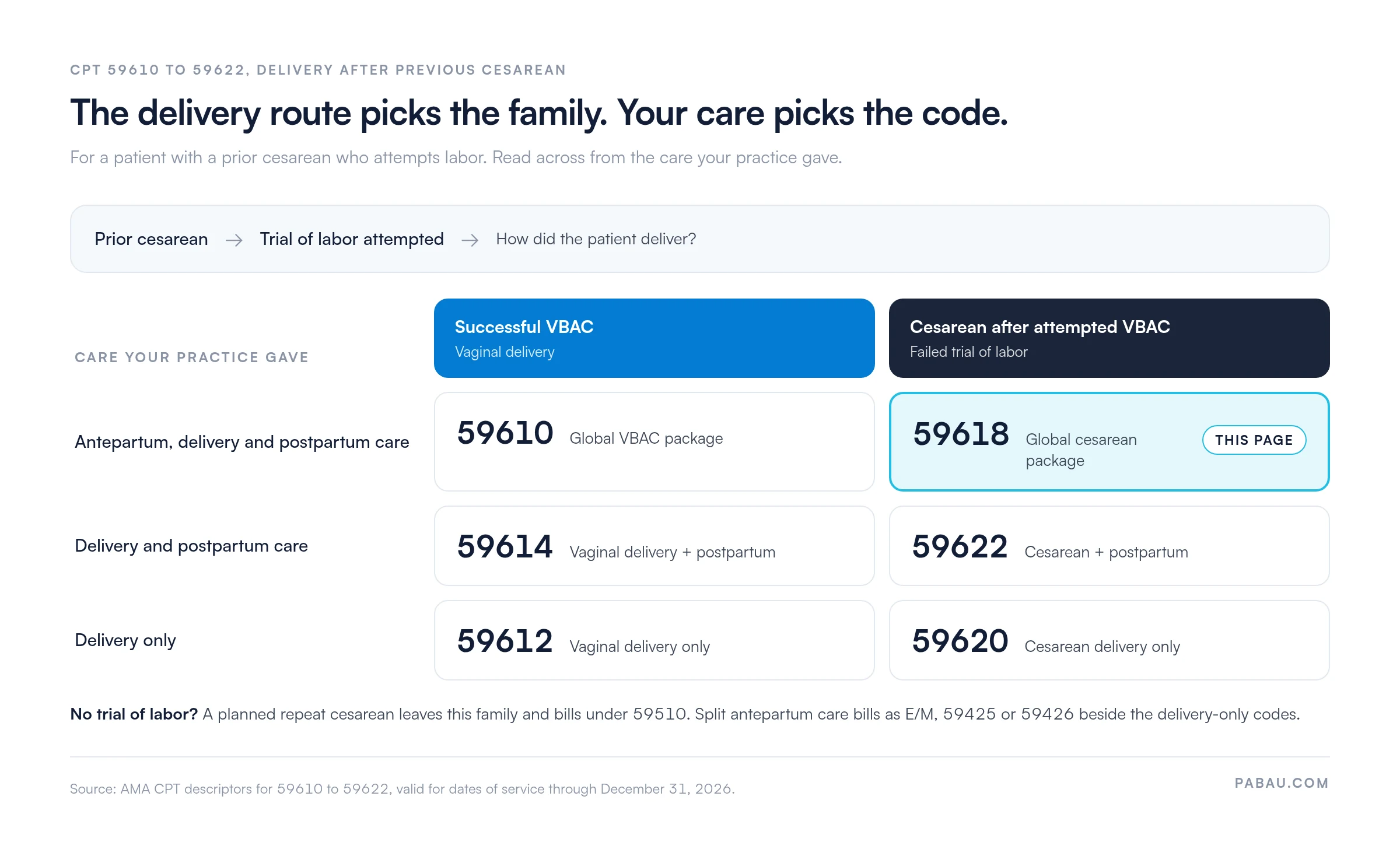
A patient with a prior cesarean who labors lands in one of two code families. The delivery route picks the family, and the care your practice provided picks the code inside it.
A failed trial moves the claim into the 59618 family, and the care you gave chooses between 59618, 59620 and 59622. That makes 59618 vs 59622 a question about the package your practice delivered.
Read the matrix below across from the care you gave to land on the right line.
The claim is built across the whole pregnancy, then coded in a few minutes after the cesarean. Here is the path it takes in a typical OB practice.
A patient with one prior low transverse cesarean transfers to your practice at 30 weeks. Your physicians see her five times, then admit her for a trial of labor at 39 weeks.
Labor stalls, and the physician performs a cesarean. Your group also provides her postpartum care.
Your practice did not provide the full antepartum care, so 59618 does not fit. Bill 59622 for the cesarean and postpartum care, and 59425 for the five antepartum visits. The diagnoses include O34.211, O66.41, Z3A.39 and Z37.0.
Had she been with your practice from her first prenatal visit, the same delivery would bill as a single line of 59618.
Payers audit OB packages closely, and a missing element can turn into a records request or a denial. Each item below should be findable in the chart without a search.
Building these fields into your prenatal forms keeps billing compliance requirements part of each visit. That beats a hunt through old records after a denial lands.
The diagnosis codes have to tell the same story as the CPT code. They show a prior cesarean, a trial of labor that failed, and the outcome of the delivery.
The O34.21- codes are complete at six characters, so they take no 7th character. Adding one makes the code invalid. Use O34.219 sparingly, because payers can read an unspecified scar as missing documentation.
Check each code against the current CMS ICD-10 code set before you submit, since the set updates every October 1.
Make O66.41, a Z3A code and a Z37 code required fields on every delivery claim after a prior cesarean. Together they prove the trial of labor, the gestational age and the outcome, which is the story payers look for on a 59618 claim.
Most 59618 claims go out with no modifier at all. When one is needed, the documentation has to carry it.
Skip modifier 52 when a provider leaves before the package is complete. The delivery-only codes exist for that case, so bill 59620 or 59622 instead.
Medicare is rarely the primary payer for obstetric care, but it applies to patients who qualify through disability. The Medicare fee schedule gives maternity codes a global period of MMM, so the usual 0-, 10- and 90-day surgical rules do not apply.
Look up current RVUs in the CMS MPFS look-up tool, and expect your locality’s cost index to move the payment. Treat the national figure as a baseline, and confirm the rate in each payer contract.
Medicaid pays for a large share of US births, and each state writes its own maternity billing rules. Some states pay the global package, while others want antepartum visits billed as they happen. Read your state’s provider manual before the first claim goes out.
Most commercial payers follow CPT packaging, but policies differ on when the global claim may be filed. Request each payer’s obstetric policy every year, because changes rarely reach the practice directly.
Track each electronic remittance advice against the contracted rate, so an underpaid package is caught within days. For OB/GYN practices that bill several payers, a clearinghouse such as Claim.MD checks each claim against payer edits before it arrives.
Run this list before the claim leaves, alongside your own clean claim checks.
The errors on these claims repeat from practice to practice. Each one has a straightforward fix.
Effective denial management workflows track each denial by reason code and payer, so a repeat pattern shows up early. Claims management software with denial tracking turns those patterns into a worklist for appeal or rebilling.
The AMA’s CPT 2027 maternity care changes delete 59618 for dates of service from January 1, 2027. The whole delivery-after-cesarean family goes with it: 59610, 59612, 59614, 59618, 59620 and 59622.
The same revision deletes the other maternity packages, including 59400, 59510, 59425 and 59426. Its new codes include 59080 to 59083, 59431 to 59434, 59502 to 59504 and 59623.
The AMA overview page does not publish the new descriptors, so take them from the CPT 2027 code book before you rebuild fee schedules. Until then, bill 59618 for qualifying deliveries through December 31, 2026. To check a neighboring maternity code fast, start from our CPT code library.
Most of the work behind a 59618 claim happens months before the claim exists. The prior cesarean, the TOLAC counseling and the visit log are collected across a pregnancy, then pulled together after the cesarean.
Pabau, the practice management and billing platform we build, keeps those pieces on one patient record. Prenatal forms capture the scar type and TOLAC consent at intake, and each visit is logged against the provider who saw the patient.
When the claim is ready, Pabau sends it electronically through Claim.MD, which checks it against payer edits first. Remittances and rejections come back to the same record, so your billing team works denials in one system.
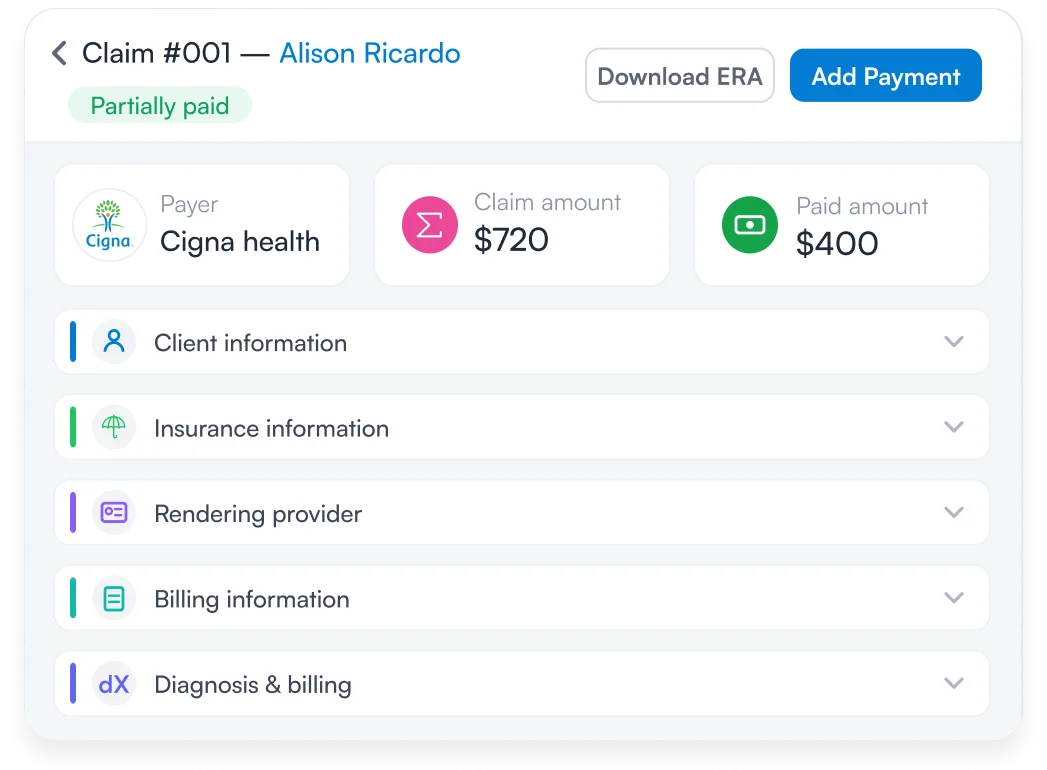

Pabau brings prenatal forms, visit records and electronic claim submission through Claim.MD into one system. See how OB/GYN practices keep 59618 documentation and claims on a single patient record.

Code 59618 from what the operative note says happened, never from the birth plan. A prior cesarean, a trial of labor and a cesarean put you in the 59618 family, and the care your group gave picks the line.
Getting it wrong costs a denial weeks after a long episode of care. With the code gone from January 1, 2027, tighten your VBAC documentation now, so the move to the new codes starts from clean records.
If your team is reworking its medical billing process before 2027, start with delivery claims. Book a demo to see how Pabau keeps OB documentation and claims on one record for your practice.

Need to understand how medical claims clear from submission to payment? Medical claims clearinghouse guide explains how claim validation, NCCI edits, and ERA processing work in a US billing cycle.
Tracking denial patterns across your OB claim volume? Denial codes in medical billing covers the remark codes and claim adjustment reason codes most commonly returned on global OB package denials.
Billing 837P claims to Medicaid or Medicare for obstetric services? 837 file guide covers loop and segment requirements relevant to professional claim submission for delivery codes.
Planned repeat cesarean with no trial of labor? CPT code 59510 covers the routine cesarean global package that sits outside the VBAC family.
Billing a vaginal delivery with no prior cesarean? CPT code 59400 explains the routine obstetric care package for a standard vaginal birth.
Both are cesarean global packages. 59510 covers a cesarean with no trial of labor, such as a planned repeat cesarean. 59618 applies only when the patient first attempted vaginal delivery after a previous cesarean.
Both cover a patient with a previous cesarean who attempts vaginal birth. 59610 is the package when the vaginal delivery succeeds, and 59618 is the package when it ends in cesarean.
No. The anesthesia provider bills separately under the anesthesia codes. When a labor epidural converts to a cesarean, that is usually 01967 with the add-on code 01968.
In the same group, the group bills one package. Across groups, the surgeon usually bills 59620 or 59622. The other physician bills their antepartum visits with 59425, 59426 or E/M codes, so check payer policy for labor management alone.
The AMA’s CPT 2027 FAQ says a cesarean after a VBAC attempt is reported with 59503, Cesarean delivery; repeat. A trial of labor before the repeat cesarean may be reported separately as labor management.