

HCPCS Code Q4185: Cellesta flowable amnion billing guide
HCPCS Code Q4185: definition and official descriptor HCPCS Code Q4185 is the Lev...

Last Updated: Nov 20, 2026
59414 is the CPT code for delivery of placenta (separate procedure). It is reported only when a provider other than the one who delivered the infant delivers the placenta.
When the delivering provider also delivers the placenta, the service is bundled into the global obstetric or delivery code, and 59414 is not separately payable. The deciding fact is who performed the placenta delivery, as named in the delivery note.
Let Pabau's smart automation suggest the right codes, reduce claim denials, and keep your practice compliant—effortlessly.
Automate repetitive tasks and focus on what matters most—your patients.
Reduce coding errors and ensure compliance with the latest regulations.
Clean claims, fewer denials, and faster reimbursements.
Powerful insights and reporting to help your practice thrive.
HIPAA compliant SOC 2 certified GDPR-compliant Trusted by 4,000+ clinics worldwide

CPT Code 59414 covers placenta delivery only when a different provider performs it, not the delivering doctor.
When the same provider delivers both baby and placenta, 59414 is bundled into the delivery code, such as 59400, 59409, 59410 or 59510.
Medicare assigns 59414 an MMM (maternity) global period, and its facility and non-facility rates are the same.
Pair 59414 with the diagnosis that explains the separate service, such as O73.0 (retained placenta without hemorrhage) or O72.0 (third-stage hemorrhage).
Pabau’s claims management submits claims through Claim.MD with eligibility checks and electronic remittance, and tracks denials so a bundled 59414 line gets corrected quickly.
CPT Code 59414 is the code for delivery of placenta (separate procedure), reported only when a second provider delivers the placenta. Medicare’s 2026 NCCI policy manual lists 59414 as included in 59400, 59409, 59410, 59510 and the other delivery packages. So the delivering provider never reports it with them.
The descriptor comes from the American Medical Association’s CPT code set. The “(separate procedure)” tag means the service is usually part of a larger procedure, and it is reported on its own only when a provider does it apart from the delivery.
The code sits in the Maternity Care and Delivery subsection (59000-59899) of the CPT code set, and Medicare assigns it an MMM (maternity) global period. Its clinical scope is placenta expulsion or manual extraction, done as its own written-up service.
CPT Code 59414 covers the placenta delivery itself, whether spontaneous or manual, when it is done as a distinct professional service. Every delivery includes placenta expulsion, so billing turns on who did it. The code applies only when that provider differs from the one who delivered the baby.
Misusing 59414 is a common cause of NCCI bundling denials, so its exclusions matter as much as its scope.
The global obstetric package bundles antepartum visits, delivery, and postpartum care under one CPT code, which is 59400 for a vaginal delivery. Billers who miss this structure either over-bill 59414 or leave a covering provider’s work unbilled.
The National Correct Coding Initiative (NCCI) bundles placenta delivery into the intrapartum service when the same provider bills both. A provider who bills 59409 for the delivery cannot add 59414 for the same birth. CPT 59414 becomes billable on its own only when a second provider, named in the operative or delivery note, delivers the placenta.
That often happens when the delivering doctor is called away and a covering provider finishes the third stage of labor. It also happens when a nurse-midwife delivers the infant and the attending doctor delivers the placenta. The decision tree below sorts each case by who delivered the placenta and how.
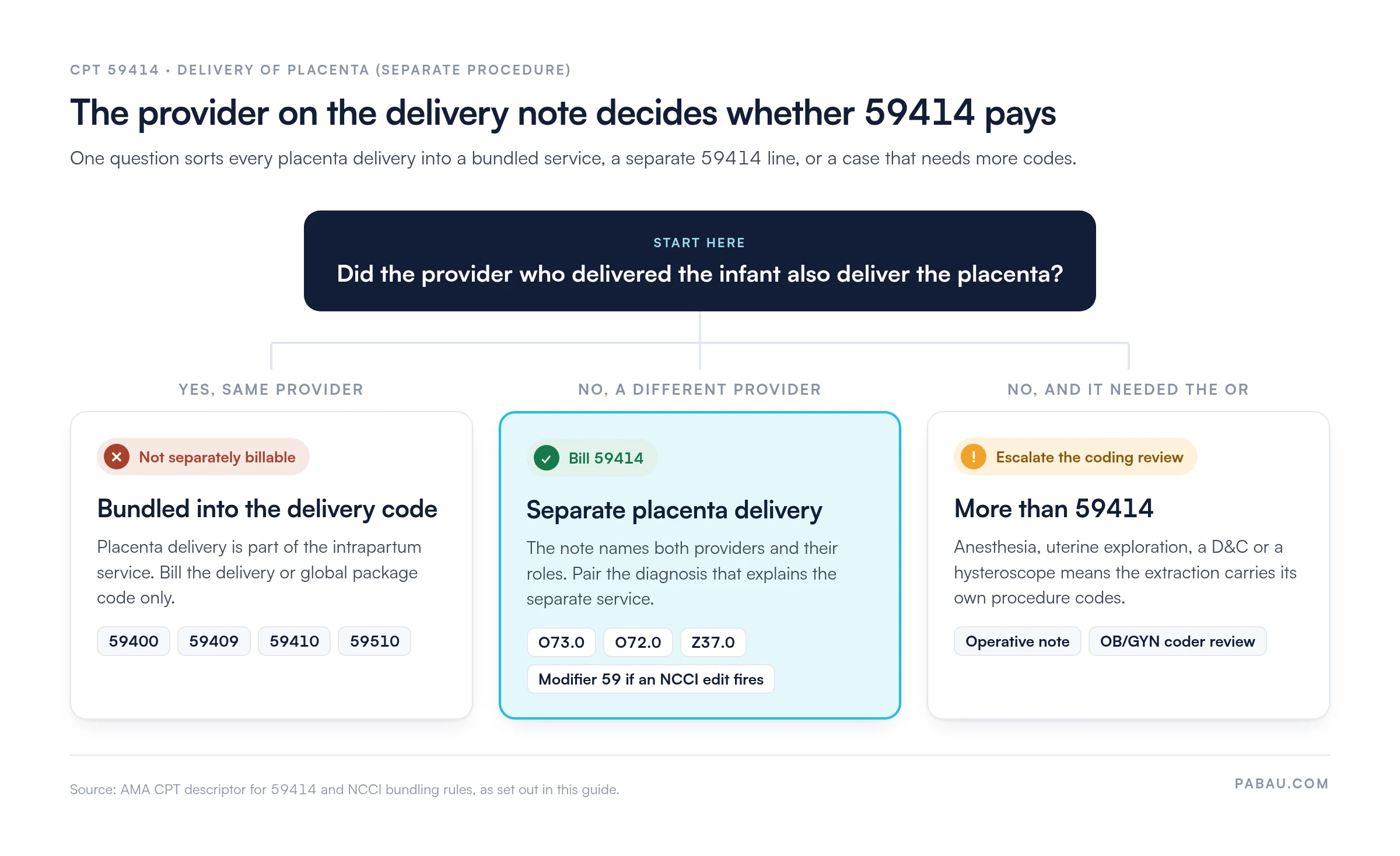
Billing 59414 depends on a chain of paperwork steps as much as on code selection. Miss any one of the five below and the claim denies.
Payers check that the diagnosis codes on a 59414 claim reflect a clinical reason for separate placenta delivery. An outcome of delivery code alone is rarely enough. The table below lists the ICD-10-CM codes most often paired with 59414.
Check these codes against the current-year ICD-10-CM tabular list via the CDC/NCHS ICD-10-CM web tool before filing. Code descriptions and validity statuses change with each fiscal year update.
Always pair a retained placenta or hemorrhage code with the outcome of delivery code, such as Z37.0. A claim carrying a hemorrhage code with no delivery context invites a records request before payment.
Modifier application on 59414 claims is payer-dependent. The table below covers the three modifiers most often seen, with guidance on when each applies.
Modifier 59 carries compliance risk when overused. Apply it only when the notes show that the service was distinct. Payers audit modifier 59 on obstetric claims and may flag a practice for medical review when the modifier appears without a clinical explanation.
Weak notes are the root cause of most 59414 denials. Clean claim submission for this code requires the delivery note to answer five questions before the biller ever touches the claim.
Five denial patterns account for most 59414 rejections, and each has a known root cause and a fix path. Billing teams on claims software for billers can track denial reason codes and fix a pattern before it recurs.
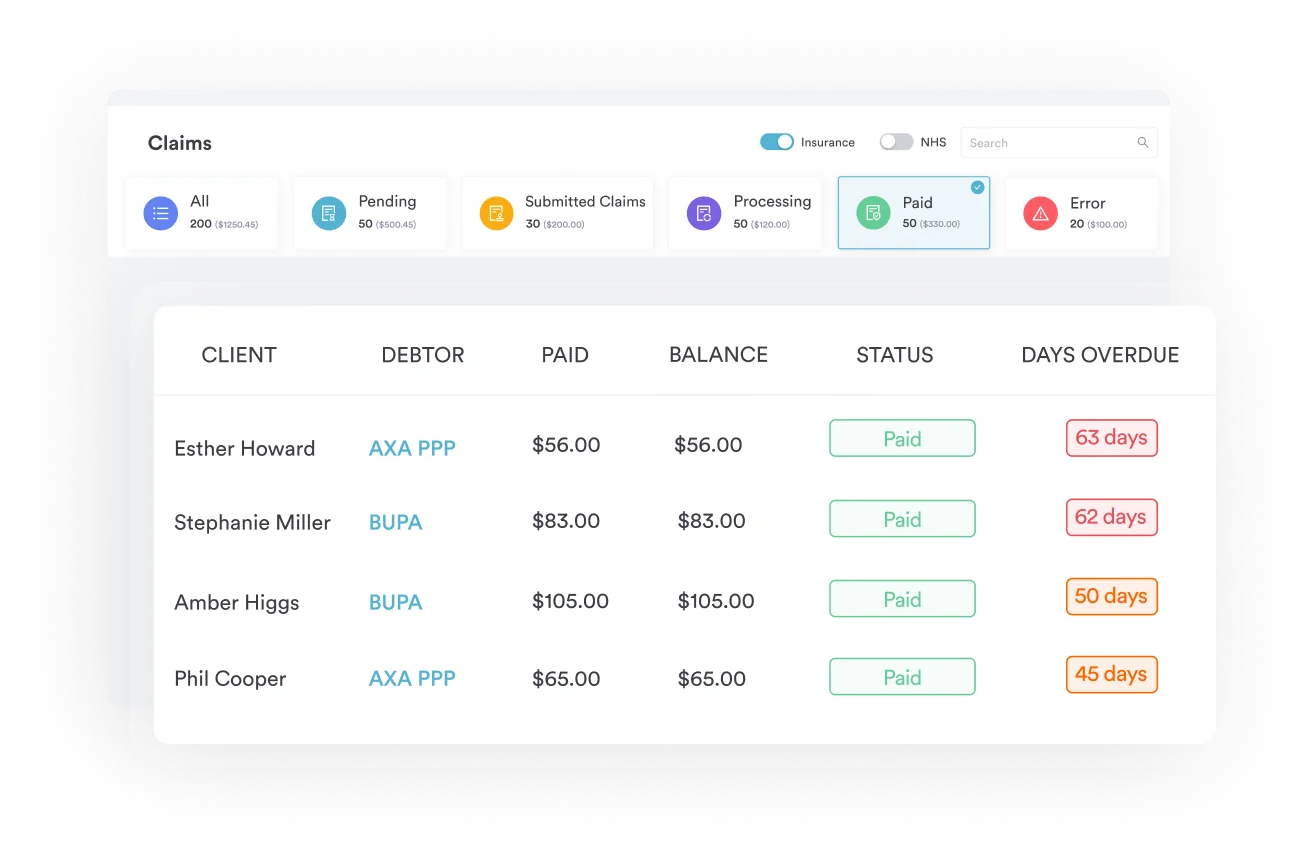
The remittance’s CARC and RARC codes tell you which row applies, and our guide to denial codes maps each one to its fix. Consistent denial management workflows then stop the same pattern from turning into write-offs.
Medicare payment for CPT Code 59414 is set by the Medicare Physician Fee Schedule (MPFS) and changes each calendar year. A dollar figure printed here would go stale within months. Use the CMS Physician Fee Schedule search tool to look up current non-facility and facility rates for 59414 by locality.
For RVU-based estimates, the FastRVU lookup tool provides current Work, Practice Expense, and Malpractice RVU values for 59414. It applies the Medicare conversion factor by geographic locality. Use it to build your expected payment range before contract negotiations.
Key payment context for 59414:
OB practices can list 59414 on a medical superbill with the delivery codes and ICD-10 pairings, which speeds up clean filing. Pabau, the practice software we build, supports claim filing, eligibility checks and electronic remittance (ERA) through Claim.MD.
CPT 59414 covers placenta delivery, including manual extraction in straightforward retained placenta cases. Retained placenta covers a range of clinical cases, and the coding grows more complex as the intervention gets more invasive.
Uterine exploration under anesthesia, dilation and curettage, or hysteroscopic removal of placental fragments each carry their own CPT codes. A postpartum curettage, for example, is reported with 59160. On a UK private claim, the same curettage is CCSD procedure code R2810. Billing 59414 alone in those cases under-codes the work and can prompt a medical review when the operative note describes more.
Coders who encounter retained placenta notes should ask the clinical team three questions before coding:
If the answer to any of these is yes, send it for a coding review. A complicated retained placenta often needs codes beyond 59414, and under-coded claims of this kind are what audits find. When in doubt, consult an AAPC-certified OB/GYN coder before submitting.
Flag all retained placenta cases for coder review before billing. When the operative note references anesthesia, uterine exploration, or a D&C, 59414 alone is insufficient. Attach the full operative note and consult your coding team or an AAPC-certified OB/GYN coder before filing.
Without a system, a biller reads each delivery note by hand to confirm a second provider. The denial gets chased only when it comes back. The provider check happens late, after the payer has already bundled the line.
Pabau submits claims through Claim.MD with eligibility checks and electronic remittance, and tracks claim status and denials next to the patient record. A bundled 59414 line shows up when the remittance arrives, so the biller can pull the note and refile while the case is fresh.
Pabau does not choose the code for you. It keeps filing, remittance and denial follow-up in one workflow, so the paperwork checks in this guide sit next to the claim they protect.

Pabau’s claims management submits claims through Claim.MD with eligibility checks and electronic remittance, and tracks every denial. Your team sees which 59414 claims need a corrected note before they age.

Treat 59414 as a paperwork code first. If the delivery note names a second provider for the placenta, bill it with the diagnosis that explains why. If the note names one provider, the placenta delivery is already paid inside the delivery code, and the write-off is correct.
The trade-off is time at the front end. Checking who the provider is before filing takes a minute per claim, while a bundling denial costs a refiling and often an appeal. Pabau’s claims management lets practices submit claims through Claim.MD and track denials, so the paperwork checks above sit next to claim filing.
Book a demo to see how Pabau keeps OB claim filing and denial follow-up in one workflow.

Billing the delivery and postpartum care together? CPT code 59410 explains what that package includes and when it applies.
Was the placenta delivered at a cesarean? CPT code 59510 covers the routine cesarean package that absorbs it.
Want to understand what makes a claim pay on first filing? Clean claim fundamentals covers the filing requirements that prevent automatic rejection before adjudication.
Seeing recurring denials across your OB claims? Denial management in healthcare outlines the workflow for tracking, appealing, and preventing repeat claim rejections.
CPT Code 59414 is a procedure code for delivery of placenta as a stand-alone professional service. It is billable only when a provider other than the one who delivered the infant delivers the placenta. It sits in the Maternity Care and Delivery subsection of CPT. It has an MMM (maternity) global period on the Medicare fee schedule.
CPT 59414 is billable on its own only when a second provider, not the delivering doctor, performs the placenta delivery. If the same provider delivers both the infant and the placenta, the service is bundled into the delivery code (59400, 59409, or 59410). In that case 59414 is not payable as a separate line item.
Modifier 51 (multiple procedures) applies when the same provider bills 59414 with another procedure on the same date. Modifier 59 (distinct procedural service) may be used when an NCCI edit applies and the record shows a second provider delivered the placenta. Modifier 22 (increased procedural services) applies when a complicated retained placenta required much more work.
The most common pairings are O73.0 (retained placenta without hemorrhage), O72.0 (third-stage hemorrhage), and Z37.0 (single liveborn, vaginal delivery). O72.2 (delayed postpartum hemorrhage) fits only if the notes link the later hemorrhage to the placental delivery service. Always check these against the current-year ICD-10-CM tabular list before filing.





