Pabau Engage inbox

Pabau Engage is here: every patient conversation in one inbox.

Learn more
Book a demo Book a demo
☰
CPT Code

CPT code 52648 – Laser ablation of the prostate


Code Definition

52648 is the CPT code for complete laser vaporization of the prostate, including control of postoperative bleeding. It covers holmium laser ablation (HoLAP), GreenLight photovaporization (PVP) and other lasers that vaporize obstructing prostatic tissue.

Cystourethroscopy, TURP, vasectomy, meatotomy, urethral calibration or dilation and internal urethrotomy are included when performed, so they aren't billed separately. Laser coagulation code 52647 was deleted on January 1, 2026. Code selection now turns on vaporization (52648) versus laser enucleation with morcellation (52649).

Section
10004-69990 Surgery
Subsection
50010-53899 Urinary system
Code range
52400-52700 Vesical neck and prostate surgical procedures
Billable
No
Code also known as
holmium laser ablation prostate, HoLAP, GreenLight PVP, photovaporization prostate, laser prostatectomy, laser vaporization prostate
Save time. Improve accuracy. Get paid faster.
Automate coding with Pabau

Let Pabau's smart automation suggest the right codes, reduce claim denials, and keep your practice compliant—effortlessly.

  • AI-powered code suggestions
  • Real-time compliance checks
  • Faster claims, fewer denials
Why practices choose Pabau
Save hours every week

Automate repetitive tasks and focus on what matters most—your patients.

Improve accuracy

Reduce coding errors and ensure compliance with the latest regulations.

Get paid faster

Clean claims, fewer denials, and faster reimbursements.

Grow with confidence

Powerful insights and reporting to help your practice thrive.

HIPAA compliant SOC 2 certified GDPR-compliant Trusted by 4,000+ clinics worldwide

Key takeaways

Key takeaways

CPT code 52648 covers complete laser vaporization of the prostate, including HoLAP, GreenLight PVP and other vaporization lasers.

Code selection turns on vaporization (52648) versus laser enucleation with morcellation (52649), and laser coagulation code 52647 was deleted on January 1, 2026.

Cystourethroscopy, TURP and the other services named in the descriptor are included in 52648 when performed, so they aren’t billed separately.

52648 carries 9.80 work RVUs for 2026 (10.05 before the 2.5% efficiency adjustment). Payment varies by locality, so check the CMS MPFS lookup for your rate.

Most 52648 denials trace back to the operative note, the prior authorization or a bundled code, so check all three before you submit.

What CPT code 52648 covers, and what it bundles in

CPT code 52648 is the code for laser vaporization of the prostate. In the AMA CPT code set, the descriptor reads “laser vaporization of prostate, including control of postoperative bleeding, complete.” Its parenthetical lists the services included if performed:

  • Vasectomy
  • Meatotomy
  • Cystourethroscopy
  • Urethral calibration and/or dilation
  • Internal urethrotomy
  • Transurethral resection of prostate (TURP)

The operative word is vaporization. The laser destroys obstructing prostatic tissue in place, so no intact specimen is retrieved. The code doesn’t depend on whether the fiber touches the tissue, because contact and non-contact wording appeared only in older versions of the descriptors.

Laser systems that bill under 52648

Any laser that vaporizes prostatic tissue reports to 52648. The common systems are:

  • Holmium laser ablation of the prostate (HoLAP): The holmium:YAG laser vaporizes the obstructing tissue instead of enucleating it. HoLAP maps to 52648, not 52649 (HoLEP), because the tissue is destroyed in place rather than removed as lobes.
  • GreenLight photovaporization of the prostate (PVP): The 532-nm GreenLight laser vaporizes the adenoma through a side-firing fiber. GreenLight is typically a non-contact technique, and it still bills as 52648.
  • Other vaporization lasers: A thulium or diode laser used to vaporize prostatic tissue also codes to 52648 when the operative report documents vaporization.

The operative note must name the laser system and state that prostatic tissue was vaporized. If the note records only coagulation, or describes enucleation and morcellation, it doesn’t support 52648.

52648 vs 52649 and deleted 52647: The tissue decides the code

For 2026 dates of service, laser prostate code selection turns on what happens to the tissue. Vaporization in place reports 52648, and enucleation with morcellation reports 52649.

Laser coagulation code 52647 was deleted effective January 1, 2026, as the AUA News review of the 2026 CPT updates confirms.

CPT code Status in 2026 Procedure Tissue outcome Typical techniques
52647 Deleted January 1, 2026 Laser coagulation of prostate Coagulation Not reportable for dates of service from January 1, 2026
52648 Active Laser vaporization of prostate, complete Tissue vaporized in place, no specimen HoLAP, GreenLight PVP, other vaporization lasers
52649 Active Laser enucleation of prostate with morcellation, complete Lobes enucleated, morcellated and retrieved HoLEP

Laser technique doesn’t decide the code. A non-contact GreenLight PVP and a holmium vaporization both bill as 52648, because in both the tissue is vaporized. The decision path below starts from the one question a coder should ask of the note.
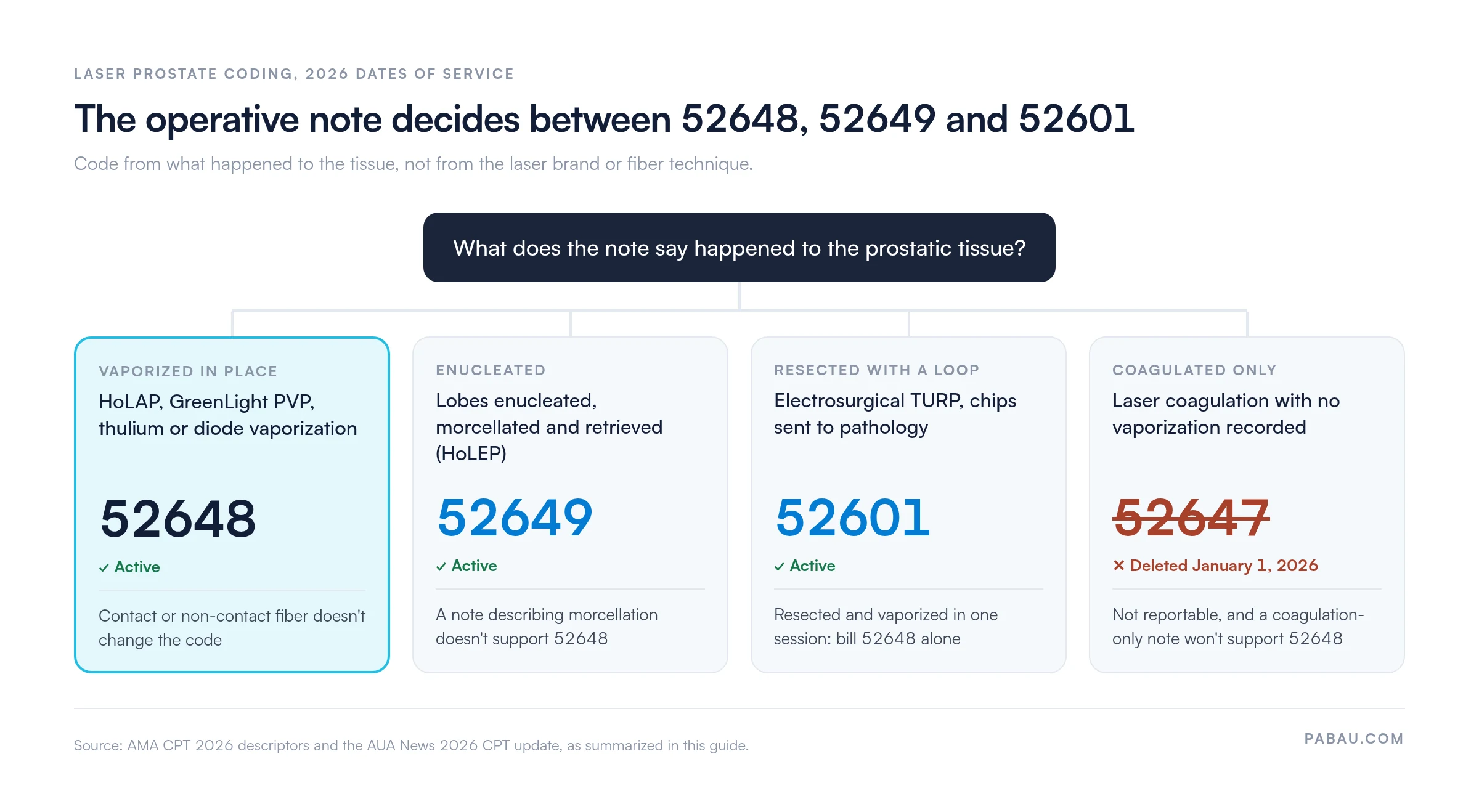
Decision diagram for laser prostate coding in 2026
Four tissue outcomes map to four codes, and only vaporization supports 52648. Based on the AMA 2026 CPT descriptors and the AUA News 2026 update.

Laser vaporization or TURP: When each code applies

CPT code 52601 describes transurethral electrosurgical resection of the prostate (TURP), where a resectoscope loop cuts tissue out in chips. CPT 52648 describes laser vaporization with no tissue extraction.

The 52648 descriptor includes TURP if performed. When a surgeon resects and vaporizes in the same session, bill 52648 alone and don’t report 52601 separately.

Factor CPT 52648 CPT 52601 (TURP)
Energy source Laser (holmium, GreenLight, thulium, diode) Electrosurgical resectoscope
Tissue outcome Vaporized in place Resected and irrigated out
Specimen No intact tissue specimen Chips sent to pathology
Setting ASC or hospital outpatient ASC or hospital outpatient

ICD-10 codes that prove medical necessity for 52648

Every CPT 52648 claim needs a supporting ICD-10-CM diagnosis code that establishes medical necessity. Per CMS ICD-10-CM coding guidance, the diagnosis must reflect the clinical indication documented in the operative note and pre-operative evaluation.

ICD-10-CM code Description Usage notes
N40.1 Benign prostatic hyperplasia with lower urinary tract symptoms Preferred primary diagnosis when LUTS are documented; stronger medical necessity than N40.0
N40.0 Benign prostatic hyperplasia without lower urinary tract symptoms Use only when LUTS are absent; payers may question surgical necessity without documented symptoms
N40.2 Nodular prostate without lower urinary tract symptoms Use when histologic nodularity is confirmed without obstruction symptoms
N40.3 Nodular prostate with lower urinary tract symptoms Nodularity confirmed plus documented LUTS; strong medical necessity indicator
R33.8 Other retention of urine Urinary retention as the presenting symptom; may be coded alongside N40.1
N31.9 Neuromuscular dysfunction of bladder, unspecified Secondary code when neurogenic bladder complicates BPH management

Pairing rule: N40.1 gives a laser vaporization claim stronger support than N40.0. When the patient reports frequency, urgency, nocturia or reduced urine flow, document those symptoms explicitly and code N40.1. Check each code’s full descriptor and Excludes notes in our searchable ICD-10-CM code library before you assign it.

Pro Tip

Always verify ICD-10-CM codes against the service-date code year. Codes update each October 1, and a code valid in FY2025 may be revised in FY2026. Use the CDC/NCHS ICD-10-CM web tool to confirm validity before billing.

What Medicare pays for CPT 52648 in 2026

Medicare pays for CPT 52648 under the Medicare Physician Fee Schedule (MPFS), adjusted for place of service and locality. The code carries 9.80 work RVUs in 2026. Add 4.75 practice expense and 1.27 malpractice RVUs, and the facility total comes to 15.82 RVUs.

RVU component Facility setting Non-facility setting
Work RVU 9.80 9.80
Practice expense RVU 4.75 No non-facility rate is published
Malpractice RVU 1.27 No non-facility rate is published
Total RVU 15.82 No non-facility rate is published
2026 conversion factor $33.4009, or $33.5675 for qualifying APM participants $33.4009, or $33.5675 for qualifying APM participants
Geographic adjustment Applied via GPCI by MAC locality Applied via GPCI by MAC locality

At the $33.4009 conversion factor, 15.82 RVUs works out to about $528 before locality adjustment. For your own figure, enter 52648 in the CMS MPFS lookup tool for the service year. Rates update each January 1, so check them again before billing a new year’s claims.

Facility and professional claims run separately

The physician bills the professional component with the place-of-service code for where the procedure happened.

That is POS 22 (on-campus outpatient hospital), POS 19 (off-campus outpatient hospital) or POS 24 (ambulatory surgical center), as applicable. The facility bills a separate claim under its own payment system (APCs for hospital outpatient, ASC rates for ASCs).

  • Hospital outpatient department (POS 22 or 19): The physician bills 52648 at the facility rate. The hospital bills the APC separately on its own facility claim.
  • Ambulatory surgical center (POS 24): The physician bills 52648 with POS 24 at the facility rate. The ASC is paid separately under the ASC payment system.
  • Physician office (POS 11): Laser prostatectomy is rarely performed in an office because of the equipment it needs. The 2026 MPFS publishes no non-facility rate for 52648, so confirm the payer’s policy before billing POS 11.

What the operative note must prove for a 52648 claim

The operative report for CPT 52648 must confirm both the procedure performed and the medical necessity for surgery. Submitting a clean claim for laser vaporization depends on a complete operative note.

  • Laser system and outcome: Name the laser used (holmium:YAG, GreenLight XPS and so on) and state that prostatic tissue was vaporized.
  • Prostate gland size: Some payer policies use documented prostate volume (transrectal ultrasound or MRI) as a medical necessity criterion. Gland size thresholds vary by payer policy.
  • Conservative treatment history: Many payer policies ask for a documented trial of alpha-blockers, 5-alpha-reductase inhibitors or combination therapy before surgery.
  • Symptom scores: The American Urological Association Symptom Index (AUA-SI/IPSS) at baseline and pre-operatively, showing moderate-to-severe LUTS.
  • Anesthesia type: General, spinal or regional anesthesia documented in the anesthesia record.
  • Postoperative bleeding control: The CPT 52648 descriptor includes control of postoperative bleeding, so document any hemostatic measures taken.

A note that omits the laser system, or records coagulation without vaporization, won’t support the claim. For medical billing compliance, finalize and sign the operative note before the claim is submitted.

Prior authorization for 52648 depends on the payer

Prior authorization requirements for CPT 52648 vary by payer, plan type and service setting. No single rule covers every payer, so verify with the specific plan before scheduling.

  • Traditional Medicare (Parts A and B): CMS’s prior authorization list for hospital outpatient department services applies nationally, and 52648 is not on it. CMS updates the list periodically, so check it for the service date.
  • Medicare Advantage (Part C): Many plans may require prior authorization for laser prostate procedures, so verify per payer. Clinical criteria often include documented moderate-to-severe LUTS, failed medical therapy and gland size.
  • Commercial insurance: Many commercial plans may require prior authorization, so verify per payer. Submission packages typically include the pre-operative AUA-SI score, prostate volume, medication history and the urologist’s clinical summary.
  • Medicaid: Requirements vary by state program. Some states cover laser prostatectomy only after specific prior authorization review.

Once an approval comes through, record its number, the approved code, the site of service and the validity dates in the patient’s file. If the procedure moves from an ASC to a hospital, ask the payer whether the approval still applies.

Modifiers that fit a 52648 claim

A routine 52648 claim needs no modifier. Append one only when the operative note supports one of the scenarios below.

Modifier When to apply Documentation required
-22 Increased procedural service; unusually complex case (large gland, difficult anatomy, extended operative time) Operative note describing the additional complexity and time; submit with the operative report
-51 A separately reportable, unrelated procedure in the same session; the lower-valued procedure is paid at a reduced rate Both procedures documented in the operative report; services listed in the 52648 descriptor are included and never take -51
-59 Distinct procedural service, only where NCCI allows a modifier and the second procedure is clinically separate Operative note documenting a separate indication, site or session; never used for services included in the 52648 descriptor
-76 / -77 Repeat of 52648 on the same date of service, by the same (-76) or a different (-77) physician Operative note for each session and the reason for the same-day repeat
-58 / -78 / -79 A return procedure within the 90-day global period: staged or planned (-58), unplanned return to the OR for a related problem (-78), or unrelated (-79) Operative note stating why the patient returned and how it relates to the first procedure

The AAPC Codify CPT lookup provides current bundling edits and modifier guidance for the 526xx code family. It is useful for confirming which modifier applies before submission.

Repeat laser prostatectomy: timing picks the modifier

Repeat laser prostatectomy happens when residual tissue or regrowth causes recurrent obstruction after an initial 52648 procedure.

CPT 52648 may be billed again for the repeat session. The modifier, if any, depends on when the repeat takes place.

  • Same date of service: Append -76 when the same surgeon repeats the procedure, or -77 when a different surgeon does.
  • Within the 90-day global period: Use -58 for a staged or planned procedure. Use -78 for an unplanned return to the OR for a related problem, or -79 for an unrelated procedure.
  • After the 90-day global period: Bill 52648 without a repeat modifier. A new date of service outside the global is a new procedure, not a duplicate.

What the documentation must show for a repeat session:

  • Clinical evidence of recurrent obstruction, such as new or worsening LUTS, elevated post-void residual or urodynamic findings, documented after the original procedure
  • The interval since the original procedure, and whether it falls inside the 90-day global period
  • A new pre-operative evaluation, including an updated AUA-SI score and prostate imaging where applicable
  • Prior authorization for the repeat procedure from plans that required it for the initial session
  • An operative note that identifies the session as a repeat and documents the clinical rationale

A same-day repeat billed without -76 or -77 can trigger a duplicate-claim flag. The claim then needs a corrected claim or an appeal with documentation. A steady denial management workflow catches these before they age past appeal deadlines.

Pro Tip

Before billing a repeat 52648, check the date against the first procedure. Use -76 or -77 only for a same-day repeat, and -58, -78 or -79 within the 90-day global. After the global ends, no repeat modifier is needed. In every case, the operative note should name the laser and document the clinical basis for re-treatment.

How a 52648 claim moves from operative note to payment

A 52648 claim passes five checkpoints between the operating room and the payment. The medical billing process follows the same arc for most procedures, but laser prostate claims add a few checks of their own.

  1. Prior authorization: The front office confirms what the payer requires and logs the approval before the procedure date.
  2. Operative note: The surgeon names the laser, states that the tissue was vaporized, and signs the note.
  3. Coding: The coder assigns 52648, the supporting ICD-10-CM code and any modifier that the timing calls for.
  4. Claim build: The biller works from the urology superbill, adds the POS code and referring provider, then checks the claim against NCCI edits.
  5. Remittance: The payer pays the claim or returns CARC codes, and any denial goes into the work queue.

A claim that stalls usually stalls at steps two or four. Those are the steps where a vague note or a stray TURP line slips through.

Common mistakes that get 52648 claims denied

Most CPT 52648 denials trace back to the operative note, the prior authorization, or a code billed alongside 52648. A pre-submission review of each 52648 claim catches these before the payer does.

Denial reason Root cause Prevention
Missing or lapsed prior authorization PA not obtained, expired before the procedure date, or not obtained for the correct setting Verify PA by payer, POS and procedure date before scheduling
Procedure not supported by the note Operative note records only coagulation, omits the laser system, or describes enucleation and morcellation (52649) Use note templates that name the laser system and state that prostatic tissue was vaporized
Diagnosis unsupported for surgical intervention N40.0 coded without LUTS; no medical therapy trial documented Code N40.1 when LUTS are present; document the failed medication trial in pre-op notes
NCCI bundling edit triggered 52601 (TURP) or cystoscopy billed alongside 52648 on the same date Bill 52648 alone; TURP and cystourethroscopy are included in its descriptor when performed
Wrong place-of-service code POS 11 (office) submitted for a procedure performed in an ASC or hospital outpatient department Confirm the facility type before submission: POS 22 or 19 for hospital outpatient, POS 24 for an ASC
Duplicate claim (repeat procedure) A same-day repeat billed without -76 or -77, or a return within the global billed without -58, -78 or -79 Match the modifier to the timing; a repeat after the 90-day global needs no repeat modifier

Electronic remittance advice (ERA) files contain the CARC denial reason codes that identify which of these categories triggered each denial. Reviewing electronic remittance advice after each claim run lets urology billing teams spot patterns before they become write-offs.

Before you submit: A six-point check for 52648 claims

Run these checks before a 52648 claim leaves the practice. Each one matches a denial reason in the table above.

  • The operative note names the laser system and says the tissue was vaporized.
  • The diagnosis is N40.1 or N40.3 when symptoms are documented, not N40.0.
  • No TURP (52601) or cystoscopy line sits on the same date of service.
  • The POS code matches the facility: 22 or 19 for hospital outpatient, 24 for an ASC.
  • Any repeat modifier matches the timing against the 90-day global period.
  • The prior authorization covers this payer, this setting and this date of service.

How claims management software keeps 52648 claims clean

Several of the mistakes above happen at a handoff. A coder reads the note, a biller rekeys codes, diagnoses and POS into a clearinghouse portal, and a modifier drops out along the way.

In Pabau’s claims management software, the claim is pre-filled from the patient record. CPT and ICD-10 code lookup libraries let the coder select 52648 and the diagnosis without retyping them. Pabau validates the fields a claim needs, then submits it through its Claim.MD integration.
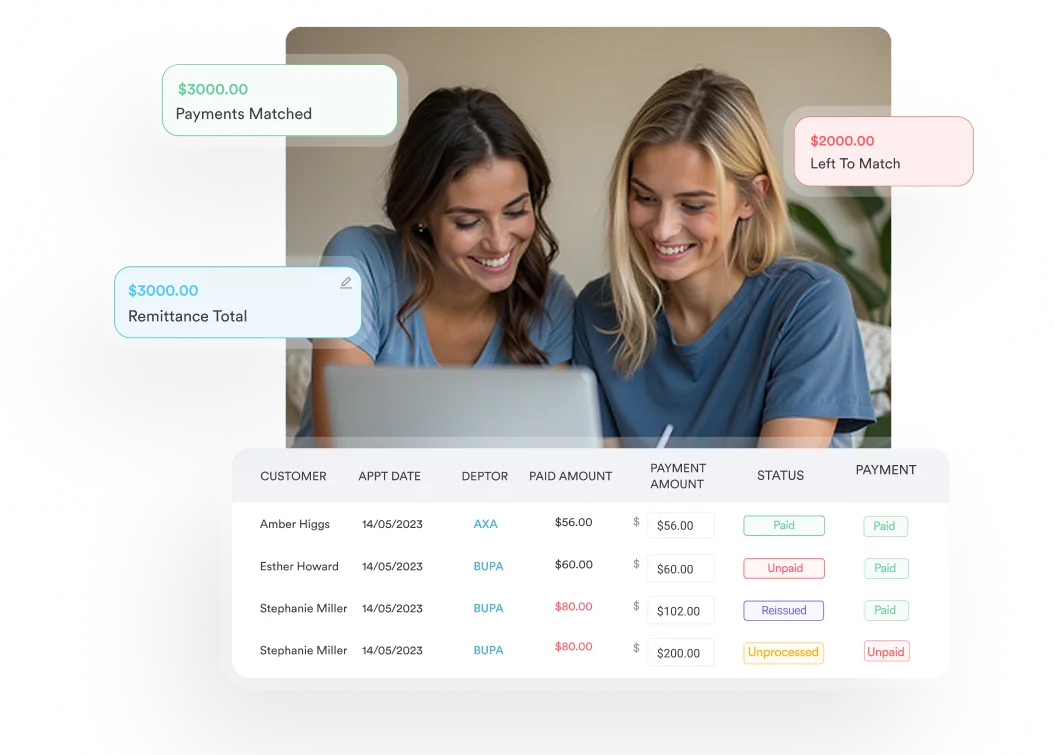
Fully Integrated with Pabau Billing
Pabau’s billing tools pre-fill each 52648 claim from the patient record and check required fields before it goes to Claim.MD.

For US practices, eligibility checks run before the procedure date, ERA posting matches payments to claims, and claim tracking shows where each claim sits. Billers can then spend their time on the claims that need a coder’s judgment.

Submit cleaner CPT 52648 claims with Pabau

Pabau pre-fills each claim from the patient record, checks the required fields and submits it through Claim.MD. Your team spends less time fixing rejected claims.

Pabau practice management platform

Conclusion

Coding 52648 correctly in 2026 starts with the operative note. If it names the laser and records vaporization, 52648 holds up whatever the fiber technique. If it describes enucleation and morcellation, the claim belongs on 52649.

Two more checks protect the claim before it leaves the practice. The services in the descriptor are included, so TURP and cystoscopy aren’t billed alongside it. A repeat procedure takes the modifier that matches its timing, and none once the global period has ended.

Book a demo to see how Pabau pre-fills and submits urology claims straight from the patient record.

Continue your research

Continue your research

Need guidance on claim submission workflows? What is revenue cycle management covers the end-to-end process from coding through payment posting for urology practices.

Dealing with repeated claim denials? Denial codes in medical billing explains CARC and RARC denial reason codes and how to respond to each.

Want to understand clearinghouse claim validation? Claim.MD clearinghouse overview explains how electronic claim scrubbing works before claims reach Medicare and commercial payers.

Frequently asked questions

What is the difference between CPT 52647 and 52648?

CPT 52647 described laser coagulation of the prostate and was deleted on January 1, 2026. CPT 52648 describes laser vaporization and remains active. For 2026 claims, compare 52648 with 52649, laser enucleation with morcellation.

What is the GreenLight PVP CPT code?

GreenLight PVP bills as CPT 52648. The 532-nm laser is usually non-contact, and the delivery method doesn’t change the code. The note should name the laser and document vaporization.

How many RVUs is CPT 52648 in 2026?

CPT 52648 carries 9.80 work RVUs and 15.82 total facility RVUs in 2026. At the $33.4009 conversion factor, that is about $528 before locality adjustment.

What ICD-10 code pairs with CPT 52648?

N40.1, BPH with lower urinary tract symptoms, is the usual primary diagnosis. N40.3 fits a nodular prostate with LUTS, and R33.8 can be added for urinary retention.

Which CPT codes do Rezum and UroLift use?

Neither bills as 52648. Rezum water vapor thermotherapy reports 53854. UroLift reports 52441 for the first implant and add-on code 52442 for each additional implant.

Why do CPT 52648 claims get denied?

The usual causes are a missing prior authorization and a note that doesn’t document vaporization. Others are N40.0 without symptoms, TURP billed separately, the wrong POS code, and a repeat missing its modifier.
×