CPT code 52648: Laser ablation of the prostate billing guide
What CPT code 52648 covers, and what it bundles in CPT code 52648 is the code fo...

Last Updated: Oct 21, 2026
52649 is the CPT code for laser enucleation of the prostate with morcellation, including control of postoperative bleeding, complete. Vasectomy, meatotomy, cystourethroscopy, urethral calibration or dilation, and internal urethrotomy are included when performed. None of them is billed on its own.
Urology coders most often assign it to holmium laser enucleation of the prostate (HoLEP). Choosing between the adjacent 52647, 52648 and 52649 codes depends on the documented laser modality and whether tissue was morcellated. That choice, and the operative note behind it, decide whether a 52649 claim pays on the first pass.
Let Pabau's smart automation suggest the right codes, reduce claim denials, and keep your practice compliant—effortlessly.
Automate repetitive tasks and focus on what matters most—your patients.
Reduce coding errors and ensure compliance with the latest regulations.
Clean claims, fewer denials, and faster reimbursements.
Powerful insights and reporting to help your practice thrive.
HIPAA compliant SOC 2 certified GDPR-compliant Trusted by 4,000+ clinics worldwide

CPT code 52649 covers complete laser enucleation of the prostate with morcellation. Laser coagulation (52647) and laser vaporization (52648) have their own codes.
HoLEP is the procedure most often billed under 52649. The operative note must name the laser, the energy settings, and a complete enucleation.
Cystourethroscopy, urethral dilation, and internal urethrotomy are included in 52649 when performed, so they are not billed on their own.
The 90-day global period bundles related post-op care, so an unrelated service in that window needs modifier 24 or 79.
Pabau’s claims management software pre-fills each claim from the patient record. It checks required fields, such as authorization numbers, before sending.
The American Medical Association defines CPT code 52649 as “laser enucleation of the prostate with morcellation, including control of postoperative bleeding, complete.” Its parenthetical adds that vasectomy, meatotomy, cystourethroscopy, urethral calibration and/or dilation, and internal urethrotomy are included when performed.
The word “complete” carries the most weight. It separates this code from partial laser work and from the vaporization techniques billed under 52648.
Clinically, 52649 describes holmium laser enucleation of the prostate (HoLEP). A high-powered holmium:YAG laser shells the prostatic adenoma away from the surgical capsule.
A morcellator then breaks the freed tissue into fragments, which are evacuated. HoLEP treats benign prostatic hyperplasia (BPH) by removing the obstructing tissue, rather than vaporizing or coagulating it.
The diagnosis codes most often paired with 52649 are N40.1 and N40.0. N40.1 is BPH with lower urinary tract symptoms, and it is the usual choice. Payers and MAC local coverage determinations (LCDs) expect documented urinary symptoms as proof of medical necessity.
52649 applies when a laser enucleates the entire prostatic adenoma from its capsule and a morcellator reduces the excised tissue. It does not apply when tissue is vaporized, coagulated, or only partly enucleated.
The line between 52648 and 52649 is where most miscoding happens. Photoselective vaporization of the prostate (PVP) with the GreenLight laser belongs under 52648. HoLEP produces excised tissue that needs morcellation, so it belongs under 52649. Confirm the laser platform and technique before you pick the code.
All three codes describe endoscopic laser work on the prostate. What sets them apart is the technique and the tissue outcome. If the operative note doesn’t name the modality, a coder can’t tell 52648 from 52649.
A pathology specimen is the clearest signal in the chart. Follow the tissue in the diagram below and the code usually picks itself.
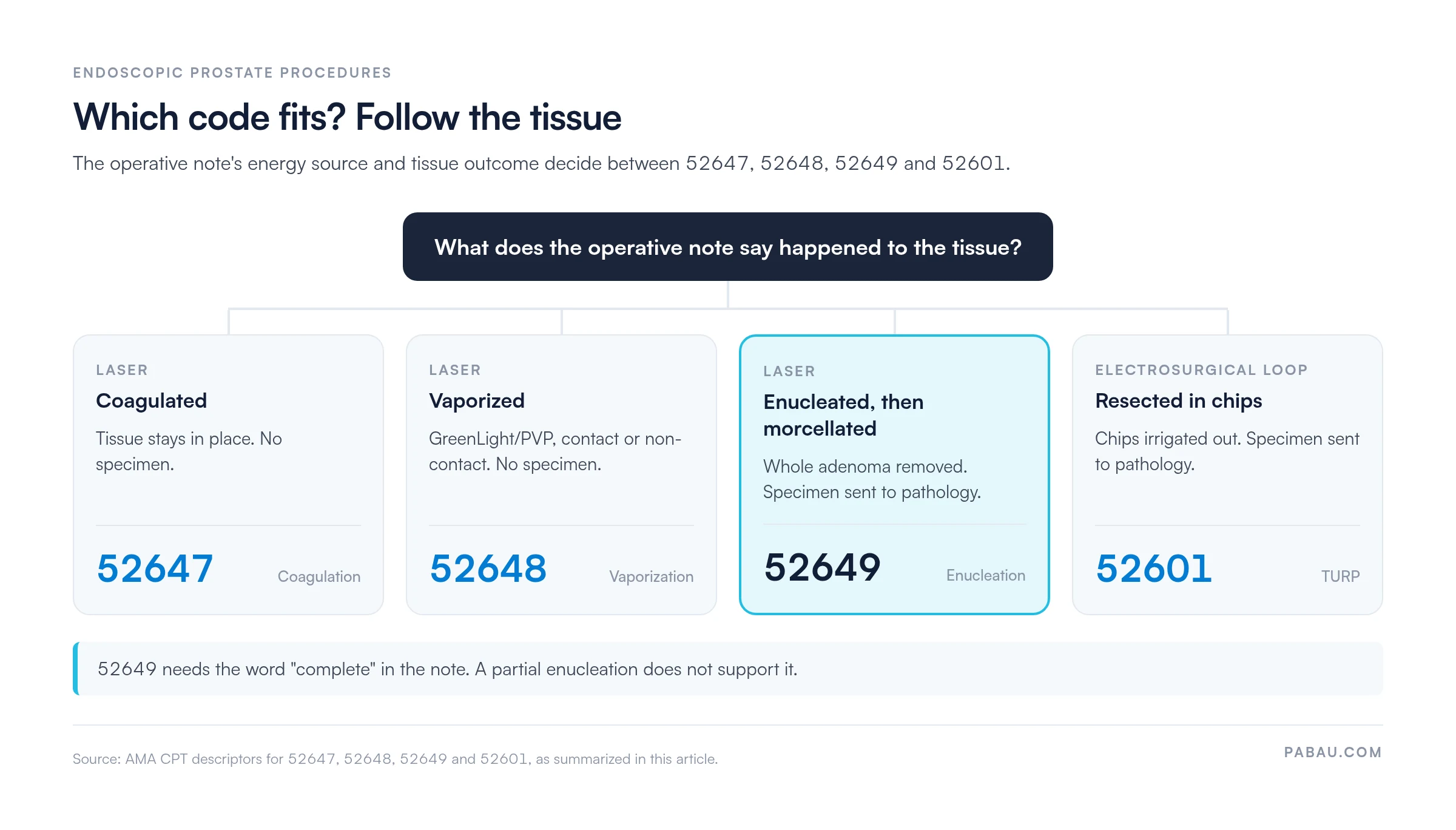
If enucleated tissue was morcellated and sent for analysis, 52649 is almost certainly right. If no specimen was generated, look at 52647 or 52648, depending on the energy applied.
CPT code 52601 covers transurethral electrosurgical resection of the prostate (TURP). Like 52649, it includes vasectomy, meatotomy, cystourethroscopy, urethral calibration or dilation, and internal urethrotomy when performed.
Defaulting to 52601 for any endoscopic prostate resection is a common audit finding. It tends to happen when the coder knows TURP well and the surgeon performed HoLEP.
So read how the operative report describes the instruments. A laser fiber, a morcellator, and an enucleation technique point to 52649. An electrosurgical loop and irrigated chips point to 52601.
A HoLEP claim passes through several hands before it pays. Here is the usual path, and where each step can go wrong.
A weak operative note at step 2 rarely gets caught until step 6. By then, the fix means a corrected claim or an appeal.
Missing operative note elements commonly trigger 52649 denials. The report must support both the code and the diagnosis. A clean claim submission for 52649 starts with an operative note that covers these points:
The American Urological Association’s BPH guideline sets the medical necessity benchmarks that most MAC LCDs reflect. Check the documented criteria against your MAC’s LCD before you submit.
HoLEP is performed in an ambulatory surgical center (ASC) or a hospital. The place of service (POS) code matters, because CMS pays the physician at facility RVUs when care happens in a facility.
Most cases bill POS 24 or POS 22. Use POS 21 (inpatient hospital) or POS 19 (off-campus outpatient hospital) when applicable.
HoLEP is not billed from a physician office (POS 11). It needs a high-powered holmium laser and a tissue morcellator. That makes an ASC or a hospital operating room the realistic setting. Submitting POS 11 for 52649 will lead to a denial, or to payment at the non-facility rate.
Medicare pays the surgeon for 52649 at the facility rate, because HoLEP happens in a facility. The hospital or ASC bills its own costs separately. Electronic claims sent through a clearinghouse such as Claim.MD reach US payers with real-time eligibility verification and ERA remittance processing.
The 2026 value is a cut. The RUC recommended a work RVU of 14.56, but CMS set 13.00 after a crosswalk to 53500, citing shorter procedure time. The AUA’s final rule summary tracks the dispute.
For national payment amounts by locality, use the CMS Physician Fee Schedule lookup. Filter by payment year and your MAC’s locality. RVUs and the conversion factor change every year, so confirm the year before you quote a dollar figure.
Verify your 52649 RVU values and payment amounts in the CMS fee schedule for the payment year you are billing. Third-party figures may reflect a prior year. CMS updates the Physician Fee Schedule each January 1. Budget neutrality adjusts the conversion factor, not the work RVUs.
CPT code 52649 carries a 90-day global surgery period, which makes it a major procedure under CMS rules. The global package folds related pre-op and post-op services into one payment.
That package includes one pre-op visit the day before or the day of surgery. It also covers related post-op visits within 90 days, plus complications that don’t need a return to the operating room. Your urology superbill must separate related visits from unrelated ones, so the unrelated ones can be billed.
To bill a post-op service separately within the global period, add the right modifier:
Prior authorization rules for CPT code 52649 vary by payer, plan, and state. Medicare fee-for-service generally does not require it, but Medicare Advantage plans often do. Commercial payers commonly require it too, and they apply clinical criteria before approving the procedure.
Check the payer’s medical policy for laser prostatectomy before you schedule. Policies lean on the AUA BPH guideline. Many ask for a minimum AUA symptom score and a urinary flow rate. They also want evidence that alpha-blocker or 5-alpha reductase inhibitor therapy failed.
Most 52649 claims go out without a modifier. When the case calls for one, these are the options:
Check the CMS NCCI edit tables for any code you plan to bill alongside 52649. NCCI edits change every quarter.
Denials on 52649 cluster around five causes. Denial management workflows that track each reason code let a billing team fix patterns, not single claims. The remittance will cite denial codes that point to the cause.
Pabau’s claims management software pre-fills the claim from the patient record and validates required claim fields (such as authorization numbers) before sending. It then submits via Claim.MD.
The same handful of errors turns up again and again in HoLEP billing. Each one is easy to prevent once you know it.
A solid grasp of medical billing fundamentals helps here. Each mistake starts as a missing link between the chart and the claim.
Run through these checks before a HoLEP claim leaves the practice:
For current descriptors and annual updates, try the AAPC Codify CPT lookup. It holds code descriptors, RVU values, and crosswalk data in one place.
Many urology billing teams still build each HoLEP claim by hand. Someone re-types the CPT and ICD-10 codes, then hunts down the authorization number. Each re-keyed field is another chance for a rejection.
Pabau pre-fills the claim from the patient record. The CPT code attached to the service lands on the charge line, and ICD-10 slots draw from the recorded problem list. Built-in CPT and ICD-10 lookup libraries let coders check a code without leaving the record.
Before the claim goes out, Pabau checks that required fields, such as the authorization number, are complete. US claims then travel through Claim.MD, with eligibility checks, ERA posting, and claim-status tracking in one place. Your team spends less time re-keying and more time on the claims that need a person.

Pabau pre-fills each claim from the patient record and checks required fields, such as authorization numbers, before it sends. US claims go through Claim.MD, with eligibility checks and ERA posting in the same workflow.

52649 rewards precision more than speed. The code turns on two words in the operative note, “morcellation” and “complete.” So the strongest fix sits upstream of billing. Agree a structured HoLEP note template with your urologists, and the code choice stops being a judgment call.
The trade-off is a little effort up front. Checking payer policy at scheduling and confirming the laser before coding takes minutes per case. Reworking a denied claim takes far longer.
Pabau supports the claim side of that work with record-based pre-fill, CPT and ICD-10 lookup libraries, and required-field validation. Claim.MD eligibility, ERA, and claim-status tracking sit alongside them. Book a demo to see how it carries a urology claim from the patient record to the remittance.

Need to understand how claims reach payers electronically? How the Claim.MD clearinghouse works explains the 837P submission path, ERA matching, and payer enrollment process.
Struggling with recurring claim rejections? Understanding electronic remittance advice covers how to read ERA 835 files and use CARC denial codes to resolve root causes.
Want a reference for billing code structures and denial codes? Denial codes in medical billing breaks down the most common CARC and RARC codes your team will encounter on 52649 remittances.
Yes, when the enucleation is complete and the tissue is morcellated. The 52649 descriptor says laser enucleation without naming a laser type. So a thulium enucleation fits, as long as the operative note documents the technique and the morcellation.
Yes, under Medicare’s teaching physician rules. The teaching surgeon must be present for the key or critical portions of the procedure. The claim carries modifier GC, and the operative note must document that presence.
The pathologist bills the tissue exam separately, under their own surgical pathology code. The urologist’s 52649 payment doesn’t include it. The surgeon’s part is to document that the specimen went to pathology.
Yes, when treatment for BPH is medically necessary. Medicare fee-for-service generally doesn’t require prior authorization for 52649, but your MAC’s coverage criteria still apply. Medicare Advantage plans often do require authorization, so check the plan first.