

CCSD code G5100: Bypass of duodenum billing guide
CCSD code G5100 bills a bypass that leaves the duodenum in place CCSD code G5100...

Last Updated: Oct 16, 2026
52260 is the CPT code for cystourethroscopy with dilation of the bladder for interstitial cystitis, performed under general or conduction (spinal) anesthesia.
The dilation is a hydrodistention, and it is what separates 52260 from 52000, the diagnostic cystoscopy code. The operative report has to document it, or the claim will not hold up. The same procedure under local anesthesia is reported with 52265. Medicare assigns 52260 a 0-day global period, so no post-op follow-up care is bundled into its payment.
Let Pabau's smart automation suggest the right codes, reduce claim denials, and keep your practice compliant—effortlessly.
Automate repetitive tasks and focus on what matters most—your patients.
Reduce coding errors and ensure compliance with the latest regulations.
Clean claims, fewer denials, and faster reimbursements.
Powerful insights and reporting to help your practice thrive.
HIPAA compliant SOC 2 certified GDPR-compliant Trusted by 4,000+ clinics worldwide

CPT code 52260 describes cystourethroscopy with hydrodistention of the bladder under general or spinal anesthesia. Diagnostic cystoscopy (52000) has no distension component.
The main ICD-10 indications are N30.10 and N30.11, interstitial cystitis without and with hematuria. A mismatched or unspecified diagnosis code is a leading denial trigger.
Medicare lists no non-facility rate for 52260, so it is billed from a hospital outpatient department or ASC, and it carries a 0-day global period.
Claims management software such as Pabau scrubs each claim for missing or invalid details before submission, so fewer 52260 claims come back denied.
The American Medical Association’s CPT code set defines CPT code 52260 as Cystourethroscopy, with dilation of bladder for interstitial cystitis; general or conduction (spinal) anesthesia.
In everyday coding language, that dilation is the hydrodistention. The descriptor sets the entire scope of the code. Biopsy, fulguration and ureteral catheterization fall outside it and need additional or different codes.
Two things define a valid 52260 claim. First, the procedure is a cystourethroscopy, meaning a rigid or flexible scope is passed transurethrally into the bladder.
Second, hydrodistention is performed. The bladder is filled with fluid under controlled pressure, typically to capacity, then held briefly before deflation. The distension both stretches the bladder wall (therapeutic intent in interstitial cystitis) and allows inspection of petechial hemorrhages and Hunner lesions on decompression.
The code sits in the CPT Surgery section, urinary system subsection, within the transurethral surgery range for the urethra and bladder (52204-52318). Medicare assigns it a 0-day global period, shown as indicator 000 in the CMS 2026 Physician Fee Schedule relative value file.
Its payment covers the procedure and related care on the day of service only, with no post-op follow-up window attached.
Cystourethroscopy with hydrodistention is a minimally invasive endoscopic procedure performed under general or regional anesthesia. Anesthesia is needed because filling the bladder to full capacity is painful. That is what separates it from a simple office cystoscopy. The procedural steps the operative report must reflect are:
Each of these steps is an audit touchpoint. An op note that leaves out the distension pressure, the volume instilled or the post-deflation findings is a common trigger for medical necessity denials.
Payers require a matching ICD-10-CM diagnosis on every CPT code 52260 claim. A non-specific or mismatched code is one of the most common denial reasons. The accepted primary indications are interstitial cystitis and related painful bladder conditions.
Coding tip: never submit CPT code 52260 with R39.9, an unspecified symptom code, as the primary diagnosis. That pairing routinely draws a medical necessity denial, which needs a chart-level appeal rather than a simple refile. Use the specific interstitial cystitis code whenever the chart documents one.
CPT code 52260 and CPT 52265 describe the same procedure: cystourethroscopy with dilation of the bladder for interstitial cystitis. Anesthesia type picks the code. CPT code 52260 is reported under general or conduction (spinal) anesthesia, and 52265 is reported under local anesthesia.
The practical rule: when an anesthesiologist or CRNA provides general or spinal anesthesia and a separate anesthesia record exists, 52260 is the appropriate code.
Report 52265 only when the urologist uses local anesthesia alone. Monitored anesthesia care (MAC) is not local anesthesia, so a hydrodistention under MAC is coded 52260.
Add 52000 to the picture and two questions settle the code: was the bladder distended, and under which anesthesia.
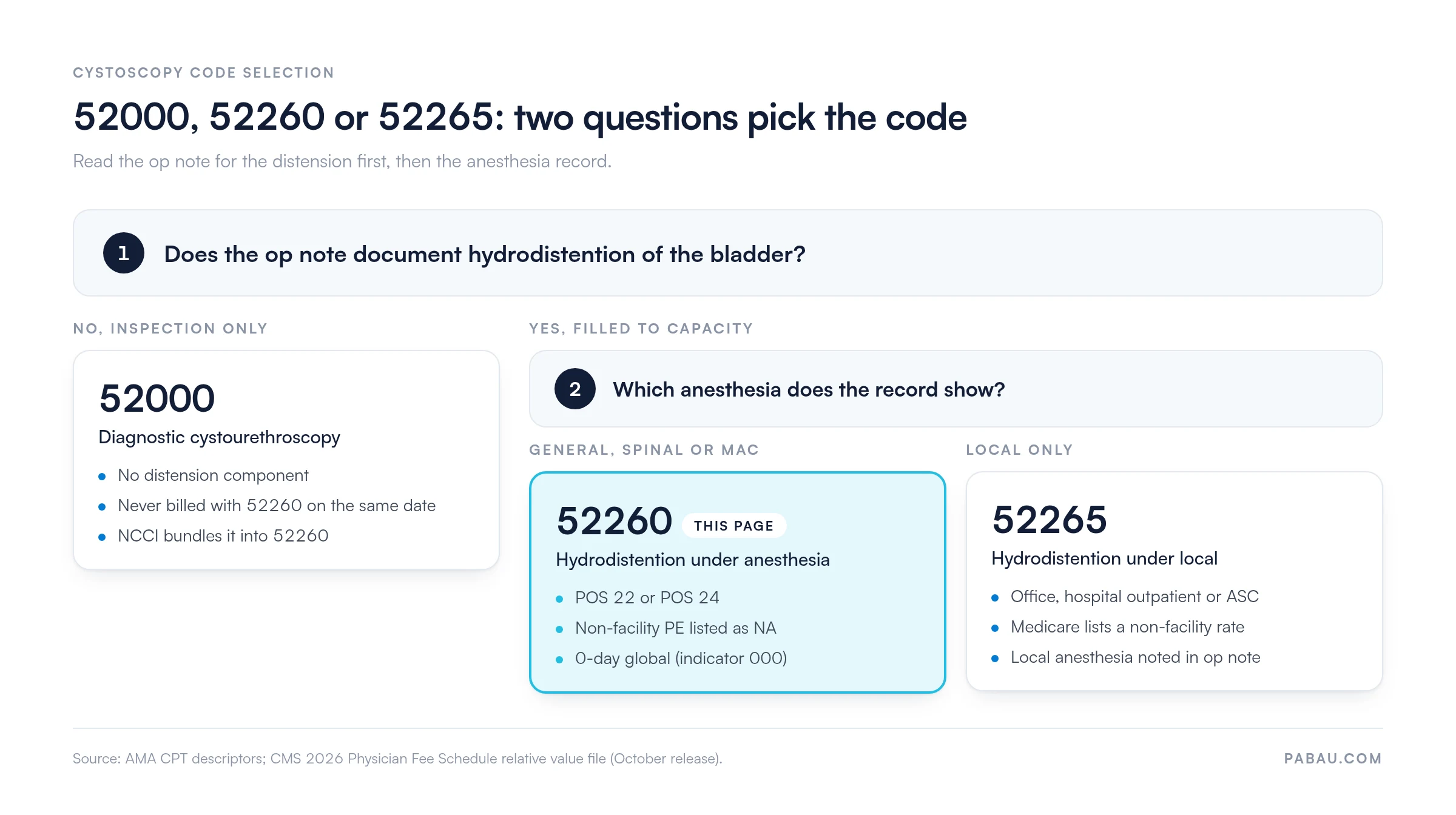
Four codes in the cystoscopy and bladder procedure family are routinely confused. The table below shows when each is correct and, critically, when it cannot be billed alongside CPT code 52260.
Billing 52000 alongside 52260 is a frequent cause of denials for this procedure. The diagnostic bladder inspection is integral to CPT code 52260, so it cannot be reported separately as 52000 on the same date.
NCCI edits enforce this. Check the current National Correct Coding Initiative table before you submit both codes on one claim.
The operative report is the claim’s foundation. Missing or vague documentation is a common reason 52260 appeals fail. Meeting clean claim standards for this code requires the op note to address each of these elements:
Auditors flag op notes that describe a cystoscopy with irrigation and water distension without the word “hydrodistention.” That single missing term can reclassify the procedure to 52000, reducing reimbursement significantly and triggering a recoupment demand on retrospective audit.
Run a pre-submission audit on every 52260 op note: check for the words ‘hydrodistention’, ‘distension pressure’, and ‘bladder capacity under anesthesia’. If any are absent, return the note to the provider for addendum before the claim goes out. An addendum added before billing is always more defensible than one added post-denial.
Medicare pays for CPT code 52260 under the Medicare Physician Fee Schedule (MPFS) using a resource-based relative value scale.
The CMS relative value file lists the non-facility practice expense for 52260 as NA, so Medicare pays it only at the facility rate. That rate applies when the work occurs in a hospital outpatient department or ASC.
The table below shows the national 2026 RVUs from the CMS October 2026 relative value file (RVU26D). Multiply the total by the conversion factor, then apply your locality’s geographic adjustment.
To check a local amount, use the FastRVU lookup tool or the CMS MPFS search. Rates change with each January update.
Pabau’s urology claims management tools send CPT code 52260 claims electronically through Claim.MD, Pabau’s US clearinghouse partner. Before a claim leaves the system, claim validation scrubs it for missing or invalid details. Your billing team fixes those errors before they turn into denials.
Prior authorization for CPT code 52260 depends on the payer, the plan year and the state. Many commercial payers and Medicare Advantage plans require it before the procedure is scheduled.
Traditional Medicare (Parts A and B) does not require prior authorization for 52260 under current policy. Even so, medical billing compliance requires that the procedure still meets medical necessity criteria. Medicare Advantage plans may require pre-authorization even where traditional Medicare does not. Always verify the specific plan’s requirements before scheduling.
A typical prior authorization submission for 52260 should include:
A denied 52260 claim is almost always one of five identifiable problems. Each has a defined corrective path. Knowing which one applies tells you whether to refile a corrected claim or submit a formal appeal.
Strong denial management workflows for urology practices separate these categories at the point of denial rather than treating every denial as an appeal.
For denial-code reference, the common denial codes guide covers CARC and RARC definitions that appear on 52260 EOBs. Building a denial-code lookup into your daily workflow cuts resolution time for the most common rejections.
Anesthesia for cystourethroscopic procedures is reported with CPT code 00910, by the anesthesiologist or CRNA only. The urologist bills 52260 for the surgical procedure. The anesthesia provider bills 00910 separately on their own claim.
Two common billing errors occur here. First, urology practices occasionally include 00910 on the surgeon’s claim by mistake. That triggers an immediate denial, because the urologist’s rendering provider record does not establish the anesthesia provider relationship.
Second, a CRNA may provide anesthesia under physician supervision. The claim must then set up the billing relationship between the supervising anesthesiologist and the CRNA correctly, or it draws a medical direction denial.
CPT code 52260 is performed in a hospital outpatient department (POS 22) or an ambulatory surgical center (POS 24). CMS lists its non-facility practice expense as NA, so Medicare does not normally pay it in an office (POS 11). If a MAC does allow an office claim, it pays at the facility rate of 5.56 total RVUs.
When the procedure is done in the office under local anesthesia, the correct code is 52265.
Place of service still shapes the payment. The facility bills its own overhead under OPPS or the ASC payment system, and the urologist is paid the professional amount at the facility rate. Reporting an office POS for a procedure done in a hospital or ASC misstates where the service happened. Auditors treat that as a compliance issue.
Medicare assigns 52260 a 0-day global period (indicator 000), and the CMS file sets its pre-op, intra-op and post-op shares at zero. No follow-up window runs after the procedure. That changes five billing decisions:
Use superbill documentation to mark same-day E/M encounters at the point of charge capture. Your coders then know whether a visit needs modifier -25 before it reaches the claim queue.
Do not copy a 90-day global flag from major urology surgery onto 52260 cases. CPT 52260 has a 0-day global, so visits on later days bill as standard E/M services without modifier -24. Flag same-day E/M visits instead, and route each one to a modifier -25 review before billing.
Most 52260 denials trace back to one missing detail. It might be a vague diagnosis code, a 52000 line that does not belong, or a same-day visit without modifier -25. Catching them by hand means a coder rereads every op note and claim before it goes out.
In Pabau, the operative note, the diagnosis and the claim sit in the same patient record. Claim validation scrubs each claim for missing or invalid details, then Pabau sends it through Claim.MD. Your team fixes errors before the payer sees them, so fewer 52260 claims come back for a refile or an appeal.
Real-time eligibility checks through Claim.MD also confirm the patient’s coverage before the procedure date. That catches a lapsed or changed plan while there is still time to request prior authorization.

Pabau’s claim validation scrubs every 52260 claim for missing or invalid details before it reaches the clearinghouse. Your team fixes errors before submission, not weeks later on an EOB.

A clean CPT code 52260 claim is settled before the patient reaches the operating room. Confirm the interstitial cystitis diagnosis, the anesthesia plan and any prior authorization at scheduling, and the code choice follows from the record.
The trade-off is a few minutes of review per case. A coder who checks the op note for “hydrodistention” before billing spends minutes. An appeal costs records requests, addenda and a second wait for payment. Book a demo to see how Pabau checks each urology claim for missing details before it reaches the payer.

Need to understand how your clearinghouse fits into the claim lifecycle? Medical claims clearinghouse guide explains how electronic claims move from practice to payer and where errors are caught.
Want to verify eligibility before scheduling a 52260 case? Insurance eligibility verification covers real-time eligibility checks that flag prior authorization requirements at the point of scheduling.
Dealing with 835 remittance files and ERA reconciliation? Electronic remittance advice walks through how to read ERA files and match CARC codes to specific denial reasons.
CPT code 52260 covers cystourethroscopy with hydrodistention of the bladder, performed under general or conduction (spinal) anesthesia. It includes the transurethral scope insertion, controlled fluid filling of the bladder to capacity, maintained distension, and post-deflation inspection, all in a single operative encounter. Diagnostic inspection without hydrodistention is reported separately with 52000, which cannot be billed on the same date as 52260.
CPT 52260 and 52265 describe the same procedure, cystourethroscopy with dilation of the bladder for interstitial cystitis. Anesthesia type separates them. Report 52260 under general or conduction (spinal) anesthesia, typically in a hospital outpatient department or ASC. Report 52265 when the urologist uses local anesthesia only.
Prior authorization requirements vary by payer. Traditional Medicare (Parts A and B) does not currently require prior authorization for 52260, but many Medicare Advantage plans and commercial insurers do. Always verify the specific plan’s requirements before scheduling. PA submissions typically require documentation of failed conservative therapies, an established interstitial cystitis diagnosis, and physician attestation of medical necessity.
The primary ICD-10-CM codes that support a 52260 claim are N30.10 (interstitial cystitis without hematuria) and N30.11 (interstitial cystitis with hematuria). N32.89 (other specified disorders of bladder) may be used when the diagnosis is established but does not precisely map to N30.1x. Avoid an unspecified symptom code such as R39.9 as the primary diagnosis. Payers routinely deny claims where the diagnosis does not meet their medical necessity criteria for hydrodistention.
No. CPT 52000 (diagnostic cystoscopy) is bundled into 52260 under NCCI edits because the diagnostic scope component is integral to the hydrodistention procedure. Billing both on the same date of service results in a denial with CARC 97 or B15. Remove 52000 from any claim that includes 52260. Check the current NCCI table before each billing cycle to confirm the edit is still in effect.
CPT 52260 has a 0-day global period under Medicare (indicator 000). Only care on the day of the procedure is bundled into its payment. A same-day E/M visit needs modifier -25 and separately identifiable documentation. Visits on later days are billed as standard E/M services, without modifier -24.
Five problems cause most denials. They are an unspecified or mismatched ICD-10 code, NCCI bundling of 52000 with 52260, and missing hydrodistention documentation in the operative report. The other two are a missing prior authorization and a place of service mismatch on the claim form. Most coding or documentation errors can be refiled as corrected claims. Denials based on medical necessity or a missing PA need a formal appeal with supporting clinical records.



