HCPCS Code L0472: Hyperextension TLSO billing guide
HCPCS code L0472: Official descriptor and device definition HCPCS code L0472 des...

Last Updated: Nov 5, 2026
K0077 is the HCPCS Level II code for a front caster assembly, complete, with solid tire, replacement only, each. It is billed per caster when a worn or damaged front caster on a beneficiary-owned wheelchair is replaced.
The tire type sets the code. K0071 covers a pneumatic tire and K0072 a semi-pneumatic tire. Most K0077 denials come from a code that does not match the delivered part, a wrong pricing modifier or a missing practitioner order.
Let Pabau's smart automation suggest the right codes, reduce claim denials, and keep your practice compliant—effortlessly.
Automate repetitive tasks and focus on what matters most—your patients.
Reduce coding errors and ensure compliance with the latest regulations.
Clean claims, fewer denials, and faster reimbursements.
Powerful insights and reporting to help your practice thrive.
HIPAA compliant SOC 2 certified GDPR-compliant Trusted by 4,000+ clinics worldwide

HCPCS code K0077 is a complete front caster assembly with a solid tire, billed per caster and only as a replacement part.
The tire type picks the code. Use K0071 for a pneumatic tire, K0072 for a semi-pneumatic tire, and K0077 for a solid tire.
K0077 is an inexpensive or routinely purchased item, so it takes NU, UE or RR rather than BP, BR or BU. CR and EY apply only in narrow cases.
Power wheelchair caster parts have their own codes. E2395 is the caster wheel, E2396 the caster fork, and E2384 and E2387 to E2392 cover tires.
Pabau, the billing and practice software we build, keeps the order, the delivery record and the claim together. The billed code then matches the part delivered.
HCPCS code K0077 describes a front caster assembly, complete, with solid tire, replacement only, each. It is billed when a worn or damaged front caster on a beneficiary-owned wheelchair is replaced with a solid-tire unit. The short descriptor on claim forms is “Fr cstr asmb sol tire rep ea.”
K-codes are temporary HCPCS Level II codes that CMS maintains for durable medical equipment. The annual HCPCS file takes effect on January 1, and CMS publishes quarterly updates during the year. Confirm the code is active for your date of service in the CMS HCPCS overview and annual code files before billing.
K0077 covers one complete front caster assembly: the fork, the wheel and a solid tire supplied together. It is billed for a replacement when the original caster is worn, damaged or no longer safe. “Replacement only” means the code is never billed with a new wheelchair, because the base code already includes its casters.
Billed under K0077: A complete solid-tire front caster assembly that replaces the original on a beneficiary-owned wheelchair, one unit per caster.
Not billed under K0077: Front casters with a pneumatic or semi-pneumatic tire, rear wheels, armrests, footrests and anti-tip devices. Separate power wheelchair component parts are not billed here either. A power wheelchair caster wheel is E2395, and a caster fork is E2396. Power wheelchair tires fall under E2384 and E2387 to E2392, and E2384, E2387, E2389, E2391 and E2392 are the caster tires.
K0077 has two close neighbors, and the tire is the only thing that separates them. All three codes describe a complete front caster assembly, replacement only, billed per caster. Bill the code that matches the tire on the part your delivery record shows.
Do not treat these three codes as strictly manual-wheelchair codes. Some payer tables list K0071, K0072 and K0077 alongside E2395 and E2396 for certain wheelchair bases. Check the payer’s own code table for the base on file before you choose.
E2395 and E2396 are separate component codes, not alternatives for a complete assembly. E2395 is a power wheelchair caster wheel that excludes the tire, and E2396 is a caster fork of any size. Bill them only when that individual part is supplied on its own. No E-code describes a complete power wheelchair front caster assembly. The chart below sorts each replacement caster part to its code.
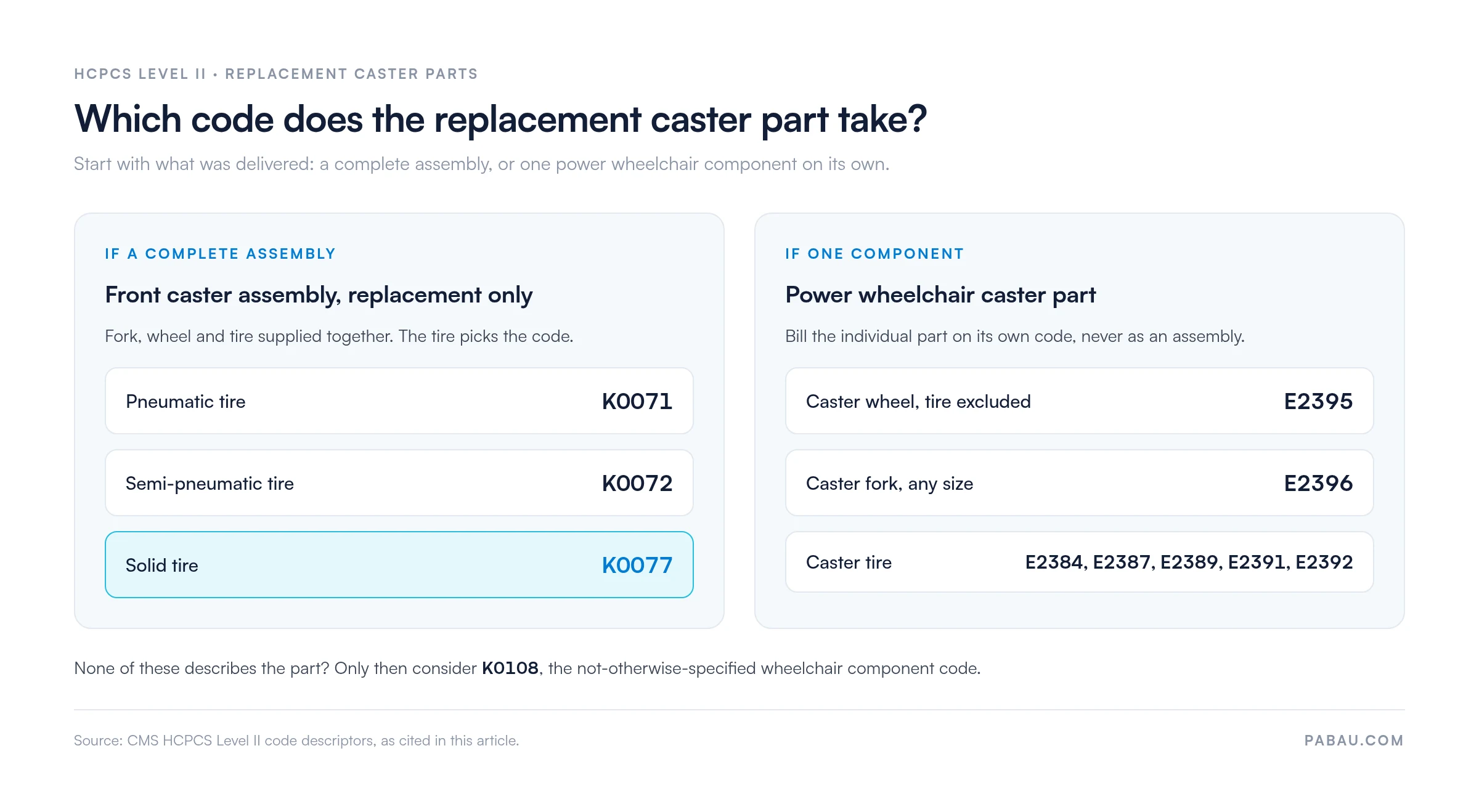
Two other codes come up in the same claims. K0017 is a detachable, adjustable height armrest base, replacement only, each, and it is unrelated to casters. K0108 is the not-otherwise-specified wheelchair component code, and it should not be used when K0071, K0072 or K0077 describes the part.
Medicare Part B covers K0077 as a DMEPOS item when the replacement is reasonable and necessary and the wheelchair itself is covered. The supplier must be enrolled, accredited and bonded as a DMEPOS supplier. Coverage follows the DME MAC wheelchair options and accessories policy for the beneficiary’s jurisdiction.
Four DME MAC jurisdictions handle these claims, and two contractors run them. Noridian Healthcare Solutions administers Jurisdictions A and D, and CGS Administrators administers Jurisdictions B and C.
Key conditions for K0077 coverage under Medicare:
A K0077 claim carries the diagnosis that explains why the beneficiary needs a wheelchair. The caster itself has no diagnosis of its own. Pick the most specific code the medical record supports, and list wheelchair dependence where the payer asks for it.
These are common examples, not a payer-approved list. Use the code that the treating practitioner documented, and code to the highest specificity the record allows.
K0077 documentation has to prove two things: why the caster needed replacing, and which caster was delivered. At minimum, the claim file should contain:
Auditors flag K0077 claims where the order is unsigned or undated, or where it describes a different part. Sound medical billing compliance checks catch an unsigned order or a mismatched part before the claim goes out.
Ask the technician to record the tire type and the caster size in the repair note, not only the part number. That one line settles K0071, K0072 or K0077 if an auditor asks months later which caster was delivered.
K0077 carries pricing indicator 32, which marks it as inexpensive or routinely purchased DME. That decides the pricing modifier. A missing or wrong modifier is one of the most common reasons a K0077 claim is rejected or adjusted.
BP, BR and BU are not normally required on K0077, because they apply to purchase or rental elections on capped rental items. Confirm each payer’s preference in the DME MAC supplier manual before you submit. The AAPC HCPCS code lookup lists descriptors and related codes.
K0077 is not on the Medicare Required Prior Authorization List for DMEPOS items under traditional Medicare. That list focuses on power mobility devices and other high-cost items. Prior authorization rules still vary by payer, so check each one before supplying the part.
Commercial payers and Medicaid managed care plans may require prior authorization for wheelchair parts, including K0077. Check the payer portal before delivery. A claim submitted without required prior authorization usually comes back with CARC CO-197.
Under the DMEPOS Competitive Bidding Program, check whether K0077 falls in a product category bid for the beneficiary’s area. Where it does, only a contract supplier can furnish it to Medicare beneficiaries there. Fee schedule amounts can also differ between bid and non-bid areas.
CMS publishes the DMEPOS fee schedule each year, with rates effective January 1 and quarterly updates. Medicare allows the lower of the billed charge or the fee schedule amount for the beneficiary’s state. Verify the current amount in the Medicare Informatics HCPCS fee schedule tables or the CMS DMEPOS fee schedule files before quoting a cost share.
Check the K0077 allowable for the beneficiary’s state before delivery. Knowing the amount up front lets you quote the 20% coinsurance and decide whether an ABN is warranted, without waiting for the remittance advice.
Accurate K0077 billing follows the same sequence every time. A slip at any step raises the risk of denial or recoupment. Review medical billing fundamentals if any step is unclear.
K0077 denials cluster around a few recurring problems. The reason code on the remittance advice points to the fix. Structured denial management workflows help you track and clear these patterns.
For appeals, the CARC denial codes reference matches each reason code to its appeal route. Pabau’s claims management software shows denial reason codes on the claim record, so billing staff act without switching between systems.
An Advance Beneficiary Notice of Noncoverage (ABN) is required when you expect Medicare to deny a K0077 claim as not reasonable and necessary. Give it to the beneficiary before the part is supplied, not after. Without a valid ABN, you cannot bill the beneficiary if Medicare denies payment.
Issue an ABN when the records do not clearly show that the caster needs replacing. Issue one too when the payer has denied a similar claim for this beneficiary before. Use form CMS-R-131 and keep a signed copy in the claim file.
Medicaid programs and commercial plans set their own rules for wheelchair repair parts, including prior authorization and quantity limits. Read the payer’s DME policy and code table before the first claim, and record the answer against the patient.
In many supplier offices, the order, the repair note and the claim live in three places. The billing team picks K0077, K0071 or K0072 from memory or a part number. When an auditor asks which tire was delivered, someone has to rebuild the answer from scattered files.
Pabau keeps those records on one patient file. The order, the delivery record and the claim sit together, and Pabau’s claims management software tracks the modifier on every line. Every Pabau subscription includes the full feature set, so documentation and billing share the same record.
The result is a claim that matches the part on the delivery record. Your team spends less time answering audit requests and resubmitting corrected claims.

Pabau’s claims management software tracks modifier requirements, links documentation to claims, and flags incomplete records before submission, so fewer K0077 claims come back denied.

K0077 is a narrow code, and most of its denials come from treating it as a broad one. It pays for one solid-tire front caster assembly as a replacement, nothing more. If the tire was pneumatic or semi-pneumatic, the claim belongs to K0071 or K0072. If only a fork or wheel was replaced, it belongs to a component code.
The suppliers who get paid first time record the tire type at delivery and price the line with NU, UE or RR. Pabau’s claims management software keeps that record and the claim together. Book a demo to see how it works for DMEPOS billing teams.

Need a denial resolution framework for DMEPOS claims? Denial management in healthcare covers the full appeal workflow from CARC code to corrected claim.
Unclear on how clearinghouse submission works for HCPCS codes? Medical billing fundamentals explains the end-to-end claim lifecycle for DME suppliers.
Looking for a reference on billing compliance documentation? Medical billing compliance outlines the documentation standards Medicare auditors check on DMEPOS claims.
Billing a semi-pneumatic caster instead? HCPCS code K0072 covers the semi-pneumatic front caster assembly, with its own modifiers and documentation.
Filing the claim on paper? The CMS-1500 form template explains each field on the paper claim form.
HCPCS code K0077 covers a complete front caster assembly with a solid tire, replacement only, billed per caster. Complete means the fork, wheel and solid tire are supplied together as one unit. The code is not billed when the caster comes with a new wheelchair, because the base code already includes it.
K0077 is an inexpensive or routinely purchased item. The usual modifiers are NU for a new part, UE for a used part or RR for a rental. Some payers accept RB for a part supplied as part of a repair. CR applies only to disaster-related claims, and EY flags an item supplied without a practitioner order. BP, BR and BU are not normally required on K0077.
The Medicare allowable for K0077 comes from the annual CMS DMEPOS fee schedule. It varies by state and by whether the beneficiary lives in a Competitive Bidding Area (CBA). Medicare pays 80% of the lower of the billed charge or the allowable after the Part B deductible. Verify the current amount in the CMS fee schedule files or the Medicare Informatics HCPCS tables before billing.
All three codes describe a complete front caster assembly, replacement only, billed per caster. The tire is the only difference: K0071 has a pneumatic tire, K0072 a semi-pneumatic tire and K0077 a solid tire. Bill the code that matches the tire on the delivered part, and keep the product detail in the claim file to prove it.
Issue an Advance Beneficiary Notice (ABN) before delivery when you expect Medicare to deny the K0077 claim as not reasonable and necessary. Typical cases are a replacement that the records do not justify, or a caster replaced sooner than the wear history supports. Use form CMS-R-131 and have the beneficiary sign it before the part is supplied.
Common causes are a missing or wrong pricing modifier and a code that does not match the tire on the delivered part. Thin records that do not show why the caster needed replacing are the third. Fix a modifier error with a corrected claim using frequency code 7. Correct a tire-type mismatch to K0071 or K0072 where that part was supplied. Appeal a medical necessity denial with the order, the repair notes and the proof of delivery.