CPT code 65205: Conjunctival foreign body removal
CPT code 65205 covers superficial conjunctival foreign bodies only CPT code 6520...

Last Updated: Oct 22, 2026
52284 is the CPT code for drug-coated balloon dilation of a male urethral stricture or stenosis during cystourethroscopy, with fluoroscopy included when performed. The code applies to male patients only and took effect on January 1, 2024, replacing Category III code 0499T.
The operative note must name the drug-coated device, such as the Optilume paclitaxel-coated balloon. A note that only says dilation lets payers downcode the claim to 52281, the uncoated equivalent used in male and female patients.
Let Pabau's smart automation suggest the right codes, reduce claim denials, and keep your practice compliant—effortlessly.
Automate repetitive tasks and focus on what matters most—your patients.
Reduce coding errors and ensure compliance with the latest regulations.
Clean claims, fewer denials, and faster reimbursements.
Powerful insights and reporting to help your practice thrive.
HIPAA compliant SOC 2 certified GDPR-compliant Trusted by 4,000+ clinics worldwide

CPT 52284 reports cystourethroscopy with drug-coated balloon dilation of a male urethral stricture, with fluoroscopy included when performed.
It became a Category I code on January 1, 2024, replacing Category III code 0499T, while uncoated dilation stays with 52281.
The operative note must name the drug-coated device, such as the Optilume balloon, or the claim can be downcoded to 52281.
The 2026 office rate is about $2,683 because its practice expense carries the device, against about $146 in a hospital or ASC.
Pabau’s claims management software submits 52284 claims through Claim.MD, checks eligibility, posts ERAs, and flags denied claims for rework.
CPT Code 52284 is the procedure code for drug-coated balloon (DCB) dilation of a male urethral stricture during cystourethroscopy. Its official AMA descriptor reads:
Cystourethroscopy, with mechanical urethral dilation and urethral therapeutic drug delivery by drug-coated balloon catheter for urethral stricture or stenosis, male, including fluoroscopy, when performed.
It is a Category I code, effective January 1, 2024. It replaced Category III code 0499T, which practices used for the same procedure before then.
The code sits within the Urinary System section of the CPT code set, under Transurethral Surgery, Urethra and Bladder (52204-52318). It is a surgical endoscopy code with a 0-day Medicare global period. The diagnostic cystourethroscopy is bundled into it and isn’t billed separately on the same date.
Two limits sit in the descriptor itself. Fluoroscopy is included when performed, so you don’t report it separately. And 52284 applies to male patients only, so female urethral stricture dilation stays with 52281.
The word “drug-coated” in the descriptor is the operative distinction. A balloon without a pharmacologic coating is a different procedure and maps to a different code. Payers use that distinction to adjudicate claims, so the operative note must reflect it.
The most common coding error on Optilume procedures is billing CPT 52281 instead of CPT Code 52284. The two codes share the cystourethroscopy component, but the device, the patient population, and the RVUs differ.
According to the AMA’s CPT code set overview, each CPT code carries a distinct descriptor for the service performed. Billing 52281 for an Optilume procedure misrepresents the service, whatever the intent, and can trigger payer audits or recoupment. 52281 remains the right code for uncoated dilation in male and female patients.
CPT Code 52284 claims require a supporting ICD-10-CM diagnosis code that confirms urethral stricture. Payers cross-reference the procedure code against the diagnosis code to verify medical necessity. A generic or imprecise pairing increases the risk of a medical necessity denial.
N35.8 and N35.9 are non-billable parent categories, so a claim carrying either one is rejected. The least specific valid code for a male stricture is N35.919. Some Medicare Advantage and commercial plans flag unspecified stricture codes for review on a higher-paying procedure like 52284. Document the cause and site of the stricture to support a more specific code.
Medicare payment for CPT Code 52284 is published in the CMS Physician Fee Schedule lookup tool, as facility and non-facility national unadjusted rates. Your MAC adjusts them by the Geographic Practice Cost Index (GPCI), and they change each January 1.
For 2026, 52284 carries 4.37 total facility RVUs, about $146 nationally at the $33.4009 conversion factor. In an office it carries 80.32 RVUs, about $2,683. Qualifying APM participants use a slightly higher $33.5675 factor.
Almost all of that difference is practice expense: 76.91 non-facility RVUs against 0.96 in a facility. The non-facility practice expense is what pays for the drug-coated balloon when the urologist performs 52284 in the office. The chart below sets those figures against 52281.
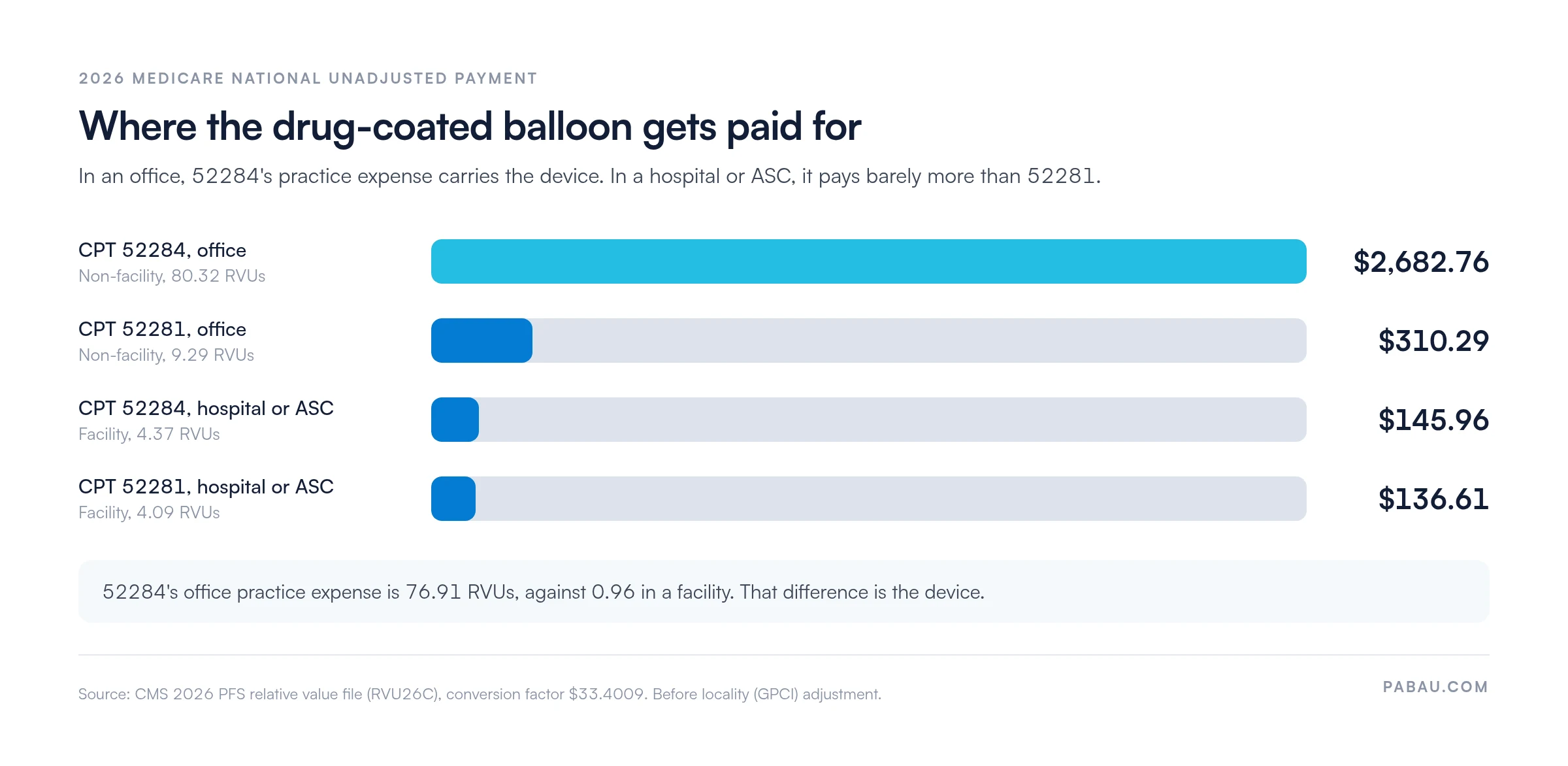
These are national figures from the CMS 2026 relative value file. Check your locality’s adjusted rate in the CMS lookup tool before you quote a payment to a facility or a patient.
CPT Code 52284 is often performed in a hospital outpatient department (POS 22) or an ambulatory surgery center (POS 24). Both are facility settings for Medicare purposes. The place of service decides which RVU set pays the physician, and who pays for the device.
In ASC and hospital settings, the Optilume device is a facility expense and isn’t billable by the physician. In an office, the non-facility rate already covers it, so there is no separate device charge either. Confirm any pass-through or C-code status with the facility before assuming separate device billing is allowed.
Traditional Medicare Part B does not require prior authorization for CPT Code 52284 as a standard rule. Your Medicare Administrative Contractor (MAC) may still set coverage conditions through a local coverage determination (LCD). One common condition is documented failure of conservative treatment before DCB dilation counts as medically necessary.
Medicare Advantage plans and commercial insurers frequently require prior authorization. Meeting billing compliance requirements means submitting the right clinical documentation at the PA stage, not just at the claim stage.
Typical documentation required for a PA request:
Payers expect the operative note to contain specific elements before adjudicating CPT Code 52284. Writing “urethral dilation performed” without naming the drug-coated balloon is the single most common documentation failure on these claims. It gives the reviewer grounds to deny or downcode to 52281.
A compliant operative note for 52284 should include all of these elements. An op-note template with a required field for each one cuts omissions at the point of dictation.
Practices can verify whether their notes meet clean claim submission standards before billing by auditing a sample of operative notes against this checklist quarterly.
Run a monthly audit on your 52284 operative notes. Pull 5 random cases and check each one against the documentation checklist above. If any note omits the device name or balloon dwell time, retrain the dictating provider before those notes trigger a payer audit.
Most denials on CPT Code 52284 fall into a predictable set of categories. Robust denial management workflows catch these before they age into write-offs.
Each denial arrives with a claim adjustment reason code on the remittance. Match that code to the fix above, and use our guide to decode denial codes faster when one is unfamiliar.
Modifier selection for CPT Code 52284 depends on the clinical scenario and payer rules. A wrong modifier triggers claim edits, and a missing one delays payment.
Modifier -50 (bilateral) is not applicable to urethral procedures. The LT/RT laterality modifiers are likewise not standard for urethral codes. Applying them without payer-specific guidance can cause claim rejections.
Because CPT Code 52284 is a surgical endoscopy, it includes the diagnostic cystourethroscopy by definition. Billing the diagnostic cystoscopy, CPT 52000, on the same date triggers a National Correct Coding Initiative (NCCI) edit. The same goes for CPT 52351, diagnostic ureteroscopy.
NCCI edits update quarterly, so check the current CMS NCCI edit files before billing any co-procedure with 52284.
Verify current NCCI edits for 52284 quarterly at the CMS NCCI files page. Older billing system rule sets don’t pick up new code and modifier pairs on their own. An outdated NCCI table causes denials that only surface at the remittance stage.
Without one system, a 52284 claim often moves from the operative note to a separate clearinghouse portal, then to a spreadsheet of open denials. Each handoff is another chance for the device name or a billable diagnosis to drop off the claim.
Pabau, the practice management platform we build, connects to the Claim.MD clearinghouse for US practices. With its time-saving claims management, your team checks eligibility before the procedure date and submits the claim to thousands of US payers.
Once a claim is out, status tracking shows where it sits, and ERA posting brings each remittance back against it. Denied claims are flagged for rework, so a downcoded 52284 surfaces while there is still time to appeal with the operative note.

Pabau connects to the Claim.MD clearinghouse, so your team can check eligibility, submit 52284 claims, post ERAs, and rework denied claims in one place.

CPT Code 52284 pays for what 52281 doesn’t: the drug-coated balloon, and in an office, the device itself. That makes the setting a business decision as much as a clinical one.
In a hospital or ASC, the facility absorbs the device and you earn about $146. In your own office, the rate rises to about $2,683, but the practice buys the balloon and carries the coverage risk. Check each payer’s policy before you move the procedure in-house.
Whichever setting you choose, the claim stands on the operative note. Name the device, record the dwell time and stricture site, and pair a billable male N35 code. Book a demo to see how Pabau tracks those claims from submission to payment.

Billing an uncoated dilation instead? CPT code 52281 billing guide covers calibration and dilation of urethral strictures in male and female patients.
Need to understand how claims flow from procedure to payment? Revenue cycle management explained covers the end-to-end billing journey for urology and specialty practices.
Billing urethral procedures alongside endoscopic codes? How 837 electronic claim files work explains the transaction format that carries your 52284 claims to payers and clearinghouses.
Looking for a structured approach to denial prevention? Medical billing denial codes reference maps the most common CARC codes that appear on 52284 remittances.
Need payer approval before a DCB procedure? The prior authorization process walks through each step from request to decision.
CPT code 52284 is the procedure code for cystourethroscopy with dilation of a male urethral stricture using a drug-coated balloon, with fluoroscopy included when performed. It took effect on January 1, 2024, replacing Category III code 0499T. The drug-coated balloon, typically the Optilume paclitaxel-coated device, is what separates it from 52281.
Traditional Medicare Part B does not require prior authorization for CPT 52284 as a universal rule, though your MAC’s LCD may impose coverage conditions. Medicare Advantage plans and most commercial insurers do require PA. Submit documentation of the confirmed stricture, prior treatment failure, and the clinical rationale for using a drug-coated balloon device when requesting authorization.
No. In a hospital or ASC, the device is a facility cost covered by the facility’s own claim. In an office, the non-facility rate’s 76.91 practice expense RVUs already pay for it, so there is no separate device charge. Confirm any pass-through or C-code status with the facility’s billing team before billing the device separately.
Use the most specific billable ICD-10-CM code for the documented male urethral stricture. N35.010-N35.016 are post-traumatic, N35.111-N35.119 post-infective, N35.81x other, and N35.91x unspecified. Avoid N35.919 (or a site-specific N35.91x) when the cause and site are documented, since unspecified codes may prompt extra payer review on 52284.