HCPCS Code L0472: Hyperextension TLSO billing guide
HCPCS code L0472: Official descriptor and device definition HCPCS code L0472 des...

Last Updated: Nov 5, 2026
23474 is the CPT code for revising a total shoulder arthroplasty when both the humeral and glenoid components are revised, including allograft when performed.
Its sister code 23473 covers the same revision when only one component is revised. The operative report decides between them, and both carry a 90-day global period.
Let Pabau's smart automation suggest the right codes, reduce claim denials, and keep your practice compliant—effortlessly.
Automate repetitive tasks and focus on what matters most—your patients.
Reduce coding errors and ensure compliance with the latest regulations.
Clean claims, fewer denials, and faster reimbursements.
Powerful insights and reporting to help your practice thrive.
HIPAA compliant SOC 2 certified GDPR-compliant Trusted by 4,000+ clinics worldwide

CPT code 23474 covers revision of a total shoulder arthroplasty when both the humeral and the glenoid component are revised, including allograft when performed.
Its sister code 23473 covers the same revision when only one component, humeral or glenoid, is revised. The component count is the whole distinction.
CPT 23472 is the primary total shoulder arthroplasty, not a revision code, so it never competes with 23474 on a revision claim.
23474 carries 26.53 work RVUs and a 90-day global period, so routine follow-up is bundled and unrelated E&M visits need modifier 24.
Pabau, the practice management platform we build, turns the invoice into a claim and tracks it through Claim.MD. The billed code then matches the operative note.
CPT code 23474 reports revision of a failed total shoulder arthroplasty. It applies when the surgeon revises both the humeral and the glenoid component in the same session. Allograft is included when it is performed, so it is not billed on its own line.
Common reasons for revision include component loosening, instability, periprosthetic infection, mechanical failure, and wear. The procedure is a major surgical service on the Medicare Physician Fee Schedule (MPFS). The American Medical Association (AMA) publishes the official descriptor below.
A typical revision runs in four phases. The surgeon removes the failed components and manages the bone bed, including cement removal and grafting. Trial components come next, then final implant insertion and stability testing. The bundled work includes:
The coding decision on a revision shoulder claim is 23473 against 23474. Both codes share the same descriptor up to the semicolon. The only difference is whether one component or both were revised.
The operative report must name each component that was removed and replaced. If the glenoid component stays in place and only the humeral side is revised, 23473 is correct. The same applies when only the glenoid is revised.
When both components are exchanged, 23474 applies. Never choose between the two codes on operative time or difficulty alone. Extra work beyond the typical case belongs to modifier 22, not to a code change.
Bundling rules on a revision shoulder claim decide what goes on the claim and what stays off it. The table below summarizes what is included and what may be reported separately.
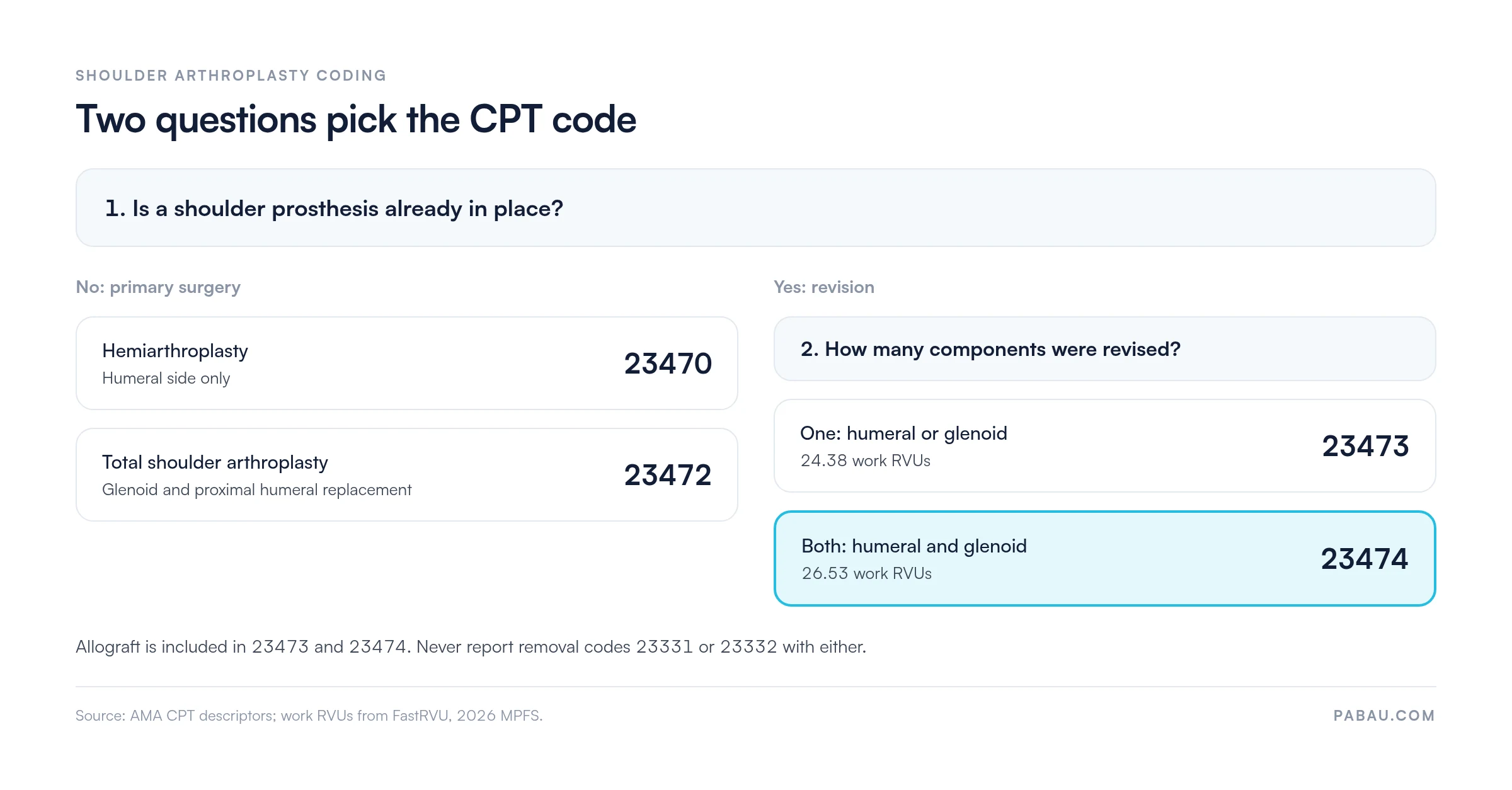
23474 sits in a small family of shoulder arthroplasty codes. Two cover primary surgery and two cover revision, so the first question is whether a prosthesis is already in place.
Because 23472 describes a first-time replacement, it has no place on a revision claim. A revision is coded 23473 or 23474, depending on how many components the surgeon exchanged. The decision path below puts both questions in the order a coder asks them.
The diagnoses that support 23474 come mainly from ICD-10-CM category T84, complications of internal orthopedic prosthetic devices. ICD-10-CM has no shoulder-specific T84 codes, so a shoulder prosthesis is reported under the “other” joint subcodes.
The 7th character matters. Use A for the initial encounter, D for subsequent encounters, and S for sequela. Because the T84 codes carry no side, report laterality on the CPT line with modifier RT or LT.
Verify each selection against the CDC/NCHS ICD-10-CM browser tool for the current fiscal year before billing. A non-specific shoulder pain code should never be the primary diagnosis on a revision claim.
Modifier choice on a 23474 claim affects both payment and audit risk. The table below covers the modifiers that apply most often to revision shoulder arthroplasty.
Medicare pays CPT code 23474 through the MPFS. Relative Value Units are multiplied by the annual conversion factor, then adjusted by Geographic Practice Cost Indices for your locality. Check current figures in the CMS Physician Fee Schedule Look-Up Tool before quoting a rate.
The FastRVU 2026 RVU lookup tool shows work, practice expense, and malpractice RVUs for 23474 in one view. Multiply the total RVU by the annual conversion factor to estimate the national payment before geographic adjustment.
Run the locality-adjusted Medicare rate before you quote expected reimbursement to the surgeon. Pick your MAC locality in the CMS look-up tool and confirm the place of service, because facility and non-facility rates differ.
CPT code 23474 carries a 90-day global surgical period. Routine post-operative care by the operating surgeon, from the day of surgery through day 90, is bundled into the procedure payment.
What is bundled during the global period:
What may be billed separately during the global period:
Revision claims draw closer payer review than primary arthroplasty claims. The record has to prove that the prosthesis failed and that both components were revised.
The operative report decides between 23473 and 23474, so it carries the most weight on the claim. “Shoulder replacement revised” is not enough. The report should name both components, the implant system, the explant technique, and the extent of bone loss.
Submitting a clean claim for a revision starts with a detailed operative report dictated on the day of surgery.
Prior authorization for CPT code 23474 varies by payer. Most commercial plans require it for revision shoulder arthroplasty, and Medicare Advantage plans may set their own rules. Confirm the requirement with each payer before you schedule surgery.
Typical commercial payer criteria for approval include:
For Original Medicare, check your MAC for any Local Coverage Determination that applies to shoulder arthroplasty. Pairing insurance eligibility verification with an authorization check before surgery prevents the costliest denials. Those are the ones where authorization was never obtained.
Most denials on revision shoulder claims trace back to six fixable errors, listed in the table below. Denial management workflows that catch these before submission save weeks of rework.
When a 23474 claim is denied, start with the common denial codes on the remittance advice. Claim Adjustment Reason Codes 4, 5, 50, 96, and 197 are common on surgical claims. Each one points to a specific fix before you appeal.
In many practices, the component count makes two trips. The surgeon writes it into the operative note, and a biller later reads that note and picks between 23473 and 23474. Every ambiguous line becomes a judgment call days after surgery.
Pabau shortens that trip. Its claims management software builds each claim from the invoice you already raised. US practices check eligibility and send claims to thousands of payers through Claim.MD, Pabau’s US clearinghouse partner.
Claim statuses update from the payer, and electronic remittance advice comes back into Pabau against the claim it settles. Denied claims are flagged for rework, so a 23473 or 23474 correction is not lost in a portal. For wider context, see our guide to medical billing workflows.

Pabau turns your invoices into insurance claims, checks eligibility through Claim.MD, and matches remittances back to each claim. The code on a 23474 claim stays tied to the record behind it.

CPT code 23474 is easy to define and easy to misapply. Primary surgery codes such as 23472 never appear on a revision claim, so the only live decision is how many components the surgeon exchanged.
Make the operative report answer that question in plain words, and the code follows. Leave it vague, and you either underbill a full revision as 23473 or invite a downcode on 23474. The other costly denial is a missing prior authorization, so lock it in before the surgery date.
Book a demo to see how Pabau carries revision shoulder claims from invoice to remittance for orthopedic practices.

Need a clearinghouse for orthopedic claims? Medical claims clearinghouse guide explains how clearinghouses route 837P claims and process ERA responses for surgical procedures.
Struggling with remittance reconciliation after revision surgery? Electronic remittance advice (ERA) covers how 835 transaction files work and how to match payments to claims automatically.
Want to reduce denials across your surgical claims? Claim.MD clearinghouse overview details the payer connections, real-time eligibility checks, and denial reporting available through Pabau’s US clearinghouse integration.
CPT code 23474 covers revision of a total shoulder arthroplasty when both the humeral and the glenoid component are revised. Allograft is included when performed. It applies when an implanted shoulder prosthesis has failed through loosening, infection, instability, wear, or mechanical failure.
Both codes report revision of a total shoulder arthroplasty, including allograft when performed. CPT 23473 covers revision of one component, humeral or glenoid. CPT 23474 covers revision of both the humeral and the glenoid component. The operative report decides which one applies.
No. CPT 23472 is the primary total shoulder arthroplasty, with glenoid and proximal humeral replacement. It describes a first-time replacement, so it is not used on a revision claim. Revisions are reported with 23473 or 23474.
CPT code 23474 carries a 90-day global surgical period. Routine post-operative visits by the operating surgeon are bundled into it. Use modifier 24 to bill an E&M service for an unrelated condition, with that diagnosis clearly documented.
CPT 23474 carries 26.53 work RVUs on the 2026 MPFS, according to FastRVU. CPT 23473 carries 24.38. Rates are listed for facility and non-facility settings, so confirm yours on the MPFS for your locality.
It depends on the payer. Most commercial health plans require prior authorization for revision shoulder arthroplasty, and Medicare Advantage plans may set their own rules. Confirm the requirement with the specific payer before scheduling surgery.
Most supporting diagnoses come from T84, under the “other” joint subcodes: T84.018, T84.028, T84.038, T84.098, and T84.59X. Periprosthetic fracture is reported with M97.31XA or M97.32XA. Avoid a non-specific shoulder pain code as the primary diagnosis.
No. A CPT note says not to report 23331 or 23332 with 23473 or 23474. Removing the failed components is part of the revision, so it is not billed on its own line.