HCPCS Code L0472: Hyperextension TLSO billing guide
HCPCS code L0472: Official descriptor and device definition HCPCS code L0472 des...

Last Updated: Nov 5, 2026
K0603 is the HCPCS Level II code for a 1.5 volt alkaline replacement battery for an external infusion pump the patient owns. Medicare does not pay it separately when the pump is rented, so confirm ownership before billing. The rest of the K0601–K0605 series covers silver oxide and lithium batteries at other voltages.
Let Pabau's smart automation suggest the right codes, reduce claim denials, and keep your practice compliant—effortlessly.
Automate repetitive tasks and focus on what matters most—your patients.
Reduce coding errors and ensure compliance with the latest regulations.
Clean claims, fewer denials, and faster reimbursements.
Powerful insights and reporting to help your practice thrive.
HIPAA compliant SOC 2 certified GDPR-compliant Trusted by 4,000+ clinics worldwide

K0603 is billed per battery, for a 1.5 volt alkaline replacement battery in an external infusion pump the patient owns.
Batteries coded K0601 to K0605 are not separately payable when billed with a rented infusion pump, so confirm ownership before you dispense.
Add the KX modifier when every LCD L33794 criterion is met, or GA or GZ when one is not. Lines without one of them are rejected.
KH, KI, KJ and KR are capped-rental modifiers for the pump itself and never apply to a K0603 battery.
A standard written order (SWO), proof of pump ownership and signed proof of delivery must all be on file before the claim goes out.
HCPCS code K0603 is a Level II K code maintained by the Centers for Medicare and Medicaid Services (CMS) for DME supply billing. K codes are temporary HCPCS Level II codes that CMS assigns for the DME Medicare Administrative Contractors (DME MACs). K0603 is one of five infusion pump battery codes, K0601 to K0605, each tied to one chemistry and voltage.
The code pays for one battery and no other item. Accurate medical billing for DME starts with matching the item supplied to the exact descriptor. The table sets out the attributes that decide a K0603 claim.
The official CMS descriptor for K0603 is “Replacement battery for external infusion pump owned by patient, alkaline, 1.5 volt, each.” Each part of that wording narrows when the code can be billed.
K0603 applies when all of the following are true:
K0603 does not apply in these cases:
K0603 is often confused with the pump codes it supports and with the other battery codes beside it. The AAPC HCPCS code lookup confirms each descriptor, and the table shows where each code differs from K0603.
Match the code to the battery the pump takes, not to the battery that happens to be in stock. A 1.5 volt alkaline cell is K0603, but a 1.5 volt silver oxide cell is K0601 and a 1.5 volt lithium cell is A4602. Check the pump manufacturer’s battery specification before you assign the code. Billing the wrong chemistry can lead to an overpayment demand on audit.
Medicare Part B covers K0603 as a supply for an external infusion pump that meets LCD L33794 (External Infusion Pumps). The billing rules sit in the companion Policy Article A52507. A K0603 claim pays only when all four of these conditions hold.
Medicaid coverage varies by state. Many state programs follow the Medicare criteria, but some keep their own supply lists or require prior authorization. Commercial plans vary as well, so verify benefits before you dispense.
Every K0603 line needs one of three modifiers. Policy Article A52507 tells suppliers to add KX to pump, drug and supply lines when every LCD criterion is met. When a criterion is not met, the line takes GA or GZ instead, depending on whether a valid Advance Beneficiary Notice (ABN) is on file.
Since March 1, 2023, the DME MACs reject external infusion pump lines that carry none of these modifiers. A rejected line is not denied, so it cannot be appealed. Correct the modifier and submit it again as a new claim.
KH, KI, KJ and KR do not belong on a K0603 claim. They are CMS capped-rental modifiers that mark the month of a rented item. KH marks the first rental month, KI months two and three, KJ months four to fifteen, and KR a partial rental month. A battery bought for a pump the patient owns has no rental month to report.
The modifier is the last of three checks that decide every K0603 line. Ownership and battery chemistry come first, in that order.
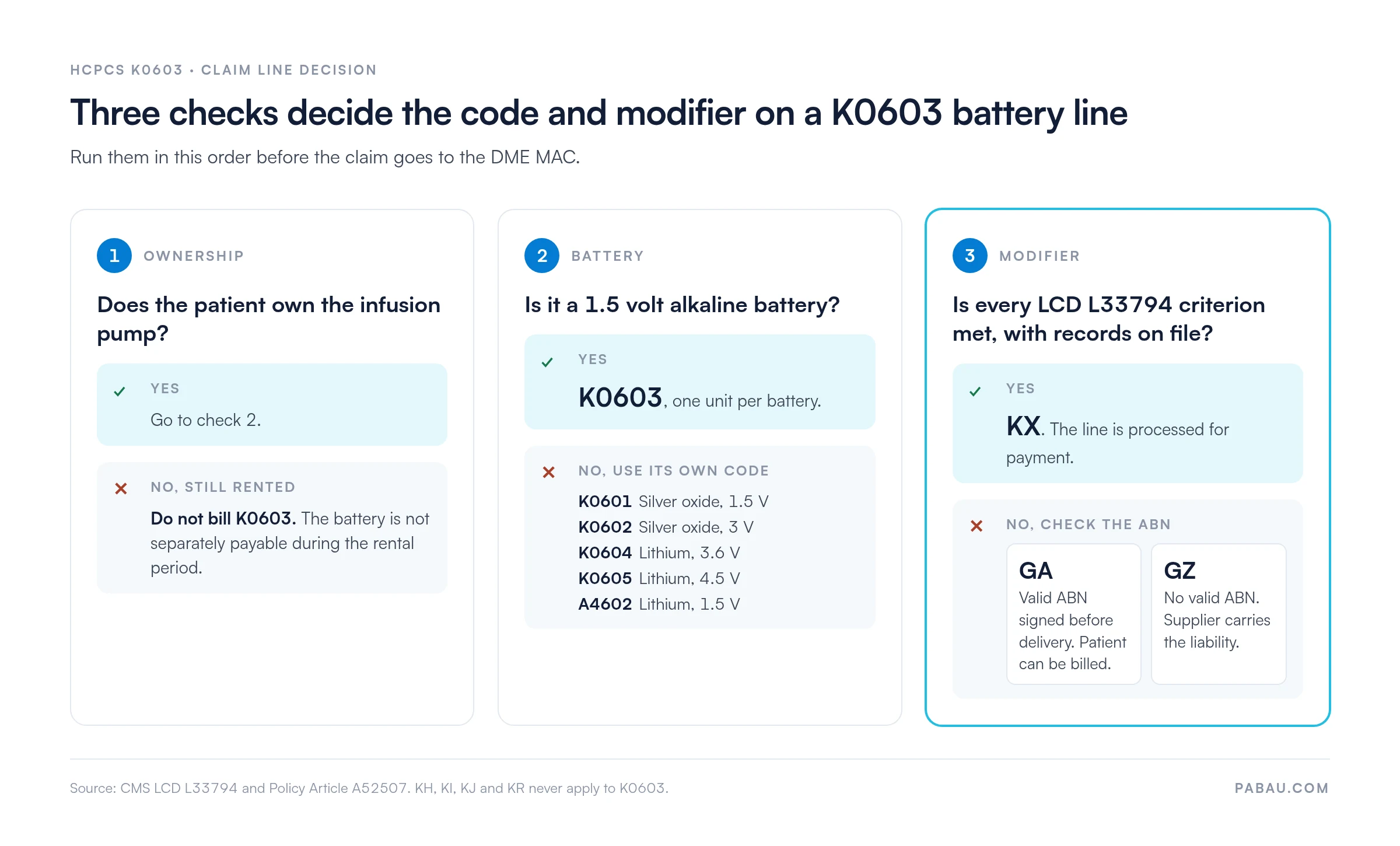
A clean claim for K0603 goes to the DME MAC for the patient’s state, on the 837P or the CMS-1500 form. Work through these steps in order.
Pabau, the practice management platform we build, includes claims management software for DME claim workflows. It scrubs each claim for missing or invalid details before submission and tracks its status from pending to paid. When a line is rejected, Pabau shows the reason so the team can correct and resubmit it.
Check three things on every K0603 line before it goes out. Confirm the pump is owned rather than rented, confirm the SWO predates delivery, and confirm the line carries KX, GA or GZ. Each check maps to a denial or rejection reason in the table further down.
A K0603 claim pays only when the records behind it hold up on review. Medicare’s medical billing compliance rules expect these records on file before the claim is submitted.
Never create an order after the battery has shipped. An order dated after delivery does not support the claim, and backdating one is a compliance breach.
Traditional Medicare does not list K0603 in its DMEPOS prior authorization program. That program focuses on higher-cost items such as power mobility devices and pressure-reducing support surfaces.
Other payers set their own rules, so check each one:
When a payer requires authorization, send the SWO, the qualifying diagnosis and the clinical notes that support the pump. Keep the approval in the patient’s record and report the authorization number on the claim.
Most failed K0603 claims trace back to the pump’s ownership status or the records behind the line. The denial management table below pairs each common cause with the fix.
A denied K0603 claim follows the standard five-level Medicare appeal process. The first two levels are redetermination by the DME MAC within 120 days, then reconsideration by a Qualified Independent Contractor within 180 days. After that come an Administrative Law Judge hearing, the Medicare Appeals Council and federal court. Most battery disputes resolve at the first or second level once the missing records are supplied.
HCPCS code K0603 is priced on the CMS DMEPOS fee schedule. CMS updates the allowed amounts each January, and they vary by the state where the patient lives. Billing from an old rate table is a common cause of payment errors for suppliers that serve several states.
Keep these reimbursement points in mind:
Because rates change each year, avoid fixing a dollar amount for K0603 in internal billing guides. Pull the current-year figure from the CMS file at the start of each year. Then update every battery code from K0601 through K0605 at once, as part of your revenue cycle management routine.
Pull the new DMEPOS fee schedule file each December and update the allowed amounts for every K0601 to K0605 code at once. Updating one battery code and missing its neighbors leaves the charge master out of step for a full year.
In many DME billing teams, the facts behind a battery claim live in different places. Ownership status sits in the billing history, the order in a scanned file, and proof of delivery with the courier. Someone has to pull them together before each claim, and a missing piece shows up as a denial weeks later.
Pabau brings that work into one workflow. Its claims management scrubs each claim for missing or invalid details before it leaves, then tracks it from pending to paid. When a line comes back rejected for a missing modifier, Pabau shows the reason and the team resubmits it from the same record.
The result is fewer battery lines rejected for a missing modifier or detail, and a clear view of which claims still need attention.

Pabau scrubs each DME claim before submission and tracks it from pending to paid. When a line is rejected, it shows why, so your team can resubmit it.

HCPCS code K0603 is a narrow supply code, and most of its billing errors trace back to two root causes. The first is billing against a rented pump, where the battery is not separately payable. The second is missing documentation or an unmet LCD criterion, which turns a KX line into a denial.
Both are settled before the claim is built. Confirm ownership, keep the SWO and proof of delivery on file, and add KX, GA or GZ to every line. A supplier that runs those checks on every battery claim spends far less time on appeals.
Book a demo to see how Pabau scrubs, tracks and resubmits DME claims for your billing team.

Need a full breakdown of medical billing compliance? Medical billing compliance covers HIPAA requirements, documentation standards, and audit-readiness for healthcare practices.
Confused about how clearinghouses handle DME claims? How medical claims clearinghouses work explains the 837P transmission process and how electronic claims reach payers.
Want to understand the full revenue cycle behind DME billing? Superbill in medical billing explains how charge capture connects to claim submission for outpatient and DME providers.
Supplying a 3 volt silver oxide cell instead? HCPCS code K0602 covers that battery for a pump the patient owns.
Billing the insulin pump itself? HCPCS code E0784 explains the device code for an external ambulatory insulin infusion pump.
HCPCS code K0603 covers one 1.5 volt alkaline replacement battery for an external infusion pump the patient owns. It is billed per battery as a DME supply. When the pump is rented, Medicare does not pay the battery separately.
Add KX to the K0603 line when every criterion in LCD L33794 is met and the documentation is on file. Add GA when a criterion is not met and a valid ABN is on file, or GZ when it is not. KH, KI, KJ and KR do not apply, because they are capped-rental modifiers for the pump.
No. Policy Article A52507 states that K0601 to K0605 batteries are not separately payable when billed with a rented infusion pump. Battery replacement during the rental period is covered by the rental payment. Bill K0603 only once the patient owns the pump.
Traditional Medicare does not list K0603 in its DMEPOS prior authorization program. Medicaid programs and Medicare Advantage plans may require it, so check with the plan before you dispense infusion pump supplies.
You need a standard written order (SWO), proof that the patient owns the pump, and signed proof of delivery. The medical record must also show the pump still meets LCD L33794. Where the LCD requires a written order before delivery, it must exist before the battery ships.
E0779 is the device code for a reusable mechanical infusion pump, while K0603 is a supply code for one battery. A battery-powered ambulatory pump is coded E0781. K0603 is billed when that pump is owned and needs a 1.5 volt alkaline replacement.
Bill one unit for each battery supplied. The quantity should match what the pump uses and what the order and delivery record show. Billing more units than the pump needs invites a medical review.