

HCPCS code E0198: Water pressure pad billing guide
HCPCS code E0198 is a water pad for a standard mattress HCPCS code E0198 is the ...

Last Updated: Oct 13, 2026
52234 is the CPT code for cystourethroscopy with fulguration (including cryosurgery or laser surgery) and/or resection of small bladder tumor(s). Small means a tumor of 0.5 cm up to 2.0 cm.
Its neighbors split the same procedure by size. 52224 covers minor lesions under 0.5 cm, with or without biopsy. 52235 covers medium tumors of 2.0 to 5.0 cm, and 52240 covers tumors over 5.0 cm. Report one code per session for the largest tumor, with its size stated in the operative note.
Let Pabau's smart automation suggest the right codes, reduce claim denials, and keep your practice compliant—effortlessly.
Automate repetitive tasks and focus on what matters most—your patients.
Reduce coding errors and ensure compliance with the latest regulations.
Clean claims, fewer denials, and faster reimbursements.
Powerful insights and reporting to help your practice thrive.
HIPAA compliant SOC 2 certified GDPR-compliant Trusted by 4,000+ clinics worldwide

CPT Code 52234 covers cystoscopy with fulguration and/or resection of small bladder tumors, which the AMA defines as 0.5 cm up to 2.0 cm.
Lesions under 0.5 cm go to 52224, medium tumors of 2.0 to 5.0 cm to 52235, and large tumors over 5.0 cm to 52240.
Report one code per session, based on the largest tumor, with its size stated in the operative note rather than taken from pathology.
The most common denial triggers are wrong size-tier selection, unbundling of 52000, and an operative note that gives no size in centimeters.
Pabau’s claims management software checks each 52234 claim for missing details, submits it through Claim.MD and shows its live status until payment.
CPT Code 52234 is defined by the American Medical Association as “Cystourethroscopy, with fulguration (including cryosurgery or laser surgery) and/or resection of; small bladder tumor(s).” The parenthetical clarification confirms that electrocautery, cryosurgery, and laser ablation all qualify as fulguration for purposes of this code. Resection is also covered, meaning the code applies whether the urologist destroys the lesion in place or removes it.
“Small” has a fixed meaning in this family. CPT Code 52234 covers a bladder tumor of 0.5 cm up to 2.0 cm, measured at its largest dimension in the operative note.
Per the AMA’s CPT code set, the code sits within the Urinary System section (50010-53899), specifically the endoscopy subsection for cystoscopy procedures. It is owned by the AMA and updated annually in the CPT codebook.
The urologist inserts a rigid or flexible cystoscope transurethrally and inspects the bladder mucosa. Once the tumor is identified, fulguration or resection destroys or removes it. Tissue usually goes to pathology during the same session, and the pathology code is billed separately.
The AMA splits cystoscopic fulguration and resection of bladder lesions into four size tiers. Selecting the wrong tier is the most frequent coding error in this family. Billing 52234 for a medium tumor leaves money unpaid. Billing 52235 without a documented size of at least 2.0 cm invites an audit.
Report one code per session, chosen by the largest tumor treated. The tiers are set in centimeters, so the operative note should record a measured or estimated size for each tumor.
Code the size from the surgeon’s note, not the pathology report, because resected tissue usually reaches the lab in fragments. The scale below shows where each boundary falls, with three worked examples.
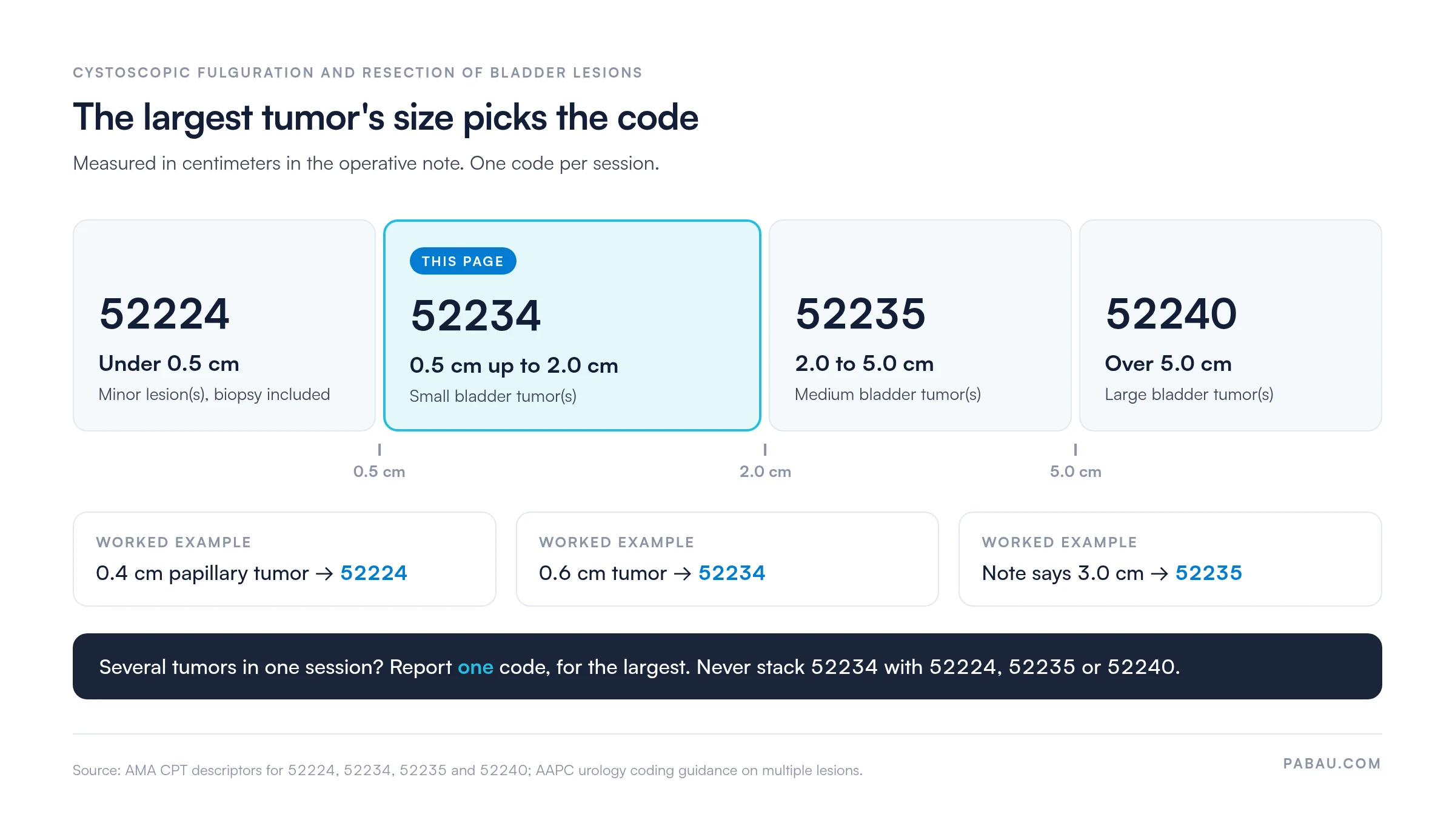
The difference between 52234 and 52224 is size. Both codes involve fulguration or resection during a cystoscopy, and a small tumor can fall under either one depending on how large it measures.
A 0.4 cm papillary tumor is reported with 52224, even though it is a neoplasm. A 0.6 cm tumor moves up to 52234. Because the line sits at 0.5 cm, the operative note needs a measurement in centimeters. A word like “small” or “minor” cannot place a tumor on either side of it.
AAPC’s “My Urology Coding Alert” guidance covers cystoscopies that treat multiple lesions in one session. Report a single code based on the largest lesion treated. Do not report CPT Code 52234 multiple times, and do not stack it with 52224, 52235 or 52240.
Modifier -22 (increased procedural complexity) may be appropriate when the number of lesions or their anatomical distribution creates substantially greater surgical effort. Payers require a written explanation and supporting operative documentation when -22 is appended. Even then, the extra payment is not automatic.
Payer claim processing matches the CPT procedure code against the diagnosis code for medical necessity. A generic or insufficiently specific ICD-10 code on a 52234 claim invites automatic review or denial.
Use the AAPC CPT-to-ICD-10 crosswalk to verify current medical necessity pairing for 52234. ICD-10-CM codes are updated every October, so confirm each code against the current fiscal-year release before submission.
The modifiers below are the ones most commonly encountered on 52234 claims. Applying the wrong modifier, or omitting one that a payer requires, generates either a denial or an audit flag.
Left/right modifiers (-LT/-RT) are not anatomically applicable to bladder procedures, as the bladder is a midline organ. Some payers have historically misconfigured their systems to require laterality on cystoscopy codes. If a payer rejects 52234 for missing laterality, contact its provider relations line instead of appending -LT or -RT.
When appending modifier -22 to CPT Code 52234, send a cover letter explaining what made the procedure substantially more complex before the claim processes. Waiting to respond to a denial is slower and requires an appeal. Most MACs accept a proactive narrative attachment with the original claim.
CPT Code 52234 carries a 0-day global surgical period per CMS Physician Fee Schedule data. Only services on the day of the procedure are bundled into its payment. Related visits from the next day onward are billed separately. Verify the global period for the current year using the CMS Physician Fee Schedule lookup, as global period assignments can change with annual PFS updates.
Medicare reimbursement for CPT Code 52234 is calculated from the Relative Value Unit (RVU) schedule updated annually by CMS. Rates vary by geographic practice cost index (GPCI) locality and are adjusted each January. The table below shows the component RVU breakdown. For current dollar amounts, use the FastRVU 2026 lookup tool or the CMS PFS search and enter your MAC locality.
Medicare fee-for-service does not currently require prior authorization for CPT Code 52234 in most MAC jurisdictions. Requirements vary by payer and change with plan updates. Commercial insurers and Medicare Advantage plans apply different rules.
For emergent cases where prior authorization cannot be obtained before the procedure, document the clinical urgency in the medical record. Most payers have an expedited or retrospective review process for urgent cystoscopy. Refer to your medical billing compliance protocols for handling retrospective authorization requests.
Most CPT Code 52234 denials fall into six categories. Each one can be prevented before the claim is submitted.
Track denials by reason code, so a 52234 rejected for size goes back to the coder and one rejected for bundling goes to the biller. Work each one within 30 days, so a corrected claim goes out well inside the payer’s appeal window.
A clean claim for this code carries the measured size, the matching tier and no separate 52000 line. Payers flag each missing element with its own denial codes, and the same few repeat across urology claims.
Run a monthly audit of all 52234 claims denied for ‘wrong procedure code.’ Pull the operative notes for those cases and check whether the documented lesion size actually supports the code billed. If the note says ‘3.0 cm tumor’ but 52234 was billed, the coder undercoded. Corrected claims with the right code (52235) can be resubmitted and often recover payment within 30 days.
The operative note is the foundation of every 52234 claim. Six specific elements must be present to support the code, defend it under audit, and satisfy payer medical necessity requirements.
The table below covers codes that appear in the same operative session or billing cycle as CPT Code 52234. Bundling status follows prevailing NCCI principles. Check the current NCCI edit table before each use, because the edits update quarterly. The pairing you will meet most is 52000, the diagnostic cystoscopy that 52234 already includes.
Practices that regularly bill 52234 alongside 52332 should use a superbill for cystoscopy encounters. It pre-populates the common code combinations and flags NCCI-sensitive pairings at the point of billing. The AAPC Codify CPT lookup provides bundling indicators and coding notes for each code in this family.
Most 52234 denials start before the claim leaves the practice. The operative note lacks a size, or the tier was picked from the surgical schedule. Pabau, the practice management and billing platform we build, keeps the operative note, the code and the claim in one patient record. Your coder reads the measured size in the same place they assign the tier.
Urology practices billing CPT Code 52234 submit claims through Pabau’s claims management software, which sends them to thousands of US payers via Claim.MD. Validation checks run in the background and catch missing details, such as an authorization code, before they become rejections.
Every claim then shows a live status, from pending and submitted to paid or error. ERA remittances post back into Pabau, so your billers can match each 52234 payment to its claim without re-keying it.

Pabau keeps the operative note, the CPT code and the claim in one record, then tracks each claim through Claim.MD to payment. Your coders see the measured size before they choose the tier.

CPT Code 52234 rewards a practice that measures before it codes. The size written in the operative note decides between 52224, 52234, 52235 and 52240, so a vague note costs more than any coding rule.
Build the measurement into your cystoscopy note template, code once per session from the largest tumor, and keep 52000 off the claim. Book a demo to see how Pabau helps urology billing teams submit 52234 claims that hold up on first review.

Need a framework for reducing claim rejections across your urology practice? Denial management in healthcare covers the end-to-end workflow for tracking, categorizing, and appealing denied claims efficiently.
Submitting claims electronically for the first time? Understanding the 837 file format explains how electronic claim files are structured and transmitted to payers and clearinghouses.
Want to verify remittance data against expected reimbursement? Electronic remittance advice (ERA) explains how 835 files work and how to reconcile payments against submitted claims.
Billing the anesthesia side of a TURBT? CPT code 00912 covers anesthesia for transurethral resection of bladder tumors and how it is reported.
Coding other cystoscopic bladder procedures? CPT code 52287 explains cystourethroscopy with injection for chemodenervation of the bladder.
CPT Code 52234 covers cystourethroscopy with fulguration and/or resection of small bladder tumor(s), meaning tumors of 0.5 cm up to 2.0 cm. Fulguration includes electrocautery, cryosurgery, and laser ablation. The code includes the cystoscopic examination, while pathology and anesthesia are billed separately.
The difference is tumor size. 52234 applies to small bladder tumors of 0.5 cm up to 2.0 cm, and 52235 applies to medium tumors of 2.0 to 5.0 cm. Both codes cover the same fulguration and/or resection technique. The size documented in the operative report decides which code is correct, and multiple tumors are coded once by the largest.
The difference is size. 52224 covers minor lesions under 0.5 cm, with or without biopsy, and that includes small tumors under 0.5 cm. CPT Code 52234 starts at 0.5 cm and covers tumors up to 2.0 cm. The operative note should state the measured size so the tier holds up on review.
CPT Code 52234 carries a 0-day global period per current CMS Physician Fee Schedule data. Same-day care is included in the payment, and related visits from the next day onward are billed separately. Verify the global period indicator in the current-year CMS PFS before billing, as assignments can change with annual updates.
Report a single code based on the largest tumor treated, per AAPC urology coding guidance. If every lesion is under 0.5 cm, bill 52224. If the largest is 0.5 cm up to 2.0 cm, bill 52234 once. A largest tumor of 2.0 to 5.0 cm moves the claim to 52235, and one over 5.0 cm moves it to 52240. Modifier -22 may apply when multi-lesion work far exceeds typical effort, supported by a written narrative.
CPT Code 52234 is one of the TURBT codes. Transurethral resection or fulguration of a bladder tumor is reported with 52234, 52235, or 52240, and the largest tumor’s documented size decides which one applies. 52234 covers 0.5 cm up to 2.0 cm, 52235 covers 2.0 to 5.0 cm, and 52240 covers tumors over 5.0 cm.



