CPT code 44625: Enterostomy closure with resection
CPT code 44625 needs three things in one operation CPT code 44625 reports an ope...

Last Updated: Oct 8, 2026
CPT Code 52287 is the procedure code for cystourethroscopy with injection(s) for chemodenervation of the bladder. A urologist reports it after injecting botulinum toxin through a cystoscope into the detrusor muscle. The two covered indications are overactive bladder and neurogenic detrusor overactivity.
Every claim also carries HCPCS J0585 for the drug itself. Medicare’s 2026 national average pays $363.74 in the office and $148.97 in a facility. Missing documentation of failed conservative therapy is the most common reason the claim is denied.
Below are the fee schedule, the ICD-10 pairings, the modifier rules, and the documentation checklist that keeps claims clean.

CPT Code 52287 covers cystourethroscopy with chemodenervation of the bladder by botulinum toxin injection, distinct from the head and neck codes 64615 and 64612.
J0585 (onabotulinumtoxinA, 1 unit) must be billed alongside CPT Code 52287 on every claim, and the units must match the documented dose.
Medicare requires documented failure of conservative therapy, meaning an anticholinergic or a beta-3 agonist, before the procedure counts as medically necessary.
The 2026 Medicare national average pays $363.74 in the office setting and $148.97 in a facility, on a work RVU of 3.12.
Practice management software like Pabau pairs the codes automatically and flags a missing diagnosis code before the claim is submitted.
CPT Code 52287 is a surgical procedure code in the Urethra and Bladder (Transurethral) section of the AMA CPT code set. The official descriptor reads: Cystourethroscopy, with injection(s) for chemodenervation of the bladder.
In clinical terms, the urologist passes a cystoscope through the urethra. Botulinum toxin is then injected into the detrusor muscle at several sites along the bladder wall. The toxin temporarily inhibits acetylcholine release at the neuromuscular junction, which reduces involuntary detrusor contractions.
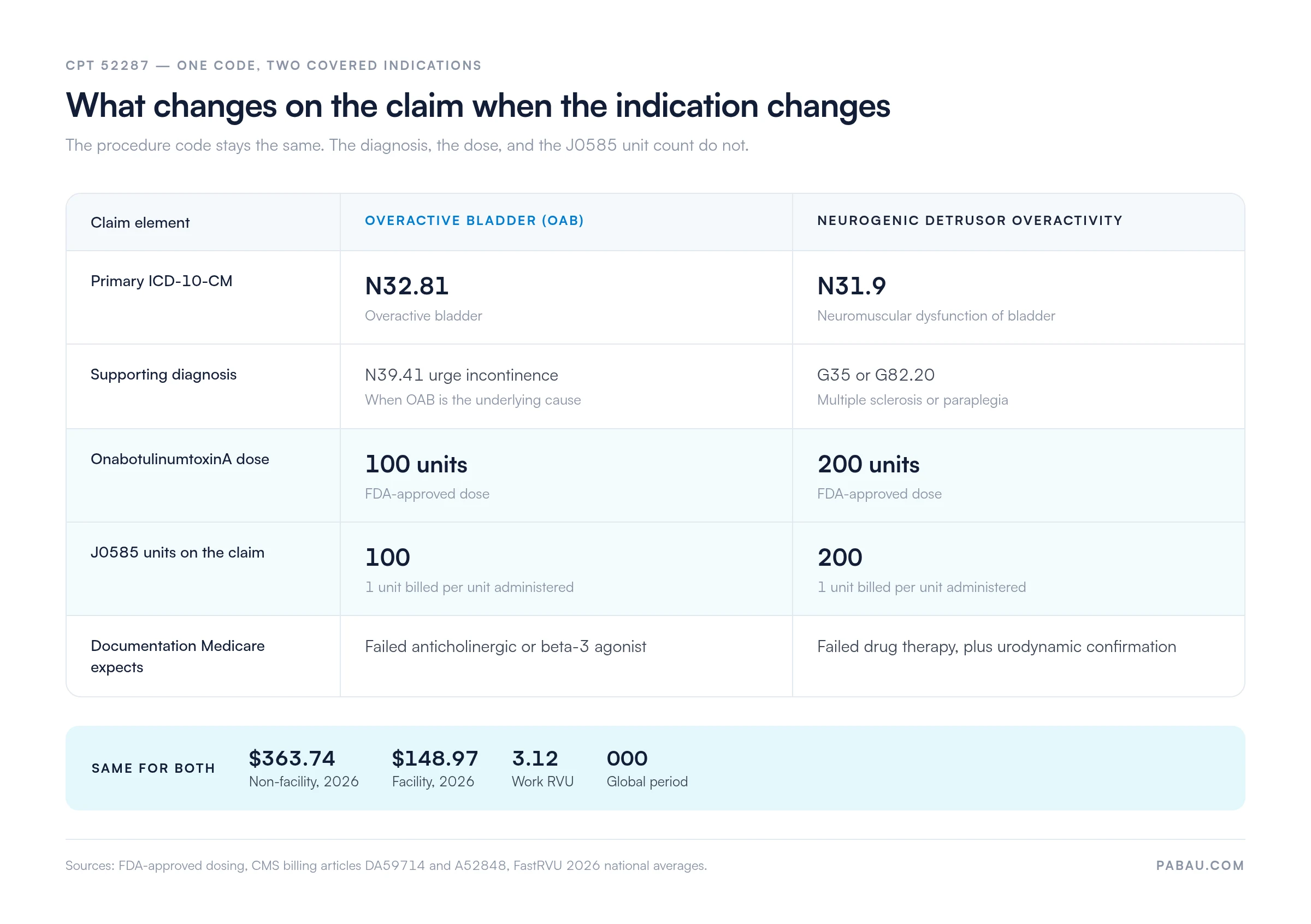
FDA-approved dosing is 100 units of onabotulinumtoxinA for overactive bladder (OAB). Neurogenic detrusor overactivity (NDO) caused by spinal cord injury or multiple sclerosis takes 200 units.
Every claim for CPT Code 52287 requires a supporting diagnosis code. Medicare’s coverage articles DA59714 and A52848 specify which ICD-10-CM codes satisfy medical necessity.
A non-listed code is one of the fastest routes to an automatic denial, so confirm the selection before submission rather than after. You can cross-reference pairings using the AAPC CPT-to-ICD-10 crosswalk or check a MAC’s LCD directly.
Off-label indications such as bladder pain syndrome and interstitial cystitis are not covered by Medicare under CPT Code 52287. Confirm the diagnosis sits on the covered list before the service date, not after the denial arrives.
J0585 is the HCPCS Level II drug code for onabotulinumtoxinA (Botox), billed at 1 unit per 1 unit of drug administered. It is reported on the same claim as CPT Code 52287. The quantity must match the exact dose documented in the operative note.
According to CMS HCPCS guidelines, J0585 is billed per unit administered rather than per vial purchased. Practices that bill for a full 200-unit vial when only 100 units were administered are creating a compliance exposure.
The diagnosis, the dose, and the J0585 unit count all move together with the indication. The comparison below lines both versions of the claim up side by side.
Practices that submit claims through Claim.MD, Pabau’s integrated US clearinghouse, can automate the pairing. J0585 is attached whenever 52287 is scheduled, so billing staff never have to check it by hand.
Medicare reimburses CPT Code 52287 under the Medicare Physician Fee Schedule (MPFS). The rates below are national averages, before any Geographic Practice Cost Index (GPCI) adjustment. Your payment varies by location, so check the CMS MPFS lookup tool for a location-specific figure.
Use the FastRVU 2026 RVU lookup to pull the Work, Practice Expense, and Malpractice RVU breakdown for 52287 at your own location. The place of service on the claim decides which of the two figures applies, so an incorrect POS changes what you are paid.
CMS assumes the practice carries the overhead in an office setting, so the non-facility rate is higher. In a facility, the hospital or ASC bills CMS separately for its own costs, and the physician payment drops to match.
When you decide where to perform bladder chemodenervation, weigh the whole reimbursement event rather than the physician line alone. Depending on your contract mix, one site of service may favor the practice over the other.
Modifier selection for CPT Code 52287 depends on the clinical circumstances. The wrong modifier is a common denial trigger, especially in bilateral or reduced-service scenarios. Verify modifier applicability against the current CMS MPFS modifier indicators before submitting.
Modifier 22 (increased procedural services) may fit when the documentation supports substantially greater effort than usual. Attach a detailed operative note every time you use it.
Run a pre-submission edit check on every 52287 claim. Confirm that the J0585 units match the administered dose. Check that the ICD-10 code sits on the MAC’s covered list, and that the place of service matches where the procedure happened. Those three checks catch the denial patterns this code attracts most often.
Medicare covers CPT Code 52287 for overactive bladder and neurogenic detrusor overactivity under CMS billing articles DA59714 and A52848. Local coverage determinations (LCDs) issued by Medicare Administrative Contractors govern the detail.
Always read your own MAC’s LCD, because what applies in one jurisdiction may not apply in another. Verifying the patient’s benefits before the procedure date confirms coverage under their specific plan.
CMS expects the following elements to establish medical necessity for CPT Code 52287. Missing any one of them is grounds for denial on audit or pre-payment review.
Some screening codes score the note by element count instead of clinical criteria. Medicare pays HCPCS code G0101 in full only when the record shows at least 7 of the 11 countable pelvic and breast exam elements.
Capture the diagnosis, the procedure code, the drug code, and the administered units before the patient leaves the facility. Building that step into the standard procedure checkout stops the billing team reconstructing the note days later.
Knowing the code family around CPT Code 52287 prevents both under-coding and over-coding. The table below covers the adjacent codes that urology and chemodenervation billing teams confuse most often.
A separate endoscopic procedure at the same encounter, such as a cystoscopy for biopsy, changes the coding. Modifier 59 on the secondary code may be necessary. Check the NCCI edits for that code pair before you submit.
These are the denial patterns urology billing teams hit most often on this code, drawn from CMS audit guidance and MAC LCD policy requirements.
Effective denial management for 52287 starts before the claim goes out. A pre-submission checklist inside the billing workflow catches most of these errors without a separate audit step. Tracking which reason codes recur also tells you whether the problem is systemic or a one-off.
Urology practices billing this code repeatedly hit the same friction. Someone attaches J0585 by hand, checks the ICD-10 against the MAC’s covered list, and hunts for the note proving conservative therapy failed. Every one of those steps is a manual touchpoint where errors compound.
Practice management software like Pabau handles those touchpoints in one system. Pabau’s claims management software lets you configure default code pairings. Every 52287 appointment then generates the J0585 line, with the unit quantity taken from the clinical note. Update the administered units in the patient record and the billing line updates with them.
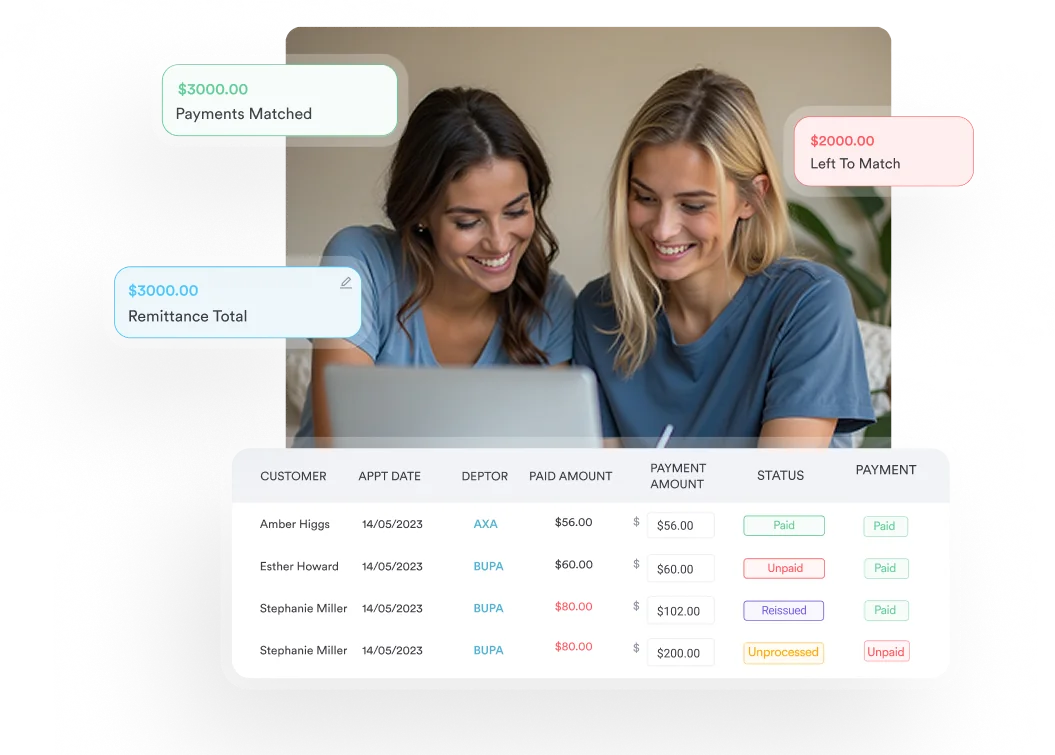
Documentation templates built around the CMS medical necessity checklist capture failed conservative therapy at the visit where it happens, not at the billing stage. Pabau also flags claims where the appointment’s place of service differs from the billing record, so POS mismatches surface before the 837 file is generated.

Pabau connects scheduling, clinical documentation, and claims management in one system, so urology teams spend less time chasing paperwork and more time with patients.

Two habits decide whether 52287 pays cleanly. Pair the drug code with the procedure at the point of care. Record the failed conservative therapy while the patient is still in front of you. Fix both upstream and the claim stops coming back.
The trade-off worth remembering is the site of service. The office rate is more than double the facility rate, but the practice absorbs the overhead that earns it. Model both before you move the procedure.
Book a demo to see how Pabau builds a 52287 claim, drug line included, straight from the urology operative note.

Need to understand how clearinghouse claim submission works end to end? Medical claims clearinghouse guide explains the full submission pathway from practice to payer.
Struggling with 837 file errors on urology claims? Electronic 837 claim file breaks down the format requirements and common rejection reasons.
Want to benchmark your denial rate against industry norms? Denial codes in medical billing covers the CARC and RARC codes you’ll see on remittances for procedure code denials.
Want the drug units captured before the patient leaves? What a superbill is shows which fields to capture at checkout so the claim builds itself.
Paid less than the fee schedule says you should be? Electronic remittance advice explains how to read the ERA and spot an underpayment early.
CPT Code 52287 reports cystourethroscopy with injection(s) for chemodenervation of the bladder. That means the transurethral injection of botulinum toxin into the detrusor muscle to treat overactive bladder or neurogenic detrusor overactivity. It is an endoscopic surgical procedure performed by urologists and billed alongside HCPCS J0585 for the drug cost.
Yes, Medicare covers CPT Code 52287 for the FDA-approved indications: overactive bladder (N32.81) and neurogenic detrusor overactivity related to spinal cord injury or multiple sclerosis. Coverage requires documented failure of conservative treatment, meaning an anticholinergic or a beta-3 agonist. Your MAC’s local coverage determination may impose further requirements beyond the national CMS articles DA59714 and A52848.
Yes, J0585 (onabotulinumtoxinA, 1 unit per unit of drug) must appear on the same claim as CPT Code 52287. Bill J0585 x 100 units for the OAB indication and x 200 units for neurogenic detrusor overactivity. The billed quantity must match the administered dose documented in the operative note, because overbilling unused units is a compliance violation.
Modifier 52 (reduced services) applies when fewer injection sites were used due to patient tolerance. Modifier 59 applies when 52287 is performed alongside a separate, distinct procedure on the same day. Modifier 51 goes on the secondary procedure when multiple procedures are billed together. Modifier 50 (bilateral) is not typically applicable to bladder chemodenervation, so confirm with your MAC before using it.
The non-facility (office) rate is higher for the physician, about $364 at the 2026 national average, because the practice absorbs the overhead. The facility rate for a hospital or ASC is about $149, because the facility bills CMS separately for its own costs. Total reimbursement into the system is similar, but the physician’s portion differs by site of service.
The primary ICD-10-CM codes used with CPT Code 52287 are N32.81 (overactive bladder), N31.9 (neuromuscular dysfunction of bladder), and N39.41 (urge incontinence). For neurogenic cases, G35 (multiple sclerosis) or G82.20 (paraplegia) may be added as secondary codes. Always verify the full covered-diagnosis list against your MAC’s LCD before service.