

CCSD code G5100: Bypass of duodenum billing guide
CCSD code G5100 bills a bypass that leaves the duodenum in place CCSD code G5100...

Last Updated: Oct 16, 2026
51600 is the CPT code for an injection procedure for cystography or voiding urethrocystography. A catheter is passed into the bladder and contrast is injected so the bladder, and often the urethra during voiding, can be imaged.
The code covers the injection, including the catheterization. The imaging is reported separately, with 74430 for cystography or 74455 for voiding urethrocystography. Therapeutic bladder instillations are not 51600. They are reported with 51700, or with 51720 for an anticarcinogenic agent.
Let Pabau's smart automation suggest the right codes, reduce claim denials, and keep your practice compliant—effortlessly.
Automate repetitive tasks and focus on what matters most—your patients.
Reduce coding errors and ensure compliance with the latest regulations.
Clean claims, fewer denials, and faster reimbursements.
Powerful insights and reporting to help your practice thrive.
HIPAA compliant SOC 2 certified GDPR-compliant Trusted by 4,000+ clinics worldwide

CPT code 51600 reports the contrast injection for cystography or voiding urethrocystography, and the bladder catheterization is part of it.
The imaging is billed separately, with 74430 for cystography and 74455 for a voiding cystourethrogram (VCUG).
Therapeutic bladder instillations such as mitomycin, DMSO or lidocaine are never 51600, so report them with 51700 or 51720 instead.
For CY2026, 51600 carries 6.21 non-facility and 1.12 facility total RVUs, with a 000-day global period.
Pair the code with an imaging indication, such as vesicoureteral reflux (N13.7-), recurrent UTI, bladder injury (S37.2-) or urinary retention.
CPT Code 51600 is defined by the American Medical Association (AMA) as Injection procedure for cystography or voiding urethrocystography. It is a diagnostic imaging service. A catheter is passed through the urethra and contrast is injected to fill the bladder for X-ray imaging.
The code pays for the injection and the catheter placement that delivers it. Reading the images is a separate radiology service with its own code. No drug is delivered for treatment, which is why therapeutic bladder instillations sit under different codes.
Every 51600 claim needs a matching radiology supervision and interpretation (S&I) code. The S&I code depends on whether the patient voids during imaging.
The voiding phase decides the S&I code, so the report has to say whether it happened. A note that reads only “cystogram” supports 74430, even when a VCUG was ordered. The path below shows how three facts in the note settle each code on the claim.
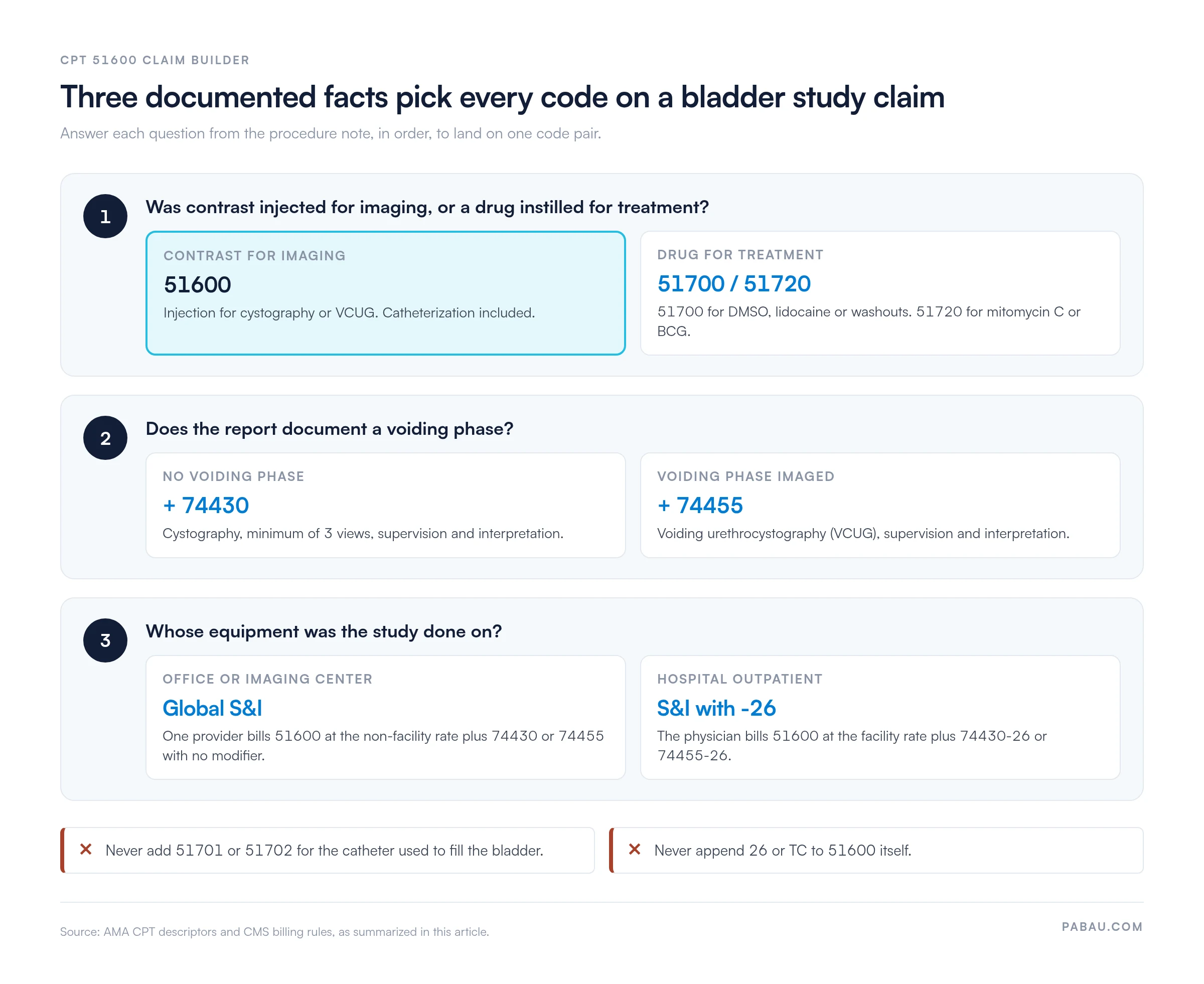
Code 51600 has no professional and technical split of its own. Modifiers 26 and TC belong on the S&I codes only, never on the injection.
Knowing the bundle keeps you from adding codes the payer will strip out, or leaving off codes it expects to see.
Because catheterization is part of the 51600 service, 51701 and 51702 are not reported for the same catheter. A separately indicated catheter placed at another session is a different service and needs its own documentation.
The bladder introduction codes split into two groups. Codes 51600, 51605 and 51610 are contrast injections for imaging, while 51700 and 51720 deliver treatment.
Catheter codes 51701 and 51702 differ by catheter type, non-indwelling versus temporary indwelling. Neither one is a simple or complex version of 51600. The complicated insertion code, 51703, is the indwelling code for altered anatomy or a difficult placement.
The costliest error with this code is billing a treatment session as 51600. A mitomycin, DMSO or lidocaine instillation has no imaging component, so 51600 misstates the service, and payers that review the note will deny it.
A complete procedure note supports both the injection and the S&I code. Record these elements for every study.
For children, document why the study was ordered at that point. The American Academy of Pediatrics 2011 guideline for children aged 2 to 24 months does not recommend a routine VCUG after a first febrile UTI. It supports the study when the renal and bladder ultrasound is abnormal or the infection recurs.
Capture these elements on a superbill before the claim is built, so coders are not chasing the radiologist for the voiding phase after the fact.
Build the voiding phase into your report template as a required yes or no field. That single field decides whether 74430 or 74455 goes on the claim.
Payers look for a diagnosis that explains why bladder imaging was needed. The codes below are common imaging indications for a cystogram or VCUG. Always report the most specific ICD-10-CM code the record supports.
Treatment diagnoses such as bladder cancer (C67.-) or interstitial cystitis (N30.1-) do not support 51600 on their own. They belong with 51720 or 51700, unless a separate imaging question is documented.
Medicare pays 51600 under the Medicare Physician Fee Schedule (MPFS). The figures below come from the CMS CY2026 PFS relative value file (October release). They are national amounts before locality adjustment.
Each dollar figure is the total RVU multiplied by the CY2026 conversion factor. CMS set two factors for 2026, $33.5675 for qualifying APM participants and $33.4009 for everyone else. The non-facility rate is much higher because the office absorbs the practice expense.
The S&I codes are paid on top. In the same file, 74430-26 carries 0.45 total RVUs and 74455-26 carries 0.47. Use the CMS Physician Fee Schedule lookup tool for your locality rate. Commercial payers set their own rates by contract.
Most modifier errors on this pair come from putting the professional and technical modifiers on the wrong line.
The National Correct Coding Initiative (NCCI) publishes procedure-to-procedure edits every quarter. Check them before you report 51600 with another bladder procedure on the same date.
The AAPC Codify CPT lookup and the CMS NCCI tables show the current edit status for each code pair.
Traditional Medicare does not require prior authorization for 51600. Medicare Advantage, Medicaid managed care and commercial plans set their own rules, and some require it for imaging. Run insurance eligibility verification before the study is booked. When a plan does require authorization, send the indication, the ordering physician and any prior ultrasound result.
Denials on 51600 follow a handful of patterns, and each one has a fix at charge entry. A routine denial management review shows which pattern your practice hits most.
A clean claim for this study carries three matched pieces: 51600, the right S&I code and an imaging diagnosis. If one is missing, expect the claim back.
Many urology and radiology practices still key cystography claims into a clearinghouse portal by hand. The procedure note lives in one system, the claim in another, and every status check means another login.
Pabau, the practice management and EHR platform we build, keeps the patient record and the claim together. Its claims management feature submits claims electronically through Claim.MD and tracks each claim’s status after submission.
Code selection stays with your coders, who apply the 51600, 74430 and 74455 rules above. Pabau removes the re-keying and the extra portal, so your billing team sees a rejection as soon as Claim.MD reports it.

Pabau’s claims management submits claims electronically through Claim.MD and tracks their status. Your team follows each 51600 claim without logging into a separate portal.

Treat 51600 as half of an imaging claim, never as a treatment code. The injection only pays cleanly when the S&I code, the voiding phase in the report and the imaging diagnosis all agree.
Fix the report template first, because it decides the S&I code before a coder ever sees the chart. Then keep therapeutic instillations on 51700 and 51720, where they belong. Book a demo to see how Pabau submits and tracks your urology claims through Claim.MD.

Billing a treatment instillation instead? CPT code 51720 for bladder instillation covers intravesical chemotherapy and BCG, including the retention time.
Placing a catheter for its own reason? CPT code 51702 for Foley insertion explains when a temporary indwelling catheter is a separate, billable service.
Scoping the bladder on the same day? CPT code 52000 for cystourethroscopy walks through billing for a diagnostic cystoscopy.
Need guidance on claim submission standards? Billing compliance requirements outlines documentation and submission standards that support clean claims across specialty procedures.
Want to understand how clearinghouse submissions work? 837 file format and electronic claims explains the electronic transaction structure used to transmit claims from your practice to payers.
CPT code 51600 is the injection procedure for cystography or voiding urethrocystography. A catheter is placed in the bladder and contrast is injected so the bladder, and sometimes the urethra, can be X-rayed. The catheterization is included. The imaging is billed separately with 74430 or 74455.
No. CPT 51600 is a contrast injection for imaging only. A treatment instillation such as DMSO or a lidocaine cocktail is reported with 51700. An anticarcinogenic agent such as mitomycin C or BCG is reported with 51720.
Bill 74430 for a cystogram with no voiding phase. Bill 74455 for a voiding cystourethrogram, where images are taken while the patient voids. In a hospital, the physician adds modifier 26 to the S&I code, while 51600 itself never takes 26 or TC.
Not for the catheter used to fill the bladder. Catheterization is part of the 51600 service. A catheter placed at a separate session for its own documented reason is a different service.
Imaging indications support it, such as vesicoureteral reflux (N13.70, N13.71), congenital reflux (Q62.7), recurrent UTI (Z87.440), bladder injury (S37.20XA to S37.29XA) and urinary retention (R33.9). Treatment diagnoses alone, such as bladder cancer, do not.



