CCSD Code H2220: Endoscopic ultrasound for tumour staging
What is CCSD Code H2220? CCSD Code H2220 is the UK private healthcare procedure ...

Last Updated: Oct 16, 2026
CPT code 51701 covers insertion of a non-indwelling bladder catheter, such as a straight catheterization for residual urine. The catheter goes in through the urethra, drains or samples the urine, and comes straight back out.
That last detail decides the claim. If a catheter stays in, the correct code is 51702 or 51703, not 51701. Getting it right protects a small but frequent charge, worth about $45 from Medicare in the office. Here's how to code it cleanly, from the code boundaries and 2026 payment to modifiers, bundling, and a pre-submission checklist.
Let Pabau's smart automation suggest the right codes, reduce claim denials, and keep your practice compliant—effortlessly.
Automate repetitive tasks and focus on what matters most—your patients.
Reduce coding errors and ensure compliance with the latest regulations.
Clean claims, fewer denials, and faster reimbursements.
Powerful insights and reporting to help your practice thrive.
HIPAA compliant SOC 2 certified GDPR-compliant Trusted by 4,000+ clinics worldwide

CPT code 51701 covers a single in-and-out (straight) catheter pass, not a Foley catheter left in place.
Billing 51702 when a non-indwelling catheter was placed is a frequent coding error.
Modifier 25 goes on the E/M code when an office visit is billed on the same date as CPT 51701.
In 2026, Medicare pays about $45 for 51701 in the office and about $22 in a facility.
Catheterization done at the time of, or just before, a surgical procedure is bundled and not billed separately.
CPT code 51701 is defined by the American Medical Association (AMA) as: Insertion of non-indwelling bladder catheter (eg, straight catheterization for residual urine). It sits within the Introduction subsection of the Bladder section (51600-51720) of the CPT Surgery chapter. Its neighbors in that range are listed in our CPT codes directory.
In plain clinical terms, it’s a single-pass catheterization. A catheter goes through the urethra into the bladder, the urine is drained or measured, and the catheter comes straight out. No device is left in place.
You’ll see it for three jobs in practice. It measures post-void residual (PVR) urine, collects a sterile specimen, or relieves acute retention when no indwelling catheter is planned.
The 517xx catheterization family is a common source of urology billing errors. The catheter type and whether it stays in the patient decide the code, not the diagnosis.
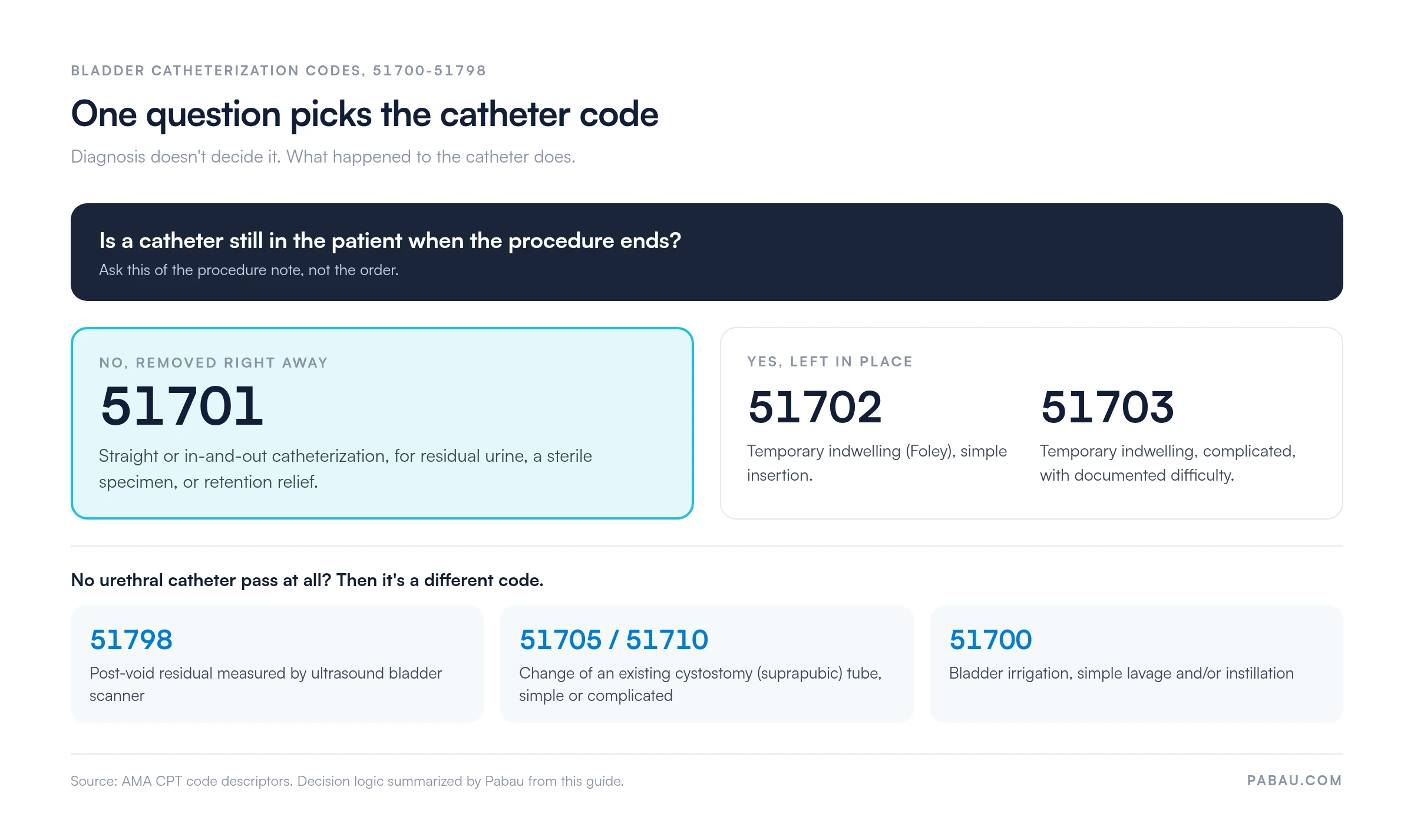
The practical test: after the procedure, is a catheter still in the patient? Yes means 51702 or 51703. No means 51701. If the Foley stayed in, the 51702 guide covers the simple insertion in detail. When the urethra cannot take a catheter at all, drainage goes in above the pubic bone, and that placement is 51102.
The chart below maps that question, plus the three codes people most often confuse with this family.
Both codes measure post-void residual urine, but by very different methods. 51798 uses an ultrasound bladder scanner, so nothing enters the urethra. 51701 uses a catheter, which is invasive but also drains the bladder and can collect a specimen.
Payers may question medical necessity when a bladder scanner was available. So document why catheterization was needed, for example a specimen, retention relief, or a scanner reading you couldn’t trust. Without that line, some Medicare Administrative Contractors (MACs) will deny 51701 as not medically necessary.
Here’s the path a typical office claim takes, and where each step can go wrong.
Steps one to four happen inside your practice. That’s where a clean 51701 claim is won.
Vague documentation is a common audit trigger for CPT 51701. Each element below should appear in the medical record for the date of service.
If the catheterization happens during an office visit, the E/M note must show a separate, distinct evaluation. That’s the foundation for applying modifier 25 correctly.
Flag any chart that lists the catheter as simply ‘Foley’ when a straight catheter was used. Auditors spot that documentation-to-code mismatch quickly, and it can turn a correctly coded 51701 claim into an audit finding.
Under the CMS Medicare Physician Fee Schedule (MPFS), CPT 51701 carries a relatively low reimbursement because the procedure has a low work RVU value. The figures below are 2026 national amounts at the $33.4009 conversion factor, before any locality adjustment.
The non-facility rate applies in a physician office. The facility rate applies in a hospital outpatient department or ambulatory surgery center, where the facility bills separately for overhead.
Commercial payers often pay above Medicare, but check your contracted rate rather than assuming it. For locality-adjusted figures, use the FastRVU 2026 RVU lookup tool or query the CMS MPFS directly.
Modifiers are where many 51701 claims fail quietly. Each one has a specific trigger. The wrong one, or a missing one, produces denials that are hard to appeal without a clear note.
Correct modifier use is a key denial-prevention step, particularly when 51701 is billed alongside a same-day E/M.
CPT 51701 denials tend to cluster around a handful of root causes. Each one is preventable with a quick chart review before the claim drops.
All five fixes share one habit: a quick check of the note before the charge leaves your system. Our guide to clean claims in medical billing shows how to build that check into the wider workflow.
The CMS National Correct Coding Initiative (NCCI) edits define which codes are bundled with CPT 51701. Billing a bundled pair without a valid modifier usually results in a denial. NCCI tables update quarterly, so check the current version before billing.
In the office, catheter supplies usually fold into the practice expense that 51701’s non-facility rate already pays. Straight intermittent catheters are A4351 (straight tip) or A4352 (coudé tip), and both are DME-benefit codes. Check payer rules, since they’re usually not separately payable in the office setting.
A non-specific or mismatched ICD-10 code is a common medical necessity denial trigger for CPT 51701. The diagnosis must explain why the catheterization was needed. ICD-10-CM codes update every October 1, so confirm them against the current code set.
Avoid defaulting to unspecified codes when a more specific one exists. Some payers publish coverage policies that list acceptable ICD-10 codes for urological procedures, so read yours before billing an unspecified diagnosis.
If you run denial management workflows, track denials by diagnosis pairing. It quickly shows which ICD-10 choices cause the most 51701 denials, so you can fix documentation before claims drop.
Check whether your MAC or commercial payer publishes a coverage policy for catheterization before billing. Where one exists, the documented ICD-10 code may need to appear on its covered diagnoses list. A claim with a valid clinical reason but an off-list code can still deny.
Run through these checks before each 51701 claim leaves your practice. They cover the mistakes that cause most rework.
Many 51701 errors start as small slips on a busy workday. A code gets picked from memory, a claim field is left blank, or the claim goes to a plan that lapsed.
Pabau, the practice management platform we build, includes claims management software that pre-fills the claim from the patient record. The CPT code attached to the service lands on the charge line, with CPT and ICD-10 lookup libraries beside it. Before you can press Send, it checks that the claim’s required fields are complete.
In the US, claims go out through the Claim.MD clearinghouse, with real-time eligibility checks. ERA remittances post back to the account, and claim tracking shows where each claim stands. Coding calls, like 51701 versus 51702 or the right modifier, still belong to your team.

Pabau pre-fills claims from the patient record, validates required fields before Send, and submits through the Claim.MD clearinghouse with real-time eligibility. ERA posting and claim tracking show where every claim stands.

CPT code 51701 rewards a tidy note more than coding skill. When the record says a straight catheter went in and came out, names the reason, and logs the volume, the code picks itself.
The trade-off is the small fee. At about $45 in the office, rework on one denied claim quickly eats the margin. Getting it right the first time beats appealing later.
Start by tightening your catheterization note template and running the checklist above. Book a demo to see how Pabau pre-fills catheterization claims and checks required fields before they reach the payer.

Need to understand how claims move through a clearinghouse? Medical claims clearinghouse guide explains how EDI transmission, payer routing, and ERA reconciliation work end to end.
Tracking denial patterns across your CPT codes? Denial codes in medical billing covers CARC reason codes and how to categorize denials for systematic prevention.
Want to see how 837P claims submit electronically? 837 file guide walks through the ANSI 837P transaction set used to transmit CPT claims to payers.
Instilling medication instead of draining? CPT code 51720 covers bladder instillation of an anticarcinogenic agent, including retention time.
Collecting a catheter specimen for a suspected UTI? ICD-10 code N39.0 explains when urinary tract infection, site not specified, fits the claim.
Often, yes. Under Medicare’s incident-to rules, a nurse can perform the catheterization in the office under the physician’s direct supervision. The claim then goes out under the supervising provider’s NPI. Commercial payers set their own rules, so confirm them first.
No. 51701 pays for obtaining the urine through the catheter, not for testing it. If your practice runs the test, bill it with its own lab code, such as 81002 for a non-automated dipstick without microscopy.
Not under original Medicare. Medicare Advantage and commercial plans set their own rules, so check the plan’s policy when catheterization is planned in advance. For urgent retention, document the clinical reason in the note.
No. 51701 is a service your clinician performs. Home intermittent catheters are DME supplies, billed by the supplier with codes such as A4351 or A4352.
Yes, a 000-day global period. No follow-up days are bundled in, so a later unrelated visit is billed normally. A same-day E/M still needs modifier 25 and separate documentation.