HCPCS code K0900: Customized DME billing and coding guide
HCPCS code K0900 covers custom DME that no other code describes HCPCS code K0900...

Last Updated: Nov 18, 2026
T2300 is the CCSD code for repair of recurrent femoral hernia. It applies when a femoral hernia returns on a side that has already been repaired, and it fits an open repair.
Laparoscopic and robotic-assisted recurrent repairs have their own CCSD codes, and a first repair takes T2200. The K41 diagnosis code on the claim must match the side and obstruction status in the operative note.
Let Pabau's smart automation suggest the right codes, reduce claim denials, and keep your practice compliant—effortlessly.
Automate repetitive tasks and focus on what matters most—your patients.
Reduce coding errors and ensure compliance with the latest regulations.
Clean claims, fewer denials, and faster reimbursements.
Powerful insights and reporting to help your practice thrive.
HIPAA compliant SOC 2 certified GDPR-compliant Trusted by 4,000+ clinics worldwide

CCSD code T2300 covers repair of a recurrent femoral hernia, one that returns on a side already repaired. A first repair on that side is T2200.
Laparoscopic and robotic-assisted recurrent repairs have their own CCSD codes (T2214, T2215, T2211 and T2212 for one side), so T2300 fits an open repair.
The ICD-10-CM pairing depends on obstruction status: K41.31 (unilateral, with obstruction, recurrent) or K41.91 (unilateral, without obstruction or gangrene, recurrent).
Pabau, the practice management platform we build, submits UK insurance claims through Healthcode. It tracks each pre-authorization on the case and warns when one is missing.
CCSD code T2300 covers the repair of a recurrent femoral hernia. Its official descriptor in the schedule kept by the Committee of Central Clinical Services Descriptions reads “Repair of recurrent femoral hernia.” The code sits in chapter 11.9.0, Abdominal Wall. It applies when a surgeon operates on a femoral hernia that has returned after at least one previous repair.
The code records one clinical fact: The hernia has recurred. It does not record mesh use or complication status, and those details belong in the operative note. The approach does matter, though. Laparoscopic and robotic-assisted recurrent repairs have their own CCSD codes, which leaves T2300 for an open repair.
Use T2300 when the patient’s history shows a documented femoral hernia repair on the same side. The operative findings must also confirm that the hernia has returned. The clinical record must carry evidence of that previous repair. Insurers expect a prior operative note or an imaging report confirming it.
A femoral hernia passes through the femoral canal, below and lateral to the pubic tubercle. It is less common than an inguinal hernia but carries a higher risk of strangulation. That is why repair is recommended even when it causes no symptoms. Recurrence after repair occurs in roughly 1% to 5% of cases, depending on technique, patient factors, and whether the first operation used mesh.
Recurrent repair is technically more demanding than primary repair. Scar tissue from the previous operation distorts the femoral ring and the tissue planes around it. That adds dissection time, raises the risk of vascular injury, and makes the operation more complex. The separate procedure code reflects that added work.
Key risk factors for recurrence include:
When documenting the indication for T2300, the operative note should acknowledge the previous repair and confirm the recurrent defect at operation.
The approach decides which CCSD code a recurrent femoral hernia repair takes. The T2300 descriptor names no approach. The schedule does, however, list separate laparoscopic and robotic-assisted codes for recurrent femoral hernia, so T2300 fits the open operations below.
Three named open approaches are used for femoral hernia repair, and each one takes T2300 when it treats a recurrence:
Laparoscopic repair is often preferred for a recurrent femoral hernia. It reaches the preperitoneal space without re-entering the scarred planes of the previous open repair. Two techniques are in use:
Neither technique is coded as T2300. The CCSD Schedule gives laparoscopic and robotic-assisted recurrent repairs their own codes, split by side and by mesh use:
Record the technique and any mesh in the operative note. Insurers check that the approach in the note matches the code on the claim.
The most common coding error on femoral hernia claims is using T2200 when T2300 is correct. T2200 covers a first femoral hernia repair, while T2300 applies only when the hernia has come back after a previous repair. Submitting T2200 for a recurrent repair does more than reduce payment. Most insurers deny the claim outright when the patient’s history shows a prior repair, because the code contradicts the clinical record.
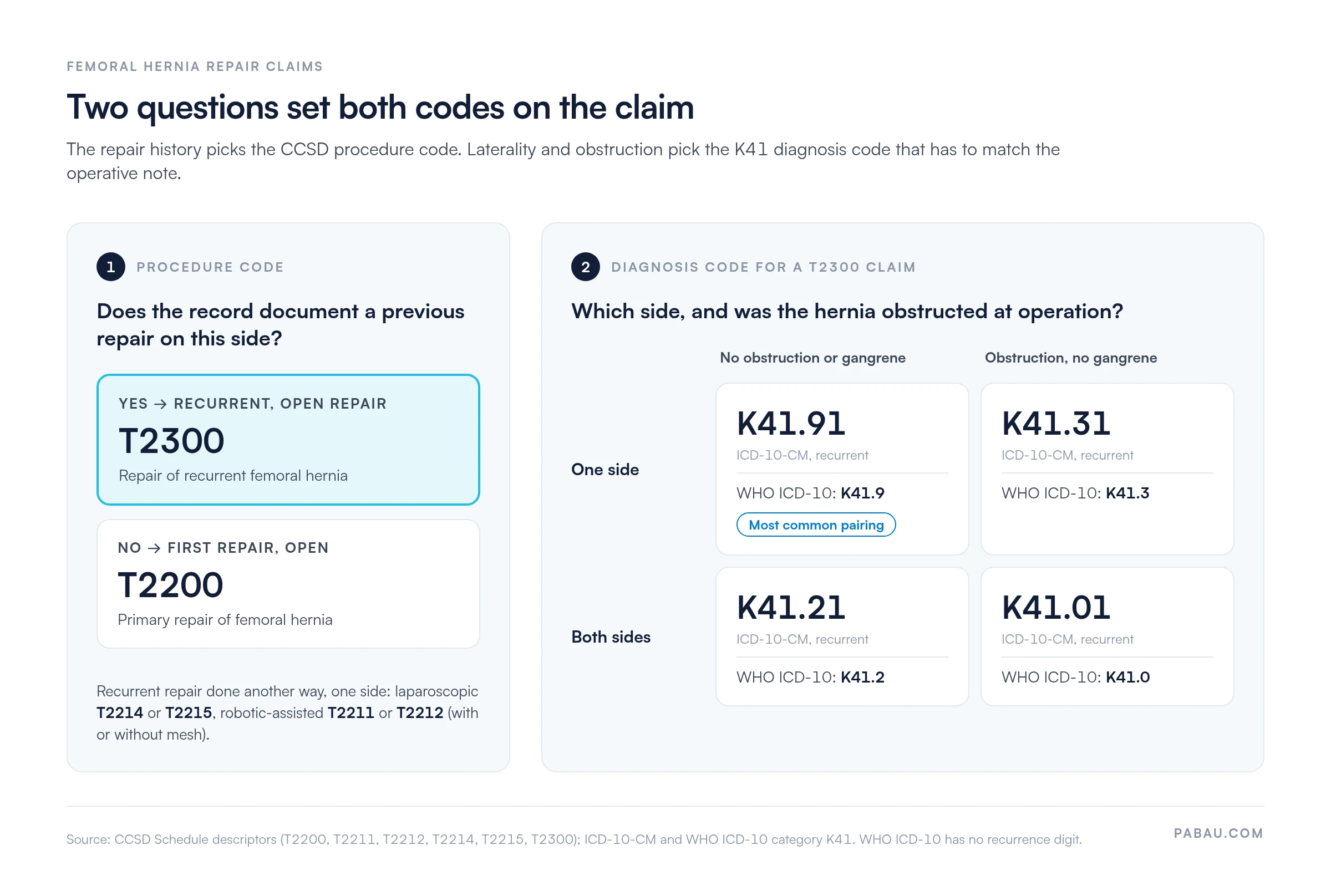
Before submitting any femoral hernia claim, check the record for a prior operative note, discharge summary, or imaging report confirming a previous repair. If that evidence exists, T2300 is correct for an open repair. If the hernia is presenting for the first time, T2200 applies. When the record is unclear, ask the operating surgeon to confirm the finding in the notes. The diagram below puts both coding decisions on the claim side by side.
Several codes appear alongside or near T2300 on hernia claims. Knowing when each applies prevents over-coding, under-coding, and unbundling disputes. Our list of private practice CCSD codes covers the wider schedule, and the guide to Bupa CCSD procedure codes adds insurer-specific context.
The CCSD’s own note on T2300 adds one exception. When different hernias are repaired in the same operation, the usual unacceptable-combination rules may not apply, so contact the insurer first. A concurrent primary inguinal repair is coded T2000.
Every T2300 claim needs a matching diagnosis code from ICD-10 category K41 (femoral hernia). The recurrence codes in the table below (K41.x1) are ICD-10-CM codes. The NHS edition of WHO ICD-10 uses K41.0 to K41.9 and has no recurrence digit. Within K41, the code turns on two factors: Whether the hernia was obstructed at operation, and whether both sides were repaired.
Use the most specific code available. Where the ICD-10 version your insurer uses has no recurrence digit, use K41.2 (bilateral, without obstruction or gangrene) or K41.9 (unilateral). Then make sure the operative note clearly documents the recurrence. Confirm which ICD-10 edition each insurer expects with your coding team.
Most UK private insurers query or deny a T2300 claim that lacks supporting documentation. The clinical record must contain all of the following before submission:
Capturing these fields on digital forms at the point of care keeps incomplete records away from the billing team. When documentation is part of the clinical workflow, the evidence insurers ask for exists before the claim is raised.

Before submitting a T2300 claim, run a documentation check against the operative episode. Look for prior repair evidence, confirmation of recurrence at operation, the approach, and mesh details if used. Then confirm the GMC number and an ICD-10 code that matches obstruction status. One missing item can be enough for a denial.
Most UK private insurers require pre-authorization for elective hernia repair, including recurrent femoral hernia repair under T2300. Requirements, turnaround times, and the consequences of proceeding without authorization vary by insurer. The table below reflects general practice, so verify each insurer’s current policy document before the operation. Reimbursement amounts are not listed here because they vary by contract and change each year.
Proceeding with an elective T2300 repair without pre-authorization usually means the insurer declines to pay. The patient or the practice then carries the full cost. Emergency cases with obstruction or strangulation are generally exempt. Notify the insurer as early as possible, and document the emergency indication clearly in the operative note.
Healthcode is the main electronic billing and payment platform for UK private healthcare, and most UK private insurers receive CCSD-coded claims through it. The steps below apply to a standard T2300 inpatient or day-case submission.
When both femoral hernias have recurred and both sides are repaired in one operation, the approach decides the coding. A laparoscopic bilateral recurrent repair has its own codes, T2226 (requiring mesh) and T2227 (not requiring mesh). A robotic-assisted one uses T2223 or T2224. An open bilateral repair has no dedicated code. The usual approach is to submit T2300 twice on the same claim, with a bilateral indicator where the insurer supports one.
Use ICD-10-CM K41.21 (bilateral femoral hernia, without obstruction, recurrent) or K41.01 (bilateral, with obstruction, without gangrene, recurrent) where available to show the bilateral nature. The diagnosis code must match the laterality documented in the operative note.
These denial patterns recur on T2300 claims. Most are preventable with accurate coding and complete documentation before submission.
In most UK private practices, a recurrent hernia claim passes through several hands. The surgeon writes the operative note, a secretary chases the pre-authorization, and the billing team keys the code into Healthcode. Each handoff is a chance for the wrong code, a missing authorization, or an absent GMC number to reach the insurer.
Pabau keeps those steps in one patient record. Its private practice claims software submits UK insurance claims through Healthcode and BUPA. The pre-authorization code, dates, and sessions are tracked on the patient’s case, with a warning when one is missing.
The outcome is fewer claims declined for a missing authorization, and less time spent rebuilding surgical detail for an insurer months later. Prior repair evidence and approach details sit on forms in the same record, ready when the claim is raised.

Pabau submits UK insurance claims through Healthcode and tracks each pre-authorization on the patient’s case. A warning flags any case missing its authorization, so fewer elective hernia claims are declined for it.

The T2300 claims that fail usually fail on evidence, not on the code itself. An insurer will not pay for a recurrent repair it cannot see was recurrent, or for an elective operation it never authorized. Checking the approach before coding matters just as much, because laparoscopic and robotic recurrent repairs carry their own codes.
Set the check before the claim is raised: Prior repair evidence, approach, laterality, obstruction status, and the authorization number on the case. A practice that runs it once per episode stops rebuilding claims after a denial. Book a demo to see how Pabau tracks pre-authorizations and sends Healthcode claims for UK surgical practices.

Need a broader CCSD billing reference? Bupa CCSD codes and procedure billing guide covers the Bupa schedule structure, code families, and submission requirements.
Coding an inguinal repair in the same episode? CCSD code T2000 explains the code for primary inguinal hernia repair and how it is documented.
Want another worked CCSD claim example? CCSD code M0222 billing guide walks through pre-authorization and Healthcode submission for another UK procedure.
Looking to reduce claim denials across the practice? Pabau claims management software submits UK claims through Healthcode and tracks pre-authorizations on each case.
CCSD code T2300 covers repair of a recurrent femoral hernia, one that has returned after at least one previous repair on the same side. It fits an open repair, because laparoscopic and robotic-assisted recurrent repairs have their own CCSD codes. T2200 is the separate code for a first (primary) femoral hernia repair.
T2300 applies to recurrent femoral hernia repair, where the hernia has returned after a previous repair. T2200 applies to primary femoral hernia repair at first presentation. Submitting T2200 when the patient’s history shows a prior repair leads to a denial, because the code contradicts the insurer’s claims history.
The most common pairings are K41.91 (unilateral femoral hernia, without obstruction, recurrent) for one-sided cases and K41.21 (bilateral, without obstruction, recurrent) for bilateral cases. Use K41.31 or K41.01 when obstruction was present without gangrene. These recurrence codes are ICD-10-CM, and WHO ICD-10 uses K41.9, K41.2, K41.3 and K41.0 instead.
Yes, for elective cases. Bupa and AXA Health both require pre-authorization before elective general surgery, including hernia repair. The request usually needs a referral letter, evidence of recurrence, the proposed CCSD code, and the ICD-10 diagnosis. Emergency cases with obstruction or strangulation are generally exempt, but notify the insurer as early as clinically possible.
Yes, for an open repair. List T2300 twice as separate line entries and use a bilateral ICD-10 code, such as K41.21 for an unobstructed bilateral recurrence. Laparoscopic and robotic-assisted bilateral recurrent repairs have their own codes (T2226, T2227, T2223 and T2224). Bupa generally accepts two T2300 lines, while AXA Health and Aviva policies should be confirmed directly.
The most common causes are T2200 submitted instead of T2300 and missing evidence of the prior repair. Others are a missing pre-authorization for an elective case and an ICD-10 code that conflicts with the note’s obstruction status. A missing GMC number on the Healthcode submission also triggers rejection. Checking the record before submission prevents most of them.
Yes. T2300 fits an open repair. Laparoscopic repair of a recurrent femoral hernia on one side is T2214 (requiring mesh) or T2215 (not requiring mesh). On both sides it is T2226 or T2227. Robotic-assisted recurrent repair uses T2211, T2212, T2223 or T2224.