

HCPCS Code L0472: Hyperextension TLSO billing guide
HCPCS code L0472: Official descriptor and device definition HCPCS code L0472 des...

Last Updated: Nov 5, 2026
49560 is the CPT code for repair initial incisional or ventral hernia; reducible. Coders now meet it only on historical claims, because the 2023 CPT restructure retired the 49560 family in favor of codes 49591-49622.
49560 remains the correct code for encounters with dates of service before January 1, 2023. Coders often confuse it with its adjacent codes: 49561 for incarcerated cases, 49565 for recurrent repairs, or the new 49591 family. That mix-up is a common cause of claim denials in hernia surgery billing.
Let Pabau's smart automation suggest the right codes, reduce claim denials, and keep your practice compliant—effortlessly.
Automate repetitive tasks and focus on what matters most—your patients.
Reduce coding errors and ensure compliance with the latest regulations.
Clean claims, fewer denials, and faster reimbursements.
Powerful insights and reporting to help your practice thrive.
HIPAA compliant SOC 2 certified GDPR-compliant Trusted by 4,000+ clinics worldwide

CPT code 49560 describes open repair of an initial (not recurrent) incisional or ventral hernia that is reducible, not incarcerated or strangulated.
CPT codes 49591-49622 replaced the 49560 family on January 1, 2023, so use 49560 only for earlier dates of service.
The 2023 codes are selected by total defect length, include mesh implantation, and apply to open, laparoscopic, and robotic repairs alike.
The 90-day global surgical package bundles routine post-op visits, and a separately billed visit without the correct modifier is denied.
In Pabau’s claims management software, each rejected claim shows its reason, claims that need action are flagged, and ERA files settle payments.
CPT code 49560 describes the open surgical repair of an initial incisional or ventral hernia that is reducible. “Initial” means the patient has not had a prior repair at this hernia site. “Reducible” means the hernia contents return to the abdominal cavity without resistance and without signs of incarceration or strangulation.
The code sits within the Digestive System section of the CPT code set, under the Hernia Repair subsection (open procedures). According to the AMA’s CPT code set overview, open hernia repair codes are categorized separately from laparoscopic codes (for example, 49650-49651 for laparoscopic inguinal repair).
The 49560 procedure involves an open abdominal approach, reduction of the herniated contents back into the peritoneal cavity, and closure of the abdominal wall defect. The surgeon accesses the hernia through an incision directly over the defect, dissects the hernia sac, and repairs the fascial opening.
Mesh placement is a common component of open incisional hernia repair, but it does not change the base code. For pre-2023 dates of service, mesh is billed separately with add-on CPT code 49568. That code covers implantation of mesh or other prosthesis for open incisional or ventral hernia repair. The operative report must document the mesh for 49568 to stand. Check the NCCI edit status for the 49560 + 49568 pairing in the year of service, as bundling edits change between code cycles.
Key procedure elements the op note must confirm for 49560:
Yes, CPT code 49560 was replaced. The AMA restructured the hernia repair code family effective January 1, 2023. It retired legacy codes 49560 through 49566 and introduced a new family spanning 49591 through 49622. For any date of service on or after January 1, 2023, use the new family, not 49560.
The new codes add a dimension that 49560 lacked: Total defect length. 49560 covered any reducible initial incisional hernia regardless of size. The 2023 codes split that repair into three by the total length of the defect or defects. A reducible initial repair now codes as 49591 (less than 3 cm), 49593 (3-10 cm), or 49595 (greater than 10 cm).
The 2023 codes also include mesh implantation when it is performed, and they apply whether the approach is open, laparoscopic, or robotic. The chart below maps each legacy code to its successors, so a coder can pick the right family from the date of service alone.
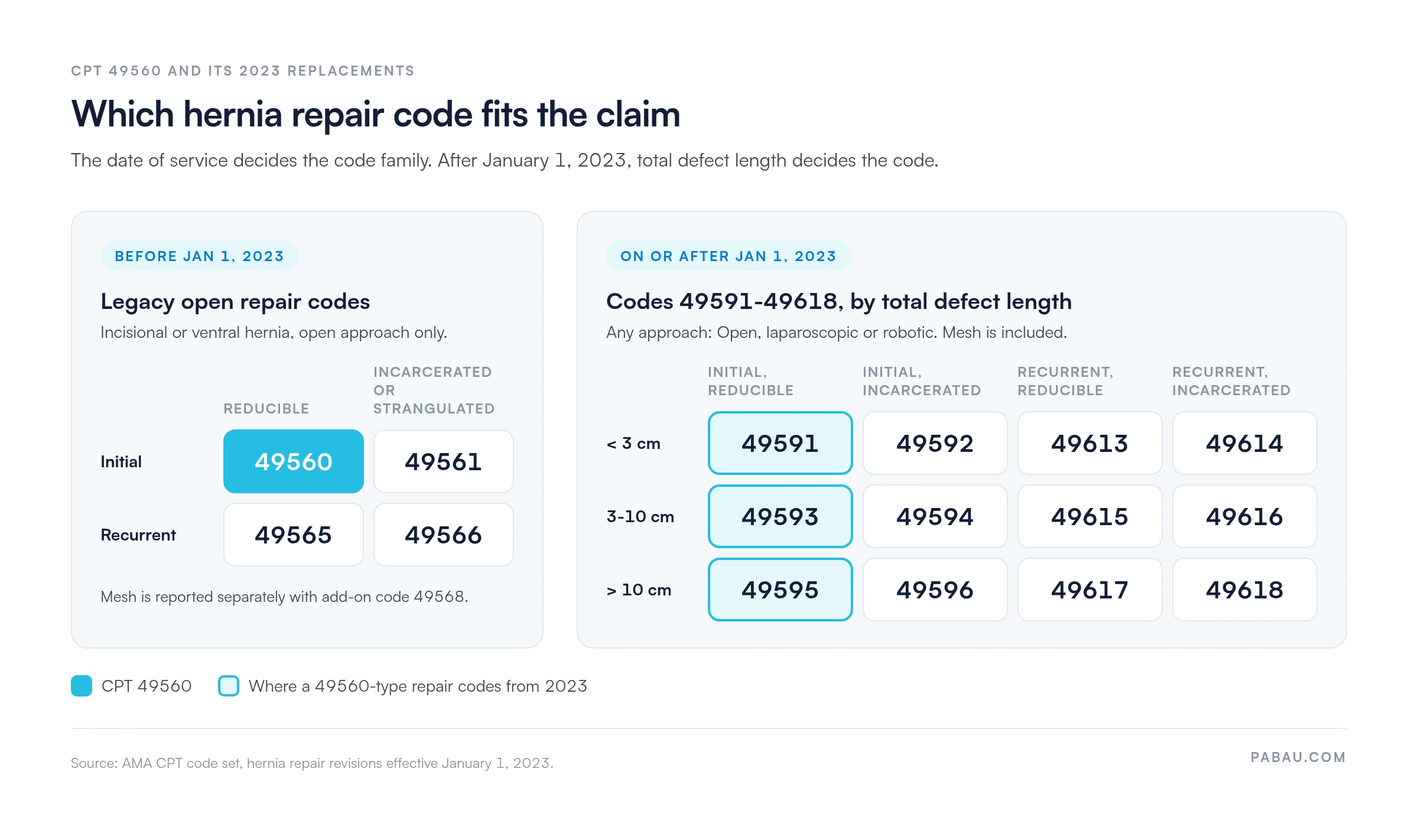
Historical claims: 49560 remains the correct code for dates of service before January 1, 2023. Do not recode historical claims to the new family. Payers adjudicate based on the code set in effect on the date of service.
Four decision variables govern code selection in this family. They are hernia type (incisional/ventral vs inguinal), approach (open vs laparoscopic), repair status (initial vs recurrent), and reducibility. Getting any one of these wrong triggers a denial or an audit flag.
Common selection mistake: Coding 49560 when the operative report documents a recurrent repair. If the patient had a prior hernia repair at the same site, the correct legacy code is 49565 (reducible) or 49566 (incarcerated). The recurrent/initial distinction must appear explicitly in the op note.
The diagnosis code on a 49560 claim must match the clinical status documented in the operative report. Because 49560 requires the hernia to be reducible, the appropriate ICD-10-CM codes are those without obstruction or gangrene. Using an obstruction or gangrene code with 49560 creates a clinical mismatch that most payer edits catch. Check each pairing against your payer’s medical necessity policy before the claim goes out.
Select the most specific code available. K43.2 is preferable to K43.9 when the operative report clearly identifies the hernia as incisional (arising from a prior surgical incision). Use K43.9 for primary ventral hernias without a prior incision history. For ICD-10-CM code verification, the CDC/NCHS ICD-10-CM web tool provides current code descriptions and hierarchical context.
As an open abdominal procedure, CPT 49560 carried substantial work RVUs. The reimbursement varies by geographic location (through the geographic practice cost index) and by setting (facility versus non-facility). Surgical practices that performed open incisional hernia repairs before 2023 and are reconciling historical claims should use the CMS Physician Fee Schedule lookup. It returns the exact allowable for the year of service, which matters because rates adjust annually.
Setting matters for payment: The facility rate applies when the procedure is performed in a hospital outpatient department or ambulatory surgery center. The non-facility rate applies in a physician office setting, though open abdominal hernia repair is rarely performed outside a surgical facility. The facility rate is lower because the facility separately bills for overhead and resources.
To check historical RVU values for pre-2023 dates of service, use the CMS PFS relative value files. CMS archives each year’s work, practice expense, and malpractice RVUs there. Because 49560 was deleted in 2023, it has no 2026 fee schedule values, so match the file to the year of service.
CPT 49560 carries a 90-day global surgical package. The global period covers routine postoperative care from the day after surgery through 90 days following the procedure. Claims for covered post-op visits submitted without an appropriate modifier during this window are denied automatically.
Global period errors are the most avoidable category of hernia billing denials. The distinction that prevents them is what the package includes and what can be billed on top of it.
What is bundled into the 90-day global package:
What can be billed separately with the correct modifier:
Elective open hernia repair under CPT 49560 typically requires prior authorization from commercial insurers and Medicare Advantage plans. Fee-for-service Medicare does not require PA for this procedure, but requirements vary significantly by payer and plan. Never assume authorization is unnecessary without checking the patient’s specific benefit plan before scheduling the procedure.
Documentation payers typically require for PA approval:
Emergency presentations involving incarceration or strangulation (coded as 49561, not 49560) generally bypass PA requirements. However, any elective repair planned in advance should be verified before the date of service. Verifying eligibility and PA status before the procedure is also a prerequisite for medical billing compliance under most payer contracts.
Request prior authorization using the specific CPT code 49560 (for historical encounters) or the appropriate new code from the 49591 family. Payers often tie the authorization number to a specific CPT code. Submitting the claim under a different code than what was authorized is a common mismatch denial that is entirely preventable.
Every element of the 49560 descriptor must be supported in the operative report. A vague op note is the single most controllable source of hernia coding denials and downcoding. Coders and surgeons should review the note together and confirm that each element below is stated in so many words.
Solid documentation also supports generating a superbill that passes payer audits without amendment. The elements below map directly to the code’s descriptor words.
Hernia repair denials cluster around a predictable set of coding and process errors. Identifying which pattern applies to a denied claim determines the fastest path to resolution. Structured denial management workflows help a billing team spot a repeating cause before it costs more claims.
Each denial on the remittance carries a claim adjustment reason code, and our guide to medical billing denial codes explains how to answer each one. Preparing a clean claim from the start, with the correct ICD-10, PA confirmation, and modifier, is faster than working an appeal.
Review the denial reason code (CARC code) on each 49560 remittance before writing off the claim. CARC 97 (included in global) and CARC 4 (inconsistent with modifier billed) point to global period issues. CARC 50 (not covered due to medical necessity) on a prior authorization denial needs a clinical appeal with supporting records. A rebill alone will not overturn it.
Most hernia repair denials start with a manual step, such as a code chosen from memory or a modifier left off a post-op visit. The rejection then surfaces only when someone reads the remittance line by line.
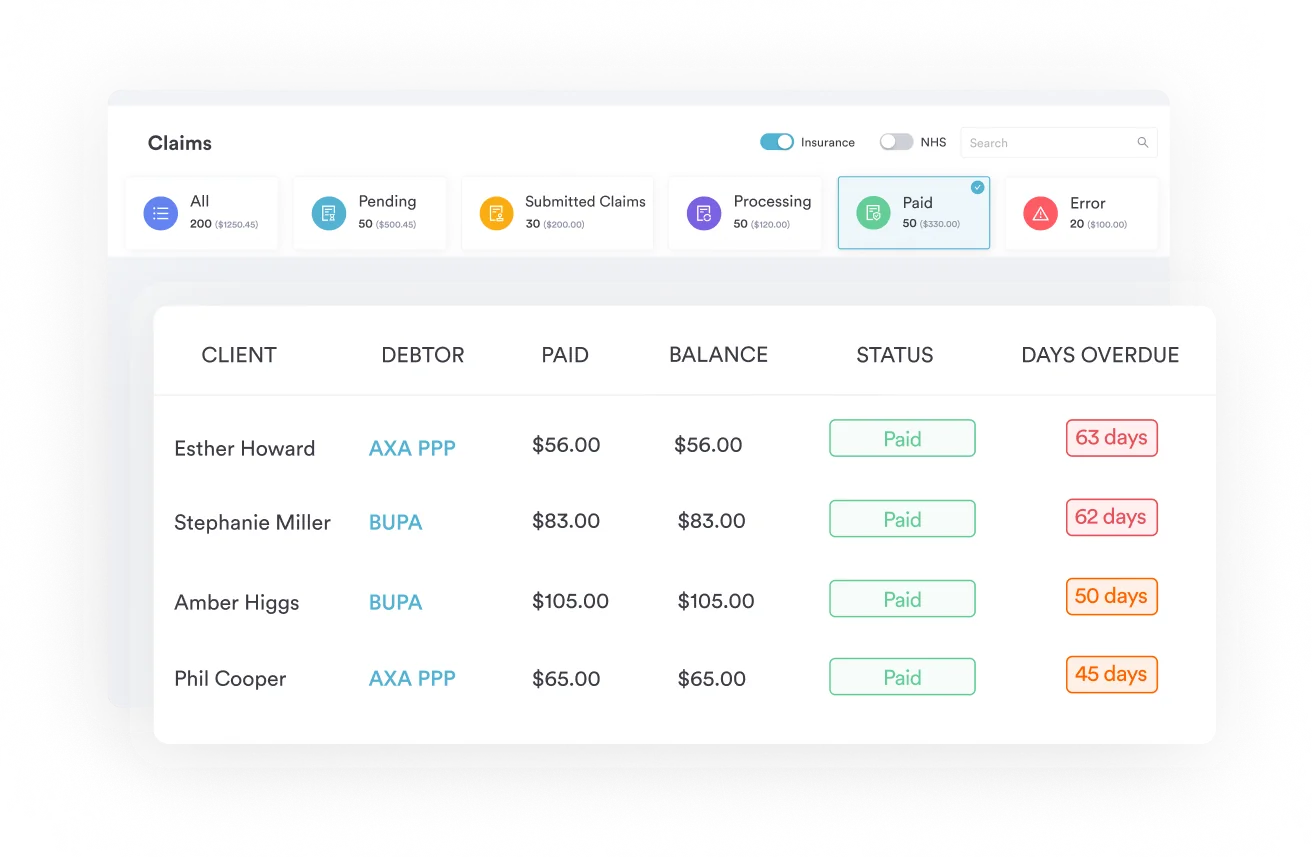
Pabau’s claims management software shows each rejected claim’s reason and flags claims that need action, so your billing team goes straight to the fix. Claims go out through Claim.MD, our integrated US clearinghouse, which routes claims to thousands of US payers.
Payments come back as electronic remittance advice files that settle against each claim. Your team can then see which pre-2023 hernia claims are paid and which still need a corrected code or an appeal.

Pabau’s claims management software shows each rejected claim’s reason, flags claims that need action, and settles payments from ERA files. See how it fits your surgical billing team.

For any hernia repair performed since January 1, 2023, 49560 is the wrong code, and the fix starts in the operating room. An op note that records total defect length, reducibility, and any prior repair gives the coder the three facts the new codes turn on.
Keep 49560 for pre-2023 dates of service, and audit those claims against the op note before you resubmit or appeal them. Correcting a code before submission costs minutes. A denied surgical claim costs an appeal, a records request, and a second wait for payment.
Book a demo to see how Pabau helps surgical practices follow each hernia repair claim from submission to payment.

Need to understand what happens after a claim is submitted? Revenue cycle management overview explains the full claim lifecycle from charge capture through payment posting.
Getting repeated denials on hernia claims? Denial codes in medical billing breaks down the most common CARC and RARC codes and how to respond to each.
Want to verify your clearinghouse is catching errors before claims reach payers? How the Claim.MD clearinghouse works covers real-time eligibility, 837P submission, and ERA processing for US surgical practices.
Coding a laparoscopic inguinal repair instead? CPT code 49650 covers the initial laparoscopic inguinal hernia repair and how to document it.
CPT code 49560 is the procedure code for open repair of an initial incisional or ventral hernia that is reducible. “Initial” means no prior repair has been performed at this hernia site. “Reducible” means the hernia contents return to the abdominal cavity without incarceration or strangulation. The procedure is performed through an open incision, not laparoscopically.
Yes. The AMA retired CPT codes 49560 through 49566 effective January 1, 2023, replacing them with the 49591-49622 family. The new codes add total defect length as a code-selection variable, include mesh implantation, and apply to any approach. CPT 49560 is still the correct code for dates of service before January 1, 2023. For later encounters, choose the new code by total defect length, reducibility, and initial versus recurrent status.
Both codes describe open initial incisional or ventral hernia repair. 49560 requires the hernia to be reducible, while 49561 applies when it is incarcerated or strangulated. Incarceration means the herniated contents cannot be manually reduced. The clinical status must be explicitly documented in the operative report. The ICD-10 pairing will also differ (K43.2 or K43.9 for reducible vs K43.0 or K43.1 for incarcerated).
No. Mesh placement is not bundled into CPT 49560. It may be billed separately with add-on CPT 49568 (implantation of mesh or other prosthesis for open incisional or ventral hernia repair). The operative report must document the mesh explicitly. Verify the NCCI edit status for the 49560 and 49568 pairing before billing, as bundling rules can change between coding cycles.
CPT 49560 carries a 90-day global surgical package. Routine post-operative care is bundled into the procedure fee from the day after surgery through day 90. Separate billing during this window requires a modifier. Use modifier 24 for unrelated E&M visits and modifier 78 for a return to the OR for a complication. Use modifier 79 for an unrelated surgical procedure during the global period. Verify the current global period indicator against the CMS MPFS data file for the applicable date of service.
From January 1, 2023, reducible initial incisional or ventral hernia repairs are coded from the 2023 family by total defect length. The codes are 49591 (less than 3 cm), 49593 (3-10 cm), and 49595 (greater than 10 cm). The correct code depends on the total defect length documented in the operative report. CPT 49560 is reserved for historical claims with pre-2023 dates of service.



