

HCPCS Code Q4185: Cellesta flowable amnion billing guide
HCPCS Code Q4185: definition and official descriptor HCPCS Code Q4185 is the Lev...

Last Updated: Nov 20, 2026
T2280 is the CCSD code for primary repair of a strangulated femoral hernia in UK private practice. It covers open repair of a femoral hernia whose trapped contents have lost their blood supply, usually as an emergency admission.
T2280 sits in CCSD chapter 11.0.0 Abdomen, sub-chapter 11.9.0 Abdominal Wall. A non-strangulated femoral hernia is coded T2200, a recurrent one T2300, and a laparoscopic repair takes its own code. Bowel resection for ischemic bowel is billed separately.
Let Pabau's smart automation suggest the right codes, reduce claim denials, and keep your practice compliant—effortlessly.
Automate repetitive tasks and focus on what matters most—your patients.
Reduce coding errors and ensure compliance with the latest regulations.
Clean claims, fewer denials, and faster reimbursements.
Powerful insights and reporting to help your practice thrive.
HIPAA compliant SOC 2 certified GDPR-compliant Trusted by 4,000+ clinics worldwide

CCSD code T2280 covers open primary repair of a strangulated femoral hernia, coded in sub-chapter 11.9.0 Abdominal Wall.
A recurrent femoral hernia is coded T2300, and a laparoscopic femoral repair takes its own code, such as T2208 or T2213.
Bowel resection for ischemic bowel needs a separate CCSD procedure code, because T2280 does not include it.
Pair T2280 with a femoral hernia diagnosis, usually K41.3 or K41.4, never an inguinal K40 code.
In Pabau, a practice management platform, the insurer’s authorization code sits on the case, with a warning when one is missing.
CCSD code T2280 is the Clinical Coding and Schedule Development (CCSD) code for primary repair of a strangulated femoral hernia in UK private practice. The CCSD Group’s procedure schedule files it in chapter 11.0.0 Abdomen, sub-chapter 11.9.0 Abdominal Wall.
Bupa, AXA Health, Vitality, Aviva, Healix and other UK insurers all use CCSD codes on their fee schedules. The Bupa CCSD procedure codes list shows how one insurer applies them.
The key clinical qualifier in T2280 is strangulation. A femoral hernia is strangulated when the contents of the hernial sac are trapped in the femoral ring and their blood supply is compromised. That separates T2280 from T2200, the code for a femoral hernia repaired before it strangulates.
Submitting T2280 for an elective repair triggers a clinical audit query from the insurer. Submitting the elective code for a strangulated case undervalues the procedure and misstates its complexity.
T2280 describes an open primary repair, usually performed as an emergency or urgent admission. The operative sequence typically runs through five steps:
“Primary” in the T2280 descriptor means this hernia has not been repaired before. A femoral hernia that comes back after an earlier femoral repair is coded T2300, repair of recurrent femoral hernia, instead. T2280 also assumes an open operation, because CCSD gives laparoscopic femoral repair its own codes.
CCSD coding convention bundles routine intraoperative tasks into the principal procedure code. Knowing what T2280 bundles prevents both under-coding (missing legitimate additional codes) and overbilling (submitting procedures already included).
Several of the CCSD codes in sub-chapter 11.9.0 cover femoral and inguinal hernia repairs. Picking the wrong one is the most common source of claim queries from UK private insurers. The table below maps T2280 against its nearest neighbors, so coders can confirm the right code for each clinical scenario.
Descriptors and code numbers change between schedule updates, so confirm each one in the current CCSD schedule before you submit. The decision flow below puts the same codes in the order a coder should test them, starting with the hernia type.
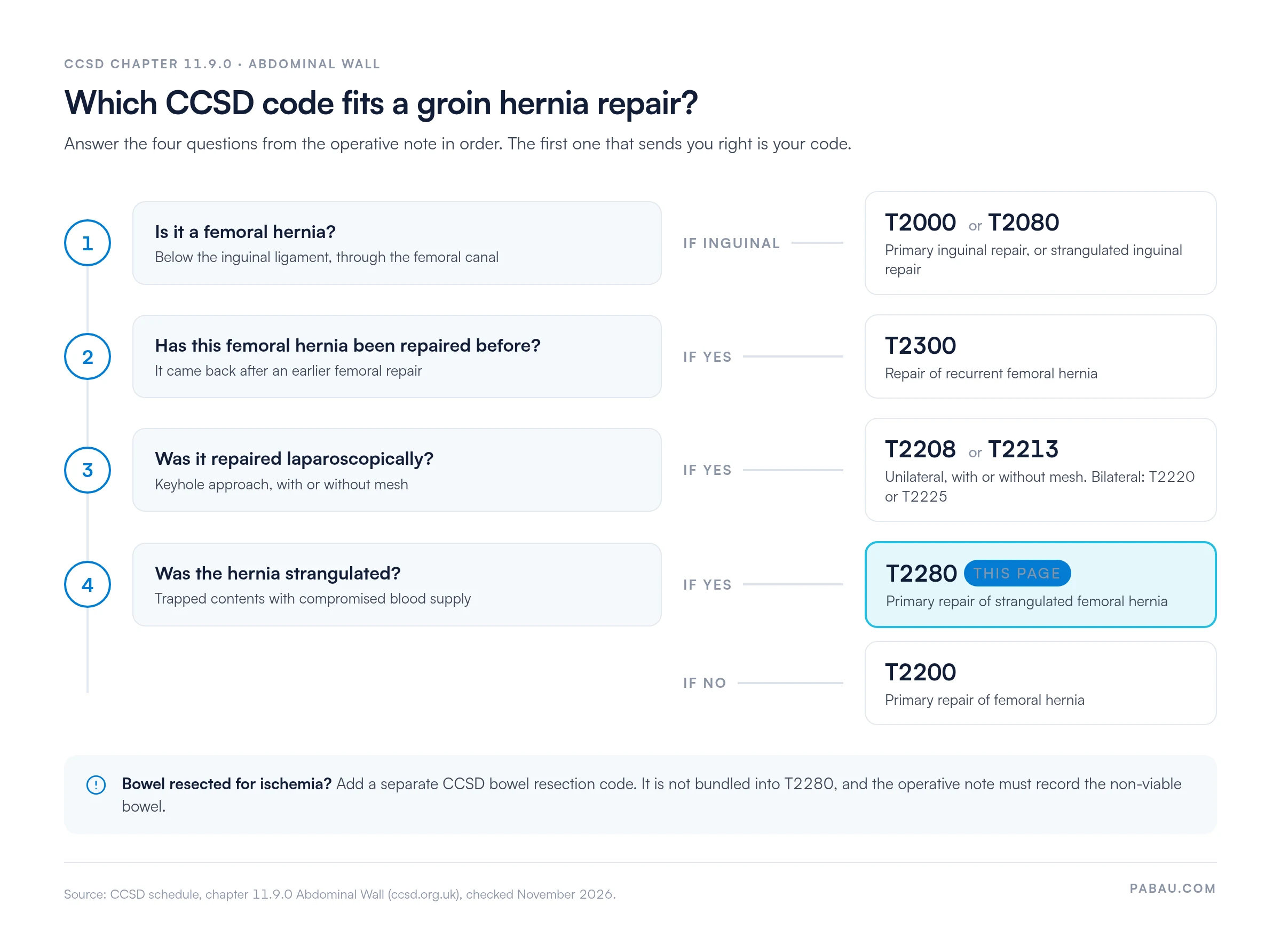
Femoral and inguinal hernias both present as groin lumps, but they are anatomically distinct and carry separate CCSD codes. A femoral hernia protrudes through the femoral canal, medial to the femoral vein and below the inguinal ligament. An inguinal hernia passes through the inguinal canal above the inguinal ligament, and its open primary repair is coded T2000.
The operative note must name the type of hernia found at surgery, not simply “groin hernia.” Without it, insurers cannot validate the T2280 code and will usually return the claim for clinical clarification.
Femoral hernias are estimated to strangulate in roughly 15% to 20% of cases, compared with around 3% for inguinal hernias. That is why femoral hernias more often present as emergencies and generate T2280 claims rather than T2200 claims.
Bowel resection performed because strangulation has caused ischemia needs a separate CCSD procedure code, as it is not bundled into T2280. CCSD coding convention treats each distinct surgical procedure as separately codeable. The operative note must document:
With those findings documented, the matching CCSD small bowel resection code goes on the claim alongside T2280. Each procedure is priced separately on the insurer fee schedule. Submitting T2280 alone for a case that also involved bowel resection undervalues the work and understates surgical complexity. That can weaken audit responses and future pre-authorization decisions.
Omentum follows a different rule. T3600 covers wedge excision of omentum as a sole procedure, so it is not added when strangulated omentum is trimmed during a T2280 repair.
UK private insurers require an ICD-10 diagnosis code alongside the CCSD procedure code on every claim submission. For T2280 claims, the diagnosis code must reflect the strangulated femoral hernia documented in the operative note.
Always cross-reference the current NHS Classifications Browser for UK ICD-10 5th edition coding. That is the edition NHS England uses and UK private insurers recognize. The K41 codes above follow the WHO ICD-10 classification, so confirm the 5th edition codes before submitting.
Always record the laterality (left, right, bilateral) and the strangulation finding (obstruction, gangrene, or viable contents at repair) in the operative note. These two data points directly determine which K41 code pairs with T2280, and they prevent the most common insurer query on femoral hernia claims.
Strangulated femoral hernia repair is a surgical emergency. Most UK private insurers accept that pre-authorization cannot come before an emergency operation, so they run a retrospective authorization pathway. The usual requirement is to notify the insurer within 24 to 72 hours of admission, or as soon as practicable. Specific timelines vary by insurer and by policy year.
Whatever the insurer, the authorization reference number must appear on the claim submission. Claims submitted without one are routinely returned as incomplete, even for emergency cases.
UK private insurer rejections on T2280 claims typically fall into five categories. Most are preventable with complete documentation before submission.
Before submitting a T2280 claim, check that the following documentation is in place. This checklist addresses the most common rejection triggers identified above.
Bilateral strangulated femoral hernia repair in a single operative episode is uncommon, but it does occur. CCSD does not use modifier codes the way CPT does. Depending on the insurer’s schedule, bilateral procedures are usually handled in one of two ways:
The bilateral rule varies by insurer. Check the current fee schedule at the Bupa code search portal and the equivalent portals for other insurers before submitting a bilateral T2280 claim. CCSD also notes that its unacceptable-combination principles may not apply when different hernias are repaired at the same time, so contact the insurer first.
Document both sides separately in the operative note, including the strangulation finding on each side.
For bilateral femoral hernia repairs, write two distinct sections in the operative note, one for each side. Document the strangulation finding, reduction, bowel viability assessment, and repair method for each side independently. A single combined narrative raises the risk that the insurer’s clinical audit team queries or disallows the second procedure.
Every CCSD claim a UK surgical practice sends carries three references that have to agree. The procedure code, the diagnosis code and the authorization reference must all match the findings in the operative note. When each one is entered at a different point in the patient record, the claim drifts away from the operation. Insurer queries and payment delays follow.
Pabau’s claims management software keeps the CCSD procedure code and the ICD-10 diagnosis code on the same patient episode. The insurer’s authorization code, dates and sessions sit on the case, with a warning when one is missing. UK claims then go out through Healthcode or directly to Bupa.
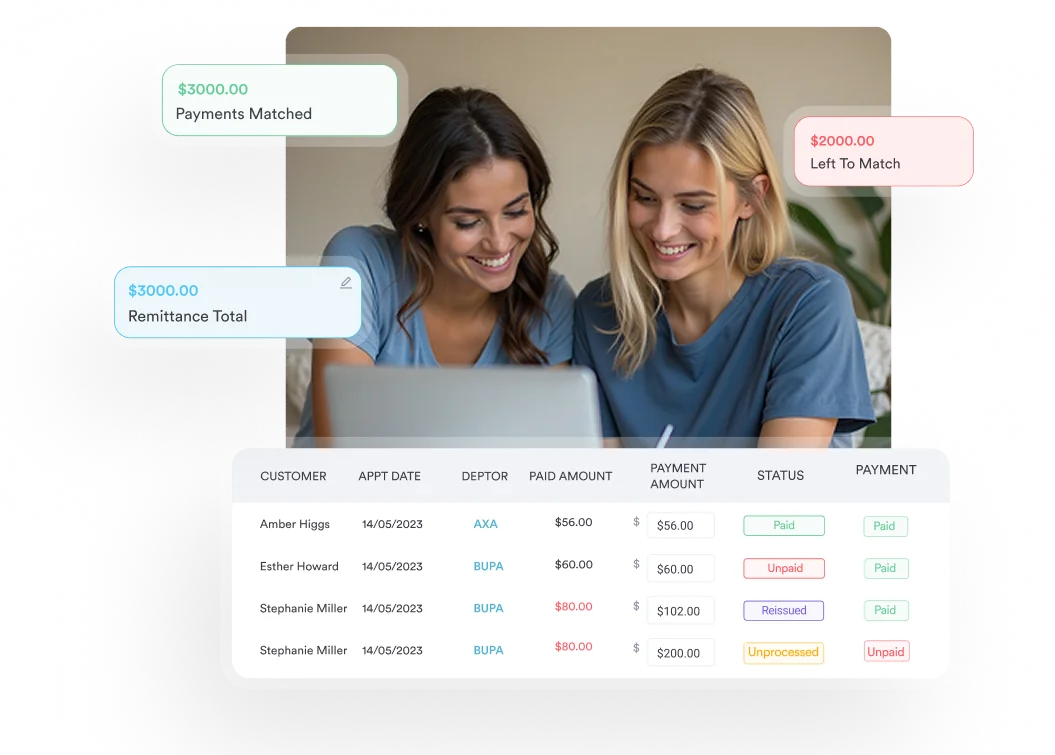
Pabau’s digital forms can also carry the operative note template itself, with fields for hernia type, strangulation and bowel viability. The billing team then reads structured answers instead of searching free text, and fewer T2280 claims come back for clarification.


Pabau keeps the CCSD code, the ICD-10 diagnosis and the insurer authorization on one patient episode, so T2280 claims leave complete. See how it works for your practice.

A T2280 claim stands or falls on four facts in the operative note. The hernia was femoral, it was strangulated, it had not been repaired before, and the repair was open. Each fact rules out a neighboring code, and an insurer that cannot find one will query the claim.
Build those four facts into the operative note template, and add a bowel resection code whenever ischemic bowel comes out. The trade-off is a few extra fields for the surgeon against fewer returned claims for the billing team.
Book a demo to see how Pabau keeps CCSD codes, ICD-10 pairings and authorization references on one episode for your surgical practice.

Need a full reference for Bupa procedure codes? Bupa CCSD codes covers the complete Bupa procedure code schedule with fee guidance for UK private practice billing.
Looking for broader private practice billing support? Claims management software explains how Pabau handles CCSD claim preparation, insurer submission, and rejection tracking.
Coding a keyhole groin repair instead? CCSD code T2002 covers laparoscopic inguinal hernia repair and how it differs from the open codes.
Billing an abdominal wall repair after surgery? CCSD code T2502 covers laparoscopic repair of an incisional hernia.
CCSD code T2280 covers open primary repair of a strangulated femoral hernia, usually performed as an emergency or urgent admission in UK private healthcare. The code applies when the hernia contents are trapped in the femoral ring with compromised blood supply. It does not cover laparoscopic repair (T2208 or T2213), recurrent hernia repair (T2300) or repair of a non-strangulated femoral hernia (T2200).
No. T2280 covers open primary repair only. A laparoscopic femoral repair takes its own CCSD code, such as T2208 with mesh or T2213 without mesh for one side. Submitting T2280 for a laparoscopic procedure invites a clinical audit query from the insurer.
No. Bowel resection is not bundled into T2280. When intraoperative assessment confirms non-viable bowel, a separate CCSD bowel resection code goes on the claim alongside T2280. The operative note must document the ischemia or gangrene, the length of bowel resected and the anastomotic technique used.
The most common reason is an operative note that never states the hernia was strangulated. Other triggers are an inguinal CCSD code submitted for a femoral hernia and a missing retrospective authorization reference. An inguinal diagnosis code (K40.x) paired with T2280 also flags automatically during insurer claim processing.
Most T2280 claims pair with K41.3, unilateral or unspecified femoral hernia, with obstruction, without gangrene. If the surgeon finds gangrene, use K41.4, unilateral or unspecified femoral hernia, with gangrene. For a bilateral strangulated repair, K41.0 or K41.1 applies, depending on whether gangrene was present. Confirm the UK ICD-10 5th edition codes in the NHS Classifications Browser.





