

HCPCS Code L0472: Hyperextension TLSO billing guide
HCPCS code L0472: Official descriptor and device definition HCPCS code L0472 des...

Last Updated: Nov 5, 2026
49585 is a deleted CPT code for repair of umbilical hernia, age 5 years or older; reducible. The AMA deleted it effective January 1, 2023, so it is valid only for dates of service before that day.
For a repair on or after January 1, 2023, report 49591-49596 for an initial anterior abdominal hernia repair, or 49613-49618 for a recurrent one. The code turns on total defect size and on whether the hernia is reducible or incarcerated/strangulated.
Let Pabau's smart automation suggest the right codes, reduce claim denials, and keep your practice compliant—effortlessly.
Automate repetitive tasks and focus on what matters most—your patients.
Reduce coding errors and ensure compliance with the latest regulations.
Clean claims, fewer denials, and faster reimbursements.
Powerful insights and reporting to help your practice thrive.
HIPAA compliant SOC 2 certified GDPR-compliant Trusted by 4,000+ clinics worldwide

CPT code 49585 (open repair of a reducible umbilical hernia, age 5 or older) was deleted on January 1, 2023. Use it only for earlier dates of service.
Umbilical hernia repairs from 2023 onward use 49591-49596 for an initial repair or 49613-49618 for a recurrent one.
The new codes are chosen by total defect size and by whether the hernia is reducible or incarcerated/strangulated, not by age or approach.
The 2023 codes include mesh when placed and carry a 0-day global period, where 49585 carried a 90-day one.
Record the total defect size in centimeters in the operative note, or the claim falls back to the smallest size band.
CPT code 49585 was the code for repair of a reducible umbilical hernia in a patient aged 5 years or older.
The American Medical Association (AMA) deleted it from the CPT code set effective January 1, 2023.
So the code now has two answers, depending on the date of service. For a repair on or before December 31, 2022, 49585 is still the code that claim carries. For any later repair, payers reject 49585 as a deleted code, and the procedure is billed with the new anterior abdominal hernia codes.
The old codes split hernia repair by hernia type, patient age and approach. The 2023 codes drop all three. They group epigastric, incisional, ventral, umbilical and spigelian hernias together as anterior abdominal hernias, repaired by any approach. Each repair is then graded by total defect size and by whether the hernia is reducible or incarcerated/strangulated.
The same change deleted 18 hernia repair codes in all. That includes the open codes 49560, 49561, 49565, 49566, 49568, 49570, 49572, 49580, 49582, 49585, 49587 and 49590, plus the laparoscopic codes 49652-49657. Inguinal and femoral hernia repair codes were not part of this change.
For a pre-2023 claim, 49585 applied when three conditions were met. The hernia was umbilical or paraumbilical, the patient was at least 5 years old, and the hernia was reducible. An incarcerated or strangulated umbilical hernia in the same age group used 49587, and a laparoscopic repair used 49652 or 49653.
49585 carried a 90-day global surgical period. The surgical fee bundled the repair itself with routine follow-up visits, wound checks and suture removal for 90 days after surgery.
Corrected claims and appeals for repairs performed in 2022 or earlier still use 49585. Code by the date of service, not the date you submit or resubmit the claim.
From January 1, 2023, an umbilical hernia repair is reported with one code from two parallel ranges. Use 49591-49596 for an initial repair and 49613-49618 for a recurrent repair at a previously repaired site. Each code covers open, laparoscopic and robotic approaches, and includes mesh when it is placed.
Two more codes complete the family. 49621 and 49622 cover parastomal hernia repair, initial or recurrent, reducible or incarcerated/strangulated respectively. Add-on code 49623 reports removal of total or near-total non-infected mesh at the time of any of these repairs.
Most repairs that would once have been billed as 49585 now map to 49591, 49593 or 49595. The defect size in the operative note decides which one.
Approach no longer changes the code. A laparoscopic repair converted to open takes the same code as either approach alone. The operative note should still record the conversion and its reason. Three other facts in the note do pick the code, and the path below shows them in order.
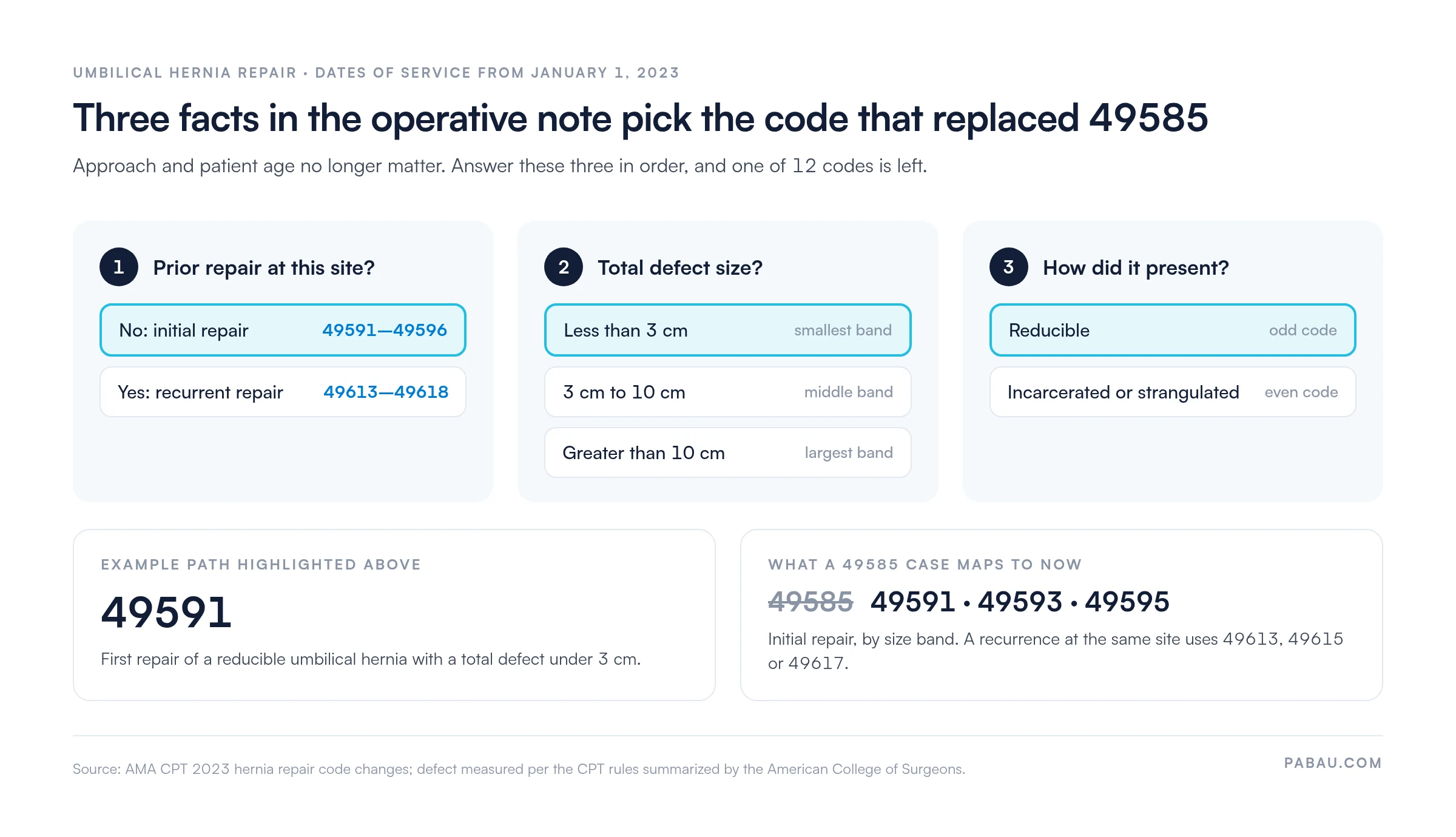
The size band is the step most likely to go wrong, because 49585 never asked for it. The CPT measuring rules, as summarized by the American College of Surgeons, work like this:
If the operative note gives no defect size, the claim can only support the smallest size band. That makes the measurement a revenue issue as well as a coding one.
Add a structured field to your hernia operative note template for total defect size in centimeters, plus a choice of reducible, incarcerated or strangulated. Those two fields decide the code, so the coder never has to infer them from narrative text.
The ICD-10-CM codes for umbilical hernia split by complication status, which lines up with the reducible versus incarcerated/strangulated split in the procedure codes.
K42.9 is the usual pairing for a routine elective repair of a reducible hernia. K42.0 also indexes incarcerated and irreducible umbilical hernias without gangrene, so it rarely fits a reducible repair code. When the diagnosis and the procedure code disagree on presentation, payer edits may flag the claim for review.
Reconcile both codes against the operative note before you submit. A K42.1 diagnosis points to a strangulated hernia, so it pairs with an incarcerated or strangulated repair code. When the same session repairs a ventral, incisional or epigastric hernia, report those defects with their own K43 diagnosis codes.
Standard surgical modifier rules apply to both the deleted 49585 and the 2023 codes. The shorter global period changes how often some of them come up.
CMS NCCI edits exist between hernia repair codes and some concurrent abdominal procedures. Before billing a repair alongside another abdominal code on the same date of service, check the specific edit pair in the current NCCI table. Modifier 59 or an X-modifier overrides an edit only when the clinical scenario supports a distinct service.
The operative note has to support every element the new codes are built on. Payers reviewing hernia repair claims look for these details, and a missing one can lead to a denial or a records request.
Local coverage determinations from your Medicare Administrative Contractor may add criteria, so check your MAC’s current policy for hernia repair. Pabau, the practice management platform we build, includes claims management software that scrubs every claim for missing or invalid details before it leaves the practice. Its Claim.MD clearinghouse connection adds eligibility verification before the visit.
Medicare pays each code from its relative value units (RVUs) in the Medicare Physician Fee Schedule. The RVUs are multiplied by the annual conversion factor and adjusted by your locality’s geographic practice cost index (GPCI). RVUs and the conversion factor change each year, so look up current values in the CMS Physician Fee Schedule lookup tool.
Facility rates for a hospital outpatient department or an ambulatory surgery center are lower than non-facility rates, because the facility bills its own costs separately. Medicare Advantage and commercial plans pay according to their own contracts, so verify each plan’s rate for the new codes.
The global period changed with the codes. 49585 carried a 90-day global period, which bundled these services into the surgical fee:
The 2023 codes, 49591-49596 and 49613-49618, carry a 0-day global period. After the day of surgery, postoperative E/M visits are separately reportable under these codes. Update any follow-up visit rules your practice built around the old 90-day window, or those visits go unbilled.
For teams reconciling payments, Pabau settles insurer payments from electronic remittance advice files in the US. The guide to electronic remittance advice processing shows how that workflow operates, from the remittance file to the posted payment.
Several common hernia repair denials since 2023 trace back to the code change itself. Each one below can be prevented before submission.
When a hernia repair claim is denied, the appeal depends on the reason. The CARC and RARC codes on the remittance state that reason, and a guide to decoding denial codes explains each one.
For a deleted-code denial, submit a corrected claim with the right 2023 code. For a medical necessity denial, attach the operative note with the size and presentation highlighted. Pabau’s guide to denial management in healthcare covers the full appeal workflow.
Run a report of hernia repair claims with 2023 or later dates of service that still carry 49585. A stale fee schedule or charge template is a common source, and one fix clears every future claim.
The 2023 change moved the code decision into the operative note: defect size, presentation and repair history now pick the code. Practices that still handle claims by hand lose time at each handoff between the note, the coder and the clearinghouse.
Pabau keeps the note, the code and the clearinghouse submission in one system, so a claim error surfaces before the payer sees it.
For the compliance side of surgical billing, Pabau’s guide to medical billing compliance covers how to keep coding policies current as code sets change.

Pabau scrubs every claim for missing or invalid details, tracks insurer authorizations as cases, and checks eligibility through Claim.MD before the visit.

CPT code 49585 belongs to claims for repairs performed before 2023, and nowhere else. For any repair since, the work is reading the operative note correctly: initial or recurrent, total defect size, and reducible or incarcerated. Get those three facts into the note at the time of surgery, and the right code from 49591-49596 or 49613-49618 follows.
Pabau scrubs claims for missing or invalid details, tracks authorizations and submits through Claim.MD. A coding error gets caught before it costs you a denial. To see how it works for a surgical practice, book a demo.

Need a clearinghouse that checks claims before submission? Pabau’s Claim.MD clearinghouse guide explains how pre-submission edits catch claim errors before the payer sees them.
Want to understand how remittance advice works for surgical claims? Electronic remittance advice processing covers how ERA data maps to expected surgical reimbursement.
Building a denial prevention workflow for your surgery practice? Denial codes in medical billing breaks down the CARC and RARC codes that appear on denied hernia repair claims.
CPT code 49585 described the repair of a reducible umbilical hernia in a patient aged 5 years or older. The AMA deleted it effective January 1, 2023. It now applies only to claims for repairs performed before that date.
No. CPT code 49585 is valid only for dates of service on or before December 31, 2022. For any later repair, payers reject it as a deleted code, so you report a code from the 2023 anterior abdominal hernia family instead.
An initial umbilical hernia repair now uses 49591-49596, and a recurrent repair uses 49613-49618. Each range is split by total defect size: under 3 cm, 3 to 10 cm, or over 10 cm. It is also split by reducible versus incarcerated or strangulated presentation. A first repair of a reducible defect under 3 cm, for example, is 49591.
Both were open umbilical hernia repair codes for patients aged 5 or older, and both were deleted on January 1, 2023. 49585 covered a reducible hernia, while 49587 covered an incarcerated or strangulated one. That distinction lives on in the new codes, alongside the total defect size.
K42.9 (umbilical hernia without obstruction or gangrene) usually supports a reducible repair code. K42.0 (with obstruction, without gangrene) and K42.1 (with gangrene) usually support an incarcerated or strangulated code. Confirm the pairing against the operative note, since the diagnosis and the procedure code should agree on presentation.
The 2023 anterior abdominal hernia repair codes, 49591-49596 and 49613-49618, carry a 0-day global period. CPT 49585 carried a 90-day global period. Under the new codes, postoperative E/M visits after the day of surgery can be reported separately.
No. Mesh implantation is included in 49591-49596, 49613-49618 and the parastomal codes 49621-49622. The one related add-on is 49623, which reports removal of total or near-total non-infected mesh during the repair.



