CCSD Code S5535: Description, tariff, medical aid and claim requirements
CCSD Code S5535: Official description and procedure scope CCSD Code S5535 is a b...

Last Updated: Nov 20, 2026
CPT code 46320 reports excision of a thrombosed external hemorrhoid, where the surgeon removes the clot or the thrombosed mass intact through an incision. It sits in the Anus range of CPT surgery codes (46020-46999) and carries a 10-day global period.
The operative note decides between 46320 and 46083. Excised, enucleated or removed intact supports 46320, while incision with the clot expressed or drained points to 46083.
Let Pabau's smart automation suggest the right codes, reduce claim denials, and keep your practice compliant—effortlessly.
Automate repetitive tasks and focus on what matters most—your patients.
Reduce coding errors and ensure compliance with the latest regulations.
Clean claims, fewer denials, and faster reimbursements.
Powerful insights and reporting to help your practice thrive.
HIPAA compliant SOC 2 certified GDPR-compliant Trusted by 4,000+ clinics worldwide

CPT code 46320 covers excision of a thrombosed external hemorrhoid, where the clot or mass is removed intact rather than incised and drained.
K64.5 (perianal venous thrombosis) is the primary ICD-10-CM diagnosis code paired with 46320.
46320 carries a 10-day global surgery period. A same-day E/M is separately reportable only with modifier 25.
The 2026 Medicare Physician Fee Schedule assigns 46320 a work RVU of 1.60.
Pabau’s claims management software sends claims through the Claim.MD clearinghouse and checks patient eligibility before the procedure.
CPT code 46320 is the procedure code for excising a thrombosed external hemorrhoid, either the intact clot or the whole thrombosed mass. AAPC’s code entry for 46320 describes it the same way: the provider excises an external thrombosed hemorrhoid below the dentate line.
The AMA lists 46320 in the Surgery section under Digestive System, Anus, with the official descriptor Excision of thrombosed hemorrhoid, external. The surgeon usually works in the office or an outpatient setting, incising over the thrombosis and removing the clot or the mass in one piece.
The AMA’s CPT Editorial Panel revises descriptors as clinical practice changes. That is why older references still quote the earlier “enucleation or excision” wording for 46320. The procedure is also distinct from a formal hemorrhoidectomy (46250, 46255 or 46260), which removes whole hemorrhoid columns for chronic disease.
The surgeon incises the skin over the thrombosed hemorrhoid and removes the intact clot or the whole thrombosed mass. The wound is left open or closed loosely. What decides the code is what happens to that tissue. Removal intact supports 46320, while expression or drainage alone does not.
Op-note language that supports CPT code 46320:
Op-note language that points to 46083 instead:
The distinction matters for medical billing because the two codes reimburse differently and are not interchangeable. A well-documented operative note that uses enucleation or excision language is the coder’s clearest signal to assign 46320.
CPT 46320 covers intact removal of the thrombosed mass. CPT 46083 covers incision only, with the clot expressed but not formally excised. The two are easy to confuse, because both procedures start with an incision over the same thrombosis.
When the operative note is ambiguous, query the surgeon before coding. Never upcode from 46083 to 46320 on assumption. Billing a higher-value service than the record supports is a compliance risk the Office of Inspector General (OIG) audits for.
Four related codes are often confused with CPT code 46320 in colorectal surgery billing. What separates them is the extent of resection, and whether the procedure treats acute thrombosis or chronic hemorrhoidal disease.
CPT code 46320 is the right choice only when the documented indication is acute thrombosis and the technique is excision or enucleation. Chronic hemorrhoidal disease treated surgically routes to 46250, 46255 or 46260 instead. The chart below runs the two questions in order, indication first and technique word second.
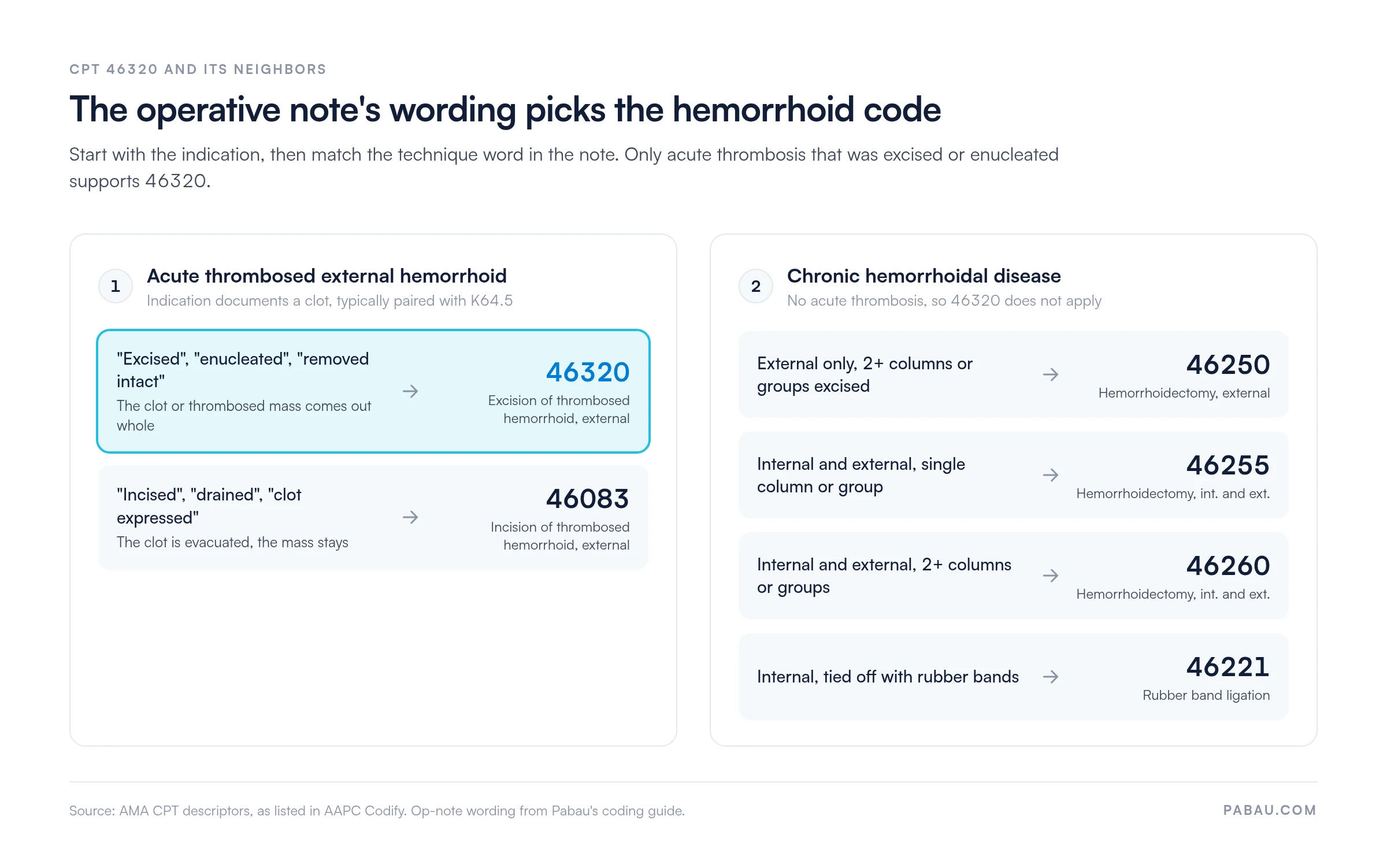
Whichever code applies, the indication has to be documented as clearly as the technique.
Before assigning 46320, confirm three things in the operative note. The indication is acute thrombosis, not chronic hemorrhoidal disease. The technique word is excision or enucleation, not incision or drainage. And the site is external, not internal. All three must be present to support medical necessity.
The primary ICD-10 diagnosis code paired with CPT code 46320 is K64.5 (Perianal venous thrombosis). It maps directly to the clinical indication of an acutely thrombosed external hemorrhoid. Payer medical necessity logic links the procedure code to this diagnosis, so a mismatch triggers a denial.
Confirm the ICD-10 code year against the current CDC/NCHS ICD-10-CM web tool, as codes are updated each October. K64.5 has stayed stable across recent code years, but verify it before billing. The rest of the hemorrhoid range, from internal hemorrhoid grades to skin tags, sits in our K64.0-K64.9 reference.
A clean claim for CPT code 46320 starts with an operative or procedure note that documents all of the following elements. Missing any one of them is an audit exposure and a denial risk.
Payers conducting post-payment audits look specifically for the technique description. Notes that describe the procedure only as “hemorrhoid removed” without specifying enucleation or excision invite downcoding to 46083 on recoupment review.
Modifiers, the global period and place of service all shape a 46320 claim, so work through them together when you prepare it.
CPT code 46320 carries a 10-day global surgery period. Routine follow-up visits within that window are bundled into the procedure payment and can’t be billed separately. Under Medicare rules, treating a complication without a return to the operating room stays inside the global payment too. An unrelated E/M visit during the global period takes modifier 24, and an unplanned return to the operating room takes modifier 78.
When billed from a physician office (POS 11), the physician collects both the professional and practice expense components of the Medicare Physician Fee Schedule rate. When performed in an outpatient hospital (POS 22) or an ambulatory surgery center (POS 24), the facility bills its own fee. The physician is then paid the lower facility rate. For most colorectal practices, the in-office setting yields higher total physician reimbursement for 46320.
Medicare reimbursement for CPT code 46320 is calculated from the Medicare Physician Fee Schedule (MPFS), which CMS updates each January. The CMS Physician Fee Schedule lookup tool is the authoritative source for current rates. Verify the figures below against the current year’s schedule before you use them in billing decisions.
Use the FastRVU 2026 lookup tool for a quick check of work, practice expense, and malpractice RVU values by locality. Commercial payers don’t publish their rates, so check your contracts or payer portals for what you are paid for CPT code 46320.
Denials on CPT code 46320 cluster around a handful of root causes. The claim denial codes you will see most are CO-50 (not medically necessary) and CO-11 (diagnosis inconsistent with procedure). CO-4 appears when the procedure code is inconsistent with the modifier used, or a required modifier is missing.
Run a quarterly denial audit on all 46320 claims. Sort by denial reason code. If CO-50 (medical necessity) appears more than twice in 90 days, the problem starts in documentation. Retrain the surgeon or the transcriptionist on what the op note must state. If CO-4 recurs, review how your team applies modifiers 25 and 59.
Every denial in the table above starts before the claim is built. The op note says “drained” where the coder read “excised”, the diagnosis lands on K64.9, or a same-day visit goes out without modifier 25. Catching those is easier when the note, the code and the claim live on one record.
Pabau, a practice management platform with built-in insurance billing, keeps the signed operative note and the claim on the same patient record. The biller codes from the note itself, not a re-keyed summary.
Where a commercial or Medicaid plan needs prior authorization, the auth code sits on the case, and Pabau warns the team when it is missing.
Pabau’s surgical practice claims software sends claims through the Claim.MD clearinghouse and checks patient eligibility before the procedure. Remittances come back against the same record, so a rejected 46320 claim reaches the biller the day it happens.

Pabau sends claims through the Claim.MD clearinghouse, checks patient eligibility before the procedure, and posts remittances to the patient record. Your billing team spends less time reworking denied anorectal claims.

A 46320 claim is won or lost in the operative note. If the surgeon writes excised or enucleated, and the indication is an acute thrombosis coded K64.5, the code holds up on audit. If the note says drained, bill 46083 and move on.
The trade-off is a little time at the front end. A quick query to the surgeon costs far less than a recoupment letter months later, and it makes the next note clearer. Book a demo to see how Pabau keeps the signed op note, the code and the claim on one patient record.

Need a full denial management framework? Denial management in healthcare covers root-cause analysis, appeal workflows, and prevention strategies for high-volume surgical practices.
Submitting claims electronically for the first time? Claim.MD clearinghouse guide explains how the clearinghouse validates claims, routes them to payers, and returns remittance data.
Want to understand ERA and payment posting? Electronic remittance advice explained breaks down 835 remittance files and how to read CARC and RARC denial reason codes.
CPT code 46320 is the billing code for excision of a thrombosed external hemorrhoid. The clot or the clotted hemorrhoidal mass is removed intact. It differs from CPT 46083, which covers incision only, without formal excision.
CPT 46320 covers excision or enucleation of the thrombosed mass. CPT 46083 covers incision of the thrombosed hemorrhoid with expression or drainage of the clot. The operative note must name the technique. “Excised” or “enucleated” supports 46320, while “incised and drained” supports 46083.
K64.5 (Perianal venous thrombosis) is the primary ICD-10-CM pairing for CPT code 46320. Using K64.9 (unspecified hemorrhoids) or K64.4 (residual skin tags) instead usually brings a medical necessity denial. Neither diagnosis documents acute thrombosis.
Medicare generally does not require prior authorization for CPT 46320, but many commercial and Medicaid plans do. Check the payer’s authorization rules before scheduling the procedure. A claim submitted without a required authorization is one of the most preventable denials for this code.
CPT code 46320 carries a 10-day global surgery period. Routine follow-up visits within this window are included in the procedure payment and cannot be billed separately. Under Medicare rules, treating a complication without a return to the operating room is included too. An unrelated E/M visit during the global period takes modifier 24.
Yes, provided the E/M service is a significant, separately identifiable service beyond the decision to perform the procedure. Append modifier 25 to the E/M code and document the separate medical decision-making in the note. Then bill the E/M and 46320 on the same claim. Without modifier 25, the E/M will be bundled and denied.