

CPT Code 52352: Ureteroscopic stone removal billing guide
CPT Code 52352: Official descriptor and procedure overview CPT Code 52352 descri...

Last Updated: Oct 30, 2026
44238 is the CPT code for an unlisted laparoscopy procedure on the intestine, excluding the rectum. Surgeons report it when a laparoscopic intestinal procedure has no specific code in the 44180-44227 range. A common example is laparoscopic repair of an internal hernia of the small intestine.
44238 has no national Medicare payment rate, so the payer prices each claim individually. The operative report and a named comparable code decide whether the claim gets paid.
Let Pabau's smart automation suggest the right codes, reduce claim denials, and keep your practice compliant—effortlessly.
Automate repetitive tasks and focus on what matters most—your patients.
Reduce coding errors and ensure compliance with the latest regulations.
Clean claims, fewer denials, and faster reimbursements.
Powerful insights and reporting to help your practice thrive.
HIPAA compliant SOC 2 certified GDPR-compliant Trusted by 4,000+ clinics worldwide

CPT Code 44238 covers laparoscopic procedures on the small or large intestine, excluding the rectum, that no code from 44180 to 44227 describes.
It is a laparoscopy code, so intestinal endoscopy and enteroscopy are reported with 44360-44408, never 44238.
Every claim needs an operative report and a comparable listed code, such as 44050 for an internal hernia repair.
Original Medicare generally needs no prior authorization for 44238, while many commercial and Medicare Advantage plans require it.
Pabau’s claims management software flags missing attachments before a 44238 claim is submitted.
CPT Code 44238 is the unlisted code for a laparoscopic procedure on the intestine, excluding the rectum. Its full descriptor reads “Unlisted laparoscopy procedure, intestine (except rectum).” The American Medical Association (AMA) places it at the end of the Laparoscopy subsection of Intestines (Except Rectum), which runs from 44180 to 44238.
“Unlisted” does not mean unrecognized. It means the AMA has no dedicated descriptor yet for the laparoscopic technique the surgeon performed. Coders reach for 44238 only after confirming that no code from 44180 to 44227 captures the procedure.
Because 44238 carries no assigned relative value units (RVUs), it is priced by comparison to the closest listed code. Each Medicare Administrative Contractor (MAC) uses that comparison to decide what, if anything, to pay.
CPT Code 44238 covers laparoscopic procedures on the small or large intestine, excluding the rectum, where no specific listed code describes the work. The example CPT Assistant and the American College of Surgeons (ACS) cite is laparoscopic repair of an internal hernia of the small intestine. It also fits a laparoscopic intestinal procedure that has an open-surgery code but no laparoscopic one.
Payers do not all agree on this code. Some ask for 44799 (unlisted procedure, small intestine) instead, so check the payer’s policy before you submit. Code 49659 is for abdominal wall hernias. CPT Assistant says it is not correct for an internal hernia, which goes to 44238.
Procedures that should not be reported under 44238:
The decision path below runs those exclusions in the order a coder checks them, so each “no” lands on the code that does apply.
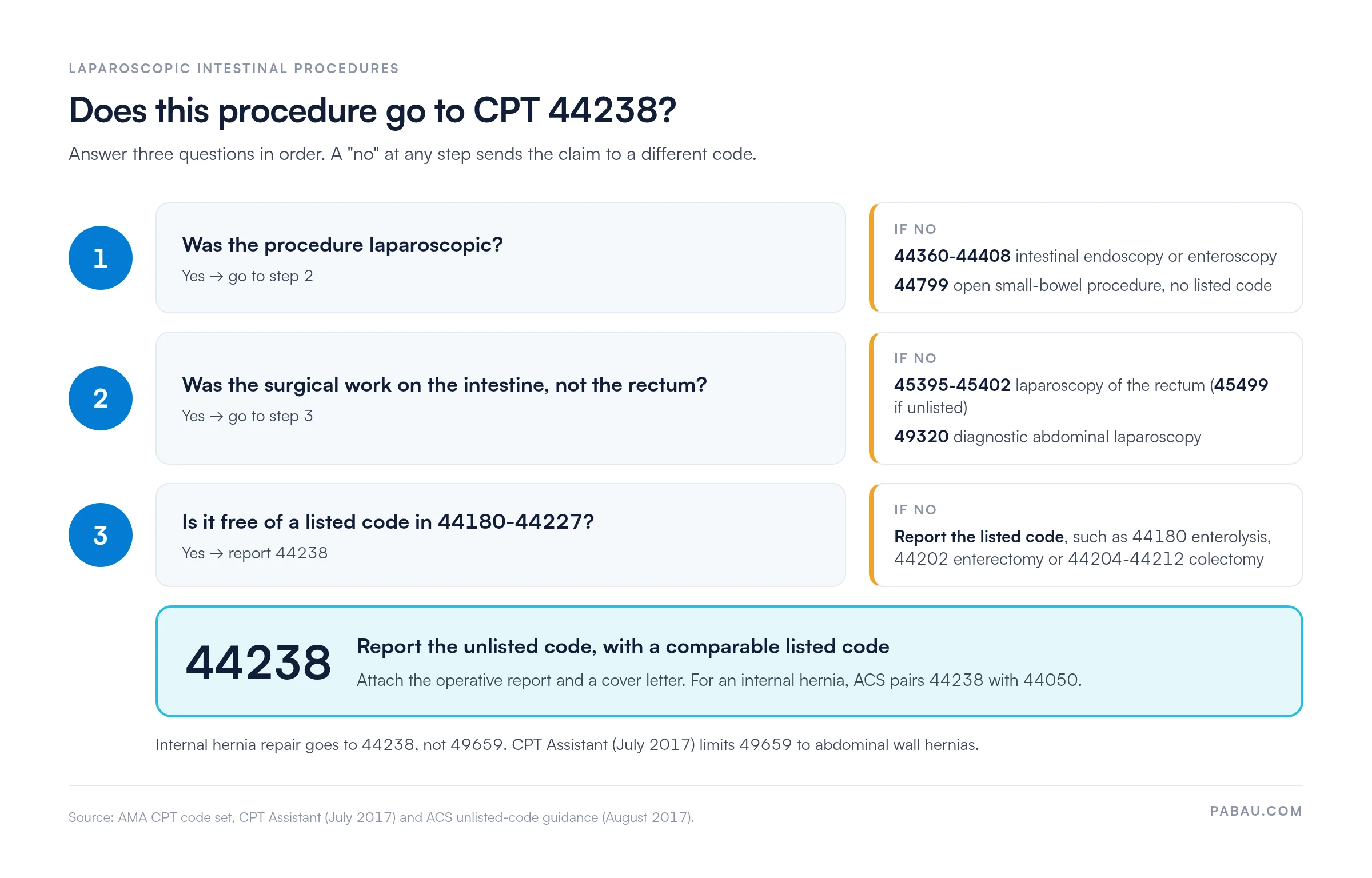
If any listed code describes the procedure, the coder must use it. Choosing 44238 when a specific code exists is a leading cause of denial for unlisted claims.
Pabau, the practice management platform we build, tracks code assignments alongside documentation in its claims software for coders. It flags any claim where an unlisted code is selected without a comparable code noted.
Selecting the correct code starts with ruling out every listed alternative. The table below covers the listed codes in the same laparoscopy subsection, plus the unlisted and open codes most often confused with it.
The hierarchy is simple: If a listed code exists, use it. An unlisted code is always the option of last resort, never a coding shortcut.
Three conditions must all be true before CPT Code 44238 is the correct choice.
Failing condition two is the most common coding error: Using 44238 because it is “close enough” when a listed code exists. According to the AMA CPT code set guidelines, unlisted codes are for procedures no specific code describes. Payers routinely deny an unlisted claim when a listed code applies.
Before submitting a 44238 claim, document your comparable code search in writing. Note every listed laparoscopic intestinal code you considered and the clinical reason each was ruled out. This narrative becomes Exhibit A if the claim is denied and you file an appeal.
Missing or incomplete documentation is the primary cause of 44238 denials. A clean claim for an unlisted code needs more supporting material than any listed procedure. Every 44238 claim needs all four of the following before it leaves the practice.
Of the four, the operative report carries the most weight. It is the payer’s only record of what the surgeon did, and every clean claim for an unlisted procedure is built around it.
Prior authorization for CPT Code 44238 depends on the payer. Original Medicare generally does not require prior authorization for unlisted procedure codes. It reviews the claim after the service instead, using the documentation you submit.
Many commercial payers and Medicare Advantage plans do require prior authorization for unlisted codes. Because 44238 has no preset payment rate, these plans review each case individually. Always verify the requirement with the specific plan before scheduling the procedure.
A prior authorization (PA) request for CPT Code 44238 typically includes:
When a plan has no request form of its own, a standard prior authorization form captures these details in one document.
Proceeding without authorization when a payer requires one results in a denial that is difficult to overturn on appeal. The payer’s position is procedural rather than clinical.
Medicare has no national fee schedule rate for CPT Code 44238. The code is carrier-priced, so the MAC for the practice’s region sets payment case by case. It uses the comparable listed code the physician submits as a pricing reference. According to CMS Physician Fee Schedule guidance, the MAC reviews each unlisted claim individually before deciding on payment.
Pabau integrates with Claim.MD, a clearinghouse that routes claims to the correct MAC. The integration also supports the electronic remittance advice (ERA) workflow once a pricing determination comes back.
The National Correct Coding Initiative (NCCI) governs which codes can and cannot be billed together. CMS updates NCCI edits quarterly, so check the current edit status before billing 44238 alongside other procedures. The CMS NCCI edits page publishes the edit tables and the NCCI Policy Manual. Chapter 6 of that manual covers digestive system procedures.
Key NCCI considerations for CPT Code 44238:
Never apply a modifier defensively without documentation to support it. Unsupported modifier use creates audit risk and does not guarantee payment.
Unlisted codes attract more scrutiny than listed ones, because a reviewer prices each claim by hand. Knowing the exact cause of a denial shapes the appeal strategy. Our denial code reference lists the reason and remark codes that accompany each denial type below.
An unlisted claim has already been reviewed by hand once, so an appeal has to answer the payer’s specific objection. A structured denial management workflow recovers more revenue than ad-hoc resubmissions. Follow these steps in sequence, and use a medical appeal form to keep each packet consistent.
Request an ERA for every 44238 claim, even when you expect payment. The ERA delivers CARC and RARC codes in a standardized format you can cross-reference against the NCCI edit tables. Manual EOB review misses the detail that makes appeals winnable.
Many practices still track unlisted code claims in spreadsheets and email threads. A missing operative report or comparable code then surfaces only when the denial arrives, weeks after the procedure.
Pabau’s claims management software tracks which attachments each unlisted claim needs and flags any that are missing before submission. Claims then go out through the Claim.MD integration, and the ERA comes back into the same record.
The result is fewer denials for missing paperwork, and a complete file to support an appeal when a payer disputes the price.

Pabau’s claims management tools flag missing documentation, track comparable code submissions, and send claims through the Claim.MD integration. See how it works.

Treat 44238 as the code that remains once every listed option is ruled out. If a code from 44180 to 44227 describes the operative note, report that code and let the fee schedule price it.
When 44238 does apply, payment moves from a fee schedule to a reviewer. Send the operative report, a named comparable code and any PA approval with the first submission, and that reviewer has little reason to deny it.
The trade-off is time. An unlisted claim takes longer to build and longer to pay, so start the packet when the surgery is booked. Book a demo to see how Pabau keeps the operative report, comparable code and payer approval attached to every unlisted claim.

Need to understand how claim denials are classified? Denial codes in medical billing covers the CARC and RARC codes used across all claim types.
Waiting on a pricing decision for an unlisted claim? Electronic remittance advice explained shows how to read the ERA that comes back with the payer’s decision.
Planning a procedure a commercial plan must approve? The prior authorization process walks through each step from request to approval.
Want to streamline clearinghouse submission? How the Claim.MD clearinghouse works explains how claims route from the practice to the payer.
Tracking 837 file submissions for complex claims? 837 file formatting and submission covers the EDI transaction structure every electronic claim follows.
CPT Code 44238 is the unlisted code for a laparoscopic procedure on the intestine, excluding the rectum. Surgeons use it when no code from 44180 to 44227 describes the work, such as laparoscopic repair of an internal hernia. Medicare carrier-prices it, so the MAC sets payment case by case.
No. CPT Code 44238 is a laparoscopy code in the 44180-44238 range. Intestinal endoscopy, enteroscopy, and endoscopy through a stoma have their own codes in the 44360-44408 family.
Use CPT Code 44238 only after confirming three things. The procedure was laparoscopic and on the intestine, excluding the rectum. No listed code describes it. A comparable listed code can be named for pricing. If any listed code fits, use that code instead.
It depends on the payer. Original Medicare generally does not require prior authorization for unlisted codes such as 44238. Many commercial payers and Medicare Advantage plans do, so verify the requirement with the specific plan before the procedure.
Every 44238 claim requires a complete operative report and a cover letter naming the comparable listed CPT code. Clinical notes that establish medical necessity complete the packet. Missing the comparable code is a leading cause of denial.
Modifier 59, or an X-modifier (XS, XE, XP, XU), applies when 44238 is distinct from another procedure billed on the same date. Modifier 22 is not appended to an unlisted code, because there is no defined work value to increase. Describe the extra complexity in the cover letter instead.
The most common reasons are a listed code that fits the procedure, a missing operative report, no comparable code, or missing prior authorization. Claims also deny when 44238 bundles with another code without a valid modifier, or when the payer expects 44799 instead.



