HCPCS Code P9100: Platelet pathogen test
HCPCS code P9100: Definition and code history HCPCS code P9100 carries the offic...

Last Updated: Nov 2, 2026
43276 is the CPT code for ERCP with removal and exchange of a biliary or pancreatic duct stent, reported once for each stent exchanged. It includes pre- and post-dilation, guidewire passage and sphincterotomy when they are performed.
Coders most often confuse it with CPT 43274, which covers stent placement only, and CPT 43275, which covers removal only. Billing 43275 plus 43274 for one exchange triggers an NCCI bundling edit. A session that replaces two stents takes two units, each with its own documented removal and replacement.
Let Pabau's smart automation suggest the right codes, reduce claim denials, and keep your practice compliant—effortlessly.
Automate repetitive tasks and focus on what matters most—your patients.
Reduce coding errors and ensure compliance with the latest regulations.
Clean claims, fewer denials, and faster reimbursements.
Powerful insights and reporting to help your practice thrive.
HIPAA compliant SOC 2 certified GDPR-compliant Trusted by 4,000+ clinics worldwide

CPT Code 43276 covers ERCP stent removal and exchange, distinct from 43274 (placement only) and 43275 (removal only).
The code is billed once per stent exchanged, and sphincterotomy, dilation and guidewire passage are bundled when performed.
Billing 43275 plus 43274 for one exchange triggers National Correct Coding Initiative (NCCI) edits, so 43276 is the correct single code.
Pabau, the practice management platform we build, checks 43276 claims for missing or invalid details and tracks prior authorization codes before submission.
CPT Code 43276 covers an ERCP that removes an existing biliary or pancreatic duct stent and places a replacement in one session. The AMA descriptor has four parts:
The phrase “each stent exchanged” is the billing unit. A patient arriving for a routine biliary stent change has one stent exchanged: One unit of 43276. If the endoscopist exchanges a biliary stent and a pancreatic stent in the same session, two units are appropriate, provided each exchange is separately documented.
The bundling rules prevent two claim errors on 43276. One is billing services the descriptor already includes. The other is missing services that are legitimately separate.
Bundled into 43276 (do not separately report):
Separately reportable (when documented and meeting payer criteria):
Sphincterotomy is bundled when performed during the stent exchange. Reporting CPT 43262 (sphincterotomy) separately alongside 43276 for the same session is a frequent NCCI edit trigger. The AMA’s descriptor language “including sphincterotomy when performed” settles this question.
Coders who understand the procedure sequence can match documentation to the code descriptor more precisely, and they catch incomplete operative notes before submitting a claim.
Check every ERCP operative report for four elements before coding 43276. Look for documented removal of an existing stent and a guidewire passage note. Then confirm the new stent type and dimensions, and the duct location (biliary vs. pancreatic). A note missing any of these four elements is incomplete for 43276 and will likely generate an audit request or denial.
The operative or procedure note must substantiate every element of the code descriptor. Payers conduct post-payment audits on high-volume ERCP codes, and inadequate documentation triggers recoupment requests even when the clinical procedure was performed correctly.
A compliant 43276 procedure note includes all of the following. Review this list against the superbill documentation your practice generates for each ERCP session.
The 43260-43278 family covers the full range of ERCP interventions. Choosing the wrong code, or combining incompatible codes in the same session, is the source of most GI endoscopy claim denials.
For the stent codes, two questions settle the choice for each duct. Did the note record removal of an existing stent, and did a new stent go in?
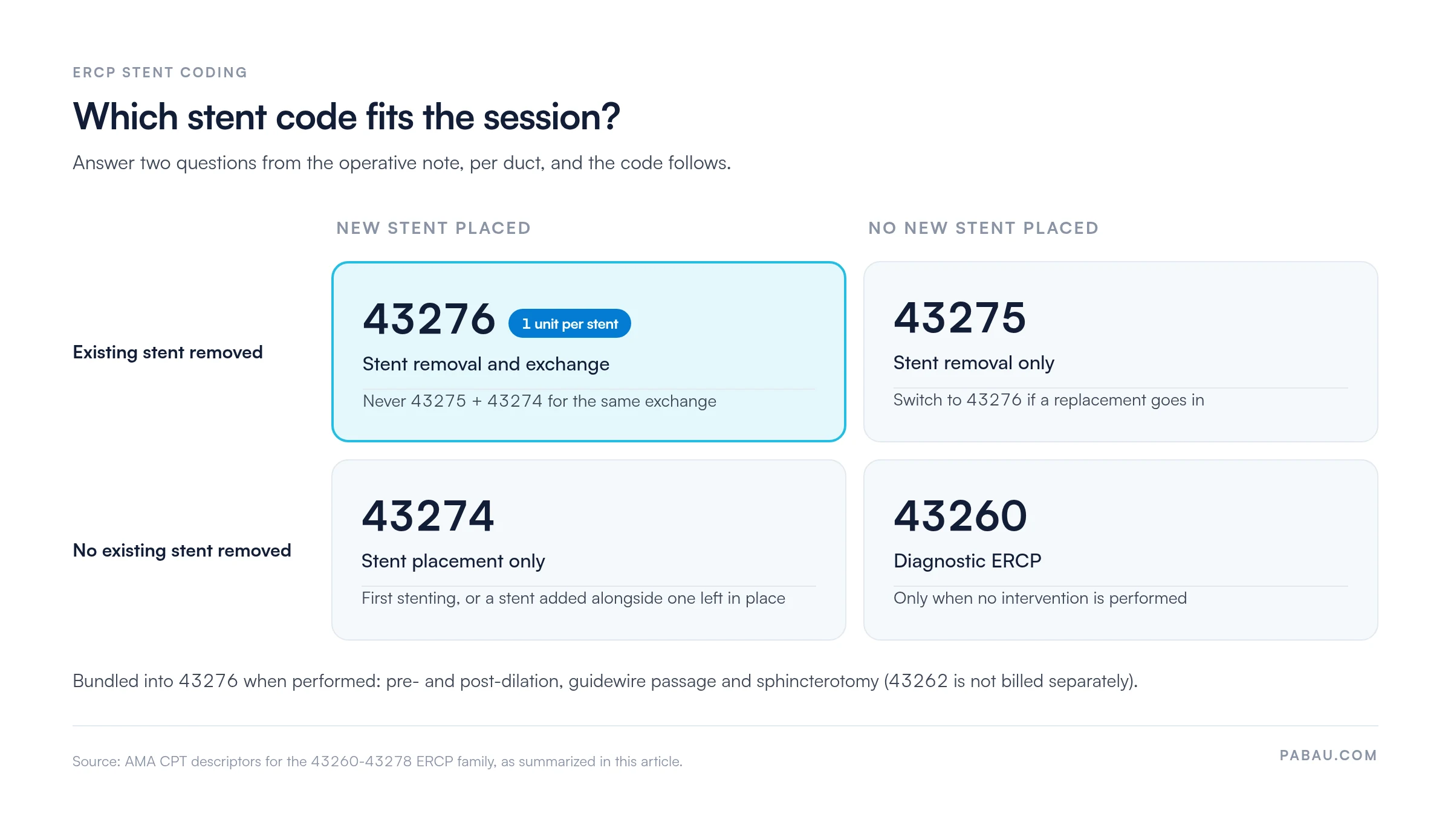
CPT 43274 is the correct code when a new stent is placed without removing an existing one. This happens at a patient’s first stenting, or when the endoscopist places an additional stent alongside a patent existing stent (e.g., bilateral hepatic stenting). CPT 43276 applies when removal and replacement occur together.
Billing 43274 and 43276 for the same duct in the same session violates NCCI bundling edits. If two different ducts are stented in the same session (biliary and pancreatic), one code per duct is appropriate, supported by distinct documentation for each.
CPT 43275 covers stent removal with no new stent placed. This is appropriate when a temporary plastic stent is removed after the underlying condition has resolved (e.g., post-cholecystectomy bile leak that has healed). If a new stent is placed in the same session, 43276 replaces 43275 entirely.
The classic NCCI denial pattern: Coding 43275 plus 43274 for an exchange encounter. The combination is an edit trigger. Use 43276 when both actions occur.
Modifiers on 43276 communicate procedural context to payers. Incorrect or missing modifiers are a consistent denial source on ERCP claims.
For modifier -22, Medicare requires a concise statement of how the service differed from the usual, plus the operative report, sent with the claim. With both, the MAC prices the claim individually.
Without them, it pays the standard rate, per the Medicare Claims Processing Manual, chapter 12. Commercial payer modifier rules vary, so confirm them in each payer’s LCD or billing policy before appending modifiers routinely.
The CY2026 values below come from the CMS national relative value file (RVU26D, October 2026 release). They are national amounts before your locality adjustment. Check your local rate in the CMS Physician Fee Schedule Look-Up Tool.
The non-facility column is empty because Medicare prices 43276 only in a facility setting. The same file lists 43260 as the endoscopic base code. So the multiple endoscopy payment rule applies when 43276 is billed with other ERCP codes in one session.
Commercial rates for 43276 are usually negotiated as a multiple of Medicare rates and vary widely by contract. Request your fee schedule from each payer every year.
Many payers require prior authorization for ERCP procedures, including stent exchange. Requirements vary by payer and plan, and the absence of authorization where it is required is a clean, avoidable denial. Confirm authorization requirements at the time of scheduling, not the day before the procedure.
Payers evaluating medical necessity for a 43276 claim typically look for all of the following, consistent with ASGE appropriateness criteria for ERCP. Meeting medical billing compliance standards starts with documenting these elements clearly.
43276 claims deny for predictable reasons. Each one traces back to a coding, documentation or scheduling step that the practice controls.
A strong denial management workflow tracks each denial reason by code, monitors patterns by payer, and routes appeals before timely filing limits expire. Knowing the denial codes in medical billing helps your team read remittances accurately.
Before you build a pre-bill review for ERCP codes, check it against the parts of a clean claim.
Fluoroscopy guidance is not bundled into the 43276 descriptor by the AMA’s language, which means it may be separately reportable. Whether a payer accepts it depends on two things: the current NCCI column 1/2 edit status and that payer’s policy.
CPT 74328 covers radiologic supervision and interpretation of a biliary catheter or stent. The ASGE lists it as a companion code to ERCP stent procedures in its annual coding guidance.
Verify the NCCI edit status against the current quarter’s table before billing 74328 alongside 43276. CMS updates NCCI edits every quarter, so a pair that passed last quarter can fail this one.
To separately report 74328, the operative report must contain a distinct radiologic supervision and interpretation note. A sentence stating “fluoroscopy was used to confirm stent position” buried in the endoscopy report is not sufficient. The interpreting physician (often the endoscopist performing dual roles) must document a separate radiologic interpretation with findings, or a radiologist must co-sign.
Before billing 74328 alongside CPT 43276, run the current NCCI table for column 1/2 status at cms.gov. If the edit exists and modifier -59 is appended, document why the radiologic service was distinct and not integral to the stent exchange. Some Medicare Administrative Contractors (MACs) have issued local coverage determinations further restricting separate fluoroscopy billing on ERCP claims.
Without software checks, a 43276 error usually surfaces as a denial weeks after the procedure. A missing authorization code, a wrong unit count or an unread remittance code each costs a full resubmission cycle.
Pabau’s claims management software raises each claim from the patient’s invoice and checks it before it leaves the practice. US claims go out as CMS-1500s through Pabau’s Claim.MD integration to thousands of payers. Eligibility checks run before the visit, and the claim stays tied to your medical billing workflow from checkout to payment.
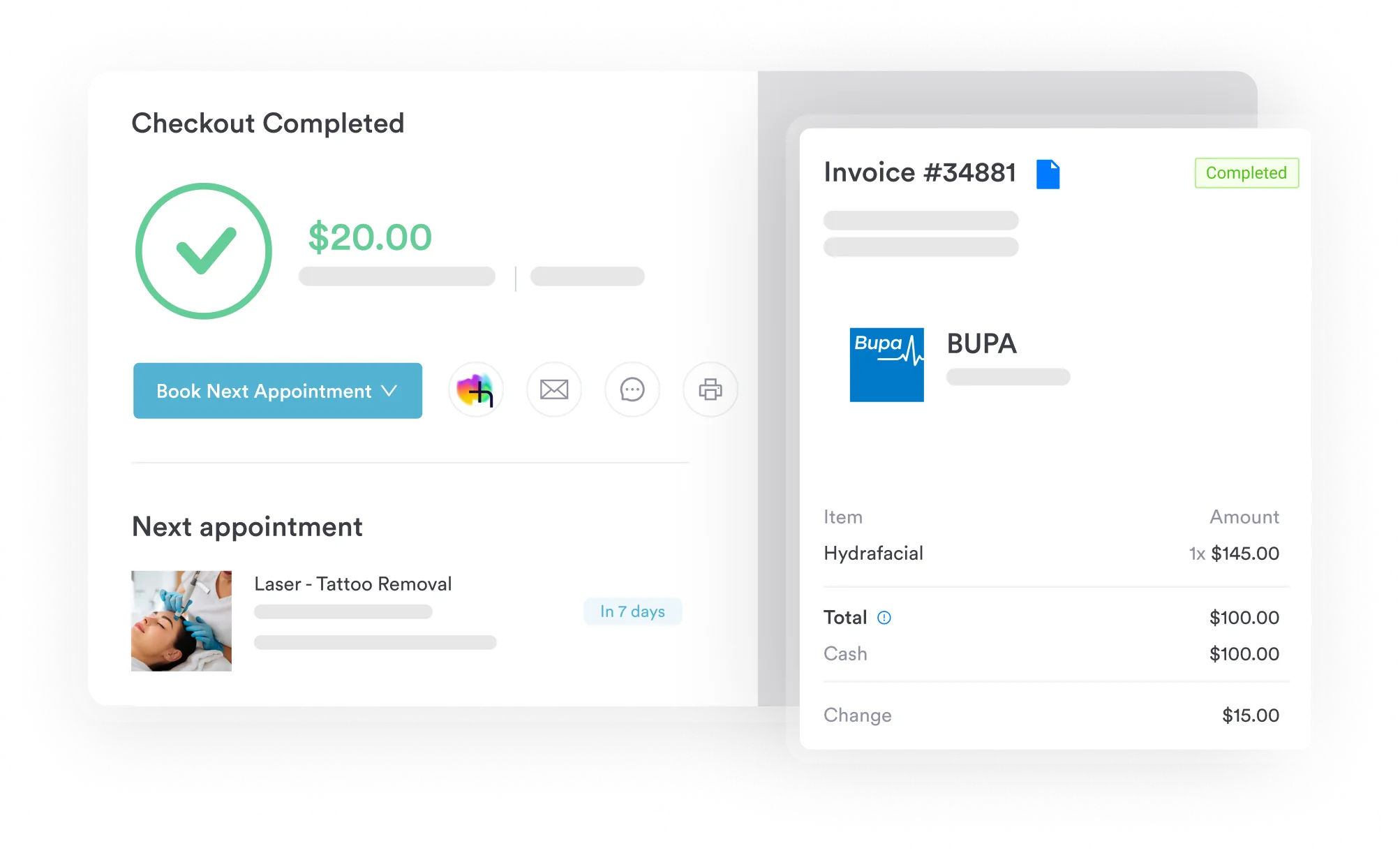
Your billing team sees every 43276 claim in one dashboard, from Pending to Paid. Fewer claims bounce back for avoidable reasons, and the ones that do arrive with the reason attached.

Pabau checks every ERCP claim for missing or invalid details and tracks prior authorization codes. Claims go out through Claim.MD, and ERA payments match back to each claim.

CPT Code 43276 rewards one habit above the rest. Code from the operative note rather than the schedule, and confirm the note records both the removal and the replacement for each stent.
Hold to that, and the usual denials on this code lose their cause. Split 43275 plus 43274 claims, missed second units and unsupported diagnoses all start from a note that was coded without being read.
The cost is a few minutes of pre-bill review on every ERCP claim. Pabau shortens that review with claim validation, authorization tracking and ERA reconciliation in one system. Book a demo to see how it carries your GI claims from invoice to paid.

Need a reference for medical billing fundamentals? What is revenue cycle management walks through the full billing lifecycle from eligibility to payment posting.
Want to understand how clearinghouses process ERCP claims? Medical claims clearinghouse explains how 837P files reach payers and where edits are applied.
Looking to improve your ERA workflow? Electronic remittance advice covers how to read 835 files and map CARC denial codes back to specific claim lines.
CPT Code 43276 is an ERCP code for removing an existing biliary or pancreatic stent and placing a new one in the same session. It is billed per stent exchanged. Bundled services include pre- and post-dilation, guidewire passage, and sphincterotomy when performed.
CPT 43275 is used when an existing stent is removed and no new stent is placed. CPT 43276 is correct when the stent is removed and a replacement stent is placed in the same session. Billing 43275 and 43274 together for one exchange, instead of 43276 alone, triggers an NCCI bundling edit.
Yes. The AMA descriptor for CPT 43276 explicitly states “including sphincterotomy when performed,” which means sphincterotomy performed during the stent exchange is bundled into the code. Separately reporting CPT 43262 alongside 43276 for the same session will trigger an NCCI bundling denial.
CPT 43276 is billed per stent exchanged, so multiple units are appropriate when multiple stents are exchanged in the same session. A session replacing one biliary and one pancreatic stent is coded as two units of 43276. Each exchange must be documented separately in the operative report.
Common supporting diagnoses include choledocholithiasis with obstruction (K80.51), biliary stricture (K83.1), recurrent cholangitis (K83.09), and mechanical breakdown of a biliary stent (T85.510A). Pancreatitis-related ductal involvement (K85.xx series) supports pancreatic stent exchanges. Verify each code against the payer’s LCD before submission; unspecified codes frequently trigger medical necessity denials on ERCP claims.
Fluoroscopy (CPT 74328) is not bundled into the 43276 descriptor and may be separately reportable. That depends on the current NCCI edit status and payer policy. Verify the column 1/2 edit status each quarter at cms.gov. If separately billing 74328, append modifier -59 where an edit exists and document a distinct radiologic supervision and interpretation note in the procedure record.