CPT Code 72193: CT Pelvis With Contrast Billing Guide
CPT code 72193: Official descriptor and procedure overview CPT code 72193 descri...

Last Updated: Nov 13, 2026
Billable Code Specific Code
43262 is the CPT code for endoscopic retrograde cholangiopancreatography (ERCP) with sphincterotomy/papillotomy. It applies when the endoscopist cuts the biliary sphincter, the pancreatic sphincter, or both during the ERCP.
The incision is what separates 43262 from diagnostic ERCP, 43260. The operative note has to state that a sphincterotomy was performed and name the sphincter that was cut.
Let Pabau's smart automation suggest the right codes, reduce claim denials, and keep your practice compliant—effortlessly.
Automate repetitive tasks and focus on what matters most—your patients.
Reduce coding errors and ensure compliance with the latest regulations.
Clean claims, fewer denials, and faster reimbursements.
Powerful insights and reporting to help your practice thrive.
HIPAA compliant SOC 2 certified GDPR-compliant Trusted by 4,000+ clinics worldwide

CPT code 43262 covers ERCP with sphincterotomy/papillotomy. Diagnostic ERCP without a sphincter incision is reported with 43260 instead.
The operative note must state that a sphincterotomy was performed and name the sphincter that was cut, biliary or pancreatic.
Stent placement, stent exchange and balloon dilation codes (43274, 43276, 43277) already include sphincterotomy, so 43262 is not added for the same duct.
Stone removal (43264) is reportable alongside 43262 when both are documented, after a check of the current NCCI edit for the pair.
In the July 2026 Medicare Physician Fee Schedule release, 43262 carries 6.34 work RVUs and 9.32 total RVUs.
CPT code 43262 is the procedure code for endoscopic retrograde cholangiopancreatography (ERCP) with sphincterotomy/papillotomy. ASGE’s ERCP coding sheet lists the AMA descriptor as Endoscopic retrograde cholangiopancreatography (ERCP); with sphincterotomy/papillotomy. The code is valid only when a sphincter incision was performed. Without a documented sphincterotomy, report 43260 for a diagnostic ERCP, or the code for the service the note describes.
ERCP with sphincterotomy starts with the same scope insertion and duodenal cannulation as a diagnostic ERCP. Once the ampulla of Vater is cannulated and contrast confirms the anatomy, the endoscopist uses a sphincterotome to cut through the sphincter of Oddi. That incision is what separates 43262 from 43260.
The operative note may describe a biliary sphincterotomy, a pancreatic sphincterotomy, or both, and all three support 43262. Common indications include choledocholithiasis (bile duct stones), biliary stricture, primary sclerosing cholangitis, and acute cholangitis. Bile duct stones without cholangitis or obstruction, for example, code to K80.50. The diagnosis on the claim should match the indication the note gives for the sphincterotomy.
Before coding, confirm the operative note states that a sphincterotomy or papillotomy was performed and names the sphincter incised. ‘Biliary sphincterotomy performed with sphincterotome; adequate drainage achieved’ is enough. A note that describes only cannulation and contrast injection does not support 43262. Code 43260 instead, and send the note back to the physician to clarify.
The ERCP family runs from 43260 through 43278, and each code above 43260 adds a specific intervention to the diagnostic procedure. The right code depends on what the note says was done. The crosswalk below covers the codes most often confused with 43262.
The 43262 and 43264 pair causes the most confusion. Both are often done in one session, with the sphincterotomy opening the papilla so the stones can come out. When the note documents both, both codes are reportable. Check the current quarterly NCCI edit table for modifier requirements before billing the pair.
Stent work runs the other way. CPT bars 43262 with a stent placement or exchange in the same location, because 43274 and 43276 already include sphincterotomy when performed. The decision path below puts the two questions in the order a coder should ask them.
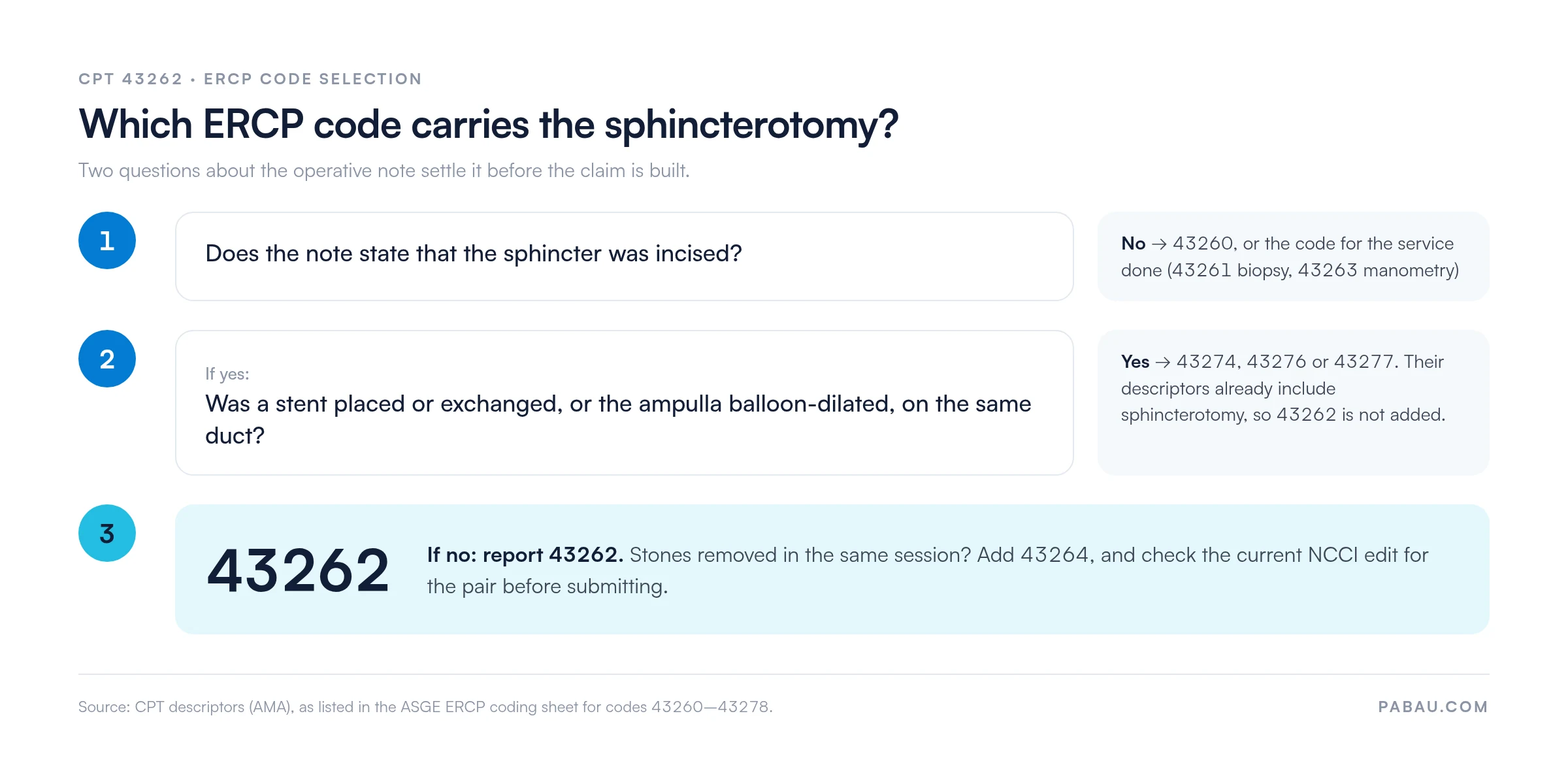
Knowing what is bundled into 43262 prevents both under-billing and claim rejection. Payers apply NCCI edits that treat certain services as integral to every ERCP.
Always cross-reference the CMS Physician Fee Schedule lookup tool and the current quarterly NCCI Policy Manual before billing any code pair involving 43262. NCCI edits update every quarter, so a pair that was separately reportable in Q1 may be bundled by Q3.
An ERCP claim for 43262 lives or dies on the operative note. Payers review these claims closely because the therapeutic code pays more than diagnostic ERCP, 43260.
Every operative note supporting a 43262 claim should contain each of the following elements.
If the note describes cannulation and contrast injection but no incision, the claim cannot be coded as 43262, whatever the physician intended. The coder codes what is documented. When a note falls short, query the physician before submission.
Modifier selection for 43262 follows standard NCCI edit logic. The table below covers the modifiers most likely to come up in gastroenterology billing.
When an NCCI edit allows a modifier, it goes on the column two code of the pair. Medicare also accepts the more specific X modifiers, such as XS for a separate structure, in place of -59.
Reimbursement for 43262 varies by place of service, geographic locality, and payer. The RVUs below come from the July 2026 release of the Medicare Physician Fee Schedule. Verify the payment for your locality with the CMS PFS lookup tool before quoting rates to physicians or administrators. Commercial rates are set by contract, so no universal figure exists.
Use the FastRVU 2026 RVU lookup tool to calculate locality-adjusted Medicare payment amounts. Most ERCPs are performed in a hospital outpatient department (HOPD) or an ambulatory surgery center (ASC), so the facility rate usually applies. The physician bills the professional component, and the facility bills separately under OPPS or the ASC payment system.
New to the three RVU components? Our guide to what an RVU is shows how they combine with the conversion factor into a payment.
Prior authorization for CPT code 43262 depends on payer type, plan design, and clinical urgency. No universal rule applies across payers, so check authorization requirements plan by plan.
ERCP claims draw extra payer scrutiny because the therapeutic codes pay well and payers invest in pre-payment review. The denial management patterns below cover the 43262 rejections that coding teams report most often.
Each denial arrives with a claim adjustment reason code that names the problem. Our reference to claim denial codes explains each one and the response it needs. Sending claims through a claims clearinghouse also cuts the keying errors behind POS and modifier mismatches.
Run a quarterly audit of 43262 claims against operative notes for your highest-volume ERCP providers. Pull every claim where 43262 was billed and confirm the note contains the word ‘sphincterotomy’ or ‘papillotomy.’ Flag any note missing that language for physician review before a payer audit finds it. The American Society for Gastrointestinal Endoscopy (ASGE) publishes coding and documentation guidance for endoscopic procedures that works as a reference standard.
Most 43262 problems start before the claim exists, in the operative note or the prior authorization. When the note, the authorization and the claim live in separate systems, billing staff re-key the details. Mismatched codes, dates and places of service follow.
Pabau, the practice management platform we build, includes claims software for practices that bill US payers. It sends CMS-1500/837P claims through the Claim.MD clearinghouse, checks eligibility, and posts ERA remittances against the patient record.
The prior authorization code, dates and sessions sit on the patient’s case, with a warning when one is missing. A coder building a 43262 claim works from the signed note, with the authorization already on file.

Pabau sends 837P claims through Claim.MD, checks eligibility, and tracks prior authorizations on the patient’s case. See how it supports gastroenterology billing.

A 43262 claim stands on one sentence in the operative note, the one stating that the sphincter was cut and which one. Check for that sentence first. Then check whether a stent or balloon dilation touched the same duct, because that code already pays for the incision.
Get those two checks into the coding routine and most 43262 denials stop before submission. Prior authorization is the remaining risk, and it is settled before the procedure, not after. Book a demo to see how Pabau keeps the note, the authorization and the claim on one patient record.

Coding an ERCP with no sphincter incision? CPT code 43260 covers the diagnostic ERCP that 43262 supersedes.
Want to understand how 837 electronic claims work before your next ERCP submission? 837 electronic claim file guide breaks down the transaction set structure and the common field errors that cause rejections.
Looking for a reference on how to handle claim denials systematically? Denial codes in medical billing covers CARC and RARC code meanings with response steps for GI billing teams.
CPT code 43262 covers endoscopic retrograde cholangiopancreatography (ERCP) with sphincterotomy or papillotomy. The procedure includes a controlled incision through the sphincter of Oddi to relieve biliary or pancreatic obstruction. It applies when the biliary sphincter, the pancreatic sphincter, or both are incised during the ERCP.
CPT 43262 covers ERCP with sphincterotomy; CPT 43264 covers ERCP with removal of calculi or debris from the biliary or pancreatic duct. When a sphincterotomy is performed and stones are also extracted in the same session, both codes may be reported. Check the current quarterly NCCI edit table for any modifier requirement before billing the pair.
The most common modifier is -59 (distinct procedural service), used when billing 43262 with another ERCP code that an NCCI edit bundles with it. Modifier -22 applies for unusual procedural complexity, -52 for a reduced or incomplete sphincterotomy, and -53 for a discontinued procedure. Modifiers -LT and -RT are not standard for GI endoscopy.
The CPT code for ERCP with stent placement is 43274, which includes sphincterotomy when performed. So 43262 is not reported with 43274 for a stent in the same location. Add 43262 only when the sphincterotomy was on a different duct from the stent and the note documents it separately.
Traditional Medicare fee-for-service generally does not require prior authorization for CPT 43262, though CMS prior authorization programs continue to expand. Medicare Advantage plans often impose their own authorization requirements. Always verify with the specific MA plan or state Medicaid program before scheduling an elective ERCP with sphincterotomy.
The operative note must state that a sphincterotomy or papillotomy was performed and name the sphincter incised, biliary, pancreatic, or both. It must also give the clinical indication, such as choledocholithiasis or cholangitis, and the procedural outcome. A note describing only scope insertion and contrast injection does not support 43262.
The leading cause is billing 43262 alongside 43260, which the therapeutic code supersedes, or alongside a stent code for the same duct. Others are a missing sphincterotomy statement, a diagnosis that does not support the incision, and misused modifier -59. Missing prior authorization for commercial or Medicare Advantage plans completes the list. A pre-submission documentation review prevents each of these.