

CCSD code G5100: Bypass of duodenum billing guide
CCSD code G5100 bills a bypass that leaves the duodenum in place CCSD code G5100...

Last Updated: Oct 16, 2026
43236 is the CPT code for esophagogastroduodenoscopy, flexible, transoral; with directed submucosal injection(s), any substance. It covers non-bleeding injections, such as lifting a lesion before resection, tattooing it for surgery, or placing a steroid in a benign stricture. Bleeding control is reported with 43255, and variceal sclerosis with 43243.
The code trips up GI billing teams because 43235 (diagnostic EGD) bundles into it and cannot be billed separately. Payers also deny the claim when the injection substance is not explicitly documented. Most 43236 denials trace back to a few causes. The main ones are a missing injection substance in the operative note, an unsupported diagnosis code, and unbundling when a same-session biopsy is also performed.
Let Pabau's smart automation suggest the right codes, reduce claim denials, and keep your practice compliant—effortlessly.
Automate repetitive tasks and focus on what matters most—your patients.
Reduce coding errors and ensure compliance with the latest regulations.
Clean claims, fewer denials, and faster reimbursements.
Powerful insights and reporting to help your practice thrive.
HIPAA compliant SOC 2 certified GDPR-compliant Trusted by 4,000+ clinics worldwide

CPT code 43236 covers EGD with directed submucosal injection for non-bleeding purposes, such as lifting a lesion or tattooing it for surgery.
Injection to control bleeding is reported with 43255, and injection sclerosis of varices with 43243, never with 43236 for the same lesion.
Diagnostic EGD (43235) is bundled into 43236 and cannot be billed separately on the same claim.
The operative note must document the injection purpose, substance, volume, and anatomical site to support the claim.
Pabau’s claims management software helps GI practices track required documentation fields and submit 43236 claims through a direct clearinghouse connection.
CPT code 43236 is defined by the American Medical Association as: Esophagogastroduodenoscopy, flexible, transoral; with directed submucosal injection(s), any substance. The phrase “any substance” refers to the agent, not the purpose. Saline, a viscous lifting solution, dilute epinephrine in a lift, India ink, or a steroid all qualify when injected submucosally under direct vision. Injections given to control bleeding or to treat varices have their own codes, 43255 and 43243.
The anatomical scope runs from the esophagus to the second or third portion of the duodenum. A non-bleeding, non-variceal injection anywhere within that reach is reported once, however many injection passes the endoscopist makes during the session.
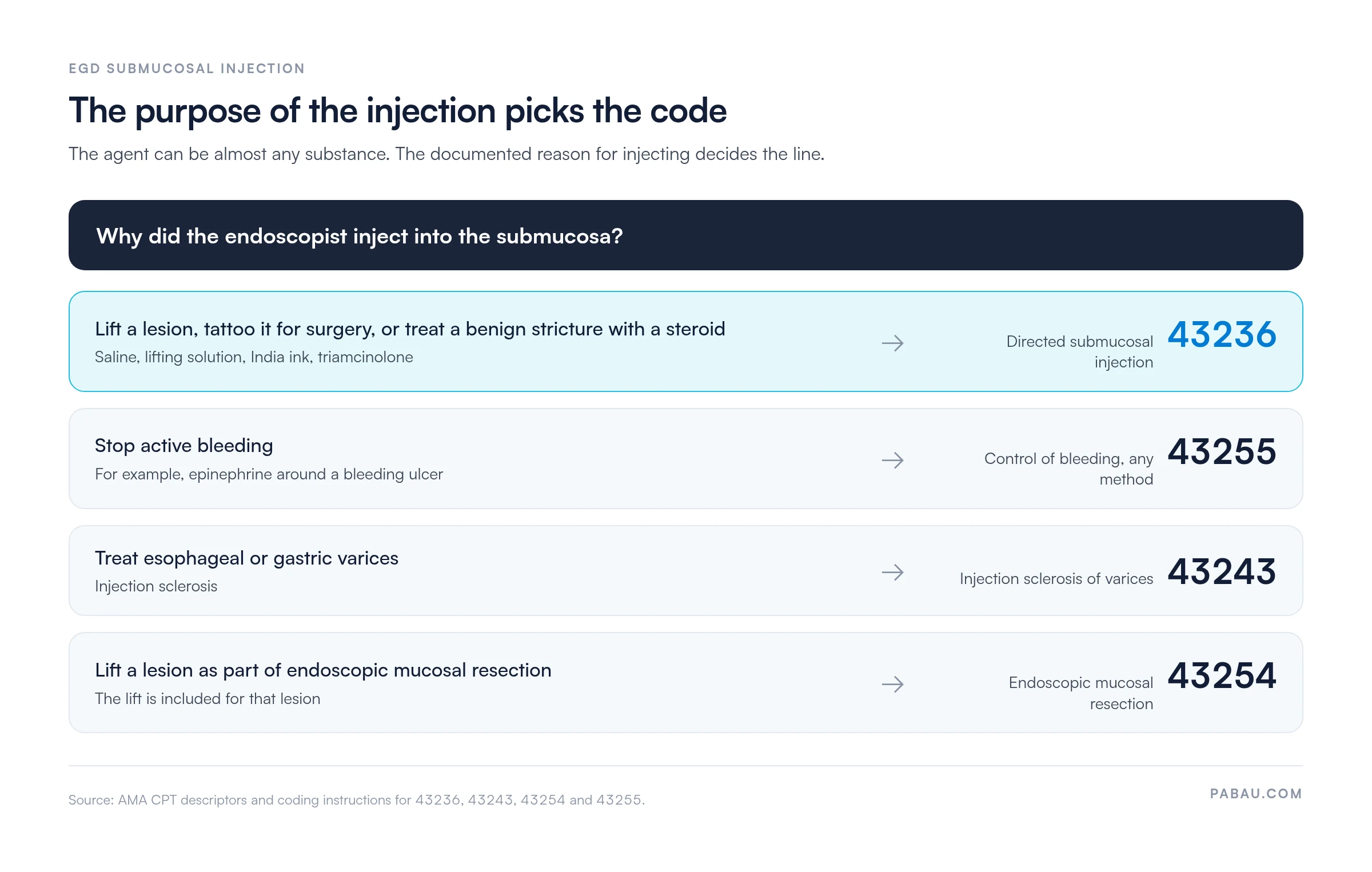
CPT code 43236 is reported when the endoscopist injects into the submucosa for a reason other than bleeding or varices. The common indications are lifting, tattooing, and steroid injection into a benign stricture.
Two injection purposes fall outside this code. Injection to control active bleeding, such as epinephrine around a bleeding ulcer, is reported with CPT code 43255. Injection sclerosis of esophageal or gastric varices is reported with 43243.
CPT instructs coders not to report 43236 with 43243 or 43255 for the same lesion. A lifting injection performed as part of endoscopic mucosal resection is included in 43254 for that lesion.
The endoscopy report must identify which purpose drove the injection. The payer’s medical necessity decision depends on matching that indication to a covered ICD-10 diagnosis code. A report that only says “submucosal injection performed” gives the payer no indication to match, so the claim is likely to be denied.
CPT code 43236 is a therapeutic esophagogastroduodenoscopy (EGD) code that includes the diagnostic component of the exam as a bundled service. Knowing what sits inside and outside the code prevents under-coding. It also prevents the unbundling errors that trigger National Correct Coding Initiative (NCCI) edits.
The most important bundling rule: CPT 43235 is always bundled into 43236 by NCCI edits. Billing both on the same claim date will trigger an automatic edit and one code will be denied. The therapeutic code (43236) is the correct choice when a submucosal injection was performed.
The 43235-43259 range covers flexible transoral EGD services. Each code in the range adds a specific therapeutic action to the base diagnostic exam. Choosing the wrong one, or billing two that are mutually exclusive, leads to denials that need appeals.
The documented purpose of the injection decides the code, as the chart below shows. Lifting, tattooing, and stricture injection go to 43236. Bleeding control goes to 43255, and variceal sclerosis goes to 43243.
Modifier selection for CPT code 43236 affects both payment and compliance. The wrong modifier, or a missing one when unbundling is required, is a frequent trigger for denials on EGD injection claims.
When billing 43236 alongside 43239 at separate sites, attach modifier XS (not -59) to 43239. Then confirm the operative note names each site by anatomical location. CMS auditors look for specificity. ‘Antrum’ and ‘duodenal bulb’ pass, while ‘two areas’ does not.
Medical necessity for CPT code 43236 is established by pairing the procedure with an ICD-10-CM diagnosis code that justifies the injection. Payers’ local coverage determinations (LCDs) differ on which diagnoses they accept. The codes below match the indications 43236 is reported for.
Diagnoses that commonly fail payer edits include unspecified abdominal pain (R10.9) with no documented endoscopic finding. Screening codes used without supporting pathology documentation fail too. Always use the most specific ICD-10 code available based on the endoscopic findings, not the pre-procedure symptom code alone.
Bleeding diagnoses do not support 43236. A bleeding ulcer (K25.4 or K26.4) or melena (K92.1) treated by injection belongs on a 43255 line. Bleeding esophageal varices (I85.01) treated by injection sclerosis belong on a 43243 line.
Medicare reimbursement for CPT code 43236 varies by place of service and geographic locality. The CMS Physician Fee Schedule lookup tool provides the authoritative national and locality-adjusted rates for the current year. The figures below are 2026 national rates at the $33.4009 conversion factor, before the geographic practice cost index (GPCI) adjustment. Verify them against the current fee schedule before billing.
Work RVU is the same in both settings, at 2.33. The difference in physician payment comes from the practice expense component: 10.76 RVUs in the office versus 1.10 in a facility. Use the FastRVU lookup tool to verify current total RVU values and Medicare conversion factor adjustments for the billing year.
GI practices billing 43236 in an ambulatory surgery center should confirm the ASC payment rate separately through the CMS ASC payment system. It uses a different payment methodology than the physician fee schedule. Submitting claims with the correct place-of-service code (POS 24 for ASC, POS 11 for office, POS 21 for hospital inpatient) affects which rate applies.
Checking eligibility electronically before the procedure cuts payment posting errors caused by benefit plan differences. After payment, electronic remittance advice shows which adjustment reason codes the payer applied to the allowed amount.
Prior authorization requirements for CPT code 43236 depend on the payer type and individual plan. No blanket rule applies across payers. Verify requirements with each plan before scheduling a non-urgent injection procedure.
For urgent or emergent cases where prior authorization cannot be obtained in advance, document the clinical urgency explicitly in the procedure note. Most payers allow retroactive authorization requests for emergent procedures, but the documentation burden shifts entirely to the practice. A written protocol for urgent cases lowers the risk of retrospective denials.
CPT code 43236 denials cluster around six root causes. Each one has a specific prevention step that can be built into the practice’s pre-submission workflow. When a claim does come back, the payer’s denial codes usually point to which cause applied.
Proactive denial management workflows catch these issues before submission rather than after. Claims management software that checks code pairs at entry flags the 43235 and 43236 unbundling error before the claim reaches the clearinghouse.
The endoscopy report is the primary documentation artifact for a 43236 claim. Payers auditing 43236 claims look for six specific data points. A report missing any one of them gives grounds for denial or recoupment.
Build this checklist into your endoscopy reporting template before cases begin, so every report carries all six elements by default. A clean claim for 43236 needs all six in the report before the coder selects the code.
A superbill that records the injection substance and site at the point of care saves the coder from chasing the endoscopist for them later.
Run a monthly audit of 43236 claims. Pull the 10 most recent and check each operative note against the six-point documentation checklist. A field that keeps going missing usually points to the report template, so fix the template before retraining physicians.
Billing 43236 alongside other endoscopy codes in the same session requires careful attention to NCCI bundling edits. The core principle is that each separately billed code must represent a distinct therapeutic action at an anatomically distinct site, supported by documentation.
NCCI edits are updated quarterly. Always verify the current edit pair status through the AAPC Codify CPT lookup or the CrossCoder crosswalk tool before billing a new combination. When the companion procedure is a biopsy, the modifier and documentation rules for 43239 govern that second line.
Most 43236 denials start in the endoscopy report, long before a coder opens the claim. A note that omits the agent, the volume, or the purpose leaves the coder choosing between 43236, 43255, and 43243 on guesswork.
Pabau, the practice management and billing platform we build, keeps the procedure note and the claim in the same patient record. Structured note templates can make injection purpose, substance, volume, and site required fields, so the coder sees the documented purpose before picking the code.
Claims then go out through a direct clearinghouse connection, and remittance data comes back into that record. Your billing team can see which 43236 claims were adjusted and why, without switching systems.

Pabau connects your clinical documentation to claims submission, so injection substance, anatomical site, and ICD-10 pairings flow directly into 43236 claims without manual re-entry.

CPT code 43236 is narrower than its “any substance” wording suggests. The agent can be almost any solution, but the purpose cannot be bleeding control or variceal treatment, which belong to 43255 and 43243. Build the endoscopy report around the purpose of each injection. The code choice, the diagnosis pairing, and the modifier decision then follow from it.
A report that names the purpose, agent, volume, and site gives the coder no guesswork and the payer no reason to query the claim. Book a demo to see how Pabau carries that endoscopy note straight into a clean 43236 claim for your GI practice.

Need to understand how clearinghouse connections reduce EGD claim errors? Medical claims clearinghouse guide explains how electronic claim routing reduces manual errors on endoscopy claims.
Want to know how 837 electronic claims work for GI procedures? 837 file billing guide covers the electronic claim format used to submit CPT codes including 43236 to Medicare and commercial payers.
Looking for guidance on reducing payer credentialing delays? Insurance credentialing guide walks through the enrollment steps that affect which payers accept your 43236 claims.
Removing a polyp in the same EGD session? CPT code 43251 covers snare polypectomy, a frequent companion to a lifting injection.
Treating a stricture with dilation as well as a steroid? CPT code 43249 explains how balloon dilation is coded alongside other EGD work.
CPT code 43236 covers flexible, transoral esophagogastroduodenoscopy (EGD) with directed submucosal injection of any substance. It is used for non-bleeding purposes, such as lifting a lesion before resection, tattooing a lesion for surgery, or injecting a steroid into a stricture. Bleeding control is reported with 43255 and variceal sclerotherapy with 43243. The diagnostic EGD component is bundled into 43236.
No. Injection to control bleeding is reported with 43255, EGD with control of bleeding, any method. CPT instructs coders not to report 43236 with 43255 for the same lesion. Injection sclerosis of varices is reported with 43243 instead.
CPT 43235 is the base diagnostic EGD code used when no therapeutic intervention is performed. CPT 43236 is the therapeutic version that includes a submucosal injection. Code 43235 is bundled into 43236 and cannot be billed separately on the same claim date.
Yes, when the submucosal injection and the biopsy were performed at anatomically distinct sites during the same session. Append modifier XS (or -59) to 43239, and document both sites by name in the operative note. Billing both codes without a modifier, or when performed at the same site, will trigger an NCCI bundling edit and denial.
The most common are -59 or XS, which unbundle 43239 when the biopsy is at a separate site. Modifier -22 marks unusual complexity and needs supporting documentation. Modifier -52 marks an intentionally limited exam and -53 a discontinued procedure. Modifier -76 applies only when the same physician repeats the procedure in a separate session. Same-session injections stay on one 43236 line.
National Medicare rates for CPT code 43236 are about $446 in a non-facility setting and about $124 in a facility setting. These are 2026 national Medicare Physician Fee Schedule rates before locality adjustment. Always verify the current rate using the CMS Physician Fee Schedule lookup tool before billing.
The most common reason is billing 43235 alongside 43236, which is an NCCI bundling error. Others are an undocumented injection substance, an unsupported or unspecified ICD-10 code, and missing prior authorization. Reporting 43236 for bleeding control instead of 43255 also draws denials. Many avoidable denials trace back to an operative note that omits the agent, volume, or site.
Yes, in the sense that CPT 43235 (diagnostic EGD) is bundled into 43236 by NCCI edits and cannot be billed separately. CPT 43236 itself is a standalone therapeutic code, not an add-on code. Other procedures performed in the same session (biopsy, polypectomy) may be separately billable with appropriate modifiers when performed at distinct anatomical sites.



