



CCSD code G5100: Bypass of duodenum billing guide
CCSD code G5100 bills a bypass that leaves the duodenum in place CCSD code G5100...

Last Updated: Oct 16, 2026
CPT code 43255 is the procedure code for an esophagogastroduodenoscopy (EGD) with control of bleeding by any method, including injection, thermal, or mechanical hemostasis. It applies when the physician finds active or recent bleeding during the scope and stops it.
Coders often confuse it with 43239 (biopsy) and 43229 (ablation of lesions such as Barrett’s esophagus), because all three sit in the same EGD family. Bleeding varices take their own codes, 43243 and 43244. Most 43255 denials trace back to an operative report that doesn’t document the bleeding source and the method used to stop it.

CPT code 43255 covers EGD with control of nonvariceal bleeding by injection, thermal, or mechanical methods.
Variceal banding is coded 43244 and variceal injection sclerosis is 43243, not 43255.
The exam covers the esophagus, stomach, and duodenum or jejunum as appropriate, and an incomplete exam takes modifier -52 or -53.
Documentation must name the bleeding source, the method used, and confirmation that bleeding stopped.
Pabau, the practice management platform we build, submits 43255 claims electronically through the Claim.MD clearinghouse and tracks their status.
The American Medical Association (AMA) defines CPT code 43255 as: Esophagogastroduodenoscopy, flexible, transoral; with control of bleeding, any method. The phrase “any method” is deliberate. It covers injection therapy (epinephrine), thermal coagulation (heater probe, argon plasma coagulation, electrocautery), and mechanical methods such as clips. Coders don’t need to pick a sub-code based on the technique the physician used.
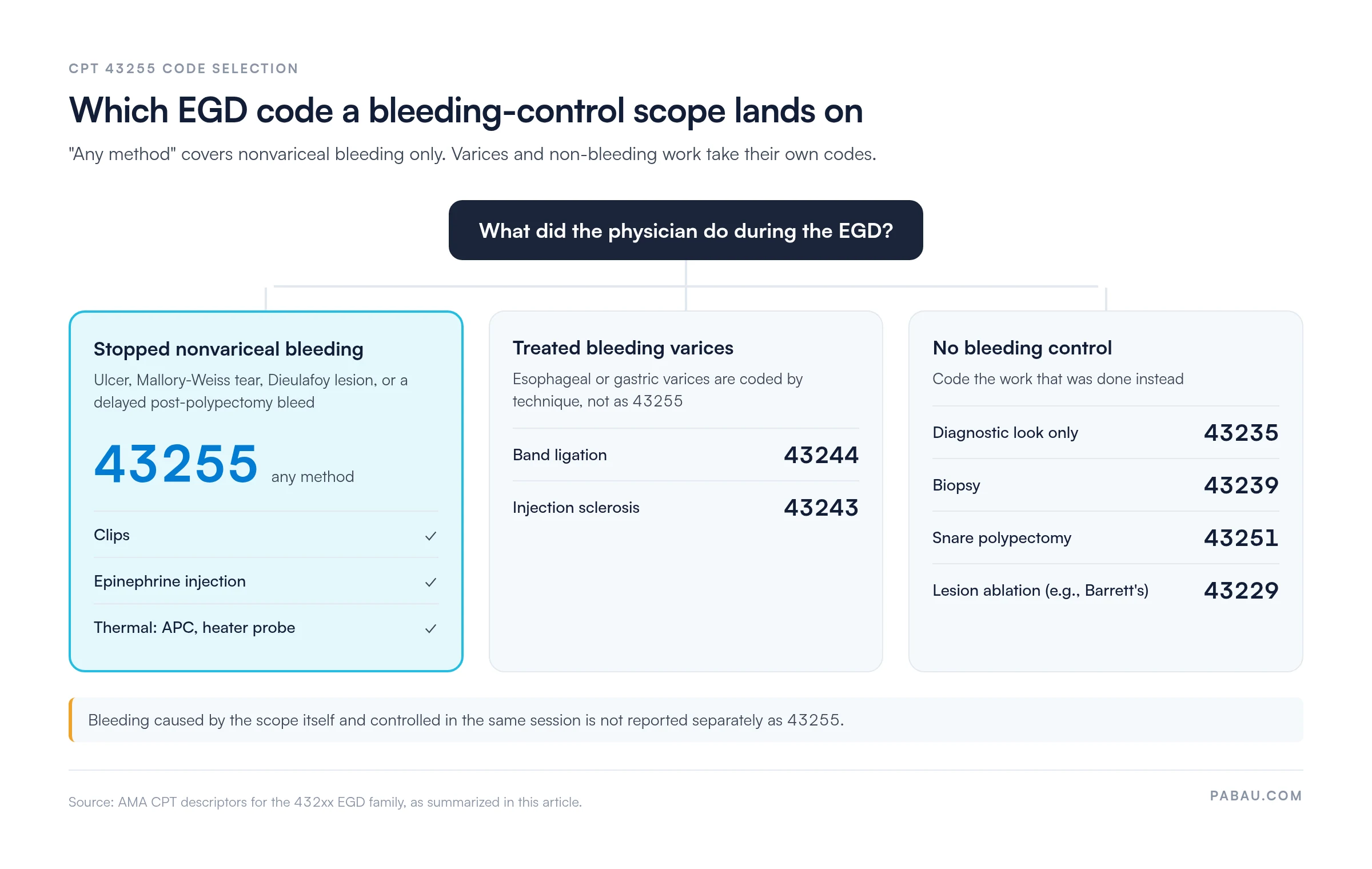
Varices are the exception. Band ligation of esophageal or gastric varices is coded 43244, and injection sclerosis of varices is 43243, so neither is reported as 43255.
The exam covers the esophagus, stomach, and duodenum, or the jejunum as appropriate. CPT sets no requirement to reach the second portion of the duodenum. An exam that stops short, such as one limited to the gastroesophageal junction, is a reduced or incomplete service. Report it with modifier -52 or -53, following CPT guidance.
Knowing the boundaries of 43255 prevents unbundling errors that draw Office of Inspector General (OIG) audit attention. The code bundles the diagnostic exam, so you don’t separately bill the diagnostic EGD, 43235, on the same date.
Thin documentation is a leading denial trigger for 43255. The operative report should contain each of these elements to support the code on audit.
A superbill workflow that captures these elements at the time of service prevents the record requests that delay payment. A note template built around the six elements gives the physician the same prompts on every hemostasis case.
Build a procedure-specific note template for GI hemostasis that includes drop-down fields for Forrest classification, hemostasis method, and hemostasis confirmation. A complete operative report generated at the time of service is far easier to defend on audit than a reconstructed addendum.
The 432xx upper endoscopy family shares one procedure, the EGD, and splits by what the physician does during the scope. The table sets each neighbor against 43255.
The source of the bleeding settles the code before the technique does, as the decision path below shows. A biopsy of a separate, non-bleeding lesion in the same session is reported as 43239, with modifier -59 where the NCCI edit allows it.
Modifiers tell payers about circumstances the code alone can’t convey. Using the wrong one on a 43255 claim causes denials and compliance exposure.
NCCI edit caution: The National Correct Coding Initiative (NCCI) bundles certain 432xx codes together. Before appending modifier -59 to override a bundling edit, check the current edit table on the CMS NCCI edits page. Using -59 on a code pair whose edit doesn’t allow a modifier is a compliance violation.
Medicare pays 43255 from the Medicare Physician Fee Schedule (MPFS), with separate facility and non-facility rates. Facility rates apply in a hospital outpatient department or ambulatory surgery center (ASC). Non-facility rates apply in an office-based endoscopy suite. Rates update every January 1, so check current figures in the CMS fee schedule lookup tool or an RVU calculator such as FastRVU.
Commercial payer rates for 43255 vary widely from Medicare. They are commonly negotiated as a percentage of the Medicare allowable, or as a flat fee. Check your current contracts and each payer’s provider portal for plan-specific allowables.
Medicare covers 43255 when the procedure meets medical necessity criteria set through Local Coverage Determinations (LCDs) from each Medicare Administrative Contractor (MAC). Requirements differ slightly between MACs, so check the LCD for your jurisdiction rather than applying one national standard.
The diagnosis code carries much of the medical necessity case. A code such as K25.0, acute gastric ulcer with hemorrhage, supports bleeding control in a way an unspecified code like K92.9 does not. These requirements apply across most Medicare contracts.
Denials on 43255 claims follow predictable patterns, so prevention can be systematic. A structured denial management workflow tied to the documentation checklist above catches most of these before the claim leaves the practice.
Reviewing common denial codes helps billing teams read the CARC and RARC codes returned on an ERA. Each denial can then go straight to the right rework queue.
CPT code 43255 carries a 0-day (000) global period under the Medicare Physician Fee Schedule, which is standard for endoscopic procedures. No follow-up services are bundled into the payment beyond the immediate post-service period on the day of the procedure.
In practice this works in the practice’s favor. A follow-up office visit, or a repeat endoscopy for rebleeding on a later date, is generally billable as a separate service. The key rules are below.
Check the current global period for 43255 each year in the AAPC CPT code reference or the CMS MPFS file. Designations can change with annual rule updates. A clean claim submission process includes that check before the claim goes out.
Set up a billing rule in your practice management system that flags same-day E/M services billed with 43255. Each flagged visit then gets a modifier -25 review. This prevents the payer from automatically bundling the office visit into the procedure payment and leaving revenue on the table.
On many GI teams, the operative report is written in one system and the claim is built in another. Each element missing from the report turns into a records request or a denial weeks later.
In Pabau, the practice configures its own clinical note and form templates. A hemostasis template can prompt for the bleeding source, the method, and confirmation that bleeding stopped. Pabau’s claims software for practices then submits the claim electronically through the Claim.MD clearinghouse and tracks its status.
The outcome is fewer claims sent back for missing detail, and a billing team that can see where each 43255 claim stands.

Pabau’s configurable note templates help your team record what a 43255 claim needs. Claims then go out electronically through Claim.MD, with status tracked in one place.

A 43255 claim stands or falls on the operative report. Name the bleeding source, the hemostasis method, and the confirmation that bleeding stopped, and the code holds up on audit.
Before you code, check the two splits that cause most wrong-code claims. Variceal bleeding goes to 43243 or 43244, and lesion ablation goes to 43229. Bleeding the scope itself caused, and stopped in the same session, adds no code at all.
Keeping the note and the claim in one system makes both checks part of the routine. Book a demo to see how Pabau fits the billing day of a GI practice.

Need a framework for tracking GI claim outcomes? Revenue cycle management fundamentals covers the end-to-end billing loop from encounter to payment posting.
Submitting 43255 claims through a clearinghouse? How the Claim.MD clearinghouse works explains the validation and routing process for electronic GI claims.
Want to understand ERA remittance codes on denied 43255 claims? Electronic remittance advice (ERA) guide breaks down how to read the 835 file and route denials to the correct rework queue.
Coding the hematemesis behind a 43255 scope? ICD-10 code K92.0 covers when hematemesis is the right diagnosis to support medical necessity.
CPT code 43255 covers an upper GI endoscopy (EGD) with control of bleeding by any method, such as injection, thermal coagulation, or clips. It bundles the diagnostic exam and applies when bleeding is identified and controlled in the same session. Variceal banding and sclerotherapy take their own codes, 43244 and 43243.
Medicare payment rates for CPT code 43255 change every January 1 with the MPFS update. Check current facility and non-facility rates in the CMS Physician Fee Schedule lookup tool or an RVU calculator such as FastRVU. Use your Geographic Practice Cost Index (GPCI) locality for accurate local rates.
The operative report must document the indication, the bleeding source and its location, and the Forrest classification or equivalent stigmata. It also needs the hemostasis method, any devices or agents used, and an explicit statement that bleeding was controlled. A missing element is a common cause of 43255 denials on record review.
Yes, in certain circumstances. When a biopsy (43239) is taken from a separate, non-bleeding lesion in the same session as hemostasis (43255), both codes may be reported. Modifier -59 goes on the lower-value code to show a distinct procedural service. Check the current NCCI edit for this pair before submitting, as the edit table updates quarterly.
CPT code 43255 carries a 0-day global period, so no follow-up services beyond the day of the procedure are bundled into the payment. A follow-up office visit on a different date is billable separately. A same-day E/M service needs modifier -25 to be paid separately.



