



HCPCS code E0198: Water pressure pad billing guide
HCPCS code E0198 is a water pad for a standard mattress HCPCS code E0198 is the ...

Last Updated: Oct 13, 2026
CPT code 43249 is the billable code for an esophagogastroduodenoscopy (EGD) with transendoscopic balloon dilation of the esophagus.
It applies when the balloon used measures less than 30 mm in diameter. At 30 mm or larger, the correct code is 43233 instead.
Medicare’s 2026 national rate for 43249 is about $1,180 in a non-facility (office) setting and about $136 in a facility. The code carries a 0-day global period, and it bundles the diagnostic endoscopy, so 43235 is not separately billable in the same session.

CPT code 43249 covers an EGD with transendoscopic balloon dilation of the esophagus, using a balloon under 30 mm.
A balloon of 30 mm or larger moves the claim to CPT 43233, so the operative note must state the diameter.
Medicare pays roughly $1,180 in the office setting and about $136 in a facility, because practice expense RVUs differ sharply.
Modifiers 22, 51, 59, 52 and 53 may apply. Modifier 59 needs a genuinely distinct service, per MLN Matters SE1418.
Pabau’s claims management software runs background validation checks on patient records and submits through Claim.MD with real-time eligibility verification.
The American Medical Association’s CPT code set defines 43249 as an esophagogastroduodenoscopy with transendoscopic balloon dilation of the esophagus, under 30 mm. A flexible endoscope is passed through the mouth to the upper GI tract. A through-the-scope balloon is then inflated to widen a narrowed segment of the esophagus.
The 30 mm threshold is the critical clinical and billing distinction. CPT 43249 applies when the balloon is calibrated to dilate the esophagus below 30 mm. When a balloon of 30 mm or larger is deployed, 43233 is the correct code instead. Selecting the wrong code on balloon size is one of the most common denial triggers for this procedure.
CPT 43249 sits within the EGD code family spanning 43235 through 43259. The family covers diagnostic EGD, EGD with biopsy, EGD with injection, EGD with hemostasis, and several dilation variants. Coders select the code matching the highest-complexity intervention performed during the session, not the baseline EGD code.
When the therapeutic act is band ligation of esophageal or gastric varices rather than dilation, 43244 is the code. Dilation and ligation are separate interventions, so check the NCCI edit status before billing both on one claim.
Balloon dilation of the esophagus is performed when a structural or functional narrowing restricts swallowing or causes other upper GI symptoms. Medical necessity documentation must link the procedure to one of the accepted clinical indications below.
Payer coverage for CPT 43249 usually requires that conservative treatment was attempted, or documented as not feasible. The operative report must state the specific indication and connect it to the patient’s presenting symptoms.
Clinical documentation is what separates a paid 43249 claim from a denied one. The operative report is the primary audit target, and it must support medical necessity on its own, without reference to other records.
A claim that clears on first submission needs every one of the following elements in the operative report.
Linking the correct ICD-10 diagnosis code to the claim matters just as much. Common ICD-10 codes paired with 43249 include K22.2 (esophageal obstruction), K22.0 (achalasia of cardia), K20.0 (eosinophilic esophagitis), and Q39.3 (congenital stenosis of esophagus).
Modifier selection for CPT code 43249 affects both claim acceptance and the amount paid. The table below summarizes the modifiers that commonly apply, and the circumstance that justifies each one.
Modifier applicability varies by payer, so verify individual payer policies before appending one. Modifier 59 draws the most scrutiny. For Medicare claims, confirm whether the X-modifier subset (XE, XS, XP, XU) replaces 59 under the payer’s NCCI edit policy.
Medicare reimburses CPT code 43249 under the Medicare Physician Fee Schedule (MPFS), at separate rates for facility and non-facility settings. The office rate is roughly eight times the facility rate. Facilities bill separately for overhead, so in that setting the physician is paid only the work and malpractice components.
These figures are national approximations derived from the 2026 MPFS conversion factor. Actual reimbursement varies by geographic practice cost index (GPCI). Verify current rates with the CMS MPFS Lookup Tool before you submit claims or set payer contract benchmarks. Commercial rates are negotiated separately and may differ considerably from Medicare.
Set up a recurring quarterly review of your MPFS rates using the CMS fee schedule search tool. GI endoscopy rates have shifted meaningfully across successive fee schedules. Coders who reconcile expected against actual ERA payments each quarter catch underpayments before they age past the timely filing window.
Relative value units (RVUs) for CPT code 43249 break into three components: work RVU (wRVU), practice expense RVU (PE RVU), and malpractice RVU (MP RVU). Total RVU multiplied by the CMS conversion factor and the GPCI produces the Medicare allowed amount. The values below come from FastRVU’s lookup tool, which pulls directly from CMS MPFS data.
Practice expense is the whole story here. Work and malpractice RVUs are identical in both settings, so the 31-point swing in PE RVU is what moves the payment from $136 to $1,180. Practice managers benchmarking physician productivity should use wRVU, which stays at 2.60 in either setting and reflects physician work alone.
Recent Medicare Physician Fee Schedules have kept the EGD code family structure intact, with no descriptor change to CPT 43249. The annual conversion factor adjustment still moves reimbursement across every code. Commercial contracts benchmarked to a percentage of Medicare adjust automatically; contracts with fixed fee schedules have to be renegotiated by hand.
CMS also updates the geographic practice cost indices (GPCIs) annually. Practices in high-cost metropolitan areas therefore see rate changes that differ from the national average. Use the CMS MPFS Lookup Tool filtered to your own locality when you calculate expected reimbursement for 43249 in a given plan year.
Commercial payers generally reimburse CPT 43249 above Medicare, though amounts vary by contract. Payers do not publish their contracted rates, so practices have to check actual payment against their own agreements. The Medicare rate remains the baseline reference point for contract negotiation.
The National Correct Coding Initiative (NCCI) defines procedure-to-procedure edits that bundle certain codes billed together. Bundling edits are updated quarterly, so billers should confirm current edit pairs before submitting a multi-code claim with 43249. Checking against the live CMS NCCI edit files beats working from a static reference list.
Common bundling scenarios involving 43249 include:
CMS MLN Matters SE1418, “Proper Use of Modifier 59”, sets the standard. The modifier applies only where the service was genuinely distinct in session, anatomic site, or indication. Routine use of modifier 59 to override edits exposes a practice to OIG audit risk. Record the distinct circumstance in the operative note before appending it.
The bundling of the diagnostic EGD is not unique to dilation. The same rule folds 43235 into 43246, where the gastrostomy tube placement already includes the endoscopy. Removal of a foreign body under 43247 absorbs the diagnostic EGD on the same terms.
Choosing correctly from the EGD family means knowing what each code covers, and where 43249 sits relative to the procedures either side of it. The table below covers the codes most often confused with it.
A persistent source of coding errors is reaching for 43248 when a through-the-scope balloon was used, or the reverse. The operative note must name the dilation technique to support the chosen code. The map below walks the same decision in the order the note should record it.
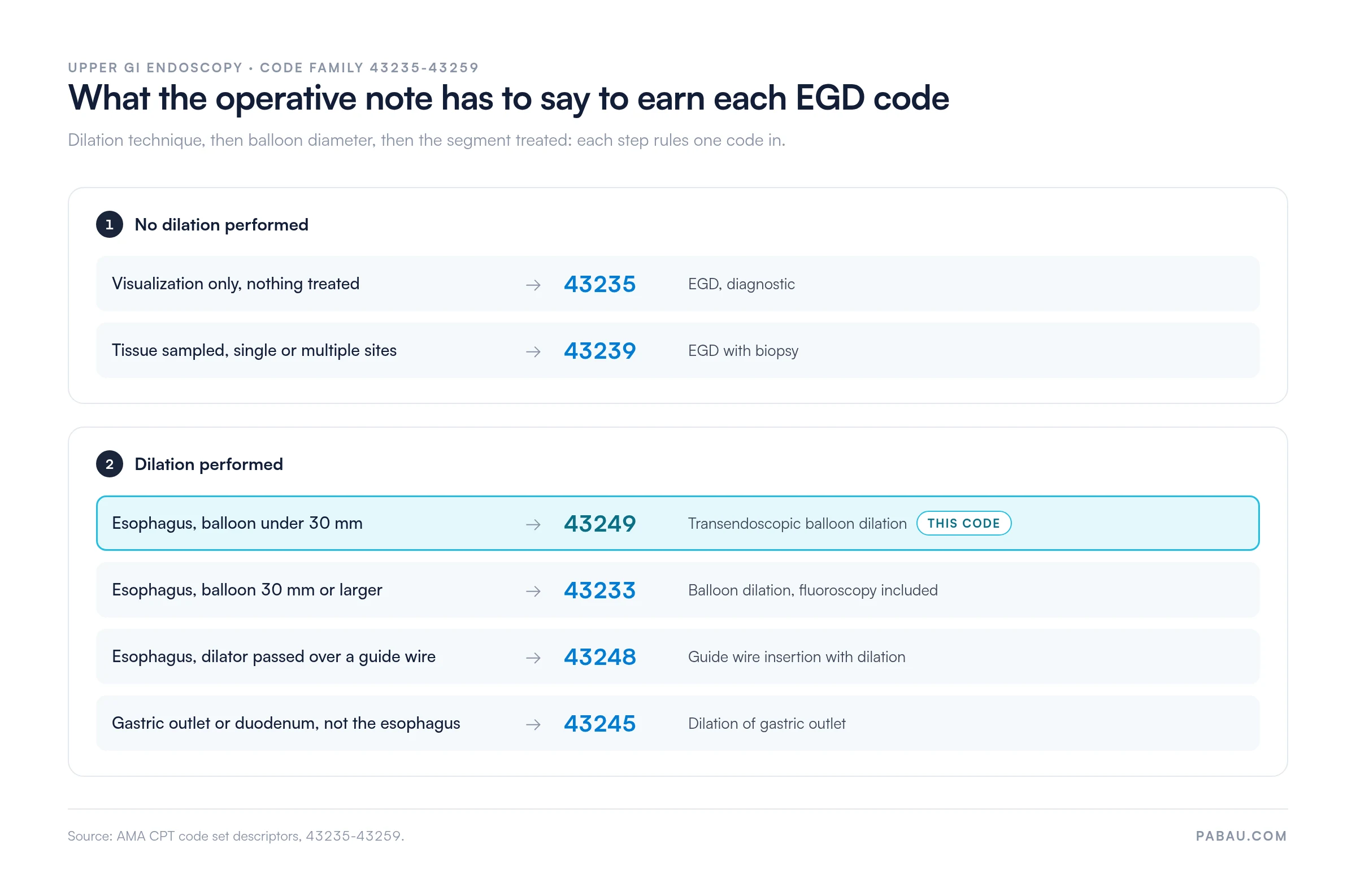
Most CPT 43249 denials trace back to a small set of recurring errors. Each one is visible in the operative note or on the claim line before submission. That is what makes them worth auditing as a group rather than case by case.
Reading denial codes alongside your ERA remittance data shows which adjustment reason codes drive 43249 rejections. CARC 97 (bundled service) and CARC 4 (service inconsistent with modifier) together account for a large share of EGD dilation denials.
In a manual billing workflow, the balloon diameter, the place-of-service code and the authorization number each get checked by a person, at three different moments. Any one of them can be missed, and the miss only surfaces weeks later on a remittance. Practice management and claims management software like Pabau moves those checks into the workflow itself.
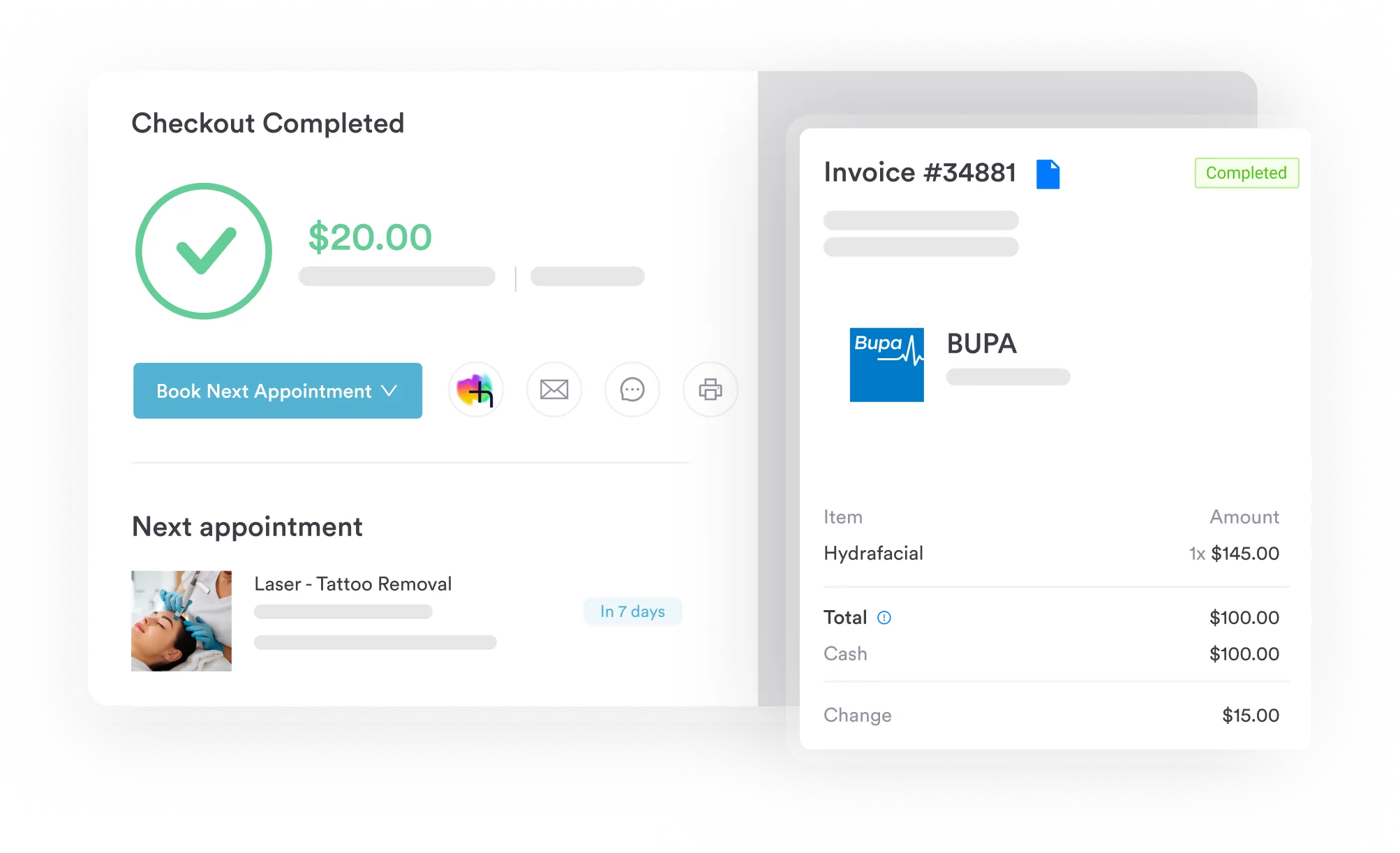
Pabau runs background validation checks on the records behind a claim, covering details such as membership numbers and authorization codes. Its Claim.MD integration then handles real-time eligibility verification before the procedure, plus 837P claim submission and ERA 835 remittance processing afterwards.
For a GI practice, eligibility is therefore confirmed while the patient is still being scheduled. Remittance data returns into the same system that holds the operative note. Administrators can track 43249 claim status, denial rates by payer, and outstanding balances without exporting anything to a spreadsheet.
Run a quarterly audit of your 43249 claims filtered by denial reason code. Pull every claim denied under CARC 97 (bundled) and CARC 4 (modifier inconsistency) for the past 90 days. If more than 5% of 43249 claims carry either code, refresh your modifier policy before the next payer contract renewal.

Pabau runs background validation checks on the records behind every claim, then submits through Claim.MD with real-time eligibility verification and ERA remittance. GI billing teams see a payer’s answer in the same system that holds the note.

Almost every 43249 denial is decided in the operative note, not in the billing office. If the note records the balloon diameter, the dilation technique and the segment treated, the code follows from it. The claim then defends itself under audit. If it does not, no amount of modifier work at submission will rescue the line.
So the highest-yield change is upstream: a dictation template that forces those three fields, and a place-of-service check before the claim goes out. The trade-off worth remembering is the setting difference. The same procedure pays about $1,180 in the office and about $136 in a facility. A wrong POS code therefore costs far more than a wrong modifier.
Book a demo to see how Pabau validates the records behind a 43249 claim and returns the payer’s response into the same chart.

List Item #1
List Item #2
CPT code 43249 describes an esophagogastroduodenoscopy (EGD) with transendoscopic balloon dilation of the esophagus, to a diameter less than 30 mm. The code covers the complete procedure: endoscope insertion, visualization of the upper GI tract, and inflation of a through-the-scope balloon. That balloon widens a narrowed esophageal segment. A balloon diameter below 30 mm is the defining clinical criterion.
Balloon diameter is the only difference. CPT 43249 applies when the esophagus is dilated with a balloon under 30 mm, and CPT 43233 applies at 30 mm or larger. The operative report must state the balloon size explicitly to support whichever code is billed. Choosing between the two on anything other than the documented diameter is a coding error.
Yes. CPT 43249 has NCCI edit pairs with the diagnostic EGD code 43235 and, in some payer scenarios, with 43239 (EGD with biopsy). The diagnostic endoscopy component is included in the dilation procedure, so billing 43235 alongside 43249 for the same session is generally not supported. Modifier 59 may override specific edits when a genuinely distinct service occurred, but clinical documentation has to support it. Verify current edit pairs in the CMS NCCI edit files, which are updated quarterly.
Prior authorization requirements vary by payer and change frequently. Medicare does not typically require prior authorization for medically necessary endoscopic procedures, though many commercial payers do require it for elective cases. Verify the requirement with each individual payer before scheduling the procedure. A claim submitted without a required PA number is denied automatically, whatever the documentation shows.
CPT code 43249 carries a 0-day global period under Medicare, listed as status 000 in the fee schedule. No postoperative services are bundled into the procedure payment beyond the day of the procedure itself. Follow-up visits on later days may be billed separately with the appropriate E/M codes. A 0-day global is standard for endoscopic procedures, but confirm the assignment in current CMS MPFS data each year.
Yes. CPT 43249 is billable in facility settings, meaning hospital outpatient departments and ambulatory surgical centers, and in office-based endoscopy suites. The physician rate differs sharply between them, because Medicare pays a much higher non-facility rate where the practice absorbs the practice expense. Use the correct place-of-service code on each claim so the right rate is applied.



