CPT code 57283: Uterosacral ligament suspension billing guide
CPT code 57283: official descriptor and procedure overview CPT code 57283 descri...

Last Updated: Oct 15, 2026
Billable Code
37244 is the CPT code for vascular embolization or occlusion to treat arterial or venous hemorrhage or lymphatic extravasation. It includes the radiological supervision and interpretation, roadmapping and imaging guidance needed to complete the procedure, with any embolizing agent.
The indication, not the vessel, decides the code within 37241-37244. 37242 covers arterial embolization other than hemorrhage or tumor, such as an AVM, aneurysm or pseudoaneurysm. 37243 covers tumors, organ ischemia or infarction. For a 37244 claim, the operative report must state the bleeding or lymphatic leak as the indication.
Let Pabau's smart automation suggest the right codes, reduce claim denials, and keep your practice compliant—effortlessly.
Automate repetitive tasks and focus on what matters most—your patients.
Reduce coding errors and ensure compliance with the latest regulations.
Clean claims, fewer denials, and faster reimbursements.
Powerful insights and reporting to help your practice thrive.
HIPAA compliant SOC 2 certified GDPR-compliant Trusted by 4,000+ clinics worldwide

CPT code 37244 reports vascular embolization or occlusion for arterial or venous hemorrhage or lymphatic extravasation, with any embolizing agent.
The indication decides the code. Bleeding goes to 37244, tumors and organ ischemia to 37243, and other arterial targets to 37242.
A pseudoaneurysm without hemorrhage is reported with 37242, not 37244.
The operative report must document the bleeding source, vessel accessed, catheter position, embolizing agent, and pre- and post-embolization angiography.
Pabau, the practice management platform we build, attaches that documentation to each 37244 claim and submits it through Claim.MD, our US clearinghouse partner.
CPT code 37244 reports vascular embolization or occlusion performed to control arterial or venous hemorrhage or lymphatic extravasation. The American Medical Association descriptor has two parts, separated by a semicolon. The stem shared by 37241-37244 reads:
Vascular embolization or occlusion, inclusive of all radiological supervision and interpretation, intraprocedural roadmapping, and imaging guidance necessary to complete the intervention;
The part specific to 37244 then reads: For arterial or venous hemorrhage or lymphatic extravasation.
Two elements define when 37244 applies. The first is the vessel: Arterial or venous, anywhere outside the head, neck and central nervous system. The second is the indication: Active bleeding from an artery or vein, or a lymphatic leak such as a thoracic duct injury. Embolization in the central nervous system is reported with 61624 instead, and non-CNS head or neck work with 61626.
Neither the vessel type nor the embolizing agent restricts the code. The clinical purpose does. A coder who picks the code from the vessel embolized, rather than the reason for embolizing it, will produce incorrect claims consistently.
The four codes in this family share a procedure type but split by clinical indication. Coders who sort them by indication rather than anatomy resolve operative reports faster.
Uterine fibroid embolization is a common point of confusion. UFE for fibroid symptoms is reported with 37243, because the target is a tumor. 37244 applies only when the embolization is done to control active hemorrhage, and the operative note must say so.
The decision path below runs the four questions in the order that settles the code fastest.
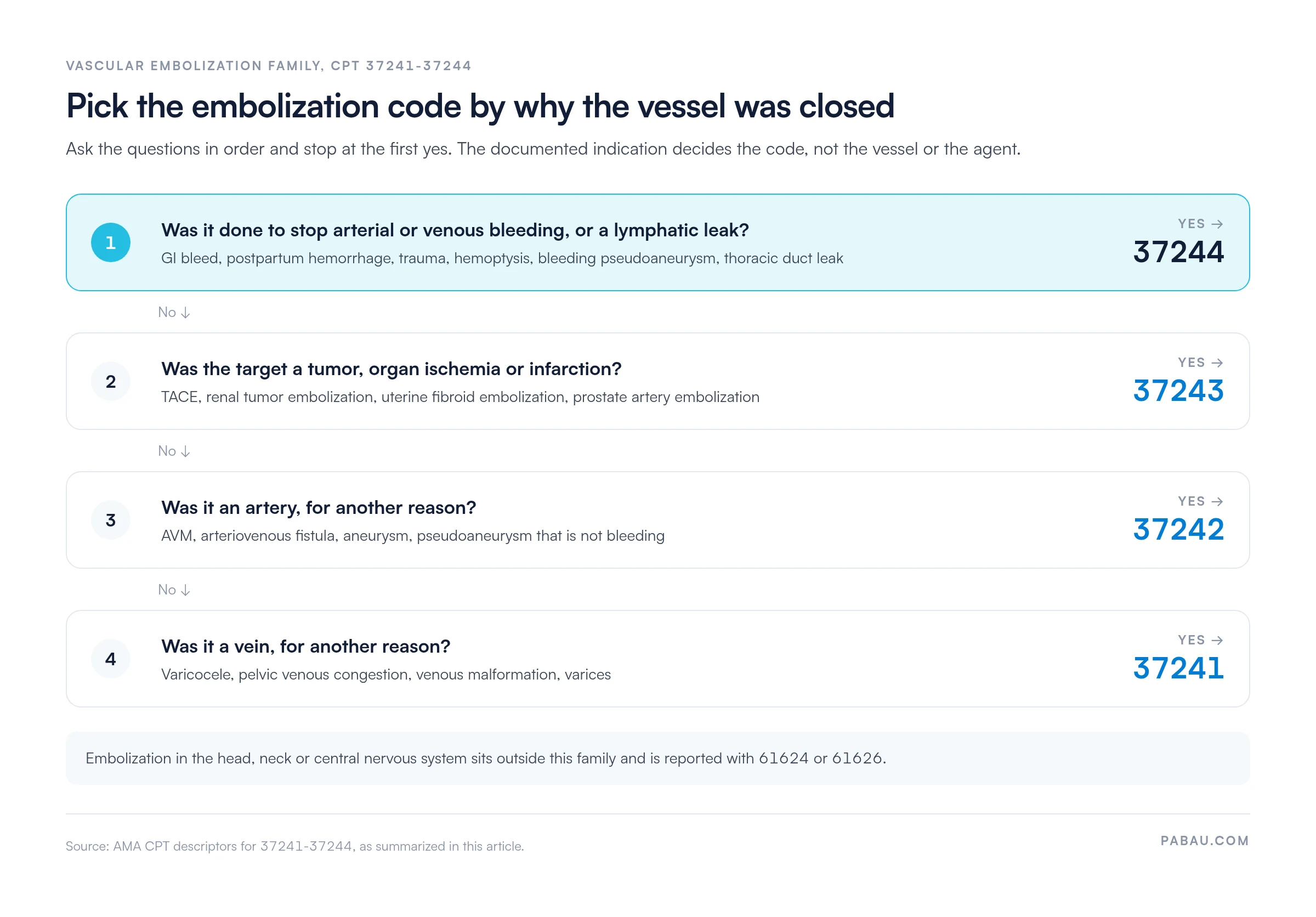
37244 differs from 37242 in one critical way: The clinical purpose is bleeding or a lymphatic leak. Both may involve arterial access, but that is where the similarity ends.
The 37243 question works the same way. 37243 applies when the target is a tumor, organ ischemia or infarction. If the same vessel and technique stop bleeding from a tumor rather than destroying it, 37244 applies. Hemostasis is then the primary intent.
The following scenarios are correctly reported with CPT code 37244 when the operative documentation confirms hemostasis or a lymphatic leak as the clinical goal.
Prostate artery embolization for BPH is reported with 37243, because the indication is organ ischemia. 37244 does not apply to PAE, since bleeding is not the reason for the procedure.
Document the hemorrhage indication with clinical language in the procedure note, not just a diagnosis code. Write ‘Procedure performed for hemostasis control of active gastrointestinal bleeding’ rather than citing a code and expecting payers to infer. Explicit clinical language in the operative report reduces medical necessity denials significantly.
CPT 37244 is a primary procedure code, and some services in the same session may be reported separately when properly documented. Selective catheterization such as 36247 is the most common example. Superbill documentation for embolization encounters should capture each companion code with its supporting catheter placement notes.
Bundling caution: 37244 already includes radiological supervision and interpretation, intraprocedural roadmapping and imaging guidance. Angiography is separately reportable only as a distinct diagnostic study, when no prior imaging is available, and never for guidance. The NCCI edit tables, updated quarterly by CMS, define which catheterization and imaging codes are bundled. Check the current CMS NCCI edit tables before submitting companion codes.
CPT code 37244 is reimbursed under the Medicare Physician Fee Schedule. Rates are set annually and vary by geographic practice cost index (GPCI). The CMS Physician Fee Schedule Look-Up Tool is the primary source for current rates. Always verify there before quoting a reimbursement amount to a practice.
37244 carries a higher work RVU than 37241 or 37242, because hemorrhage procedures typically involve greater clinical complexity and urgency. Hospital-based IR procedures like this one are generally facility-priced. The non-facility value may even be listed as not applicable. Check facility and non-facility values in the CMS look-up before quoting either. Commercial payers negotiate rates above Medicare in most markets.
For current dollar rates, use the FastRVU 2026 RVU lookup or the CMS Look-Up Tool directly. Dollar figures change every January with the annual conversion factor update. Never rely on figures quoted in secondary sources without confirming the effective year.
Prior authorization requirements for CPT code 37244 vary by payer and plan type. Emergency hemorrhage control is generally not subject to prior auth, because clinical urgency makes pre-approval impractical. Scheduled cases, such as a planned embolization after a prior bleed, frequently need pre-approval from commercial payers.
Documentation to support a prior authorization request or a retrospective review typically includes:
Horizon Blue Cross Blue Shield, a large commercial payer with published vascular coding policy, specifies documentation of clinical urgency and imaging confirmation for embolization procedures. Never assume a payer does or does not require prior auth. Check the current payer policy document or portal for each case.
The ICD-10-CM diagnosis code must directly support the hemorrhage or lymphatic leak. Pairing 37244 with a diagnosis that does not reflect active bleeding is one of the most common medical necessity denial triggers.
Verify each ICD-10-CM code against the CDC/NCHS ICD-10-CM web tool for the current fiscal year. Codes are updated each October, so a code valid in FY 2025 may be retired or revised in FY 2026.
37244 claims are denied most often for five reasons. Each has a specific documentation fix and an appeal strategy.
Tracking denial codes by code and payer shows whether a 37244 denial pattern is systemic or isolated. A systemic pattern points to the coding workflow and warrants an education session with the IR team. A one-off denial usually traces to a single encounter’s documentation and warrants a targeted appeal.
Run a quarterly audit on all 37244 claims submitted in the prior 90 days. Flag any denied for ‘wrong code’ or ‘medical necessity’ and trace each one back to the operative report. If more than 10% of denials share the same root cause, fix the documentation workflow upstream rather than appealing claim by claim.
A 37244 claim is most likely to pay on first submission when the operative report contains all of the following elements. Use this as a pre-billing review checklist.
In many IR practices, the coder reads the operative report in one system and keys the claim into another. The hemorrhage indication can get lost between the two, and the denial only surfaces weeks later.
Pabau’s claims management software lets practices attach procedure documentation to each claim record before submission. Billing staff can work through the checklist above while the claim is built, rather than during a denial appeal.
Claims go out through Claim.MD, our US clearinghouse partner, as electronic CMS-1500 claims to thousands of US payers. Eligibility is checked in real time before submission. Claim statuses and ERA remittances then flow back into Pabau, so each 37244 claim can be followed to payment or denial.

Pabau keeps the operative note attached to each 37244 claim, checks eligibility in real time, and submits CMS-1500 claims through Claim.MD. See how it works for interventional radiology and vascular surgery practices.

Code 37244 when the operative note shows the vessel was closed to stop arterial or venous hemorrhage or a lymphatic leak. A pseudoaneurysm without hemorrhage goes to 37242, and a fibroid or tumor goes to 37243.
The cheapest fix sits upstream of billing. When the IR team names the bleeding source and hemostatic intent in the indication line, wrong-code and medical necessity denials have little to catch on. The trade-off is a few extra words per note against weeks of appeal work.
If your billers still chase operative notes after a denial, book a demo to see how Pabau keeps the documentation attached to every 37244 claim.

Need a clearinghouse for electronic claims submission? Medical claims clearinghouse guide covers how clearinghouses validate, route, and track claims before they reach payers.
Want to understand how remittance works after a claim pays? Electronic remittance advice explained covers ERA formats, 835 transaction sets, and how to match payments to claims.
Dealing with recurring claim rejections? Revenue cycle management overview maps the billing workflow from charge capture through payment posting.
Coding a venous embolization instead? CPT code 37241 covers venous embolization for varicoceles, varices and venous malformations.
Billing a diagnostic angiogram alongside embolization? CPT code 75710 explains when extremity angiography is reported as a distinct study.
CPT code 37244 covers vascular embolization or occlusion for arterial or venous hemorrhage or lymphatic extravasation, using any embolizing agent. It applies when the primary clinical goal is stopping bleeding or sealing a lymphatic leak, whichever vessel is accessed. Common applications include GI bleeding, postpartum hemorrhage, trauma hemorrhage, hemoptysis, and thoracic duct leaks.
CPT 37242 covers arterial embolization other than hemorrhage or tumor, such as AVMs, aneurysms, and pseudoaneurysms that are not bleeding. CPT 37244 covers arterial or venous embolization when the purpose is controlling hemorrhage or lymphatic extravasation. Uterine fibroids belong to 37243, and varicocele is venous, so it goes to 37241. Using 37242 when the operative note documents active bleeding is a coding error that commonly results in denial.
Medicare reimbursement rates for CPT code 37244 are updated annually with the Medicare Physician Fee Schedule and vary by geographic location. Verify current facility and non-facility rates using the CMS Physician Fee Schedule Look-Up Tool at cms.gov. Dollar amounts published in secondary sources are frequently out of date. Commercial payer rates are typically negotiated above Medicare and vary by contract.
Selective catheterization codes such as 36247 may be separately billable alongside CPT 37244 when the catheter placement is documented in the operative report. Catheterization that NCCI edits bundle into the embolization cannot be billed separately. Always verify against the current NCCI edit table for 37244 before including companion catheterization codes on the claim.
Use CPT 37244 when the clinical purpose is controlling arterial or venous hemorrhage or lymphatic extravasation. Use CPT 37243 for tumors, organ ischemia, or infarction, such as TACE for hepatocellular carcinoma or uterine fibroid embolization. Even when a tumor is present, 37244 applies if the embolization stops bleeding from the tumor rather than destroying tissue.
Prior authorization requirements for CPT 37244 vary by payer and plan. Emergency hemorrhage control is generally exempt, because clinical urgency does not permit pre-approval. Scheduled procedures, such as a planned embolization after a prior bleed, often need pre-approval from commercial payers. Check the payer’s current policy or provider portal before each case, and never assume one rule covers every plan.