HCPCS Code H0047: Alcohol and drug abuse services (NOS) billing guide
HCPCS Code H0047: Definition and official descriptor HCPCS Code H0047 is the HCP...

Last Updated: Oct 15, 2026
37241 is the CPT code for vascular embolization or occlusion of a venous target other than hemorrhage. The descriptor is inclusive of all radiological supervision and interpretation, intraprocedural roadmapping, and imaging guidance needed to complete the intervention.
Pelvic congestion syndrome, gonadal vein occlusion, varicocele, and portal vein embolization all route through 37241. The code excludes central nervous system vessels, which belong to the 61624-61626 series. Because 37241-37244 share almost identical descriptor language, vascular territory and clinical purpose decide which of the four applies.
Let Pabau's smart automation suggest the right codes, reduce claim denials, and keep your practice compliant—effortlessly.
Automate repetitive tasks and focus on what matters most—your patients.
Reduce coding errors and ensure compliance with the latest regulations.
Clean claims, fewer denials, and faster reimbursements.
Powerful insights and reporting to help your practice thrive.
HIPAA compliant SOC 2 certified GDPR-compliant Trusted by 4,000+ clinics worldwide

CPT 37241 covers venous embolization and occlusion outside the central nervous system, where hemorrhage control is not the purpose.
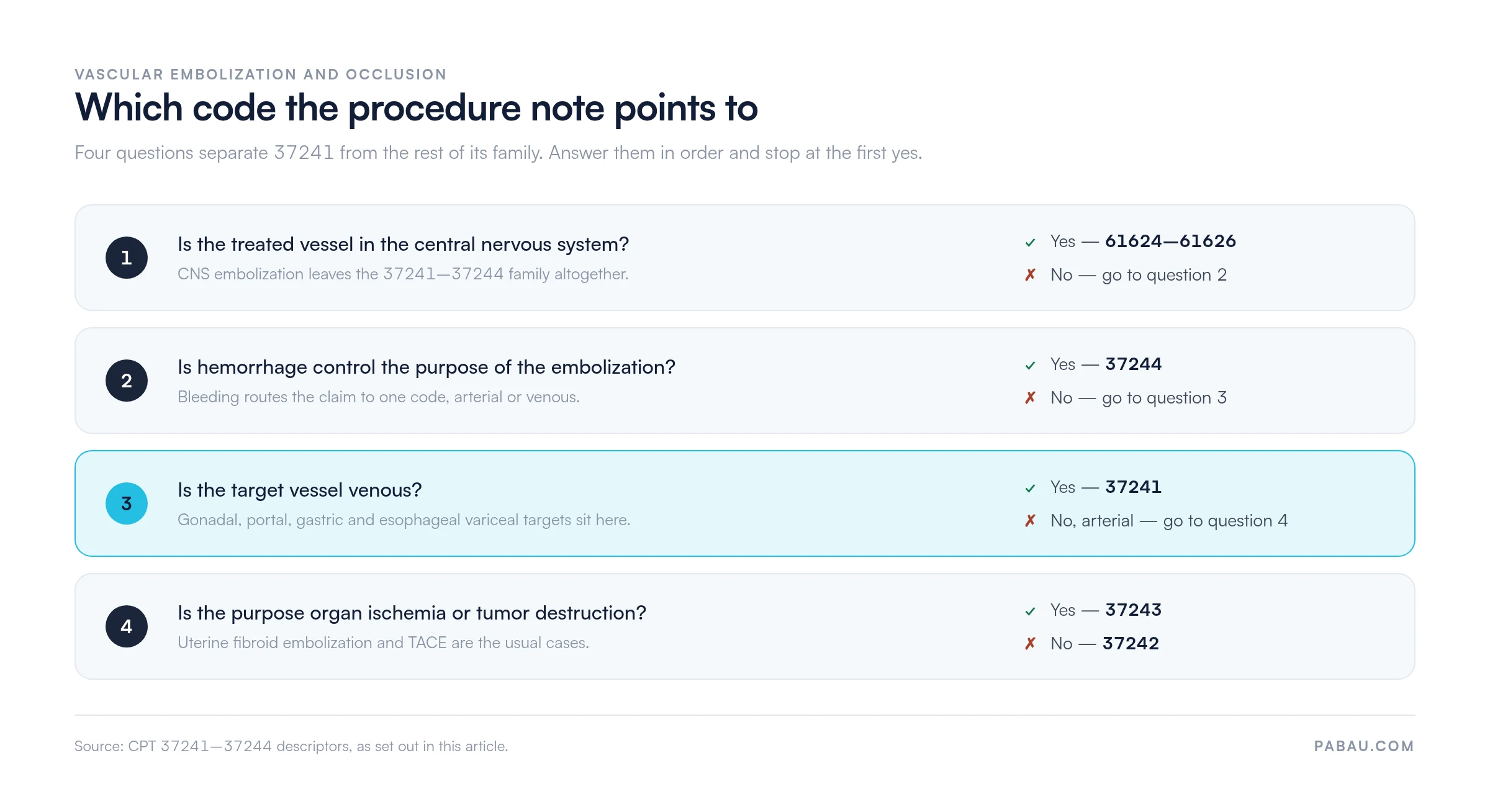
Vascular territory separates the family: venous is 37241, arterial is 37242, organ or tumor is 37243, and hemorrhage is 37244.
The code carries a 000-day global period, and imaging guidance and radiological supervision are bundled into it.
Pelvic congestion syndrome, varicocele, and portal vein embolization are the most common indications, and prior authorization is usually required.
Pabau’s claims management software handles 37241 submission, modifier tracking, and remittance reconciliation for interventional radiology practices.
CPT Code 37241 describes a complete venous embolization or occlusion service.
It takes in the catheterization work, intraprocedural roadmapping, fluoroscopic guidance, and radiological supervision and interpretation. The American Medical Association’s CPT code set gives the full official descriptor as follows. “Vascular embolization or occlusion, inclusive of all radiological supervision and interpretation, intraprocedural roadmapping, and imaging guidance necessary to complete the intervention; venous, other than hemorrhage.”
Two boundaries in that descriptor decide most claims: the “other than hemorrhage” qualifier, and the exclusion of CNS vessels. Hemorrhagic venous embolization routes to 37244 regardless of vessel type, and CNS embolization uses the 61624-61626 series. Every other venous target, from the gonadal veins to esophageal varices, belongs to 37241.
CPT 37241 applies whenever an interventional radiologist embolizes or occludes a non-CNS venous structure for a reason other than hemorrhage control. Medical necessity documentation has to state that indication plainly. Payers deny claims where the clinical rationale is absent or vague. Medicare settles those questions through its coverage determination process, nationally and at contractor level. The indications below account for most 37241 claims.
Each indication requires pre-procedure imaging confirming the venous pathology and a physician order with a linked diagnosis code. The procedure note must specify which vessel was treated and with what embolic agent. Missing any of these elements is a fast path to a medical necessity denial.
The 37241-37244 family covers the full range of vascular embolization and occlusion procedures. Two variables separate them: the vascular territory treated, and the clinical purpose of the embolization. Choosing the wrong one is a leading cause of audits. The common error is documentation that describes bleeding while the coder still reaches for 37241 instead of 37244.
Where one session involves both a venous and an arterial embolization, 37241 and 37242 may both be separately reportable with modifier 59. Document each distinct vascular territory in the operative note to support the unbundling. The ladder below runs the same test in the order a coder applies it.
Arterial revascularization sits outside this family. Iliac artery stenting once reported with 37221 was deleted on January 1, 2026, and now bills as 37258 or 37260. Opening an obstructed vein falls outside the family as well. CPT 37241 closes a vein, while a stent that reopens a peripheral vein is reported with 37238.
All four code families operate in overlapping clinical territory, treating incompetent or pathological veins. Technique and target vessel are what separate them. CPT 37241 uses transcatheter embolic agents in larger proximal veins, while 36465, 36471, and 36475 treat superficial extremity venous incompetence. Misassignment between these families is a leading audit trigger flagged by the AAPC’s coding resources.
Open surgical removal of those superficial veins belongs to neither family. A stab phlebectomy of more than 20 incisions in one leg is reported with CPT 37766.
A 37241 claim stands or falls on its documentation. Eight elements carry the weight. CMS and commercial payers read them to decide medical necessity and to confirm that the code matches the service performed.
No national coverage determination applies to 37241, so Medicare coverage is decided by your Medicare Administrative Contractor. Read the article text itself, not just its code list. CMS article A53084 is the cautionary case. It names 37241 only to rule the code out, because it covers device-based treatment of lower-extremity varicose veins.
CPT 37241 is intentionally comprehensive. The descriptor explicitly states “inclusive of all radiological supervision and interpretation, intraprocedural roadmapping, and imaging guidance necessary to complete the intervention.” That language bundles most guidance codes into the base procedure. Some add-on codes remain separately reportable, but payer acceptance varies and NCCI edits must be checked before submission.
Before appending 75898 to a 37241 claim, check its current status against the CMS NCCI edit files, which CMS republishes every quarter.
Modifier selection for CPT Code 37241 depends on whether the procedure is bilateral, performed alongside other services, or split between professional and technical components. Using the wrong modifier, or omitting one the payer requires, sits among the top denial triggers for 37241 claims. A short pre-submission checklist catches most of them before the claim is transmitted.
Run a modifier audit before submitting any 37241 claim for bilateral pelvic congestion syndrome. Confirm whether your MAC or the commercial payer wants modifier 50 on a single line, or two separate lines with RT/LT. Payer preference differs widely, and the wrong format produces an automatic technical denial that delays payment by 30-45 days on average.
Medicare reimburses CPT 37241 under the Physician Fee Schedule using a resource-based relative value unit methodology. Payment varies by geographic locality. The figures below are 2025-2026 national averages built from published CMS relative value units. Verify current rates in the CMS Physician Fee Schedule search tool before you quote reimbursement to a patient or to leadership.
For hospital outpatient services, 37241 is assigned to an Ambulatory Payment Classification group under the OPPS. The APC rate typically exceeds the facility PFS amount. That is why an outpatient hospital setting shows a lower physician payment than a non-facility office setting. Capturing the physician fee schedule and the facility OPPS components in one charge workflow stops either side from being dropped.
Rates are updated each January 1 through the CMS Final Physician Fee Schedule Rule, published in the Federal Register each November. A 37241 charge reaches the payer as an 837P transaction or a CMS-1500 form. The locality conversion factor is applied to the total RVU at adjudication.
Prior authorization requirements for CPT 37241 vary by payer and by indication. Pelvic congestion syndrome embolization is one of the most consistently prior-authorized procedures in interventional radiology. UnitedHealthcare and Aetna routinely require authorization before gonadal vein embolization, citing documented failure of conservative treatment. The software billing teams use should hold the approved number against each scheduled procedure, so no 37241 claim is submitted without one.

For every payer type, the authorization package should include the referring physician’s clinical note and the diagnostic imaging report. Add a letter of medical necessity from the interventional radiologist. Payer policies change frequently; always verify current requirements directly with the insurer before scheduling elective 37241 procedures.
CPT 37241 denials cluster around six root causes, most of them preventable before the claim is submitted. Sound denial management starts with knowing which of the six is driving your rate. The CARC code on the 835 remittance names the reason, and that decides how the appeal is built.
Correct diagnosis-to-procedure linkage carries the claim. Each ICD-10 code below corresponds to a documented clinical indication for venous embolization under 37241. The diagnosis must appear in the operative report and match what is submitted on the claim. Coders working across both code sets can check a candidate diagnosis against the ICD-10-CM code reference before charge entry, rather than after a denial.
Note that I85.01 (esophageal varices with bleeding) would redirect the claim to CPT 37244 rather than 37241, since active hemorrhage control is the primary purpose. Always confirm the bleeding versus non-bleeding distinction in the operative documentation before assigning the ICD-10 code.
In most interventional radiology practices the 37241 claim is assembled by hand. Someone reads the operative note and picks the code. Someone else looks up the authorization number in a payer portal and keys the modifier into the billing system. Each handoff is a place where the authorization number or the laterality modifier goes missing.
Practice management software like Pabau keeps that sequence in one record. The authorization sits on the scheduled procedure, and the charge is built from the completed note. The modifier and the diagnosis travel with the claim to the clearinghouse. Remittances post back against the same charge, so a CARC 97 bundle or a short payment surfaces the day it lands.
For a practice billing bilateral gonadal vein embolizations, that means the modifier format your payer expects is set once and applied every time. Your billers then spend their hours on the denials worth appealing, not on re-keying claims that were correct at the first submission.

Pabau’s claims management software automates CPT 37241 submission, tracks modifiers, and reconciles Medicare ERA payments so your IR billing team spends less time chasing denials.

CPT Code 37241 turns on two questions the procedure note has to settle. Which vascular territory was treated, and was bleeding the reason for treating it? The modifier, the diagnosis link, and the authorization requirement all follow from those two answers.
The trade-off worth remembering is how generously 37241 bundles. It absorbs the imaging guidance and the supervision work, which makes one code look thin against the effort behind it. Unbundling that work back out is what draws an audit, so the return on this code comes from clean documentation and a correct first submission.
Start with the operative note template. If it names the vessel, the embolic agent, the laterality, and the non-hemorrhagic indication in fixed places, your coders stop reconstructing each case from prose. Book a demo to see how Pabau carries that detail from the note through to the paid remittance.

Need to understand how claims move from charge to payment? Revenue cycle management overview walks through every stage from CPT assignment through ERA posting.
Submitting clean claims for interventional procedures? Clean claim requirements covers the data elements payers validate before processing any 37241 submission.
Dealing with payer credentialing for IR physicians? Insurance credentialing steps outlines the enrollment process that unlocks reimbursement for new IR practitioners.
CPT Code 37241 covers transcatheter embolization or occlusion of venous structures outside the central nervous system, performed for reasons other than hemorrhage control. All imaging guidance and radiological supervision and interpretation are included in the single code. It applies to gonadal vein embolization for pelvic congestion syndrome, varicocele embolization, and portal vein embolization before hepatic resection.
Medicare reimburses CPT 37241 at approximately $609 in the facility setting and approximately $1,133 in the non-facility setting based on 2025-2026 national average rates. Actual payment varies by geographic locality and is updated each January 1. Verify current figures in the CMS Physician Fee Schedule lookup tool before you use these amounts for budgeting or patient estimates.
CPT 37241 is used for venous embolization outside the CNS, where hemorrhage is not the purpose. CPT 37242 is the arterial equivalent, for non-hemorrhagic procedures that do not target an organ or tumor. CPT 37243 covers arterial embolization for organ ischemia induction or tumor destruction, such as uterine fibroid embolization or TACE. Vascular territory and clinical purpose are the only differentiators within the family.
Modifier 50 marks a bilateral procedure, though some payers want RT/LT on two separate lines instead. Modifier 59 marks a distinct procedural service, used when 37241 is billed alongside 37242 on the same day. Modifier 26 bills the professional component alone, and modifier 51 applies when 37241 is the secondary procedure. Confirm payer preferences before submission, because the single-line versus two-line format for bilateral claims is a common technical denial trigger.
Medicare coverage for pelvic congestion syndrome embolization under CPT 37241 is set by your Medicare Administrative Contractor, not by a national coverage determination. You need pre-procedure imaging confirming the venous pathology and a physician order carrying a supporting ICD-10 code. Read your MAC’s local coverage article in full before you submit, because some articles name 37241 only to rule it out for an unrelated service.
CPT 37241 bundles intraprocedural fluoroscopic guidance and radiological supervision and interpretation into the base code, so codes 77001 and 75894 are generally not separately reportable. CPT 75898 may be separately reportable when a distinct diagnostic angiography run is performed and independently interpreted after the embolization. Acceptance is payer-specific, so check the current NCCI edit tables before appending it.
The leading denial reasons for CPT 37241 are missing medical necessity documentation (CARC 50) and absent prior authorization (CARC 15). Incorrect code selection within the 37241-37244 family (CARC 4) and unbundling errors with imaging supervision codes (CARC 97) come next. Omitted or badly formatted bilateral modifiers round out the list. Most are preventable with a pre-submission checklist covering auth status, modifier selection, and ICD-10 linkage.