HCPCS Code A4709: Acid concentrate solution for hemodialysis
What is HCPCS code A4709? HCPCS code A4709 is the Healthcare Common Procedure Co...

Last Updated: Oct 15, 2026
61624 is the CPT code for transcatheter permanent occlusion or embolization of central nervous system vessels, performed percutaneously by any method. Typical indications include tumor destruction, hemostasis, and occlusion of a vascular malformation. Since CPT 2026 the code also includes all radiological supervision and interpretation, roadmapping, and imaging guidance.
Coders confuse it most often with CPT 61626, which covers the same technique in non-CNS head and neck vessels. That single misclassification is the leading cause of denials on neurovascular intervention claims.
Let Pabau's smart automation suggest the right codes, reduce claim denials, and keep your practice compliant—effortlessly.
Automate repetitive tasks and focus on what matters most—your patients.
Reduce coding errors and ensure compliance with the latest regulations.
Clean claims, fewer denials, and faster reimbursements.
Powerful insights and reporting to help your practice thrive.
HIPAA compliant SOC 2 certified GDPR-compliant Trusted by 4,000+ clinics worldwide

CPT code 61624 covers percutaneous permanent occlusion or embolization of central nervous system vessels, meaning intracranial and spinal cord targets only.
Since CPT 2026, 61624 includes all radiological supervision and interpretation, so 75894 and 75898 are no longer reported with it.
Picking 61624 when the target sits outside the CNS is the top denial driver, since CPT 61626 covers non-CNS head and neck vessels.
Modifier -50 may apply to bilateral embolization, but payer rules differ, so confirm with your MAC before you submit.
Pabau’s claims management pre-fills the charge line from the record and validates required claim fields before submission.
CPT code 61624 covers transcatheter permanent occlusion or embolization of a central nervous system vessel, done percutaneously. Intracranial and spinal cord targets qualify. Head and neck vessels outside the CNS do not.
The American Medical Association’s CPT code set places the code in the Endovascular Therapy subsection of the nervous system surgery chapter. That placement matters, because the subsection’s 2026 revision changed what the code pays for. The official 2026 descriptor breaks into four parts.
Three details in the operative report decide whether the code holds, and a fourth does not matter at all.
Any percutaneous procedure that permanently occludes a CNS vessel maps to 61624, whatever the indication. Neurointerventional surgeons and interventional radiologists reach for it across six common scenarios.
Location decides the code every time. If the embolized vessel feeds a CNS structure, 61624 applies. If the target is a head or neck vessel with no intracranial or spinal cord involvement, the case maps to 61626. Outside the head and neck, neither code applies, and a venous target treated for something other than hemorrhage reports CPT 37241.
An arterial target in that same territory, treated for a reason other than bleeding or a tumor, reports CPT 37242. When the indication outside the CNS is arterial or venous hemorrhage, the case reports CPT 37244 instead.
The cerebral AVM indication above names preoperative devascularization, so an open excision follows. That excision takes its own procedure code. UK private practices bill it under CCSD code A0260.
61624 covers CNS embolization and 61626 covers non-CNS head and neck embolization. The technique is the same, and only the anatomy differs. Picking the wrong one drives more denials on these claims than any other error.
Name the vessel in the operative report and state its relationship to the CNS. A note describing embolization of an external carotid branch feeding a CNS tumor can support either code. Where the occlusion happened is what settles it.
Medicare pays 61624 from the CMS Physician Fee Schedule, multiplying the code’s relative value units by the annual conversion factor. CY2026 has two conversion factors rather than one. Qualifying APM participants are paid at $33.5675, and non-qualifying clinicians at $33.4009.
Geographic practice cost indices then adjust the payment by MAC jurisdiction, so the same case pays differently in Miami and in rural Iowa. Check your locality’s figures on the PFS lookup before you quote a number to anyone.
Four inputs decide the payment: work, practice expense, malpractice, and the conversion factor. Use the FastRVU 2026 lookup to confirm the current values for your locality before billing.
61624 is a facility procedure in practice, performed in a hospital interventional suite or an ASC. The facility rate applies when the place of service is 21, 22 or 24. Non-facility rates only fit a rare office-based interventional suite. Billing the wrong place of service creates an overpayment you will have to refund.
61624 is a surgical code with no professional or technical split, so -26 and -TC do not apply to it. The modifiers that do matter cover laterality and unbundling.
Bilateral embolization is possible when vessels on either side of the CNS midline are occluded in the same session. Some MACs want one line with modifier -50. Others want two lines, one with -LT and one with -RT. Check the payer’s bilateral surgery policy before you submit.
CPT 2026 cut the list short. The revision folded all radiological supervision and interpretation into 61624, so 75894 and 75898 no longer go out with it. Catheterization access and a few other services still stand alone.
Stereotactic navigation is a separate question on a staged AVM case. The cranial intradural add-on 61781 pays only beside a primary procedure that opens the dura. A percutaneous embolization does not open it, so the navigation line belongs on the later craniotomy claim.
Check the current AAPC CPT code references and the NCCI edit table before you submit any combination.
The split between bundled and separately reportable is easier to see than to read.
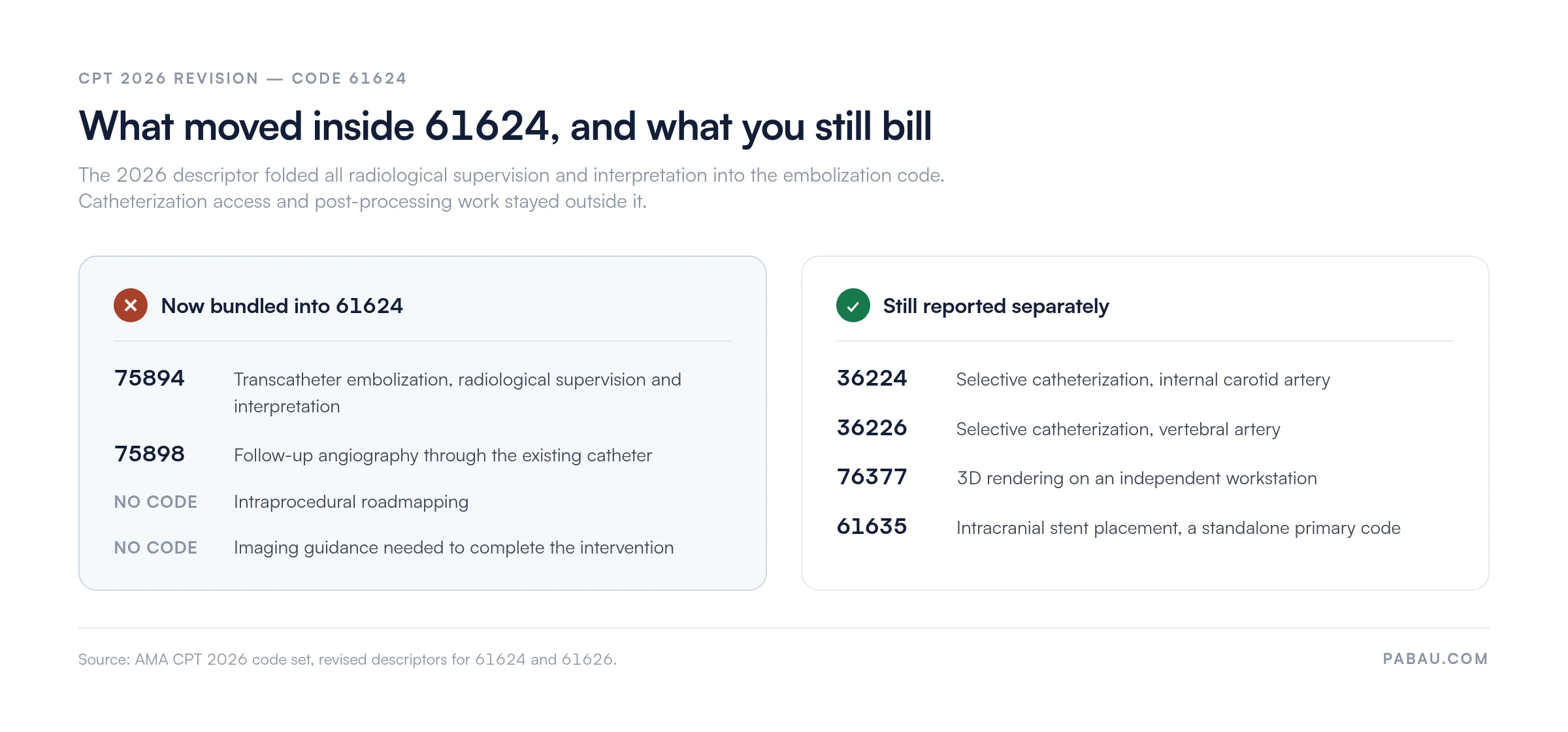
The National Correct Coding Initiative sets which codes fold into 61624 and which can go out beside it. CMS updates the tables quarterly, so a pairing that was billable in January may be bundled by April.
Every 61624 claim needs a linked ICD-10-CM code that establishes medical necessity, matched to the indication in the operative report. Specificity at the fifth and sixth character is what keeps the claim out of a truncation rejection.
Pull the subcode from the ICD-10-CM code set rather than from memory. The six codes below cover most 61624 indications.
Code to the highest level of specificity the note supports. For a ruptured aneurysm, the I60 subcode that names the vessel strengthens medical necessity and heads off a records request.
Before you submit, cross-check the indication in the operative report against the ICD-10-CM code you selected. Reviewers compare the two directly, and an unspecified code on a complex neurovascular claim invites an additional documentation request.
MAC reviewers read the operative report before they pay a 61624 claim, and they read it for seven specific elements. Capture each one before the note is signed.
A structured note template built around those seven elements catches omissions before the note closes. Store each element as its own field and the check becomes mechanical.
The claim moves in a straight line, and it stalls at predictable points. The physician dictates, the coder abstracts the operative report, the charge posts, the clearinghouse checks required fields, and the payer adjudicates.
Each item below is a handoff where a 61624 claim usually goes wrong.
Run that list once and most 61624 denials never happen. Working the same list after a denial means an appeal instead of a payment.
61624 denies more often than a routine procedure code, and the reasons repeat. Six patterns account for most of them, and each has a fix you can apply at submission. The same denial management strategies apply across the rest of your interventional claims.
When a denial does land, appeal with the operative report, the applicable MAC coverage determination and a signed necessity statement from the physician. Most 61624 denials overturn at the first level when the documentation is complete.
Most 61624 errors start before the claim form, at charge entry, where a code gets keyed by hand from a note someone else wrote. Practice management software like Pabau takes a different route. Its accurate claims management pulls the code already attached to the service straight onto the charge line. Diagnosis slots are seeded from the patient’s recorded problem list.
The code libraries behind that are lookup and reference, holding more than 20,000 ICD-10-CM, CPT and HCPCS entries refreshed with each official release. A coder searching 61624 sees the stored descriptor rather than a half-remembered one. The software does not choose the code for you, and on a neurovascular case it should not.
Submission runs through Claim.MD on the US pipeline. Before the send button unlocks, Pabau checks that the claim’s required fields are filled, which is a completeness check rather than a coding opinion. Eligibility checks run live, remittances post back as ERAs, and claim status is tracked in the same place.

Pabau pulls the codes already on the encounter onto the claim line. Coders get a searchable CPT and ICD-10 library, and submission waits until the required fields are complete.

The 2026 revision reshaped the 61624 claim more than any other change this year. Imaging supervision sits inside the code now, so the charge is simpler and the old 75894 habit is a rejection waiting to happen.
What has not changed is the vessel. One line in the operative report separates 61624 from 61626, and it decides whether the claim pays. Build that check into the note template and into charge entry, and the denial rate on these cases falls without extra work at appeal.
If charge entry is where your 61624 errors start, that is a workflow problem worth fixing. Book a demo to see how Pabau carries the encounter’s codes onto the claim and holds it until the required fields are complete.

Need to understand how claims move through a clearinghouse? Medical claims clearinghouse guide explains how electronic claim validation works before a claim reaches the payer.
Dealing with high denial volumes on complex procedure codes? Denial codes in medical billing covers the most common CARC reason codes and how to respond to each one.
Want the full revenue cycle context for interventional billing? What is revenue cycle management explains the end-to-end billing process from authorization through payment posting.
Looking up the descriptor for another procedure code? CPT code library collects the CPT billing guides on this site in one place.
The hospital bills its own facility claim, separate from the physician’s. Outpatient cases pay under OPPS, inpatient cases under the DRG, and the physician reports 61624 on a professional claim. There is no technical component to split off with -TC.
Traditional Medicare rarely requires prior authorization for an inpatient neurointerventional case. Medicare Advantage and commercial plans often do, and many of them review bilateral treatment separately. Get the approval in writing, and make sure it names the laterality you plan to treat.
Use modifier -53 when the physician discontinues the procedure because continuing would put the patient at risk. Modifier -52 fits a procedure that was deliberately reduced in scope. Either way, the operative report has to explain what was done and why it stopped there.
For Medicare, a redetermination has to reach the MAC within 120 days of the remittance advice. Commercial deadlines vary by contract and are often shorter, so check yours before the clock runs. Send the operative report and the necessity statement with the first appeal rather than the second.