

CCSD code G5100: Bypass of duodenum billing guide
CCSD code G5100 bills a bypass that leaves the duodenum in place CCSD code G5100...

Last Updated: Oct 16, 2026
37220 was the CPT code for revascularization, endovascular, open or percutaneous, iliac artery, unilateral, initial vessel, with transluminal angioplasty. The AMA deleted it effective January 1, 2026, along with the rest of the 37220-37235 family.
Iliac angioplasty is now reported with 37254 when the lesion is a stenosis and 37256 when it is an occlusion. A stent in the same artery moves the claim to 37258 or 37260 instead. Claims billed with 37220 for a 2026 date of service are rejected.
Let Pabau's smart automation suggest the right codes, reduce claim denials, and keep your practice compliant—effortlessly.
Automate repetitive tasks and focus on what matters most—your patients.
Reduce coding errors and ensure compliance with the latest regulations.
Clean claims, fewer denials, and faster reimbursements.
Powerful insights and reporting to help your practice thrive.
HIPAA compliant SOC 2 certified GDPR-compliant Trusted by 4,000+ clinics worldwide

CPT code 37220 was deleted effective January 1, 2026, together with the rest of the 37220-37235 lower extremity revascularization family.
Iliac angioplasty of an initial vessel is now 37254 for a straightforward lesion (a stenosis) or 37256 for a complex lesion (an occlusion).
The 46 new codes still split by intervention type inside each territory, and lesion complexity is a second split layered on top of it.
If a stent goes into the same artery, bill 37258 or 37260 instead, because the iliac stent codes already include the angioplasty.
Claims billed with 37220 for a 2026 date of service are rejected, while procedures performed in 2025 keep the deleted code.
CPT code 37220 is no longer valid for current claims. The American Medical Association (AMA) deleted it effective January 1, 2026, along with every other code from 37220 through 37235. None of those 16 codes appears in the CY2026 Medicare relative value files.
A practice rebuilding its charge master has to resolve all 16 at once. CPT code 37228, the tibial/peroneal angioplasty code, now bills as 37280 for a stenosis or 37282 for an occlusion.
Through 2025, 37220 carried this official descriptor:
Revascularization, endovascular, open or percutaneous, iliac artery, unilateral, initial vessel; with transluminal angioplasty.
That wording now applies only to procedures performed on or before December 31, 2025. For those cases it still belongs on the claim.
CPT 2026 replaced the family with 46 codes, numbered 37254 through 37299. The old family had three vascular territories, and the new one has four. The addition is an inframalleolar territory for the arteries of the foot.
Inside each territory, the codes still divide by intervention type, as the old family did. Each intervention type then splits by lesion complexity, and again by initial or additional vessel.
Each deleted iliac code therefore maps to a pair of successors, one for each lesion type. The crosswalk below follows the SCAI 2026 lower extremity revascularization code guide.
The stent half of that crosswalk has its own guide on our CPT code 37221 page.
Unilateral iliac angioplasty of the initial vessel is now reported with 37254 or 37256. The lesion described in the operative note decides which one.
The official descriptor for 37254 runs to four clauses:
37256 uses the same wording and ends with complex lesion, initial vessel instead. The full iliac range looks like this:
Read the table in two layers. The intervention type picks the group of codes, and the lesion type picks the code inside that group.
Four reporting rules from the SCAI 2026 guidance govern the iliac territory:
A procedure billed as 37220 in 2025 usually lands on 37254 or 37256 in 2026. Three questions, asked in order, settle the code, and the diagram after the list maps each answer to its code.
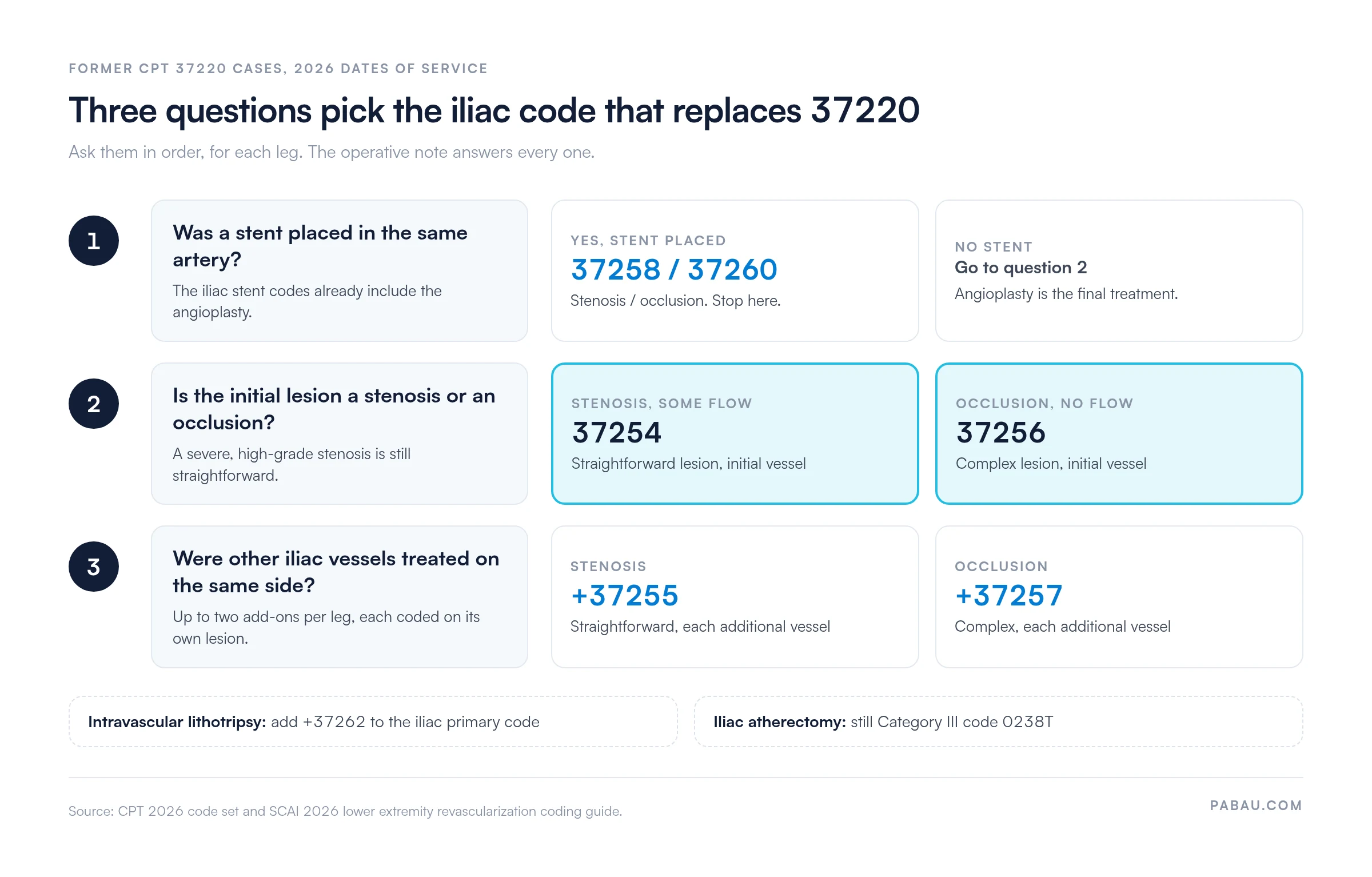
Intravascular lithotripsy adds +37262 to whichever iliac primary code applies. Iliac atherectomy has no code in the new family, so it is still reported with Category III code 0238T.
The femoral/popliteal territory works differently. A stent with atherectomy there was reported with 37227 through 2025, and the 2026 range still codes that combination.
CPT defines the two lesion types narrowly. A straightforward lesion is a stenosis, where some blood still flows through the segment. A complex lesion is an occlusion, with no flow through it. A severe, high-grade stenosis is still straightforward.
Here is how that plays out on a common case. The note describes a 90% stenosis of the right common iliac, treated with balloon angioplasty and no stent. That is 37254 with RT, not 37256.
Add a required field to your iliac operative note template that records each treated lesion as a stenosis or an occlusion. Under 37220 nobody needed it, and now it decides between 37254 and 37256.
The 2026 descriptors write the bundled services into the code text itself. Services on the list below cannot go on a separate line for the artery you treated.
Bundled imaging is the change most likely to break an existing charge template. Lines for angioplasty supervision and interpretation that used to ride along with 37220 will now reject, the same way they do under CPT 37241.
Diagnostic angiography performed before the decision to treat follows separate rules. Payer policy on it varies, so check your MAC’s guidance before you edit your charge templates.
These codes cover the artery only. A stent placed in the iliac vein is a venous service, reported with 37238 instead.
Coders reading operative reports need to recognize the steps behind an iliac angioplasty claim. A typical case runs in this order:
The usual indication is atherosclerotic peripheral arterial disease (PAD) causing claudication or chronic limb-threatening ischemia. The diagnosis code has to match that documented indication, which the ICD-10 section below covers.
Both 37254 and 37256 are unilateral codes. The CY2026 fee schedule gives them bilateral indicator 1, so modifier 50 applies when the same code is performed on both legs.
When both iliac systems are treated, code each leg on its own findings. One side can be a stenosis coded 37254 while the other is an occlusion coded 37256.
Two different codes go on separate lines with RT and LT. Modifier 50 fits only when both legs carry the same code. Confirm the format your payer or MAC expects before the claim goes out.
CY2026 Medicare uses two conversion factors. Qualifying APM participants (QPs) are paid at $33.5675 per RVU, and all other clinicians at $33.4009.
The table multiplies the total RVUs in CMS’s October 2026 relative value file by each factor. The results are national rates before any geographic adjustment.
Against 37220 in 2025, the straightforward code lost ground and the complex code gained. Work RVUs fell from 7.90 to 7.30 for 37254 and rose to 10.75 for 37256.
In dollars, 37220 paid about $2,288 non-facility at the 2025 conversion factor of $32.3465. At the 2026 non-QP rate, a stenosis now pays about $2,073 and an occlusion about $2,430.
Your locality moves every figure in that table. Look up the rate that applies to you in the CMS Physician Fee Schedule Look-Up Tool.
Both codes carry a 000 global period, the same as 37220 did. Guides that give this family a 90-day global are wrong.
A 000 global means no postoperative period follows the procedure. A documented follow-up visit on a later date is billed as its own service.
An evaluation and management visit on the procedure day is different. It needs modifier 25 and a significant, separately identifiable reason beyond the usual pre-procedure assessment.
Medicare covers iliac angioplasty under National Coverage Determination 20.7, Percutaneous Transluminal Angioplasty. It covers PTA to treat atherosclerotic obstructive lesions in the iliac, femoral, and popliteal arteries.
To show medical necessity, the record usually needs these elements:
Traditional Medicare does not generally require prior authorization for iliac angioplasty. Medicare Advantage plans and commercial payers often do, and each sets its own criteria. Check the requirement when the case is scheduled, not after it is performed.
The operative report has to support the territory, the lesion type, the laterality, and the intervention on the claim. Most medical necessity and complexity denials trace back to a missing element from this list.
A coder who cannot find the lesion character has to query the physician before the charge is released. That delay is cheaper than a denial for unsupported complexity.
The code you report follows the date of service, not the date you send the claim. A procedure performed on or before December 31, 2025 stays on 37220 through corrected claims, appeals, and late submissions.
Only a 2026 date of service moves to the new codes. Three practical steps follow from that rule:
AAPC’s Codify entry for 37220 carries the deleted-code flag. It is a quick status check when a payer questions an older line.
Most denials on the new iliac codes come from a short list of causes. The table pairs each one with the step that prevents it.
The diagnosis must match the documented indication and meet the payer’s coverage criteria. Verify each code against the ICD-10-CM tabular list for the current fiscal year.
Our ICD-10-CM code library covers the individual codes in more detail. The table lists the pairings seen most often with iliac angioplasty.
Two pairings go wrong often. I70.92 never stands alone, because the tabular list tells you to code the underlying atherosclerosis first. A claudication symptom code should not replace I70.21- when the etiology is documented.
Where the report describes an embolus or thrombus rather than plaque, I74.5 is the diagnosis that carries the claim.
The 2026 restructure touches more than a code list. Charge templates, superbills, and operative note templates written for 37220 all need to change at once. Coders also have to read the lesion type first, because it now decides the code.
Practice management software like Pabau keeps those pieces in one system. Your team updates procedure codes, fees, and note templates once, and every new encounter uses the current version.
Claims go to payers through the Claim.MD clearinghouse integration, and electronic remittance advice comes back for posting. Rejections for a deleted code show up in the same workflow, so your team corrects and resubmits them while the case is still fresh.

Keep procedure codes, operative note templates, and Claim.MD claim submission in one system, so a CPT update is a change your team makes once.

CPT 37220 is deleted, and it is valid only for procedures performed in 2025 or earlier. For a 2026 date of service, iliac angioplasty is 37254 for a stenosis and 37256 for an occlusion.
A stent in the same artery moves the claim to 37258 or 37260 instead. The choice between the two angioplasty codes also moves national non-facility payment by roughly $360.
Three changes carry most of the transition. Retire the deleted range from charge templates, add a lesion character field to the operative note, and remove the imaging lines the new codes absorb.
Pabau’s claims management software handles submission and remittance, so your team spends its time on coding rather than chasing claims. Book a demo to see it run a vascular billing workflow end to end.

Working a denied vascular claim? Denial management in healthcare shows how to triage, appeal, and stop the same denial recurring.
Want fewer rejections at first pass? What makes a clean claim covers the fields a payer checks before it pays.
Checking coverage before the procedure? Insurance eligibility verification explains what to confirm at scheduling.
Posting payments for vascular claims? Electronic remittance advice explains how 835 files map adjustments back to claim lines.
Want to see how the billing cycle connects? Revenue cycle management covers the path from charge capture to payment posting.
Through 2025, 37220 covered endovascular angioplasty of one iliac artery, unilateral, initial vessel. It applied when angioplasty was the final treatment and no stent was placed. The code is now deleted and applies only to 2025 dates of service.
Two codes replaced it, split by lesion complexity. Report 37254 for iliac angioplasty of a straightforward lesion, meaning a stenosis. Report 37256 for a complex lesion, meaning an occlusion. Add-on codes 37255 and 37257 cover additional iliac vessels in the same leg.
Use RT or LT for laterality. Modifier 50 applies when the same initial-vessel code is performed on both legs, but never on an add-on code. Modifier 59 or XS applies only to a distinct service that an NCCI edit would otherwise bundle.
At the CY2026 non-QP conversion factor of $33.4009, national non-facility payment is about $2,073 for 37254 and $2,430 for 37256. Facility payment is about $336 and $492. QP rates at $33.5675 run slightly higher, and your locality adjusts every figure.
Keep 37220 on it. The code follows the date of service, not the date you bill. A procedure performed in 2025 stays on 37220 through corrected claims and appeals. Only a 2026 date of service moves to the new codes.



