CPT code 63081: Vertebral corpectomy, cervical spine
CPT code 63081: official descriptor and procedure overview CPT code 63081 descri...

Last Updated: Oct 6, 2026
37228 was the CPT code for revascularization, endovascular, open or percutaneous, tibial, peroneal artery, unilateral, initial vessel; with transluminal angioplasty. The AMA deleted it effective January 1, 2026.
From January 1, 2026, initial-vessel tibial or peroneal angioplasty is reported with 37280 or 37282. Code 37280 is for a straightforward lesion (stenosis), and 37282 is for a complex lesion (occlusion). Keep 37228 for corrected claims and appeals with earlier dates of service.
Let Pabau's smart automation suggest the right codes, reduce claim denials, and keep your practice compliant—effortlessly.
Automate repetitive tasks and focus on what matters most—your patients.
Reduce coding errors and ensure compliance with the latest regulations.
Clean claims, fewer denials, and faster reimbursements.
Powerful insights and reporting to help your practice thrive.
HIPAA compliant SOC 2 certified GDPR-compliant Trusted by 4,000+ clinics worldwide

The AMA deleted CPT code 37228 on January 1, 2026, along with the rest of the 37220–37235 lower-extremity revascularization family.
For dates of service from January 1, 2026, report initial-vessel tibial or peroneal angioplasty with 37280 for a stenosis or 37282 for an occlusion.
Legacy 37228 covered angioplasty only, so atherectomy, stent placement and additional vessels each had their own legacy code.
The new codes are chosen by territory, intervention and lesion complexity. The operative note must state whether each lesion was a stenosis or an occlusion.
Keep 37228 for corrected claims and appeals with dates of service before 2026, using the descriptor that applied on that date.
CPT code 37228 no longer exists for current claims. The American Medical Association deleted it effective January 1, 2026, together with the whole 37220–37235 lower-extremity revascularization family.
For a tibial or peroneal angioplasty of the initial vessel on or after that date, the replacement depends on the lesion. Report 37280 for a straightforward lesion and 37282 for a complex lesion. SCAI’s 2026 tibial/peroneal coding guide defines straightforward as a stenosis and complex as an occlusion.
The 16 deleted codes were replaced by 46 new codes, 37254–37299. They are organized by four vascular territories and by lesion complexity:
Claims for procedures performed before January 1, 2026 still use 37228 and its legacy family. That matters for late charges, corrected claims and appeals.
CPT code 37228 applied to dates of service through December 31, 2025. The AMA descriptor read: Revascularization, endovascular, open or percutaneous, tibial, peroneal artery, unilateral, initial vessel; with transluminal angioplasty.
The code described angioplasty only, in the first tibial or peroneal vessel treated on one leg. Any other intervention moved the claim to a different legacy code:
When you correct or appeal a 2025 claim, match the code to the most intensive service documented in that vessel. A note that documents atherectomy supports 37229 or 37231, never 37228.
Each deleted tibial/peroneal code splits into two new codes, one for a straightforward lesion and one for a complex lesion. The crosswalk below follows SCAI’s 2026 LER code summary.
A plus sign marks an add-on code, which is reported with an initial-vessel code and never on its own. In the new series, the even-numbered codes 37280–37294 are initial-vessel codes and the odd-numbered codes 37281–37295 are add-ons. The grid below lays the series out by intervention and lesion type.
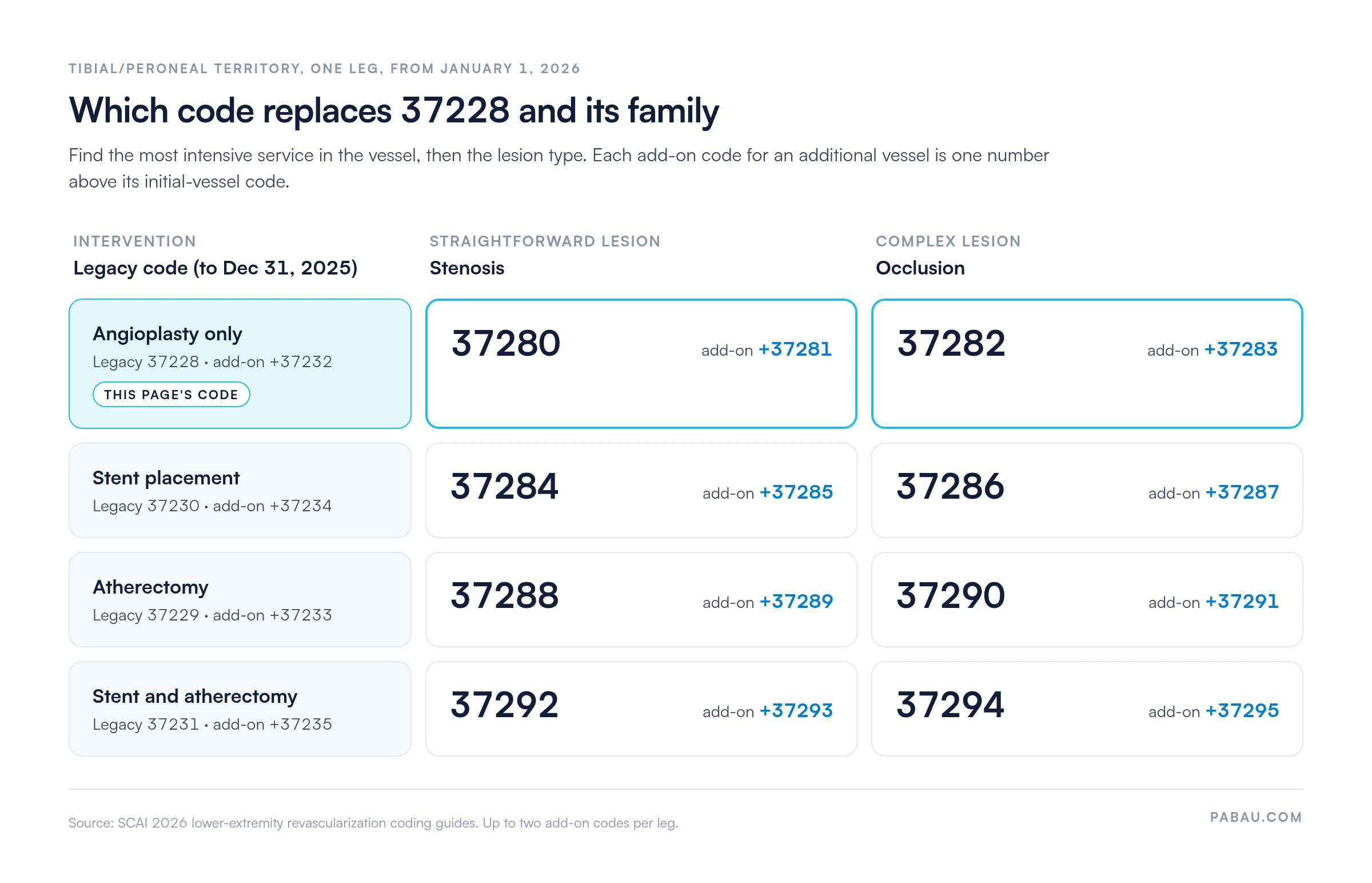
The 2026 descriptor for 37280 covers unilateral transluminal angioplasty in the tibial and peroneal vascular territory, open or percutaneous. It includes every maneuver needed to access and selectively catheterize the artery and cross the lesion.
It also includes the imaging guidance and radiological supervision and interpretation for the angioplasty within the same artery. Code 37282 carries the same wording but ends in “complex lesion, initial vessel” instead of “straightforward lesion, initial vessel.”
Lesion complexity is the new decision point, and the operative note has to settle it. Under SCAI’s guidance, a stenosis is straightforward and an occlusion is complex. Then apply the territory rules:
Treating the femoral/popliteal segment in the same session is a separate territory, so it takes its own primary code from 37263–37279. A lesion that crosses territories and is treated with a single therapy is reported with one code.
The new descriptors fold access, catheterization and imaging into each code. Billing them separately on the treated vessel is a common unbundling denial.
Payers need a diagnosis that establishes medical necessity for the revascularization. Atherosclerosis of native arteries of the extremities, I70.2-, is the usual indication. Its fifth and sixth characters identify the presentation, the leg and, for ulcers, the site.
The diagnosis has to match the documented presentation. A note describing gangrene of the left foot belongs with I70.262, not with an ulceration or rest-pain code.
Modifier choice depends on whether both legs were treated, or whether a separate procedure shares an NCCI edit with the revascularization code.
The operative report decides the code under the 2026 rules. Every element below should appear in the note to meet billing compliance requirements.
A note that says “tibial angioplasty performed” without the vessel or lesion type cannot support either 37280 or 37282.
Many commercial and Medicare Advantage plans require prior authorization for elective lower-extremity revascularization. Plans had to reload their policies with the 2026 codes, so check that an approval names 37280–37295 rather than 37228. Run insurance eligibility verification before scheduling.
An authorization issued under 37228 for a 2026 date of service may not match the claim. Ask the plan to update it before the procedure, not after the denial.
Medicare does not pay 37228 on a 2026 date of service, because the code is no longer valid. Payment for tibial and peroneal angioplasty now flows through 37280–37295, valued in the CMS Physician Fee Schedule lookup tool. Rates vary by locality and setting, so look up the current values for your MAC.
Most denials on these claims trace back to a handful of causes. Building a denial management workflow around them stops the same error from repeating.
For legacy 37228 claims with 2025 dates of service, the usual fix is the intervention level. If the note documents atherectomy or a stent, correct the claim to 37229, 37230 or 37231.
Add a required stenosis-or-occlusion field to your operative note template. Coders then pick the straightforward or complex code from the note, without sending a query back to the physician.
A code deletion hits a vascular practice in three places at once: the charge, the authorization and the claim. Practices that bill from spreadsheets or a separate billing service often find out from the first wave of denials.
Pabau, the practice management and billing platform we build, runs validation checks before a claim leaves the practice. Its claims management software confirms that required details, such as authorization codes and member numbers, are present. It also runs real-time eligibility checks through Claim.MD.
Each claim then moves through one status dashboard, from submitted to paid, with remittances posted against it. Pair that with a clean claim checklist, and your team corrects a 37228 charge before it turns into an appeal.


Pabau’s claims management checks each claim for missing details before submission and tracks its status through payment. Your team catches a deleted code or a missing authorization before the payer does.

Treat 37228 as a historical code. It still matters for 2025 dates of service, corrected claims and appeals, and it should appear nowhere else.
The larger change is in the operative note. Under the 2026 codes, the difference between a stenosis and an occlusion moves the claim between 37280 and 37282. A practice that captures lesion type, vessel and crossing in every note will code the new series correctly the first time.
Book a demo to see how Pabau helps vascular practices catch coding and authorization errors before claims reach the payer.

Want to understand what makes a claim clean before it reaches the payer? Clean claim submission guide covers the elements every vascular claim needs to clear payer edits on first pass.
Need a billing software comparison for your vascular practice? Best medical billing software breaks down the top US platforms by specialty fit and claim management capabilities.
Tracking authorization status across a high-volume vascular caseload? Revenue cycle management guide explains how integrated RCM workflows reduce prior auth and denial management overhead.
No. The AMA deleted CPT code 37228 effective January 1, 2026. Use it only for claims with dates of service on or before December 31, 2025.
For initial-vessel tibial or peroneal angioplasty, 37280 replaced it for a straightforward lesion and 37282 for a complex lesion. Additional vessels use add-on codes 37281 or 37283.
Lesion complexity. SCAI’s 2026 guidance treats a stenosis as straightforward, coded 37280, and an occlusion as complex, coded 37282. The operative note must document which one was treated.
No. Legacy 37228 covered transluminal angioplasty only. Atherectomy in the initial tibial or peroneal vessel was reported with 37229, or with 37231 when a stent was also placed.
Legacy 37228 carried a 0-day global period, and 37280 and 37282 also carry 0 days. Add-on codes follow the global period of their primary code.
Not for imaging of the treated vessel. The 2026 codes include radiological supervision and interpretation, fluoroscopy and completion imaging. A procedure that does not cross the lesion is billed as diagnostic angiography instead.