

HCPCS Code L0472: Hyperextension TLSO billing guide
HCPCS code L0472: Official descriptor and device definition HCPCS code L0472 des...

Last Updated: Nov 5, 2026
36905 is the CPT code for percutaneous thrombectomy and/or thrombolytic infusion of a dialysis circuit with balloon angioplasty of the peripheral dialysis segment. All imaging, diagnostic angiography, fluoroscopic guidance and catheter placement are included.
The distinction coders must get right is 36904 versus 36905. Thrombectomy alone is 36904, and thrombectomy plus angioplasty of a peripheral stenosis is 36905. A peripheral stent moves the session to 36906.
Let Pabau's smart automation suggest the right codes, reduce claim denials, and keep your practice compliant—effortlessly.
Automate repetitive tasks and focus on what matters most—your patients.
Reduce coding errors and ensure compliance with the latest regulations.
Clean claims, fewer denials, and faster reimbursements.
Powerful insights and reporting to help your practice thrive.
HIPAA compliant SOC 2 certified GDPR-compliant Trusted by 4,000+ clinics worldwide

CPT Code 36905 reports thrombectomy and/or thrombolysis of a clotted dialysis circuit plus balloon angioplasty of the peripheral dialysis segment.
The decision that matters is 36904 versus 36905: thrombectomy alone is 36904, and thrombectomy with peripheral angioplasty of a stenosis is 36905.
Only one base code from 36901-36906 is reported per session, so 36901, 36902 and 36903 are never billed with 36905.
Diagnostic angiography, fluoroscopic guidance and catheter placement are included in 36905, while central segment work and embolization go on add-ons +36907 to +36909.
A clean 36905 claim depends on an op note that documents both the thrombus and the stenosis that needed dilation.
CPT Code 36905 reports percutaneous mechanical thrombectomy and/or thrombolytic infusion of a clotted dialysis circuit, combined with balloon angioplasty of the peripheral dialysis segment. The angioplasty is bundled into the code, so it is never billed on its own line. The code applies to native arteriovenous fistulas (AVF) and synthetic arteriovenous grafts (AVG). It belongs to the American Medical Association (AMA) CPT code set. Balloon angioplasty of a vein outside the dialysis circuit is a different service, reported with CPT 37248.
The summary above follows the descriptor as reproduced in the American College of Surgeons 2017 dialysis coding bulletin. Therefore, confirm it against your current CPT book before you load it into a charge master.
The phrase “and/or infusion for thrombolysis” means 36905 covers mechanical declot devices, pharmacological thrombolysis, or both in one session. Either technique qualifies, as long as a stenosis in the peripheral segment is also dilated. By contrast, thrombectomy with no angioplasty is 36904, and thrombectomy with a peripheral stent is 36906.
The procedure sequence shows why so much of the session is already inside the code. A clotted circuit intervention reported with 36905 usually runs in this order.
One detail trips up op notes. Per the ACS bulletin, inflating a balloon only to push clot centrally is not angioplasty. Therefore, if no stenosis was treated, the session is 36904, whatever devices were used.
In 2017 the CPT Editorial Panel replaced the old dialysis access codes with nine bundled codes. Six are base codes arranged in two ladders, and three are add-ons. For a peripheral angioplasty with no thrombus, see the 36902 guide. In addition, the table below maps the full family.
Only one base code from 36901-36906 is reported per session. Each code includes the work of the codes below it on its ladder, as the grid below shows. Add-ons +36907 to +36909 then sit on top of whichever base code applies.
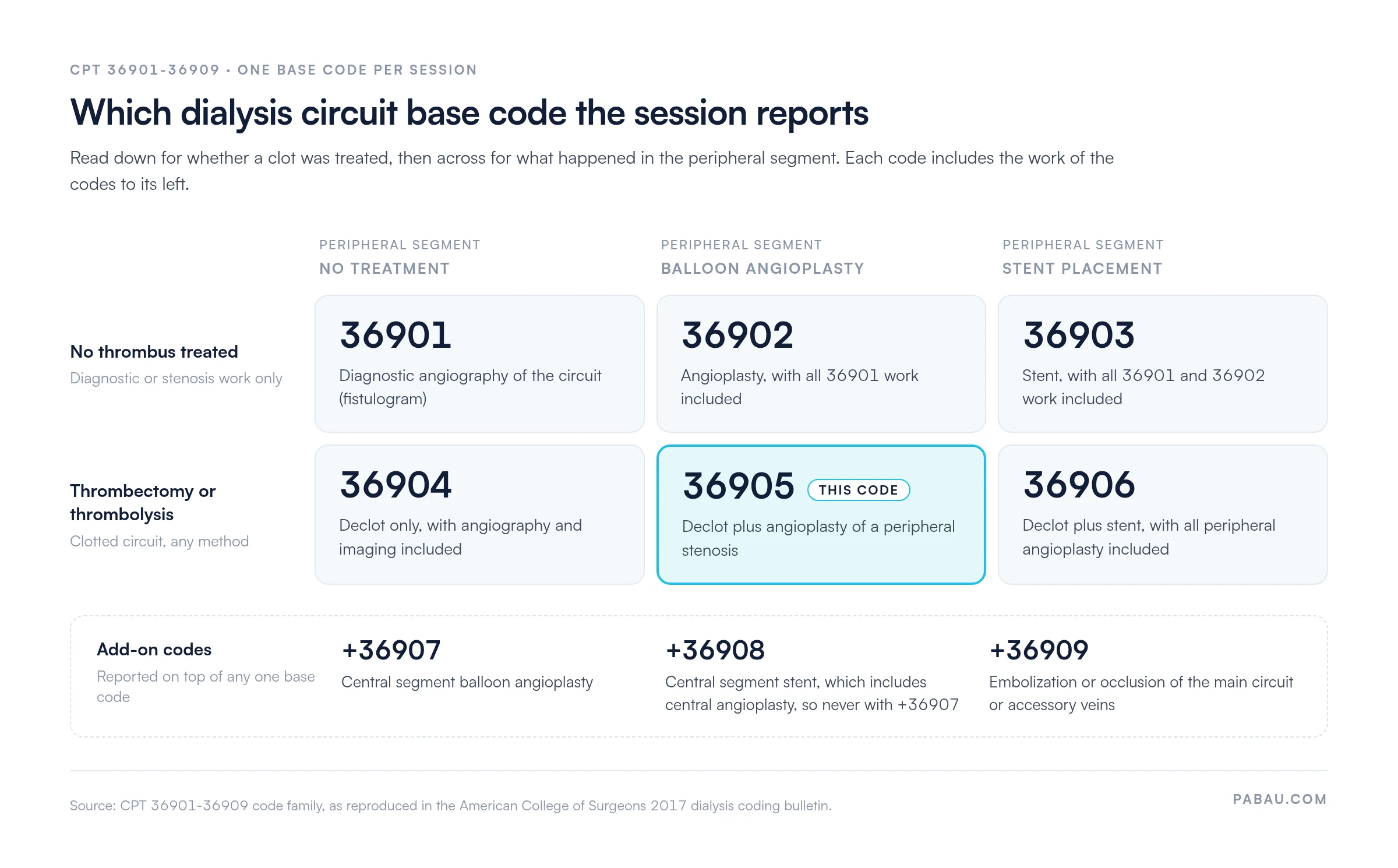
Both codes start with a thrombosed circuit and the same declot work. The difference is the peripheral segment angioplasty. If a stenosis is identified and dilated, report 36905. Otherwise, if the clot is cleared and no stenosis needs treatment, report 36904.
Also, the number of balloons or inflations does not change the code. Like 36902, 36905 covers all angioplasty in the peripheral segment for that session.
If a stent is placed in the peripheral segment during the thrombectomy, report 36906 instead of 36905. 36906 includes all peripheral angioplasty in the session, so 36905 and 36906 are never reported together.
For thrombectomy coding, clot removal from the central veins is still part of 36905. However, central segment angioplasty after a successful declot is reported separately with +36907. A central stent is +36908, which includes the central angioplasty, so +36907 drops off. Finally, embolization of a side branch or accessory vein is +36909. The op note should name each treated segment separately.
The 36905 descriptor and the CPT guidelines for the family include the following services. As a result, none of them is billed separately with 36905.
A few services in the same session can be billed in addition to 36905 when the documentation supports them.
Diagnostic angiography is included in 36904-36906. A thorough pre-intervention fistulogram in the same session therefore does not create a second base code.
Medicare pays physicians for 36905 under the Medicare Physician Fee Schedule (MPFS). Coverage follows the relevant Medicare Administrative Contractor (MAC) LCD or any national coverage determination, plus documented medical necessity. Rates change every year, so check the current CMS fee schedule rather than a saved figure.
The MPFS sets separate payment for facility settings, such as hospital outpatient departments and ASCs, and non-facility settings, such as office-based labs. The work RVU for 36905 sits above 36904, because it includes the added angioplasty. Then pull current RVUs and national payment amounts from the CMS Physician Fee Schedule look-up tool or the CMS RVU file.
The zero global period means no post-procedure care beyond the day of service is bundled into 36905. However, separate follow-up visits may be billed with the matching E/M codes when documentation supports them.
Original Medicare does not list 36905 in its hospital outpatient prior authorization program. However, many commercial payers, Medicare Advantage plans and Medicaid managed care plans set their own rules, and those rules vary by plan.
First, check each payer’s authorization rules before scheduling. When a plan requires authorization, billers typically submit the following.
Also, confirm authorization rules at the plan level, not just the payer level. One payer may require it on some products and exempt others. Finally, keep the payer’s written answer on file in case of a later denial.
A 36905 claim stands on the procedure note. Because generic templates lack circuit-specific detail, they leave the code exposed on review. The note should cover each of the following elements.
A superbill that maps each code to its documented indication at the time of billing cuts documentation requests. Clean claim submission for 36905 also depends on the code matching what the note describes.
The diagnosis codes below are illustrative examples, not a coverage list. Therefore, check the relevant LCD and the current ICD-10-CM tabular list before you submit.
Audit your 36905 op-note templates once a year. If the template has no field for the thrombosis finding, the device or agent, and the stenosis that was dilated, it cannot support the code. A template without those fields produces the same weak note on every case it is used for.
Effective dialysis claim denial management starts with the reason behind each denial, not a blind resubmission. The table below maps common 36905 denials to their causes and fixes.
The CARC and RARC codes on the remittance name the reason for each denial, and our billers’ denial code guide maps them to a fix. Tracking denial patterns through revenue cycle management reporting shows coding teams where an error repeats. Fixing the root cause once stops repeat denials.
Modifier choice depends on the setting and on what the edit tables say for the code pair. Overall, the table below summarizes the common cases for 36905.
LT and RT modifiers are not part of the 36905 descriptor. Instead, the access is identified by anatomic description in the note. Follow your payer’s instructions if it asks for a laterality modifier.
Office-based labs billing 36905 at the non-facility rate should review their payer contracts each year. Commercial contracts can set their own site-of-service rules, which change both the allowed amount and the claim form.
Dialysis circuit claims fail on small mismatches. The base code is wrong, an add-on is missing, or the note describes a different session than the claim. Pabau, the practice management and billing platform we build, keeps the procedure note, the codes and the claim on one patient record.
Pabau’s claims management software submits US claims through the Claim.MD clearinghouse. Your team can track each claim’s status and receive ERAs back in Pabau, so a 36905 denial is visible as soon as the remittance arrives.
Coding decisions stay with your coders. Instead, Pabau gives them one place to see the note, the submitted codes and the payer’s response. That makes the 36904 versus 36905 question easier to check before resubmission.

Pabau submits your 36905 claims through the Claim.MD clearinghouse, tracks their status and returns ERAs to the patient record. Your team sees denials as soon as they arrive.

CPT Code 36905 pays for two pieces of work in one session: clearing the clot and dilating a peripheral stenosis. However, the second piece has to be in the note. Most coding errors in this family come from picking the wrong rung of the ladder.
Build your review around one question: was a peripheral stenosis dilated, stented, or left alone? That answer picks 36905, 36906 or 36904. Then add central work and embolization as add-ons, and leave 36901-36903 off the claim.
Book a demo to see how Pabau keeps dialysis circuit notes, claims and remittances together for your practice.

Need a framework for handling claim rejections across all procedure codes? Denial management in healthcare covers root-cause analysis and appeal workflows for high-volume billing teams.
Submitting dialysis circuit claims through a clearinghouse for the first time? How medical claims clearinghouses work explains EDI transmission, eligibility checks, and ERA routing.
Looking for the 837P file structure behind your 36905 submissions? 837 electronic claim file guide breaks down the transaction set fields that payers validate at intake.
CPT Code 36905 reports percutaneous mechanical thrombectomy and/or thrombolytic infusion of the dialysis circuit, with balloon angioplasty of the peripheral dialysis segment. It includes all imaging, diagnostic angiography, fluoroscopic guidance and catheter placement. It applies to arteriovenous fistulas (AVF) and arteriovenous grafts (AVG).
Both codes report thrombectomy and/or thrombolysis of a clotted dialysis circuit. 36905 adds balloon angioplasty of a stenosis in the peripheral segment. If no stenosis is dilated, the session is 36904. Only one of the two is reported per session.
Yes, Medicare pays for medically necessary 36905 procedures under the Medicare Physician Fee Schedule. Coverage follows the applicable MAC LCD or national coverage determination. Rates change every year, so check the current CMS fee schedule.
Yes. 36905 includes all imaging and radiological supervision and interpretation, diagnostic angiography, fluoroscopic guidance and catheter placement. Completion imaging and the imaging for the peripheral angioplasty are included too. None of these is reported separately.



