CCSD Code G3100: Laparoscopic biliary gastric bypass billing guide
CCSD Code G3100: Definition and Surgical Scope CCSD Code G3100 is the Classifica...

Last Updated: Nov 25, 2026
36903 is the CPT code for dialysis circuit access with diagnostic angiography and transcatheter stent placement in the peripheral dialysis segment. It covers the needle or catheter access and the full fistulogram, from the arterial anastomosis through the venous outflow. Every stent deployed in that segment is included, along with all angioplasty there.
The code sits in the 36901-36909 dialysis circuit family introduced in 2017. It is reported once per session, and 36901 and 36902 are never billed alongside it. A stent placed after a thrombectomy moves the claim to 36906.
Let Pabau's smart automation suggest the right codes, reduce claim denials, and keep your practice compliant—effortlessly.
Automate repetitive tasks and focus on what matters most—your patients.
Reduce coding errors and ensure compliance with the latest regulations.
Clean claims, fewer denials, and faster reimbursements.
Powerful insights and reporting to help your practice thrive.
HIPAA compliant SOC 2 certified GDPR-compliant Trusted by 4,000+ clinics worldwide

CPT code 36903 covers diagnostic angiography of the dialysis circuit plus stent placement in the peripheral dialysis segment, with all imaging included.
Report 36903 once per session, however many lesions are treated or stents are deployed in the peripheral segment.
Peripheral angioplasty is part of 36903, so 36901 and 36902 are never billed alongside it.
Central-segment work is added with +36907 for angioplasty or +36908 for a stent, and a stent placed during a declot is 36906 instead.
Billing software such as Pabau stores the stent type, size and location in the procedure record behind each 36903 claim.
CPT code 36903 describes transcatheter stent placement in the peripheral dialysis segment, performed through the dialysis circuit, with diagnostic angiography of the whole circuit included. The American College of Surgeons’ coding guidance confirms that 36903 includes all the work of 36901 and 36902, plus the work of deploying the stent.
The full descriptor, published by the American Medical Association (AMA), reads:
Introduction of needle(s) and/or catheter(s), dialysis circuit, with diagnostic angiography of the dialysis circuit, including all direct puncture(s) and catheter placement(s), injection(s) of contrast, all necessary imaging from the arterial anastomosis and adjacent artery through entire venous outflow including the inferior or superior vena cava, fluoroscopic guidance, radiological supervision and interpretation and image documentation and report; with transcatheter placement of intravascular stent(s), peripheral dialysis segment, including all imaging and radiological supervision and interpretation necessary to perform the stenting, and all angioplasty within the peripheral dialysis segment.
The descriptor turns on where the stent sits. In the arm, the peripheral segment runs from the arterial anastomosis up to and including the axillary vein and the entire cephalic vein. In the leg, it runs up to and including the common femoral vein. Veins beyond that point form the central segment, which has its own add-on codes.
36903 is a primary code, not an add-on. It is reported once per session, regardless of how many lesions are treated or how many stents are deployed in the peripheral segment. It applies to any stent type, including bare metal, covered and drug-eluting stents.
Angioplasty within the peripheral segment is included even when it treats a separate lesion. A balloon to a juxta-anastomotic stenosis and a stent in the mid-cephalic vein are reported as one 36903. Billing 36902 or 36901 on top of it is the unbundling error payer edits are built to catch.
A typical 36903 session follows the steps below. The first three are the work of 36901 and 36902, which is why neither code is billed again.
Fluoroscopic guidance, contrast injections and radiological supervision and interpretation across all five steps are part of 36903. Billing any of them separately triggers a National Correct Coding Initiative (NCCI) edit. The procedure note has to show the stent itself, because a note that reads like angioplasty alone supports only 36902.
The 36901-36909 family was created in 2017, and its descriptors have not changed since. It has six base codes, of which only one is reported per session, plus three add-ons. The table shows where 36903 sits.
Two questions settle the base code. First, was a thrombectomy performed? If it was, the base code is 36904, 36905 or 36906, and if not, it is 36901, 36902 or 36903. Second, what was the most intensive peripheral treatment? Imaging only, angioplasty and stent placement map to the three codes in that order.
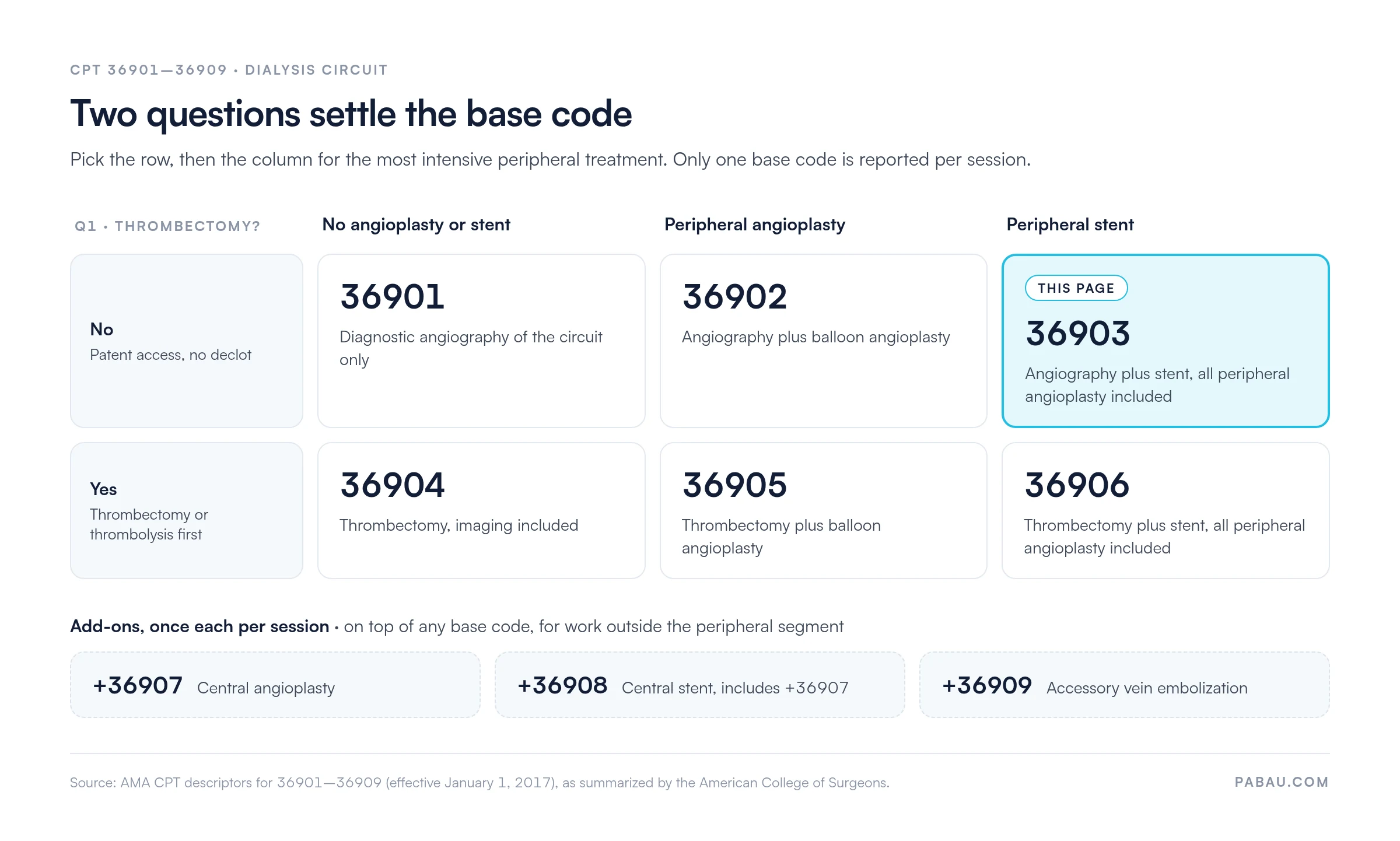
So a peripheral stent on a patent access is 36903, and the same stent placed after a declot is 36906. A balloon without a stent is 36902, or 36905 when a thrombectomy came first.
Central-segment work is added on top of the base code. Use +36907 for central angioplasty or +36908 for a central stent, each once per session. Because 36908 includes the work of 36907, the two are never reported together. In the arm, the central segment runs from the subclavian and innominate veins through the superior vena cava.
Knowing what 36903 already pays for prevents the unbundling errors that trigger NCCI edit denials.
Included in 36903 (not separately billable):
Separately reportable (when criteria are met):
A thrombectomy in the same session changes the base code. A declot followed by a peripheral stent is reported as 36906 alone.
A 36903 claim needs a procedure note that proves a stent was placed, where it went, and why angioplasty alone was not enough. Without those details, payers downcode the claim to 36902 or ask for records. A clean claim submission starts with a note that answers those questions before the claim is filed.
Build the stent fields into your procedure note template: Type, diameter, length, landing zone and residual stenosis. If any one is blank, the note no longer proves a stent was placed. That is when a 36903 claim gets paid as 36902.
Reimbursement for CPT code 36903 varies by place of service and geographic pricing locality. Verify current-year values with the CMS MPFS lookup tool, and apply the Geographic Practice Cost Index (GPCI) for the practice location. Rates change each year with the CMS final rule.
Use the FastRVU lookup tool for current work RVU and total RVU values with GPCI-adjusted payment by locality. In an office-based lab, the physician bills the non-facility rate, which covers the stent and other supplies. In a hospital outpatient department or ambulatory surgical center, the facility is paid separately. The physician then bills the professional component at the lower facility rate.
In Pabau, practices can track claims to payment for CPT code 36903 across payers. Through Claim.MD, Pabau’s US clearinghouse integration, they submit 837P professional claims. The 835 remittances that come back are matched to the submitted claims.
Medicare does not currently require prior authorization for CPT code 36903 in most outpatient settings. CMS programs change, so verify current requirements with your Medicare Administrative Contractor (MAC). State Medicaid programs and Medicare Advantage plans set their own rules.
Many large commercial plans require pre-authorization for dialysis access interventions, particularly in a freestanding interventional suite. The clinical criteria they assess typically include:
Record the authorization number in the billing record before the claim goes out. Claims without a required number are denied as “authorization not obtained,” which is one of the most avoidable denial categories. The electronic remittance advice shows the CARC denial reason codes, so authorization defects surface before the appeal window closes.
Where the procedure is performed decides which payment rate applies to the physician’s professional claim. Practices that work in more than one setting need the right rate for each date of service.
A place-of-service mismatch is a denial trigger. Billing POS 11 for a hospital outpatient case pays the claim at the wrong rate and often prompts a payer audit. Make sure the POS code on each professional claim matches the setting where that day’s procedure took place.
Medical necessity for CPT code 36903 rests on an ICD-10-CM code that reflects the documented indication. These codes are commonly paired with 36903 claims:
Select the ICD-10-CM code that most specifically reflects the documented finding. A generic diagnosis on its own, such as Z99.2 for dependence on renal dialysis, does not support a 36903 claim. Payers expect an access complication code with it, and its absence is a common medical necessity denial.
Dialysis access stent claims fail in predictable ways, and each has a corrective action. Sound denial management workflows catch most of them before an appeal is needed.
Log every 36903 denial by CARC code and review the log by category each quarter. When one root cause keeps repeating, fix the note template or the charge workflow behind it rather than appealing claim by claim.
No. The diagnostic fistulogram is CPT code 36901, and 36903 includes all of its work. It is never billed alongside 36903 in the same session. This holds even when the fistulogram was done first and the decision to stent came afterward.
CPT code 36147 is not the fistulogram code. It was deleted, together with 36148, 36870 and 75791, when the 36901-36909 family took effect on January 1, 2017. A claim that still carries 36147 rejects as an invalid code.
Two imaging services do stay separate. When a catheter is advanced from the access into the proximal inflow artery for a formal extremity study, report 36215 and 75710. Ultrasound guidance for the access puncture is reported with +76937 when it is documented. A medical claims clearinghouse can flag edit conflicts on these code pairs before the claim reaches the payer.
In many vascular access practices, the stent details live in a dictated procedure note. A coder reads that note days later and picks between 36902, 36903 and 36906. If the stent size or landing zone is missing, the claim goes out weak or pays as angioplasty.
Pabau records those details in custom procedure forms with structured fields for stent type, size, location and residual stenosis. The same record feeds the claim, which goes to US payers as an 837P file through Claim.MD. The 835 remittance comes back into Pabau, so a downcode shows up against the case that caused it.
The result is a 36903 claim that agrees with the note behind it. Billing staff spend less time rebuilding a procedure for a payer months after the session.

Pabau records stent type, size and location in the procedure note behind each claim. When a payer asks for records, the documentation that supports 36903 is already on file.

CPT code 36903 pays for a full session of work: The fistulogram, every peripheral angioplasty and every peripheral stent. That makes it one of the most heavily bundled codes in the dialysis family, and the money is lost at the edges. Extra lines for 36901 or 36902 get denied, and a note without stent details gets paid as angioplasty.
Settle the base code first, then add +36907, +36908 or +36909 only for work outside the peripheral segment. Make the stent fields mandatory in the procedure note, and the claim will stand on its own documentation.
Pabau keeps those stent fields in the procedure record behind each 36903 claim, and the 835 remittance comes back to the same case. To see how that fits your vascular access coding, book a demo.

Choosing a clearinghouse for 837P claims and ERA files? Claim.MD clearinghouse review explains how claims reach payers and how electronic remittances come back.
Want to reduce claim denials across your vascular billing team? Denial management in healthcare covers the full workflow from root-cause analysis through appeal submission.
Looking for the denial reason codes on a returned 36903 claim? Denial codes in medical billing decodes the CARC and RARC codes payers attach to remittance advice.
Balloon angioplasty with no stent? CPT code 36902 covers peripheral angioplasty through the dialysis circuit, with the fistulogram included.
Angioplasty after a declot? CPT code 36905 covers thrombectomy plus peripheral balloon angioplasty in one session.
CPT code 36903 covers diagnostic angiography of the dialysis circuit with transcatheter stent placement in the peripheral dialysis segment. All imaging, radiological supervision and interpretation, and every angioplasty in the peripheral segment are included. It applies to AV fistulas and AV grafts, and to bare metal, covered and drug-eluting stents.
Both codes treat the peripheral dialysis segment. CPT 36902 covers balloon angioplasty, while CPT 36903 covers stent placement and includes all angioplasty in that segment. When a stent is placed, report 36903 alone and never add 36902.
No. CPT 36903 includes all the work of 36901, the diagnostic fistulogram, and 36902, peripheral angioplasty. Billing either alongside 36903 in the same session triggers an NCCI edit denial. Central-segment work is the exception, and it is added with +36907 or +36908.
Medicare does not currently require prior authorization for CPT 36903 in most outpatient settings. Commercial payers and Medicare Advantage plans often do. Verify each payer’s rules before scheduling, and record the authorization number on the claim.
The most common denials come from billing 36901 or 36902 with 36903, or reporting 36903 more than once in a session. Notes missing the stent’s type, size and location lead to a downcode to 36902. Other causes are using 36903 after a thrombectomy instead of 36906, and a missing prior authorization.
CPT 36903 is a standalone primary code, not an add-on. It is reported once per session, however many lesions or stents are treated in the peripheral segment. The add-ons +36907, +36908 and +36909 can be reported with it for central or branch vessel work.
Work RVU values for CPT 36903 are set each year in the CMS Medicare Physician Fee Schedule. Use the CMS MPFS lookup tool or FastRVU to find the current work, practice expense and total RVUs, adjusted by GPCI for your location. Never carry prior-year values forward without checking them.