HCPCS Code Q4185: Cellesta flowable amnion billing guide
HCPCS Code Q4185: definition and official descriptor HCPCS Code Q4185 is the Lev...

Last Updated: Nov 20, 2026
37211 is the CPT code for catheter-directed arterial thrombolysis on the initial treatment day. It covers a thrombolytic infusion by any method in an artery other than a coronary or intracranial vessel, with radiological supervision and interpretation included.
Acute limb ischemia, a thrombosed bypass graft and mesenteric or renal artery thrombosis are the usual indications. Continued days are coded 37213 and the final day 37214. Embolization is a separate service, reported with 37241-37244.
Let Pabau's smart automation suggest the right codes, reduce claim denials, and keep your practice compliant—effortlessly.
Automate repetitive tasks and focus on what matters most—your patients.
Reduce coding errors and ensure compliance with the latest regulations.
Clean claims, fewer denials, and faster reimbursements.
Powerful insights and reporting to help your practice thrive.
HIPAA compliant SOC 2 certified GDPR-compliant Trusted by 4,000+ clinics worldwide

CPT code 37211 reports catheter-directed arterial thrombolysis on the initial treatment day, in any artery other than coronary or intracranial vessels.
Radiological supervision and interpretation is included, while catheter placement and qualifying diagnostic angiography are reported separately.
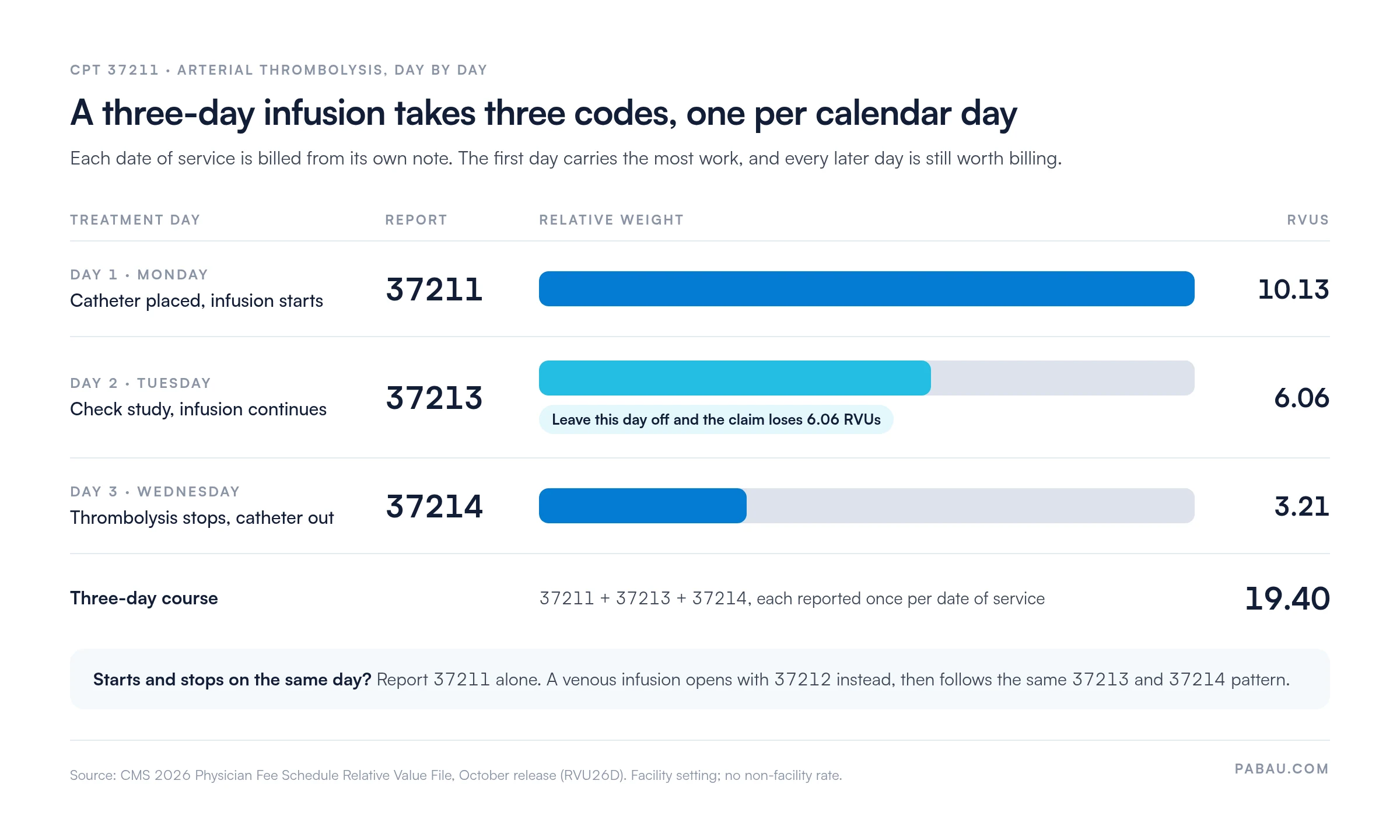
A multi-day infusion is coded 37211 on day one, 37213 on each middle day and 37214 on the day thrombolysis stops.
37211 has never been an embolization code. Uterine fibroid and other vascular embolization is reported with 37241-37244.
In the 2026 Medicare fee schedule, 37211 carries 10.13 total facility RVUs and a 000-day global period.
CPT code 37211 reports a transcatheter arterial infusion for thrombolysis on the first day of treatment. CMS’s 2026 relative value file lists it as “Thrombolytic art therapy,” next to venous code 37212 and the later-day codes 37213 and 37214. It applies to any artery other than coronary or intracranial vessels, by any infusion method.
The full descriptor, as quoted in ICD10monitor’s 2025 thrombolysis coding guide, reads as follows.
The code is built around a catheter left in place. The interventional radiologist or vascular surgeon positions an infusion catheter in the clot, and a thrombolytic drug runs through it for hours. The patient usually returns to the angiography suite for a check study before the team decides whether to continue.
Within one calendar day, 37211 includes the following work:
The code does not include catheterization, diagnostic angiography or other interventions such as angioplasty or stenting. Those are coded on their own when performed and documented.
Coders see 37211 when an artery or bypass graft is blocked by fresh thrombus and the team chooses to dissolve it over hours. The usual indications are these:
The infusion has to be a prolonged one. ICD10monitor reports that AMA speakers at the CPT Symposium said the patient must leave the treatment room with the infusion running. A thrombolytic drug injected during a mechanical thrombectomy is part of the thrombectomy code instead.
The four thrombolysis codes split a course of therapy by vessel type and by calendar day. Each one is reported once per date of service, however many check studies that day holds.
Take a patient with acute limb ischemia whose infusion starts on Monday. Monday is 37211. If Tuesday’s check study shows the clot has cleared and the catheter comes out, Tuesday is 37214.
Had the infusion run until Wednesday, Tuesday would be 37213 and Wednesday 37214. When thrombolysis starts and stops on the same day, report 37211 alone.
Thrombolysis dissolves a clot to reopen an artery. Embolization works the other way. It blocks a vessel on purpose with coils, particles or liquid agents. Closing off a varicocele is reported with 37241, for example, and blocking an arteriovenous malformation with 37242.
The two families were split apart over two CPT cycles. CPT 2013 created 37211-37214 to replace the deleted thrombolytic infusion codes 37201 and 37209, as AAPC’s Radiology Coding Alert reported. CPT 2014 then replaced embolization codes 37204 and 37210 with 37241-37244.
Radiological supervision and interpretation of the infusion is part of 37211, so it never goes on the claim as its own line. Several other services from the same session can.
Two companions stay off the claim. Do not add 75898 for follow-up angiography during the infusion, because the thrombolysis codes already include it. The old infusion supervision code 75900 was deleted for 2013.
The thrombolysis codes are unilateral, so modifier choice turns on how many access sites and vascular beds were treated. The 2026 fee schedule indicators settle the rest.
Each day of a thrombolysis course is billed from its own note, so the record has to show what happened on each date. These are the elements a reviewer checks.
Date-stamp every check study in the procedure note. The thrombolysis codes are assigned per calendar day. A study at 00:30 belongs on a different claim line than one at 23:30 the night before.
The diagnosis on a 37211 line has to describe an arterial occlusion that thrombolysis treats. Coronary and intracranial diagnoses never pair with this code, because the descriptor excludes those vessels.
Pick the most specific K55.0- code the record supports, since that subcategory splits by site and extent. The I74 codes take no 7th character, so an iliac occlusion is simply I74.5. T82.868A, by contrast, uses “A” during active treatment.
CMS prices 37211 at 10.13 total RVUs in the facility setting. The figures below come from the CMS 2026 Physician Fee Schedule Relative Value File, October release (RVU26D).
Your payment moves with your locality’s geographic practice cost indices, so check the CMS Physician Fee Schedule Look-Up Tool before quoting a figure. Under the 000 global, evaluation and management on the procedure day is generally not payable.
Each treatment day carries its own code and its own value, as the day-by-day breakdown below shows. A three-day course billed as 37211, 37213 and 37214 adds up to 19.40 facility RVUs, so a missing middle day costs 6.06 RVUs.
Most 37211 denials come from coding the wrong service or the wrong day. Check the denial codes on the remittance to see which of these applies.
Fix the cause rather than the single claim. A clean claim starts with a note that names each day’s work, and denial management tracks which error keeps returning.
A thrombolysis course rarely fits on one claim line. The infusion starts on one day, the check study happens the next, and the catheter may come out a day later. When notes and billing sit in separate systems, the biller rebuilds that timeline by hand, and a 37213 day can drop off the claim.
Pabau, a practice management platform with built-in claims management, keeps each day’s procedure note on the same patient record as the claim. Prior authorization codes, dates and sessions sit on the case, with a warning when one is missing.
US claims go out as 837P files through the Claim.MD clearinghouse, which Pabau connects to directly. Eligibility checks run before the procedure, and ERA remittances come back afterward. Each treatment day then reaches the payer under the code its own note supports.
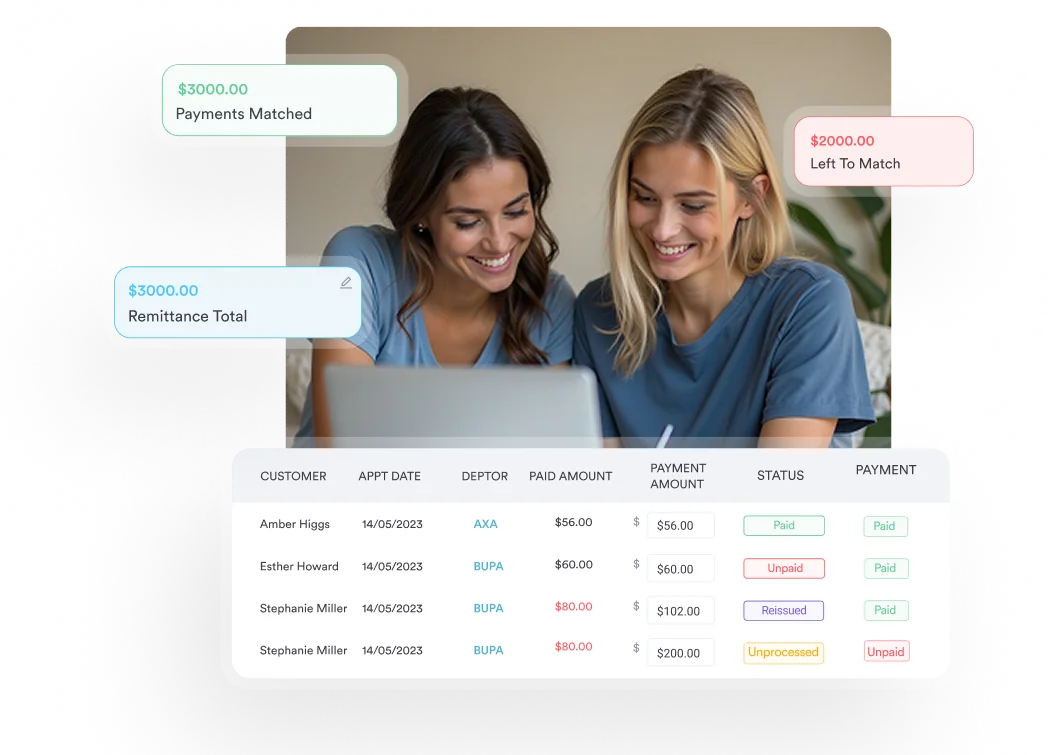

Pabau links each procedure note to the claim, tracks prior authorizations on the case and sends US claims through Claim.MD. Your 37211, 37213 and 37214 lines match the record they came from.

Before you code 37211, read the note for one answer. Either a clot was dissolved by an infusion left running, or a vessel was blocked on purpose. The first is thrombolysis and the second is embolization, and the two share no codes.
From there the work is calendar arithmetic. Day one is 37211, middle days are 37213 and the stop day is 37214, with catheterization and qualifying angiography coded alongside. Get the days right and a three-day course earns its full 19.40 facility RVUs.
Book a demo to see how Pabau ties each infusion day’s note to the claim line that bills it.

Need a framework for understanding claim rejections? Denial management in healthcare covers the full workflow for reducing and appealing payer rejections.
Want to understand the clearinghouse behind 37211 electronic claims? Claim.MD clearinghouse overview explains how EDI-based claim submission reaches US payers.
Looking for a primer on the billing pipeline? Medical superbill guide walks through how procedure codes flow from the encounter to the payer.
Coding the catheter that delivers the infusion? CPT code 36245 explains first-order selective catheterization, which is reported alongside 37211.
Using ultrasound to guide arterial access? CPT code 76937 covers what to document for ultrasound-guided vascular access and what it pays in 2026.
CPT code 37211 covers transcatheter arterial infusion for thrombolysis on the initial treatment day, in any artery other than coronary or intracranial vessels. Radiological supervision and interpretation is included. Catheter placement and qualifying diagnostic angiography are reported separately.
No. CPT 37211 is a thrombolysis code, used when a clot is dissolved with a drug infused through a catheter. Vascular embolization is reported with 37241-37244, and uterine fibroid embolization is 37243.
CPT 37211 is arterial thrombolysis on the initial treatment day, and 37212 is venous thrombolysis on the initial treatment day. Both share 37213 for continued days and 37214 for the final day.
Report 37211 on the first day, 37213 for each day between the first and the last, and 37214 on the day thrombolysis stops. If the infusion starts and stops on the same day, report 37211 only.
In the 2026 Medicare Physician Fee Schedule, 37211 has a work RVU of 7.56 and a malpractice RVU of 1.50. Its facility practice expense RVU is 1.07, for a total of 10.13 RVUs, with a 000-day global and no non-facility rate.
Not for follow-up angiography during the infusion. Same-day check studies and catheter repositioning are part of 37211, and check studies on later days are part of 37213 or 37214.
Intracranial arterial thrombolysis is reported with 61645, not 37211. The 37211 descriptor excludes coronary and intracranial vessels.