HCPCS Code L2005: Stance control KAFO billing guide
What is HCPCS Code L2005? HCPCS Code L2005 is the Medicare billing code for a cu...

Last Updated: Nov 2, 2026
37248 is the CPT code for transluminal balloon angioplasty of the initial vein, open or percutaneous, except in the dialysis circuit. It includes all imaging and radiological supervision and interpretation necessary to perform the angioplasty within the same vein.
Add-on code 37249 covers each additional vein treated in the same session. Most denials come down to two problems. One is reporting a dialysis-circuit angioplasty here instead of 36902 (peripheral) or 36907 (central). The other is a note missing balloon size, inflation pressures, or pre- and post-dilation imaging.
Let Pabau's smart automation suggest the right codes, reduce claim denials, and keep your practice compliant—effortlessly.
Automate repetitive tasks and focus on what matters most—your patients.
Reduce coding errors and ensure compliance with the latest regulations.
Clean claims, fewer denials, and faster reimbursements.
Powerful insights and reporting to help your practice thrive.
HIPAA compliant SOC 2 certified GDPR-compliant Trusted by 4,000+ clinics worldwide

CPT code 37248 covers balloon angioplasty of the first vein treated, and add-on code 37249 is reported for each additional vein in the same session.
37248 applies to peripheral and central veins outside the dialysis circuit, while angioplasty inside the circuit is reported with 36902 (peripheral) or 36907 (central).
The descriptor bundles all imaging for the dilation, so fluoroscopy isn’t billed separately, though intravascular ultrasound (37252) still can be.
Documentation must capture balloon size, inflation pressures, stenosis degree, and pre- and post-intervention imaging to survive medical necessity review.
Pabau’s claims management software validates claims for missing details and connects to Claim.MD for eligibility checks and submission to thousands of US payers.
CPT code 37248 is the American Medical Association (AMA) code for balloon angioplasty of the first vein treated in a session, outside the dialysis circuit. The official descriptor reads, clause by clause:
Interventional radiologists and vascular surgeons bill 37248 when a catheter-mounted balloon is advanced to a narrowed vein segment. The balloon is inflated to restore luminal diameter, then deflated before withdrawal.
The code covers the balloon work itself, plus the imaging, supervision, and interpretation needed to perform the dilation in that vein.
Coders frequently over-bill 37248 by separately reporting services that the AMA considers bundled into the base work. The following components are included in CPT code 37248 and cannot be billed independently:
What is separately billable: Intravascular ultrasound (CPT 37252 for the first vessel, 37253 for each additional) is reportable when performed and documented. Fluoroscopy is not, because the 37248 descriptor already includes all imaging needed for the angioplasty. Verify current NCCI edits quarterly, as CMS updates bundling rules on a rolling basis.
CPT 37249 is the add-on code that extends the 37248 encounter. Report it once for each additional vein treated in the same operative session. It cannot be reported alone and cannot be billed without 37248 as the parent code.
The most frequent mistake: Billing 37249 without documenting each additional vessel as a distinct anatomic site treated. Payers audit this aggressively. The operative note must name the second (and third, if applicable) vessel, its stenosis degree, the balloon used, and the post-dilation result. A note that references “multiple sites” without specifics will trigger a rollback to a single unit of 37248.
CPT 37246 and 37247 cover the arterial angioplasty family, and CPT 37248 and 37249 are the venous equivalents. Routing a venous angioplasty to 37246 (or vice versa) is a coding error.
The venous diagnosis on the claim won’t support an arterial code, which can draw a CO-11 denial. Repeated mismatches can flag the practice for miscoding on audit.
Several codes can be legitimately appended to a 37248 encounter. Use the AAPC Codify CPT lookup to verify current NCCI bundling edits before billing any combination, as pairing rules update quarterly.
Dialysis access cases cause the most routing errors on 37248. The 2017 CPT update created a dedicated code family (36901-36909) for percutaneous interventions on dialysis circuits, and the 37248 descriptor now excludes the circuit.
Angioplasty inside the circuit is reported with 36902 for the peripheral segment, plus add-on 36907 when a central segment is treated. The diagram below walks through the routing, and the table after it covers the common scenarios.
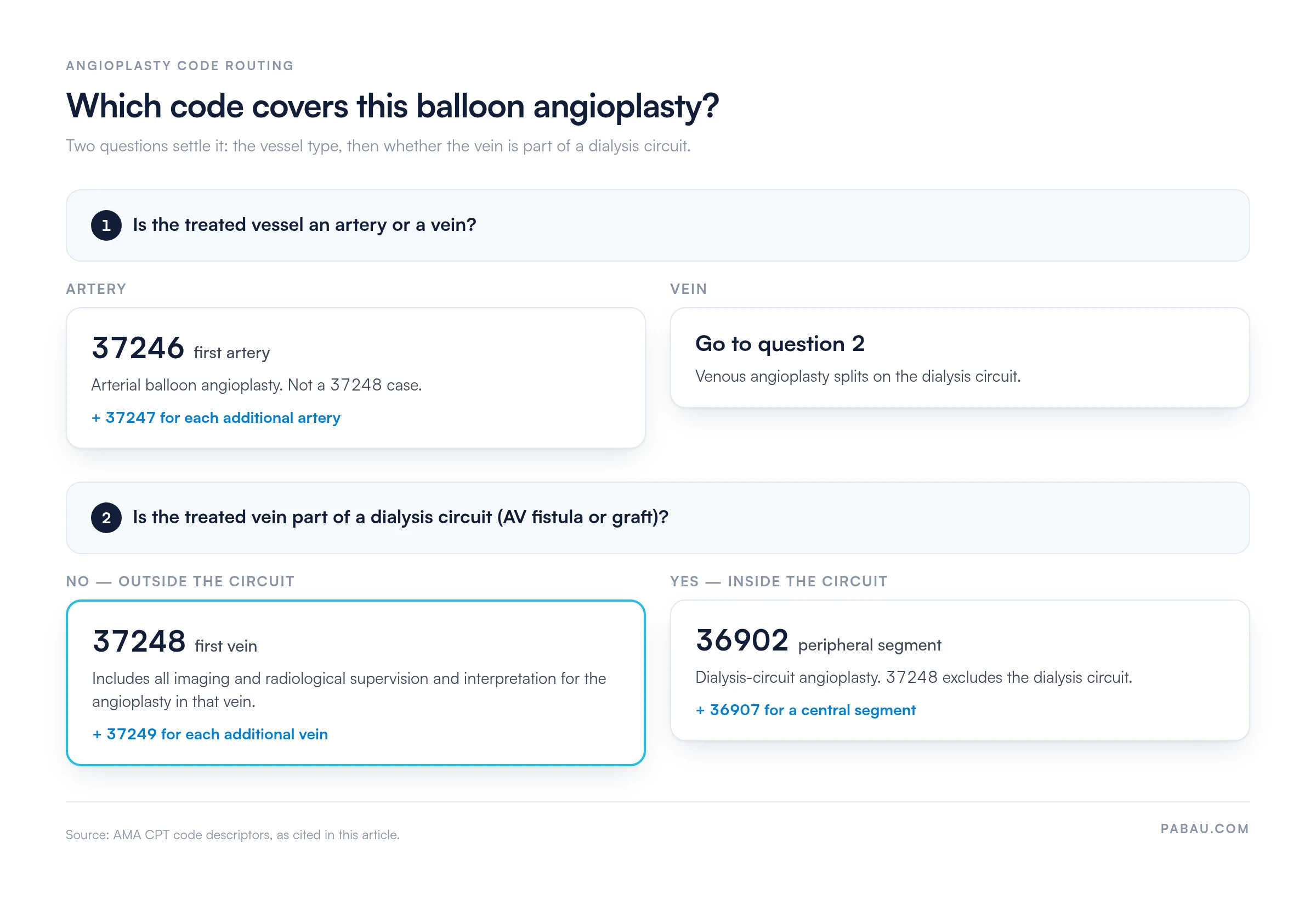
When in doubt, review the operative note for whether access was gained through the dialysis circuit itself. If the catheter entered via the fistula or graft access site, the 36901-36909 family applies. If accessed independently, 37248 is the appropriate primary code.
Flag all dialysis access angioplasty cases for dual-coder review before billing. The 36902 vs 37248 distinction turns on one sentence in the operative note. It records whether the catheter entered through the circuit or an independent access site. Standardize your operative note template to capture this routing detail explicitly.
Every claim for CPT code 37248 must link to an ICD-10-CM diagnosis code that establishes medical necessity. The following codes are most commonly submitted alongside 37248. Use the current fiscal year’s ICD-10-CM edition, and verify codes against the CDC/NCHS tabular list before each claim submission.
Payers reviewing CPT code 37248 claims check the operative note for seven specific elements. Missing any one of them is the leading cause of medical necessity denials for this code. A structured procedure note using a superbill documentation workflow reduces this risk substantially.
These are the elements auditors check. Build them into your procedure note template:
A clean claim submission for 37248 pairs the operative note with a supporting diagnosis code and confirmed prior authorization where required. The correct modifier goes on at the line-item level.
Authorization requirements vary significantly by payer. The medical billing process for venous angioplasty requires confirming each payer’s current policy before scheduling, not after the procedure. Here is the general framework by payer category:
A prior authorization request for CPT code 37248 should carry the access imaging report and the duplex ultrasound or venogram findings. Add the treating physician’s notes documenting the indication, plus access flow measurements for dialysis patients.
Medicare reimbursement for CPT code 37248 is calculated from the CMS Physician Fee Schedule using relative value units (RVUs). Rates are updated annually and adjusted by locality through the Geographic Practice Cost Index (GPCI).
The table below shows how each component behaves. Pull current-year values from the CMS lookup tool before quoting reimbursement to billing staff.
Use the FastRVU lookup tool to pull current work, practice expense, and malpractice RVU values for CPT 37248 by locality.
Effective denial management workflows for CPT code 37248 start with knowing which denial reason codes appear most often. Each denial type has a distinct appeal path.
Review common denial codes to build a denial prevention protocol across your vascular billing team.
Modifier selection for CPT code 37248 affects both claim processing speed and audit risk. Use the right modifier for the right situation, and document the clinical rationale in the note.
Effective medical billing compliance programs include a modifier audit checklist reviewed quarterly alongside the NCCI edit updates. Good claims management software flags modifier mismatches at the point of claim creation before submission.
Run a quarterly modifier audit on all 37248 claims. Pull every line item carrying -59 or -XU and confirm each has a documented rationale. Routine -59 usage without supporting notes is one of the top triggers for a focused medical review by payers and MACs.
Every 37248 denial in this guide is set before the claim leaves the practice. A vessel-type mismatch, a missing modifier, or an authorization filed against the wrong code is already on the claim line. Catching those by hand means a coder rereading each operative note against the claim.
Pabau, the practice management platform we build, raises the claim straight from the invoice and runs claim validation on it first. Missing or invalid details get flagged before submission, so each fix takes seconds instead of an appeal cycle.
Prior authorizations are stored as cases that follow the appointment through to the claim, and any claim still missing a code is flagged. Through the Claim.MD integration, you can check eligibility in real time and submit claims to thousands of US payers. Claim statuses and remittances come back into Pabau, with rejected claims flagged for rework.

Pabau validates claims for missing or invalid details, checks patient eligibility in real time through Claim.MD, and tracks each claim to payment. Less rework, faster reimbursement.

Code 37248 rewards practices that settle routing in the operative note template, before the case reaches the coding desk. The template should answer two questions explicitly: is the treated vessel a vein, and does it sit inside a dialysis circuit?
The trade-off is a slightly longer note. Balloon size, inflation pressures, and pre- and post-dilation imaging take a minute to record. They’re also what a reviewer reads first when a claim is questioned. Skip them and a correctly coded 37248 can still be denied.
Book a demo to see how Pabau validates vascular claims and tracks them from submission to remittance.

Need to understand how clearinghouses process vascular claims? Medical claims clearinghouse guide covers how claims route from practice to payer and where errors surface.
Want to reduce 837 file rejections on interventional claims? 837 file billing guide explains the electronic transaction structure and common field-level errors.
Checking eligibility before vascular procedures? Insurance eligibility verification guide covers real-time benefit checks and how to document results.
CPT code 37248 covers open or percutaneous balloon angioplasty of the first vein treated in a session, outside the dialysis circuit. It includes the balloon work, access, and all imaging and radiological supervision and interpretation needed for the dilation. Intravascular ultrasound (37252) is separately billable when documented, and so is a stent (37238) placed in a different vein.
CPT 37248 is the primary code for the first vein treated in a session. CPT 37249 is the add-on code reported once for each additional vein treated in the same session. 37249 cannot be billed without 37248 as the parent. Each additional vessel needs its own documentation in the operative note to support the extra unit.
CPT 37246 covers arterial angioplasty (the first artery treated), and CPT 37248 covers venous angioplasty (the first vein treated). Applying 37246 to a venous procedure, or 37248 to an arterial one, is a coding error. The diagnosis on the claim won’t support the code, which can draw a CO-11 denial and flag the practice for systematic miscoding. Always confirm whether the treated vessel is arterial or venous before selecting the code.
Generally no. 36902 is the dialysis-circuit angioplasty code, with 36907 for a central segment. NCCI edits typically block billing it alongside 37248 for the same dialysis access intervention. The routing decision depends on whether access was gained through the dialysis circuit or independently. If accessed through the fistula or graft, use the 36901-36909 family. If accessed independently at a separate site, 37248 may apply. Confirm current CCI edits quarterly, as bundling rules are updated by CMS on a rolling basis.
The most common are -59 or -XU for distinct procedural services that NCCI would otherwise bundle. Payers that require laterality also expect -LT or -RT. Modifier -26 generally doesn’t apply, because 37248 has no separate technical component. Avoid reflexive use of -59 without documented clinical rationale, as it is one of the highest audit triggers for interventional procedure codes.
Traditional Medicare generally does not require prior authorization for CPT 37248, but Medicare Advantage plans, Medicaid, and commercial insurers often do. Commercial payers typically want pre-procedure imaging showing greater than 50% stenosis, symptomatic documentation, and sometimes evidence of prior conservative management. Confirm each payer’s current policy before scheduling the procedure, not after.