

HCPCS Code E0272: Foam rubber mattress billing guide
HCPCS Code E0272: official descriptor and code overview HCPCS Code E0272 is the ...

Last Updated: Nov 6, 2026
33508 is the CPT add-on code for endoscopy, surgical, including video-assisted harvest of vein(s) for coronary artery bypass procedure. It must accompany an approved primary CABG code on the same claim and date of service, or the claim denies. Open (cut-down) vein harvest is bundled into the primary code and never reported with 33508.
The code carries a ZZZ global period and is exempt from the multiple procedure payment reduction. Most denials trace to a missing primary code or an operative report that doesn't confirm the endoscopic approach. A PA or NP vein harvest billed under the wrong NPI is the third.
Let Pabau's smart automation suggest the right codes, reduce claim denials, and keep your practice compliant—effortlessly.
Automate repetitive tasks and focus on what matters most—your patients.
Reduce coding errors and ensure compliance with the latest regulations.
Clean claims, fewer denials, and faster reimbursements.
Powerful insights and reporting to help your practice thrive.
HIPAA compliant SOC 2 certified GDPR-compliant Trusted by 4,000+ clinics worldwide

CPT code 33508 covers endoscopic saphenous vein harvesting as an add-on to CABG surgery, not open (cut-down) harvest.
Eligible primary codes are 33510-33516 (venous), 33517-33523 (combined) and 33533-33536 (arterial). Billed alone, 33508 always denies.
A PA or NP assistant bills 33508 with modifier AS under their own NPI. Medicare pays 85% of the 16% assistant-surgeon rate, about 13.6% of the fee schedule.
Claims management software such as Pabau scrubs each claim for missing or invalid details before it reaches the clearinghouse.
CPT code 33508 is the add-on code for endoscopic, video-assisted vein harvest during coronary artery bypass grafting (CABG). The plus sign prefix (+33508) in the AMA CPT codebook marks its add-on status. The official American Medical Association descriptor reads as follows.
“Endoscopy, surgical, including video-assisted harvest of vein(s) for coronary artery bypass procedure (List separately in addition to code for primary procedure).”
Three classification facts shape every 33508 claim before a single modifier is applied:
Getting any of these three facts wrong produces a denial. Check the primary code against the eligible list below before you code the harvest.
The AMA parenthetical instructions in the CPT codebook specify which primary codes 33508 may accompany. Coders must confirm the primary code is on this list before billing 33508. Pairing 33508 with any code outside this list will result in a denial.
When a CABG combines arterial and venous grafts, CPT requires an arterial code from 33533-33536 plus a venous add-on code from 33517-33523.
A case with one arterial graft and two vein grafts, for example, reports 33533 with 33518. The venous codes 33510-33516 are never paired with an arterial code. 33508 is still reported once on that claim.
The operative report, not the surgeon’s intent, determines which coding approach applies. Coders must read it carefully before selecting 33508 over an open harvest scenario.
EVH (endoscopic vein harvesting) follows a defined sequence. The surgeon makes a small incision near the knee, inserts the endoscope, and dissects the vein under visualization.
Branches are closed with hemostatic clips, then the vein segment is excised. The operative report must describe each of these steps for 33508 to be defensible on audit.
Every 33508 claim needs an ICD-10-CM code that establishes medical necessity for the CABG procedure. Payers require specificity. Submitting I25.10 when the chart supports unstable angina, coded I25.110, weakens the medical necessity case. Some commercial payers deny the claim on that basis.
Review the superbill documentation alongside the operative report to confirm the diagnosis codes match the clinical indication documented before surgery. Common pairings include:
CMS and commercial payers may crosswalk the diagnosis against the number of vessels bypassed. A single-vessel CABG (33510) paired with a multi-vessel disease code can trigger a medical necessity review. Code the diagnosis to the highest level of specificity the documentation supports.
CPT code 33508 receives separate Medicare payment as an add-on code. Use the CMS Physician Fee Schedule Look-Up Tool to pull current rates, because CMS updates the MPFS every January 1.
For the 2025 fee schedule year, 33508 carries about 0.31 work RVUs, far below the primary CABG code it accompanies. Verify the current-year value before quoting any rate to payers or patients.
RVU components for add-on codes follow a standard structure. You can verify current values using the FastRVU lookup tool, which pulls from CMS MPFS data:
Cardiothoracic practices that submit electronic claims through Claim.MD can send 33508 alongside its primary CABG code in a single 837P transaction. Claim.MD connects to thousands of US payers and returns real-time eligibility responses.
Verify CPT 33508 reimbursement rates directly in the CMS Physician Fee Schedule Look-Up Tool each January. Select the correct year, your MAC jurisdiction, and the facility/non-facility setting. Rates shift with each annual MPFS rule. Quoting the prior-year figure to a payer creates an accounts receivable problem that takes months to untangle.
Three modifiers appear most frequently on 33508 claims. Applying the wrong one, or omitting it when required, is the second most common denial trigger for this code after missing the primary code entirely.
No modifier is needed when the primary surgeon performing the CABG also performs the endoscopic vein harvest. The add-on code pairs directly with the primary CABG code under the surgeon’s NPI. The decision path below combines the harvest approach with who performed it.
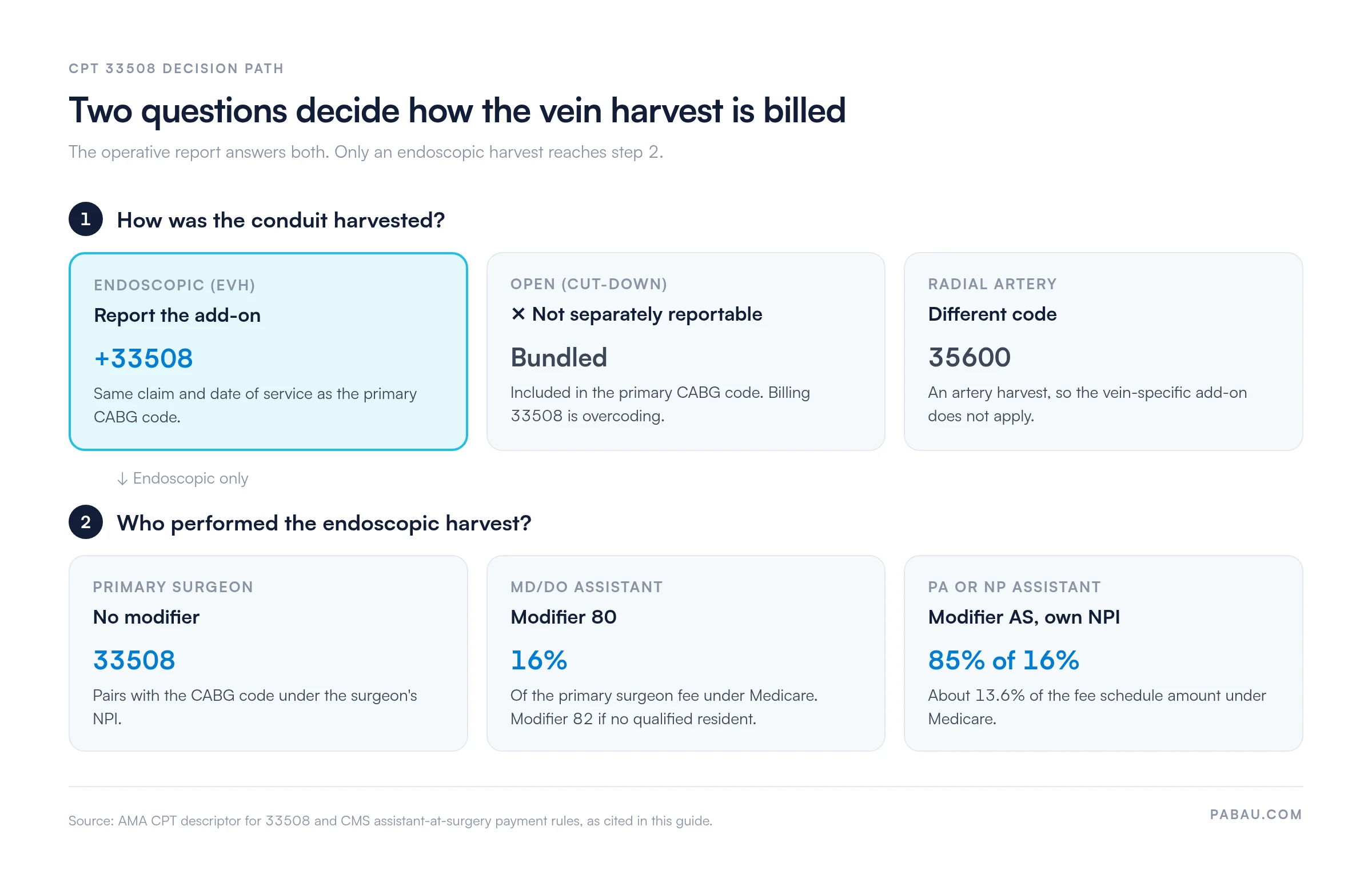
A PA or NP may bill CPT code 33508 when they perform the endoscopic vein harvest as the assistant surgeon during a CABG.
This scenario is common in cardiothoracic surgical practices where the PA harvests the saphenous vein while the surgeon begins the sternotomy and cardiopulmonary bypass setup. The billing mechanics require attention to medical billing compliance guidelines and CMS nonphysician practitioner rules.
CMS rules for this scenario (verify against Chapter 12 of the CMS Claims Processing Manual for current policy):
Prior authorization for 33508 follows the authorization secured for the primary CABG procedure. Most payers do not require a separate authorization for the add-on code when the primary CABG has been approved. However, three payer-side requirements can still block payment after the procedure.
Error-checking claims management software validates each claim before submission. A 33508 line with no same-day primary code is caught before it leaves the practice, which saves avoidable rework.
CPT code 33508 has a predictable denial profile, and the same five reasons repeat across payers. A strong denial management workflow addresses each at the source rather than in the appeals queue.
Reading the CARC denial codes explaining rejections on each remittance tells billing teams which of these five reasons applies. Each rejected 33508 claim then goes to its own corrective step instead of the generic appeals queue.
The operative report is the only document that supports a 33508 claim on audit. Surgical schedules, preference cards, and anesthesia records do not establish the approach. The coder should return the claim to coding hold until the signed operative report contains all of the following elements.
A clean claim submission for 33508 requires the operative report to document:
Build a 33508 documentation checklist into your cardiothoracic surgery operative note template. Before the case closes, the circulating nurse or surgical PA should confirm the five required elements are captured in the dictation. Adding a missing element in the OR takes 30 seconds. Fixing it during a payer audit means a 90-day appeals process.
Without a pre-submission check, a missing primary code or a misrouted PA claim surfaces only when the remittance comes back denied. The fix then means a corrected claim and weeks of waiting.
In Pabau’s claims management software, claim validation scrubs every claim for missing or invalid details before it leaves the system. Flagged claims land in a “Needs action” queue with a direct route to the field that needs fixing.
US claims go out through Claim.MD, and your team can check eligibility before the surgery date. Each claim is tracked from pending to paid on one dashboard, so a stalled 33508 line is visible within days.

Pabau’s claim validation flags missing or invalid claim details before submission, so incomplete 33508 claims get fixed before a payer sees them. See how surgical billing teams cut avoidable denials.

CPT code 33508 pays modestly on its own, so the aim is a clean first pass rather than a strong appeal. Each denial reason in this guide can be stopped before submission.
Build the five documentation elements into the operative note template, and hold any 33508 line that lacks a same-day CABG code. Route every PA or NP harvest to the practitioner’s own NPI with modifier AS.
Book a demo to see how Pabau holds incomplete CABG claims back until the add-on pairing checks out.

Need to understand how clearinghouse submission works? Medical claims clearinghouse guide explains how claims are validated and routed to payers before payment.
Want to reduce denials across your full billing workflow? Revenue cycle management overview covers the end-to-end process from charge capture to payment posting.
Confirming coverage before cardiac surgery? Insurance eligibility verification walks through how to confirm coverage before the procedure is scheduled.
CPT code 33508 is an add-on code for endoscopic (video-assisted) harvesting of the saphenous vein during a coronary artery bypass graft procedure. It is reported in addition to the primary CABG code, cannot be billed alone, and covers only the endoscopic approach. Open (cut-down) vein harvest is bundled into the primary CABG code and is not separately reportable.
Yes. CPT code 33508 is designated as an add-on code by the AMA (identified by the + prefix in the codebook). It must accompany an approved primary CABG code on the same claim and date of service. It carries a ZZZ global period and is exempt from the multiple procedure payment reduction.
Yes, with the correct modifier. A physician assistant or nurse practitioner who performs the endoscopic vein harvest as assistant surgeon bills 33508 with modifier AS under their own NPI. Medicare pays 85% of the 16% assistant surgeon rate. Commercial payer rules vary, so verify coverage policies before the procedure when possible.
The global period for CPT 33508 is ZZZ, meaning it follows the global period of the primary procedure it accompanies. All add-on codes receive a ZZZ global assignment from CMS. Post-operative care for the CABG encounter is covered under the primary code’s global, not separately.
The most frequent denial is the absence of a primary CABG code on the same claim. An operative report that never confirms the endoscopic approach is the next most common. Payers also deny NCCI bundling conflicts, where 33508 is paired with a non-approved primary code. A PA or NP harvest billed under the surgeon’s NPI without modifier AS denies too.
The most common pairing is I25.10 (atherosclerotic heart disease of native coronary artery without angina pectoris). More specific codes apply when the indication is documented. Use I25.110 for unstable angina or I25.700 for redo-CABG atherosclerosis. Acute MI requiring emergent bypass takes the appropriate I21 STEMI or NSTEMI code.




