CPT Code 25210: Excision of a single carpal bone
CPT Code 25210: Official descriptor and quick-reference data CPT Code 25210 is a...

Last Updated: Nov 26, 2026
33530 is the CPT add-on code for a reoperation, coronary artery bypass or valve procedure, more than one month after the original operation. It pays for the extra work of reopening a chest that has been operated on before.
The code never stands alone. It rides on a primary CABG or valve code, carries a ZZZ global indicator and never takes modifier 51. Most denials come from a missing primary code, an operative report that doesn't prove the redo, or a stray modifier 51. Below are the parent codes, documentation, 2026 RVUs and a fix for each common denial.
Let Pabau's smart automation suggest the right codes, reduce claim denials, and keep your practice compliant—effortlessly.
Automate repetitive tasks and focus on what matters most—your patients.
Reduce coding errors and ensure compliance with the latest regulations.
Clean claims, fewer denials, and faster reimbursements.
Powerful insights and reporting to help your practice thrive.
HIPAA compliant SOC 2 certified GDPR-compliant Trusted by 4,000+ clinics worldwide

CPT code 33530 is an add-on code for a redo CABG or valve operation done more than one month after the original surgery.
It can’t be billed alone. A primary CABG code (33510-33516 or 33533-33536) or a valve procedure code (33400-33496) must sit on the same claim.
Add-on codes are exempt from modifier 51, so appending it to 33530 invites an automatic denial.
33530 carries a ZZZ global indicator and 14.29 total facility RVUs in the 2026 Medicare fee schedule.
Pabau, a practice management platform, sends claims electronically through Claim.MD and tracks denials, so a rejected 33530 line is easy to find and resubmit.
CPT code 33530 is the AMA add-on code for a redo coronary bypass or valve operation, more than one month after the original surgery. In a Q&A, the AMA’s CPT Assistant confirms it applies to a redo CABG or valve surgery past that point. Its descriptor tells you to list it separately, in addition to the primary code.
Two parts of that descriptor trip up experienced coders. First, 33530 covers valve reoperations too, not only redo CABG. Second, the one-month threshold is strict. A return to the OR within a month of the first surgery doesn’t qualify, because that work falls inside the original global package.
A reoperative CABG is far more complex than a first bypass. The surgeon reopens the chest through scar tissue that formed after the first operation. Re-entry risks injuring working grafts, the right ventricle and lung tissue stuck to the breastbone.
Graft choice changes too. Surgeons often turn to the radial artery, more saphenous vein, or a second internal mammary artery when the first was already used. If the vein is harvested endoscopically, 33508 may be separately reportable, though payer bundling rules apply.
CPT code 33530 pays for the reoperative work. That means re-entry, clearing adhesions and the extra operating time an earlier cardiac surgery causes. The grafting or valve work itself is billed with the primary procedure code.
National Correct Coding Initiative (NCCI) edits decide which codes can be billed alongside 33530. CMS updates them every quarter, so check the current tables before you submit. A bundled pair can only be split with a modifier where the edit allows one.
CPT code 33530 must be listed with a primary procedure code on the same claim. The AMA’s parenthetical instructions name the acceptable parents. Leaving the primary code off is the most common reason these claims are denied.
Vein-only grafts run from 33510 to 33516, while arterial grafts start at 33533. Pick the primary code from the grafts placed, then add 33530 on its own line.
Valve procedure codes (33400-33496) are also acceptable primary codes under the AMA descriptor. When the redo is a valve operation, pair 33530 with that valve code rather than a CABG code.
Coders often confuse 33530 with the combined arterial-venous graft add-ons (33522, 33523). Others try it in place of the unlisted code 33999. Each one does a different job.
Another common error is billing 33530 when the only prior procedure was a cardiac catheterization. Catheterization isn’t cardiac surgery. The original operation in the descriptor means earlier open heart surgery, not an interventional cardiology procedure.
Every 33530 claim should clear four questions before it leaves the practice. A single no means the add-on doesn’t belong on the claim yet.
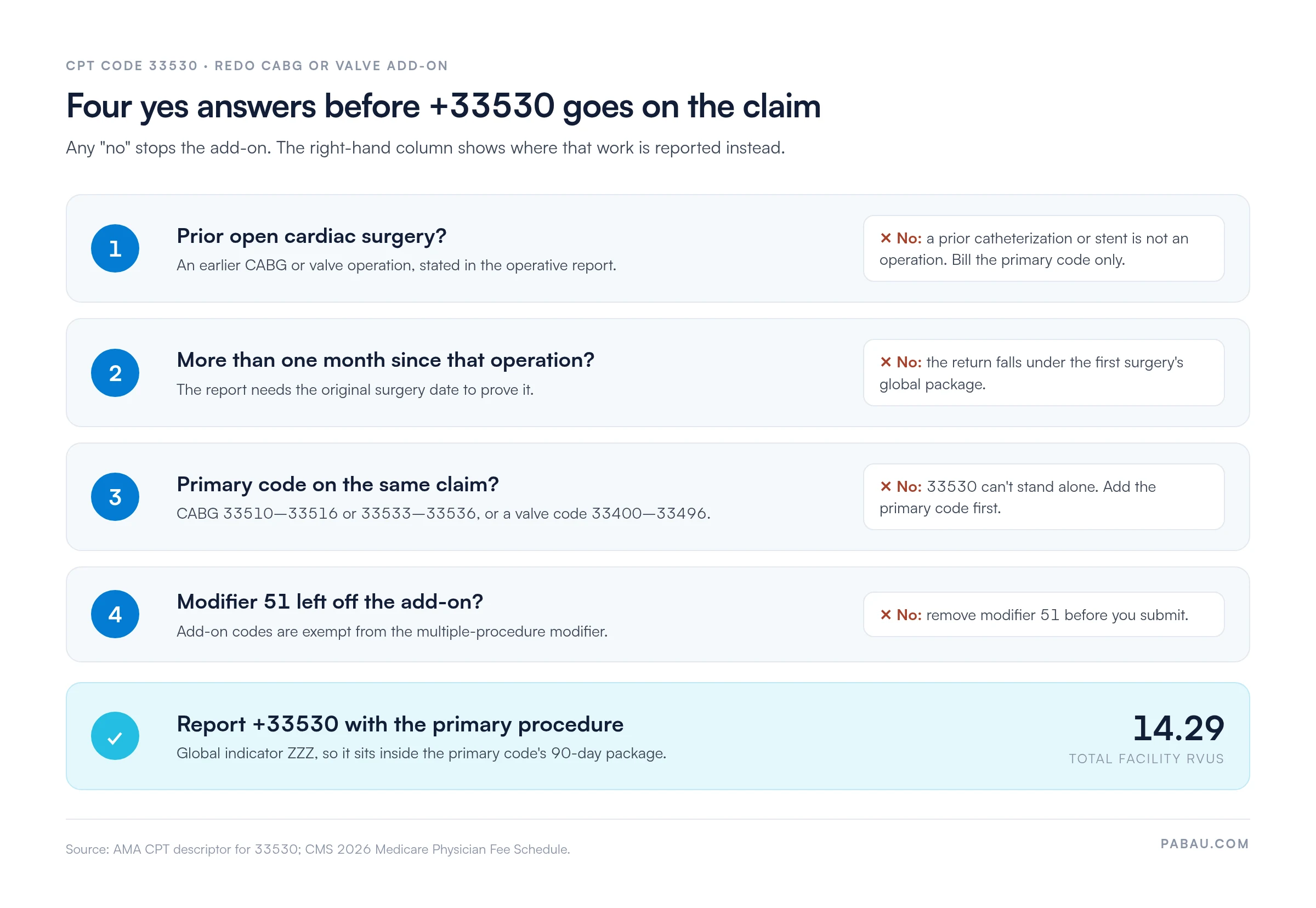
Then run this quick checklist on the claim itself:
Step six is where a missed add-on payment shows up. For example, a redo with one arterial graft should show two paid lines, 33533 and 33530. If the 33530 line is denied or paid at zero, pull the operative note and appeal.
The operative report is the billing record for 33530. Payers audit redo CABG claims closely, because procedure codes alone can’t show the added complexity. A clean claim starts with a report that answers five questions.
Strong medical billing compliance for cardiac codes means applying this standard to every redo case. One missing element is enough for a payer to deny or downcode the claim.
The diagnosis on a 33530 claim must establish medical necessity for the reoperation. The primary diagnosis usually reflects the coronary disease driving the redo. A secondary code for the earlier bypass graft supports the claim further.
Native-vessel disease without angina codes to I25.10, while disease in the old grafts takes an I25.7- or I25.81- code. Z95.1 tells the payer the patient already had a CABG. List the condition that needs surgery first, with Z95.1 after it.
CPT code 33530 carries its own work RVU for the extra effort of reoperative surgery. As an add-on, it pays on top of the primary procedure on the same claim. CMS updates the Medicare Physician Fee Schedule (MPFS) every calendar year. Check current values in the CMS PFS lookup tool before each new year.
These are facility values. Reoperative CABG happens in a hospital, so the facility rate applies in almost every case. Your local payment changes once geographic adjustments (GPCIs) apply. The FastRVU 2026 lookup tool or the CMS MPFS shows the figure for your locality.
Track 33530 payments separately from the primary CABG codes on each remittance. That way, a missing or reduced add-on payment stands out instead of hiding inside the primary line.
Add-on codes are exempt from modifier 51 under AMA CPT guidelines. Appending it to 33530 is the modifier error to watch most closely. The payer’s system rejects the line, because add-on codes can’t carry that modifier.
CPT code 33530 carries a ZZZ global indicator, so it falls within the primary code’s 90-day global package. Routine post-operative visits and typical complication care sit inside that package. They can’t be billed separately during those 90 days.
Redo CABG claims draw payer scrutiny, because the add-on’s complexity has to be documented. These six patterns come up most often in denial management workflows for cardiac surgery teams.
Compare your 33530 remittances against the medical billing denial codes to spot patterns. When one denial repeats across a quarter, the fix is usually a workflow, not a coder. Common culprits are an op-note template without the prior surgery date, or charge entry that adds modifier 51 by default.
Audit your 33530 claims each quarter against that quarter’s NCCI edit tables. NCCI edits update four times a year, so a pair that cleared in January may trigger a bundling edit by April. Set a reminder to pull the new tables from CMS each quarter and check your most common 33530 pairings.
A redo CABG claim passes through several hands, from the surgeon’s note to the coder to the clearinghouse. Each handoff is a chance for the 33530 line to slip, or for a denial to sit unnoticed.
Pabau’s claims management software sends US claims electronically through Claim.MD, as CMS-1500 or 837P claims. Eligibility checks run before the procedure, and ERA remittances post back against the claim.
Denials are tracked in the same place. Your team sees a rejected 33530 line and resubmits it without logging in to separate portals, so less time goes on chasing remittances.

Pabau sends US claims electronically through Claim.MD, checks eligibility and posts ERA remittances. Denial tracking shows which 33530 lines need resubmitting.

CPT code 33530 rewards careful paperwork more than coding knowledge. The rules are short: a qualifying prior operation, more than a month ago, a primary code on the claim, and no modifier 51.
The operative note is where these claims are won or lost. Build the prior surgery date, adhesion work and graft vessels into your redo template. That removes the most common reason for a denial.
Book a demo to see how Pabau sends cardiac surgery claims through Claim.MD and tracks each denial through to resubmission.

Need to track denial patterns across cardiac surgery codes? Denial management in healthcare covers how to build a systematic denial reduction process for surgical specialties.
Submitting claims electronically for the first time? Claim.MD clearinghouse guide explains how electronic claim submission works and what to verify before your first submission.
Want to understand how the 837P file structure affects cardiac claims? 837 file overview breaks down the electronic claim format used for professional and institutional billing.
Billing a combined arterial and vein graft? CPT code 33517 explains the first vein graft add-on reported with arterial CABG codes.
Is the redo a valve replacement? CPT code 33405 covers aortic valve replacement, a common primary code paired with 33530.
It’s the add-on code for a redo coronary bypass or valve operation done more than one month after the original surgery. It’s always billed with a primary CABG or valve code.
Yes. The descriptor covers a CABG or valve reoperation after an original operation, so the two procedures don’t need to match. The earlier operation still has to be open heart surgery more than a month before.
Bill one unit per operative session. The code describes the reoperative work as a whole, so it doesn’t scale with the number of grafts or valves. The primary code captures that.
No. Add-on codes are exempt from the multiple procedure reduction, so Medicare pays 33530 at its full fee schedule amount alongside the primary code.
Traditional Medicare doesn’t require prior authorization for an inpatient redo CABG. Most Medicare Advantage and commercial plans do, so confirm the plan’s rules before scheduling.