

CCSD code G5100: Bypass of duodenum billing guide
CCSD code G5100 bills a bypass that leaves the duodenum in place CCSD code G5100...

Last Updated: Oct 16, 2026
33533 is the CPT code for coronary artery bypass, using arterial graft(s); single arterial graft.
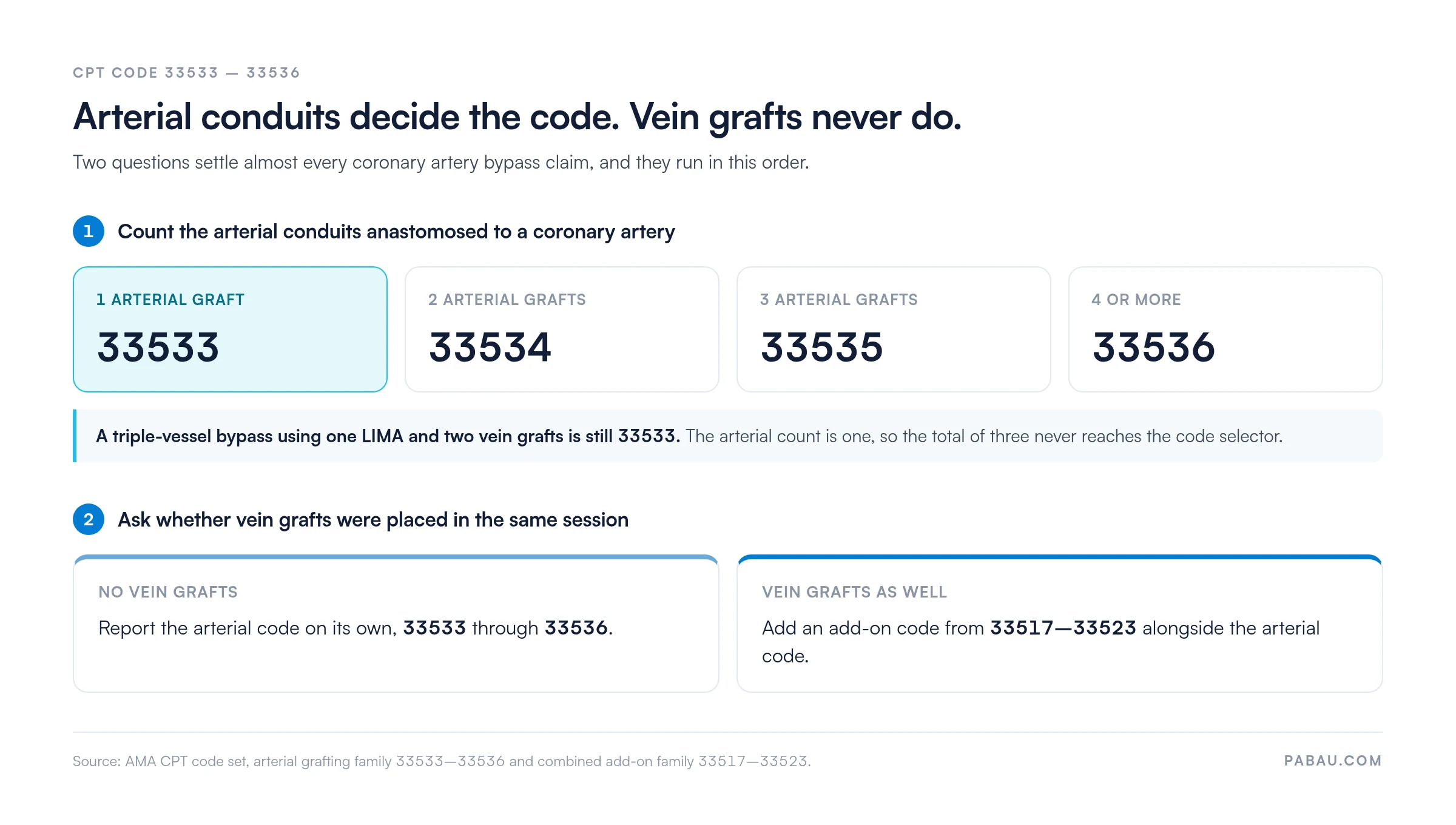
It sits in a four-code family, 33533 through 33536, where the number of arterial conduits decides which code applies. Vein grafts placed in the same session never change that count. They are reported with an add-on code from 33517-33523 instead.
Let Pabau's smart automation suggest the right codes, reduce claim denials, and keep your practice compliant—effortlessly.
Automate repetitive tasks and focus on what matters most—your patients.
Reduce coding errors and ensure compliance with the latest regulations.
Clean claims, fewer denials, and faster reimbursements.
Powerful insights and reporting to help your practice thrive.
HIPAA compliant SOC 2 certified GDPR-compliant Trusted by 4,000+ clinics worldwide

CPT code 33533 covers one arterial conduit anastomosed to a coronary artery, most often a LIMA-to-LAD graft.
Arterial graft count drives code selection, from 33533 for a single graft up to 33536 for four or more.
Vein grafts in the same session never change the arterial code, and take an add-on code from 33517-33523.
The 90-day global period bundles routine post-op care, so modifiers -24, -58 and -79 unbundle what stays separately payable.
Pabau’s claims management software tracks prior authorization status and routes 33533 claims through Claim.MD for eligibility checks and ERA reconciliation.
CPT code 33533 reports a coronary artery bypass built with a single arterial conduit. The official AMA CPT descriptor reads: Coronary artery bypass, using arterial graft(s); single arterial graft. Every word of it does work.
“Arterial graft(s)” separates 33533 from the vein-only family, 33510-33516, where no arterial conduit is placed at all. “Single arterial graft” then fixes the count at one. As soon as a surgeon harvests and anastomoses a second arterial vessel, the claim belongs to 33534.
All four codes in the family escalate on arterial graft count alone. Reading them as a set heads off two familiar errors. The first is under-coding a two-vessel arterial bypass as 33533. The second is letting vein grafts inflate the arterial total.
Cardiopulmonary bypass does not move the code. On-pump or off-pump, the arterial graft count still decides it. The pump work sits inside the global surgical package and is not reported separately by the surgeon.
A coronary artery bypass routes blood around a blocked vessel through a harvested conduit. The surgeon sews that conduit proximally to the aorta or another arterial source. The distal end goes to the coronary artery, past the obstruction.
Coding it correctly needs three facts from the operative report, and nothing beyond them:
The LIMA-to-LAD anastomosis is the single arterial graft you will meet most often. The descriptor names no conduit, though. Any one arterial vessel, whichever it is, maps to 33533.
Code selection comes down to a single count. Count the distinct arterial conduits anastomosed to coronary arteries in one operative session. Vein grafts placed alongside them never enter that count, and they carry their own add-on code instead.
Two questions settle the decision, and the order matters more than the anatomy:
Worked against real operative scenarios, the rule looks like this:
Running the count the other way round is where claims go wrong. A triple-vessel bypass using one LIMA and two saphenous vein grafts codes as 33533, never 33535. Three grafts were placed, but only one of them was arterial.
Medical necessity for 33533 rests on a primary ICD-10-CM diagnosis showing obstructive coronary artery disease. Sequence the condition that drove the bypass first. Additional coronary lesion codes follow it, and status codes appear only on later encounters.
Most elective bypass claims lean on I25.10, and urgent cases on I25.110. Choose between them from the documented angina status, not from how the case was scheduled. Both codes also justify a catheter-based case, so a lesion opened with a balloon bills as PCI under 92920.
When that catheter-based case is a planned high-risk PCI, the team may place a percutaneous assist device first, reported with CPT code 33990. The PCI itself stays separately reportable, so both the support device and the intervention belong on the claim.
Z95.1 is a status code, not a reason for surgery. It belongs on follow-up encounters after the bypass, never as the primary diagnosis on the operative claim. Put it first and the payer reads the claim as having no medical-necessity anchor at all.
Two surgeons often work a CABG at the same time, on different parts of the same procedure. That makes modifier choice harder here than on most surgical codes. These are the ones that show up on 33533 claims.
Modifier -62 is the one with real money attached. Both surgeons append it to their own claim for the same code. Medicare’s co-surgery policy expects documentation that each physician performed distinct, identifiable work.
Supervising or observing does not meet that bar. Private payer contracts also vary from Medicare’s 62.5% split, so read the plan before you submit rather than after the remittance lands.
Before you send a 33533 claim with modifier -62, check that both operative reports describe distinct surgical work. One note signed by two surgeons, with no split of who did what, is a standard audit trigger. Give each physician their own documentation, or one note that names each surgeon’s contribution.
33533 carries one of the higher work RVU values in the cardiac surgery section of the fee schedule. The CMS Physician Fee Schedule publishes facility and non-facility rates every year.
Check the current figures in the FastRVU lookup tool or the CMS look-up tool before billing, because they move with each calendar year.
High-RVU codes draw attention. 33533 claims reach pre-payment review and payer audits far more often than routine surgical codes do. The documentation behind them has to hold up on a first reading, by a reviewer who was not in the room.
33533 carries a 90-day global surgical period under CMS rules. The package covers the pre-operative visit on the day of service, the intraoperative work, and routine post-operative care for the following 90 days. Billing any of it separately is an NCCI edit violation.
Bundled into the package, and not separately payable:
Separately payable inside the same 90 days:
Tracking global windows by hand across a cardiac panel goes wrong quickly. A billing system that flags an open global period against the patient record is what stops a routine follow-up visit from being billed by mistake.
Most commercial payers and Medicare Advantage plans require prior authorization for elective CABG. Traditional Medicare, Parts A and B, does not. The documentation burden stays either way, because medical necessity still has to be substantiated in the record.
What commercial payers usually want on file before they approve:
The operative note then has to confirm a shorter list:
Leave one of those elements out and the claim has no defense in an audit. A note without conduit identity or anastomosis sites cannot prove which code was correct. Charge capture that prompts the surgeon to confirm arterial graft count before signing closes most of that exposure.
A descriptor tells you what to code. It says nothing about why the claim came back. Six patterns come up again and again on 33533, and each one has a fix.
Five of those six get caught by the same short review, run before the claim ever leaves the practice.
NCCI edits, published by CMS and updated quarterly, decide what may be reported alongside 33533. Conduit harvesting and cardiopulmonary bypass carry the decisions that matter most.
The principle underneath the table is short. Work integral to performing the bypass is bundled, including the pump run, mammary artery dissection, and routine exposure. Work that needs a separate approach or skill set, such as an endoscopic vein harvest, stands on its own.
A valve replacement performed in the same session is separate work, not part of the bypass. An aortic case adds 33405 to the claim alongside the graft code, under the payer’s modifier rules.
Set a quarterly reminder to download the current NCCI Policy Manual from cms.gov. The manual governs which harvesting codes can be billed alongside the 33533 family, and the edits around 35600 have changed more than once. A stale NCCI reference is a direct path to unbundling denials.
Six lines, worked in order. A biller who runs them takes most of the denial risk out of a 33533 claim before it is transmitted.
Two minutes per claim is cheap on a code this size. A denied 33533 costs a full rework cycle on one of the largest line items the practice bills all month.
Cardiac billing teams usually run this across three systems. Authorization sits in a spreadsheet, the claim goes out through a clearinghouse portal, and the remittance comes back on a different screen. The graft count in the operative note and the code on the claim never meet in the same place.
Practice management software like Pabau keeps them together. Documentation, charge, and claim all sit on one patient record, so the code gets picked next to the note that supports it. Authorization status lives on that record too, which is where a biller checks before an elective case is scheduled.
From there, Pabau handles claims management without rekeying. It submits 837P files through Claim.MD, returns eligibility responses, and reconciles ERAs against the original charge. On a code carrying 32.91 work RVUs, closing that loop is worth more than any single workflow shortcut.
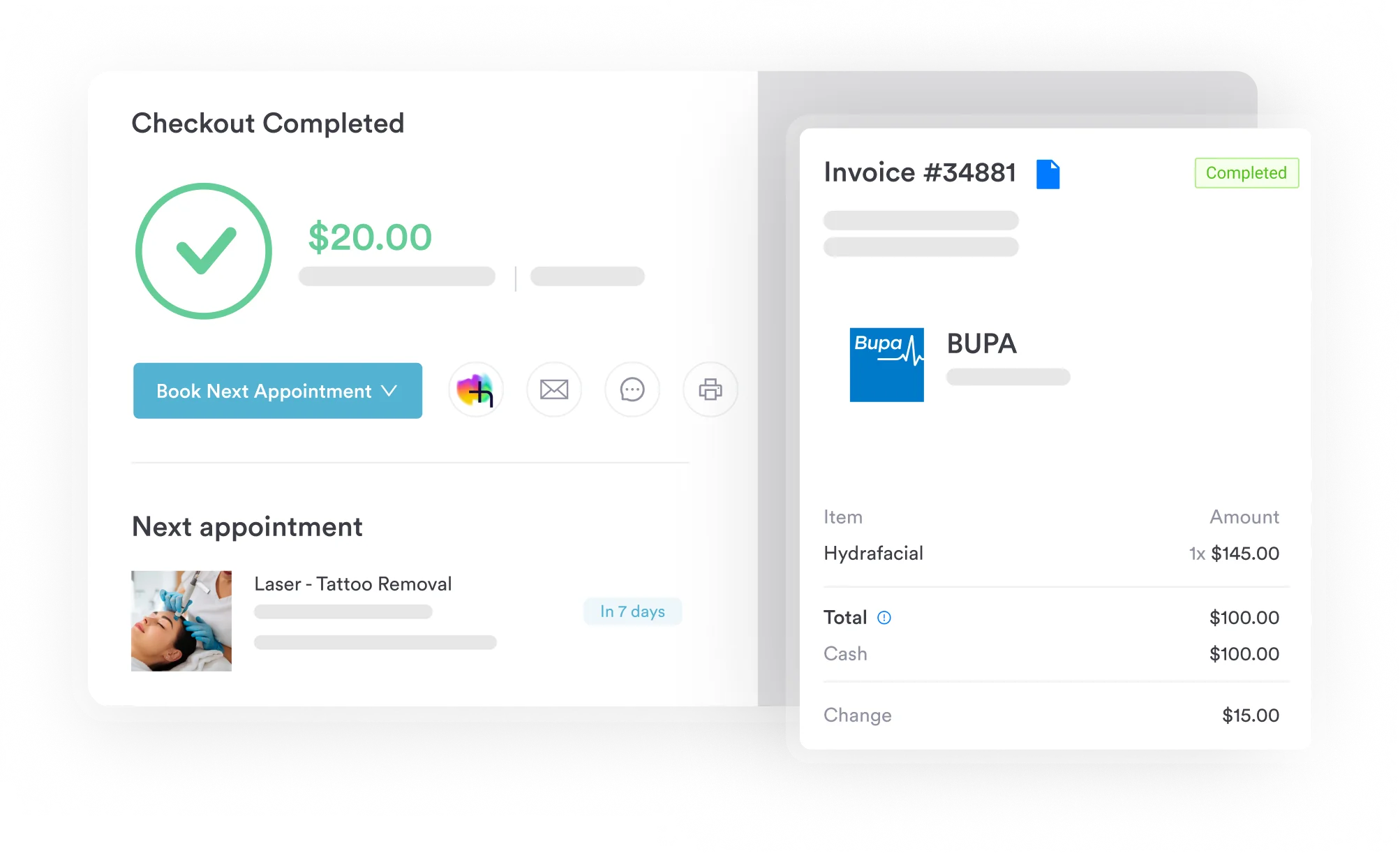

Pabau’s claims management connects to Claim.MD for eligibility checks, 837P submissions, and ERA reconciliation. Authorization, charge, and remittance for codes like 33533 stay on one patient record.

33533 rewards care at one moment: the point where a coder reads the operative note and decides how many arterial conduits were used. Get that count right and most of the claim follows from it.
The habits that protect it are small ones. Read the anastomosis section rather than the header. Hold elective cases until authorization lands. Refresh the NCCI edits each quarter. None of that takes long, and together they remove most of what sends this code back.
Systematize it and the month looks different. Fewer reworks, fewer accounts sitting past 90 days, and the practice’s biggest claims settling on first pass. Book a demo to see how Pabau tracks authorization, submission, and remittance for surgical codes on one record.

Need to track denial patterns across several cardiac codes? Denial management in healthcare covers how to categorize, track, and appeal denials systematically.
Submitting 837 files to commercial payers? How the Claim.MD clearinghouse works explains eligibility checks, claim scrubbing, and ERA routing for US practices.
Want the full picture for a surgical practice? What is revenue cycle management maps the billing workflow from pre-authorization through payment posting.
Chasing a higher first-pass rate? What makes a clean claim lists the fields payers check before they adjudicate anything.
Building charge capture around operative notes? The superbill, explained shows how charge documents feed the claim that follows.
Per session. One unit of 33533 covers the single arterial graft performed in that operative session. Quantity stays at one, and a second arterial conduit moves the claim to 33534 rather than adding a unit.
33533 reports a bypass built with an arterial conduit. 33510 belongs to the vein-only family, 33510-33516, where no arterial graft is placed in that session. When both conduit types are used together, report 33533 plus an add-on code from 33517-33523.
Medicare allows one calendar year from the date of service. Commercial payers usually set a shorter window, often 90 to 180 days, and the contract governs. Surgical claims held back for documentation queries are the ones that run out of time.
Query the surgeon before coding. Counting anastomoses from the narrative is a guess, and a guess that lands on 33534 instead of 33533 reads as upcoding in an audit. A short query costs far less than an appeal.
No. Modifier -50 reports a bilateral procedure on paired structures, and a coronary bypass has none. Use -62, -80 or -AS for surgeon and assistant roles, and -24, -58 or -79 inside the 90-day global period.



