HCPCS Code H0047: Alcohol and drug abuse services (NOS) billing guide
HCPCS Code H0047: Definition and official descriptor HCPCS Code H0047 is the HCP...

Last Updated: Oct 15, 2026
Billable Code
33228 is the billable CPT code for removal of permanent pacemaker pulse generator with replacement of pacemaker pulse generator; dual lead system.
Code selection turns on the number of leads connected to the replacement generator, not the device model. Denials on 33228 usually start in the operative report, when it never states that two leads were reconnected. Auditors then downcode the claim to 33227.
Let Pabau's smart automation suggest the right codes, reduce claim denials, and keep your practice compliant—effortlessly.
Automate repetitive tasks and focus on what matters most—your patients.
Reduce coding errors and ensure compliance with the latest regulations.
Clean claims, fewer denials, and faster reimbursements.
Powerful insights and reporting to help your practice thrive.
HIPAA compliant SOC 2 certified GDPR-compliant Trusted by 4,000+ clinics worldwide

CPT code 33228 covers removal and replacement of a dual-lead permanent pacemaker pulse generator.
Lead count separates it from 33227 (one lead) and 33229 (three or more leads).
The operative report must name two functional leads connected to the replacement generator, or the payer downcodes the claim.
Medicare claims need the KX modifier when the generator meets elective replacement indicator (ERI) or end-of-life (EOL) criteria.
Claims software that validates modifiers and NCCI edits before submission removes most technical denials on this code.
CPT code 33228 carries the official American Medical Association descriptor: “Removal of permanent pacemaker pulse generator with replacement of pacemaker pulse generator; dual lead system.” It covers one discrete surgical encounter, made up of five steps:
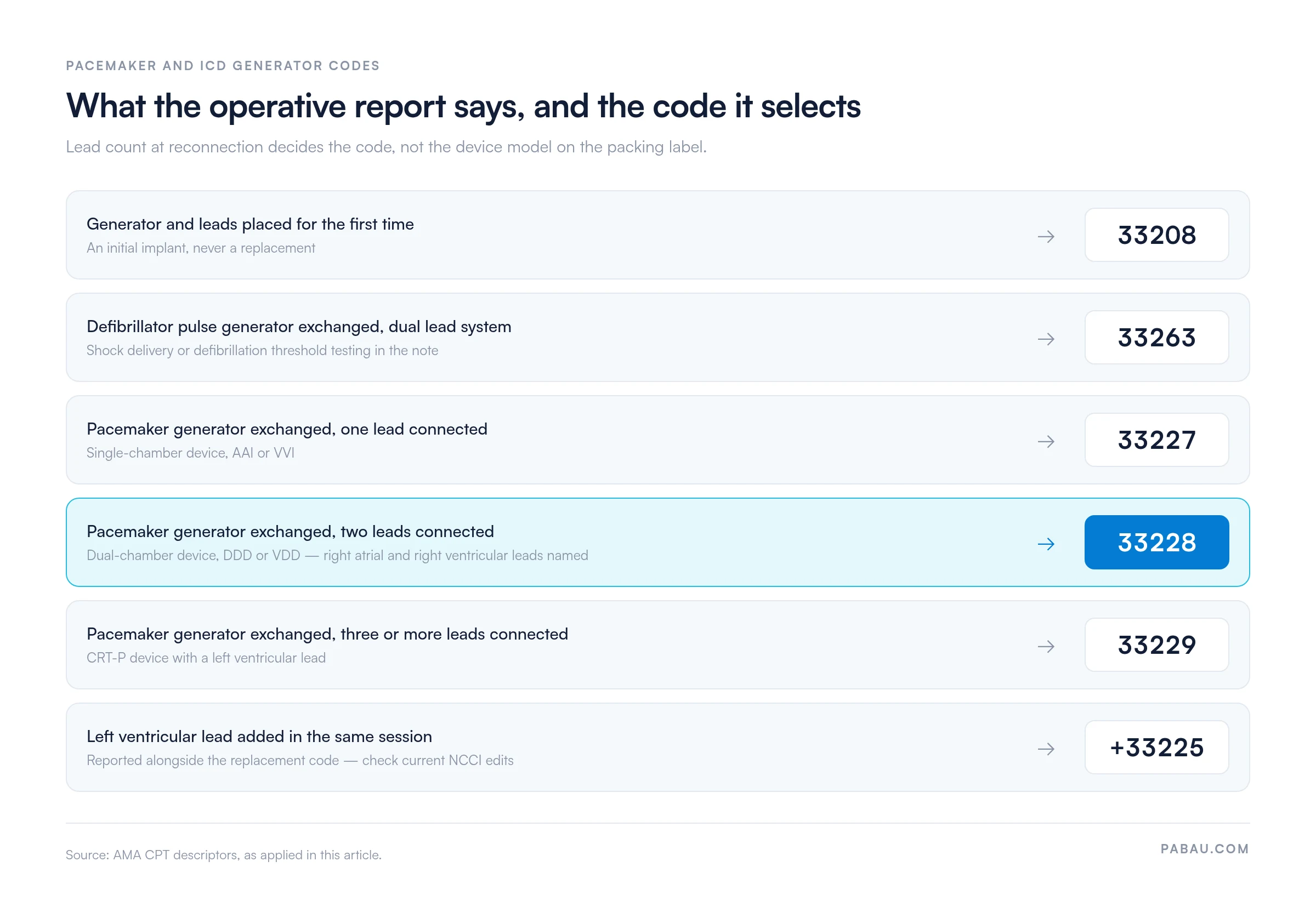
Lead count at the time of reconnection determines the code, not the chamber configuration of the original device.
33228 does not cover lead extraction or replacement, which carry separate codes. It also excludes lead repositioning that amounts to a new lead placement, and implantable cardioverter-defibrillator (ICD) generator exchanges (see 33263). An ICD exchange connecting three or more leads, typically a CRT-D, is reported with 33264, not 33263. Lead adhesion lysis performed to access the connector block is incidental to the generator replacement. Prevailing CMS guidance treats it as part of the package, though individual payer policies still vary. The broader pacemaker family sits in the 33206-33208 and 33227-33229 ranges.
The single most important selection rule: 33227 is for single-lead generator replacement, 33228 is for dual-lead, and 33229 is for three or more leads. The operative report controls the selection, not the device model number on the packing label. A dual-chamber device can be legitimately coded 33227 if only one lead was functioning and connected at the time of replacement.
That third row often carries an add-on code as well. A left ventricular pacing lead placed through the coronary sinus is reported with 33225, which payers accept only alongside a qualifying primary procedure code.
When the operative report is ambiguous, coders should query the surgeon before billing, not default to the higher-value code. Upcoding from 33227 to 33228 based on the device model rather than documented lead count is a common audit finding and a recoupment risk.
Four codes border 33228 closely, and miscoding between them drives a large share of cardiac device claim errors. Each one turns on a different fact in the operative report.
The split between a complete system insertion and a generator swap sits in the lead placement language. When the operative report documents new transvenous atrial and ventricular leads at the same session, the claim belongs under 33208.
The map below puts the whole family on one screen, keyed to what the operative report actually documents.
Modifier selection on 33228 depends on payer type, procedure circumstances, and the documentation in the operative report. Using the wrong modifier, or omitting a required one, is consistently among the top three denial reasons for this code. The AAPC CPT code lookup lists the applicable modifier families. The table below covers the scenarios most relevant to cardiac device billing.
The KX modifier warrants specific attention for Medicare claims. Per the applicable CMS billing and coding articles (A54931 and A54958), generator replacement is covered when the device has reached ERI or EOL status. Submitting 33228 to Medicare without KX, when the record documents ERI/EOL, causes an automatic technical denial. Fixing it takes a corrected claim rather than a simple appeal. Verify the modifier requirement with the relevant Medicare Administrative Contractor (MAC) for your jurisdiction, as LCD requirements can vary.
Run a modifier audit on 33228 claims before submission. Confirm KX is present on every Medicare generator replacement claim. Then check that the device interrogation report is attached or accessible. Missing KX on a Medicare claim with documented ERI/EOL is the fastest path to a preventable denial.
Medicare covers dual-chamber pacemaker generator replacement under the Medicare Physician Fee Schedule (MPFS) when medical necessity criteria are met. CMS has published specific billing and coding guidance in Local Coverage Articles A54931 and A54958, which define the clinical indications that satisfy coverage requirements.
Approximate 2026 national average payment rates are available through the CMS Physician Fee Schedule lookup tool. Verify current rates against the official MPFS data rather than third-party aggregators. Rates update annually and vary by geographic locality adjustment.
The facility versus non-facility rate differential is substantial for 33228. The procedure is almost always performed in a hospital outpatient department or ASC, so the facility rate applies. The 90-day global period bundles post-operative visits within 90 days of the replacement into the surgical fee.
Programming the replacement device on the same date, using 93280 or 93281, can trigger CCI bundling edits. Verify current NCCI tables before billing both codes on the same service date.
Claims management software like Pabau can automate this CCI edit check before submission. Electronic submission then routes the claim to the MAC that administers Medicare Part B in your jurisdiction.
Medical necessity for pacemaker generator replacement is established through the paired ICD-10-CM diagnosis codes on the claim. The CMS ICD-10 codes page maintains the official list of valid codes, and our ICD-10-CM code index covers the ones this claim relies on. The table below shows the diagnoses most commonly paired with 33228 on clean claims.
Z45.018 is the workhorse primary code for the vast majority of elective generator replacements prompted by ERI or EOL battery status. Z95.0 functions as a supportive secondary code and should not stand alone as the primary diagnosis. Payer-specific LCD policies may define a narrower list of acceptable primary diagnoses. Cross-check against the relevant MAC’s LCD for cardiac device procedures before submitting.
Prior authorization requirements for 33228 vary by commercial payer, and by plan for Medicare Advantage. Medicare fee-for-service generally does not require prior authorization for generator replacement. Medicare Advantage plans often do, and their timelines vary widely.
The following documentation typically supports a prior auth request for dual-chamber generator replacement:
Denials on 33228 cluster around four root causes: A missing modifier, an ambiguous operative report, a bundling conflict, and an ICD-10 mismatch. Each one is cheaper to catch before submission than in the appeals queue.
Submitting claims through a clearinghouse that validates modifier completeness and CCI edits before the claim reaches the payer eliminates the bulk of technical denials. Catching those errors at the clearinghouse costs a correction. Catching them at the payer costs an appeal.
Build a five-point check into your 33228 billing workflow. Confirm KX on every Medicare claim. Verify the op note documents two leads connected. Check NCCI for same-date programming codes. Confirm Medicare Advantage prior auth is on file. Match the ICD-10 codes to the MAC LCD.
The operative report is the single document that decides whether a 33228 claim survives audit. Payer audit protocols look for specific elements that confirm the procedure matches the code billed. No clearinghouse can add a detail the surgeon never dictated, so the note has to carry them at the point of care.
Most billing teams catch a missing KX modifier the same way: A remittance advice arrives weeks later with a technical denial. The claim goes back out as a correction, and payment slips another cycle.
Pabau moves that check to the front of the process. Claims are validated for modifier completeness and NCCI conflicts before submission, then sent electronically to the MAC or commercial payer. Anything the validator rejects comes back to your team the same day, not six weeks later.
For a practice billing pacemaker replacements, that means the interrogation report and the lead count get chased while the chart is still open. Your billing team spends its time on the exceptions instead of on rework.

Pabau checks modifier completeness and flags CCI bundling conflicts before a 33228 claim leaves your practice. Claims then route electronically to Medicare and commercial payers.

CPT code 33228 denials are almost always preventable. The code itself is simple: Dual-lead generator out, dual-lead generator in, two leads documented as connected. The trouble starts upstream, in an operative report that names a device model where it should have named a lead count.
The highest-value fix sits upstream of billing, with the surgeons who dictate the note and the checklist your team runs before submission. Neither costs anything to change. Both take a few weeks of reminding people.
Get those two right and 33228 becomes a routine claim rather than an appeals file. Book a demo to see how Pabau validates modifiers and NCCI edits on cardiac device claims before they reach a payer.

Need a clearinghouse that handles cardiac device codes? How Claim.MD clearinghouse works explains the electronic submission process for complex surgical codes, including modifier validation before claims reach payers.
Seeing recurring denials across your billing queue? Denial codes in medical billing covers the CARC and RARC codes your EOB shows when a 33228 claim is rejected.
Want to understand how 837 files carry your claim data? 837 file format for medical billing explains how procedure codes, modifiers, and diagnosis codes are structured in the electronic transaction your clearinghouse submits to payers.
CPT code 33228 covers removal and replacement of a permanent pacemaker pulse generator in a dual-lead system. The generator is exchanged while two existing leads stay connected. It does not include lead removal, lead replacement, or ICD generator exchanges.
33227 covers single-lead generator replacement, with one lead connected to the new generator. 33228 covers dual-lead replacement, with two leads connected. The operative report controls code selection, not the device model. A dual-chamber device with only one functioning lead at replacement is coded 33227.
Yes, Medicare covers CPT code 33228 when medical necessity criteria are met, primarily ERI or EOL battery status documented by a device interrogation report. CMS billing and coding articles A54931 and A54958 define the covered indications. Medicare Advantage plans may require prior authorization even when fee-for-service Medicare does not.
KX is required on Medicare claims to attest medical necessity when the device meets ERI or EOL criteria. Modifier -22 applies for substantially increased procedural complexity with supporting documentation. Some payers require -LT or -RT for laterality. Verify KX requirements with the specific MAC for your jurisdiction, as requirements can vary by LCD.
CCI edits bundle device programming codes (93280, 93281) with generator replacement codes in many scenarios. Whether they can be separately reported on the same date depends on current NCCI table entries and payer policy. Check the current CMS NCCI edits before billing both codes on the same service date. Attach a -59 or XU modifier only when a separately reportable service is documented.
Five denials account for most of the volume. A missing KX modifier on a Medicare claim leads the list. Next come upcoding denials, where the operative report never states that two leads were connected. CCI bundling conflicts with same-day programming codes follow. Missing Medicare Advantage prior authorization and ICD-10 codes that fail the MAC’s LCD criteria round it out.