HCPCS Code V2629: Ocular prosthesis billing guide
HCPCS Code V2629: Definition, descriptor, and code attributes HCPCS Code V2629 i...

Last Updated: Nov 6, 2026
32554 is the CPT code for thoracentesis, needle or catheter, aspiration of the pleural space; without imaging guidance. It covers draining fluid or air from the pleural cavity when the physician places the needle by anatomical landmarks, with no real-time ultrasound or fluoroscopy.
If imaging guides the needle during insertion, 32555 applies instead. 32554 sits in the Respiratory System surgery section and carries a 0-day global period. A same-day E/M visit needs modifier 25 on the E/M code.
Let Pabau's smart automation suggest the right codes, reduce claim denials, and keep your practice compliant—effortlessly.
Automate repetitive tasks and focus on what matters most—your patients.
Reduce coding errors and ensure compliance with the latest regulations.
Clean claims, fewer denials, and faster reimbursements.
Powerful insights and reporting to help your practice thrive.
HIPAA compliant SOC 2 certified GDPR-compliant Trusted by 4,000+ clinics worldwide

CPT code 32554 covers aspiration of the pleural space by needle or catheter when no imaging guidance is used or documented during the procedure.
If ultrasound or fluoroscopy guides the needle in real time, bill 32555 instead. Billing 32554 when imaging was used is a coding error with audit risk.
32554 carries a 0-day global period, and a separate E/M on the same date needs modifier 25 on the E/M code.
Claims management software such as Pabau scrubs 32554 claims for missing or invalid details and checks eligibility in real time through Claim.MD.
CPT code 32554 is maintained by the American Medical Association (AMA). Its official descriptor reads Thoracentesis, needle or catheter, aspiration of the pleural space; without imaging guidance.
The code sits in the Respiratory System surgery section of the CPT codebook, within the Lungs and Pleura subsection (codes 32035-32999).
Two coding elements define 32554. The first is the anatomical site, which is the pleural space between the visceral and parietal pleura around the lung. The second is imaging status, meaning guidance was neither used nor separately documented. Confirm both in the procedure note before assigning this code.
Thoracentesis without imaging guidance (32554) involves inserting a needle or catheter into the pleural space to aspirate fluid or air. No real-time ultrasound or fluoroscopic navigation is used. The physician identifies the insertion site by physical examination, percussion, and auscultation rather than by live imaging.
For billing staff, the phrase “without imaging guidance” is the critical coding qualifier. The procedure note must confirm that imaging was not used at all, or that it was used only for pre-procedure site marking. Real-time guidance during needle insertion moves the claim to 32555.
The post-procedure chest X-ray falls outside 32554 and can be billed separately. Imaging that guides the needle in real time is different, because it changes the code to 32555.
Medical necessity for 32554 requires documented clinical indication. Payers routinely request the operative note and supporting diagnosis codes when reviewing thoracentesis claims, particularly for repeat procedures.
Sequencing matters for secondary effusions. Pleural effusion is often secondary to a known condition, such as heart failure, malignancy, or hepatic cirrhosis. In that case, sequence the underlying disease code first and add J91.8. Sequencing J90 as primary when a more specific etiology is documented is a common audit finding.
CPT 32554 and 32555 describe the same procedure on the same anatomical site. The one variable that separates them is whether real-time imaging guided the needle during insertion. Coding the wrong one is the most frequently reported error for thoracentesis claims.
A note that says “ultrasound used for site identification prior to procedure” does not necessarily warrant 32555. Real-time guidance means the imaging device is active during needle insertion, guiding the path.
Pre-procedure marking alone keeps the claim at 32554. When this distinction is unclear in the operative note, query the physician before coding.
Imaging guidance does the same work for catheter drainage. When an indwelling catheter stays in the pleural space, real-time ultrasound or fluoroscopy makes the drainage claim 32557 rather than 32556.
Three codes adjacent to 32554 describe different pleural drainage procedures. Confusing them produces bundling denials, medical-necessity rejections, and, in some cases, fraud exposure. The clinical differentiation rests on what device is placed and whether it remains in the patient.
The 32554 vs 32551 distinction is procedural. 32554 uses a needle or catheter that is withdrawn after aspiration, while 32551 places a tube that stays in for continuous drainage. Billing 32554 for a chest tube insertion is an undercoding error. Billing 32551 for a simple aspiration overstates the procedure’s complexity.
A surgeon may perform a thoracentesis (32554) and separately place a chest tube at a distinct anatomical site in the same session. Modifier 59 or the matching X-modifier (XS for separate structure) may then be used to unbundle. Document the clinical rationale clearly; payers audit X-modifier usage heavily.
Before billing 32554 and 32556 together with modifier 59, confirm the procedures were performed at distinct pleural sites. Each one needs its own procedure note entry. A single operative note covering both aspirations without site differentiation will not survive a post-payment audit.
Complete documentation is the most effective way to prevent 32554 denials. The operative or procedure note must contain six elements before the code is assigned.
Missing any one of them gives the payer grounds for a technical denial or a post-payment recoupment request. A documentation checklist built into pre-submission review catches these omissions before the claim goes out.
A global period of zero days means no post-procedure evaluation and management (E/M) services are bundled into 32554. An E/M on the same date as the thoracentesis requires modifier 25 on the E/M code. The documentation must show that the E/M addressed a separately identifiable decision beyond the procedure itself.
Medicare reimbursement for CPT code 32554 is calculated from the CMS Medicare Physician Fee Schedule (MPFS) using relative value units (RVUs). Rates are updated annually and vary by geographic location through the geographic practice cost index (GPCI).
The figures below are 2026 national amounts. Confirm your local rate with the CMS MPFS lookup tool or the FastRVU 2026 RVU lookup before submitting claims.
Commercial payers generally follow Medicare’s coverage framework for 32554. Local coverage determinations (LCDs) from Medicare Administrative Contractors (MACs) may still add documentation requirements or frequency limits.
Novitas Solutions, CGS Administrators, and Palmetto GBA are examples of MACs that issue them. Check the applicable MAC’s LCD for the practice’s jurisdiction before assuming national standards apply.
CPT code 32554 denials cluster around a predictable set of errors. Most are preventable with pre-submission claim edits and documentation checklists. Denial management workflows cost less per claim when they run before submission than after a rejection.
Practices with high thoracentesis volume should run a quarterly denial analysis by reason code. Frequent CO-4 and CO-97 denials usually stem from modifier-25 and NCCI bundling issues. A clean claim process that checks these edits before transmission lowers first-pass denial rates.
A wrong or missing modifier is a frequent cause of CPT 32554 denials, alongside the 32554 vs 32555 coding error. Each modifier below has a specific clinical trigger.
Appending modifiers without supporting documentation is a compliance risk flagged in CMS audits, so review modifier usage against the source documentation each quarter.
The CMS MLN booklet “Proper Use of Modifiers 59, XE, XP, XS, and XU” (MLN1783722) sets out the rule. Modifier 59 is a last resort, used only when no more specific X-modifier applies. For pleural procedures at distinct sites in the same session, XS (separate structure) is more precise than 59 and less likely to draw audit scrutiny.
When billing 32554 with modifier 76 for a repeated same-day thoracentesis, document each aspiration separately in the procedure note. Record the time, volume, and clinical reason for each one. A single note covering both aspirations cannot support two billed units.
Thoracentesis claims benefit from validation before they are transmitted. Real-time eligibility checks catch coverage lapses and missing prior authorizations that would otherwise delay payment by 30-45 days.
In Pabau, the practice management platform we build, error-catching claims management scrubs each claim for missing or invalid details before it leaves the system. Through the Claim.MD integration, Pabau checks eligibility, then submits CMS-1500 and 837P claims to thousands of US payers.
The 837 file carries the diagnosis and procedure codes your payer needs, so accurate ICD-10 linkage in the record flows straight into the submission.
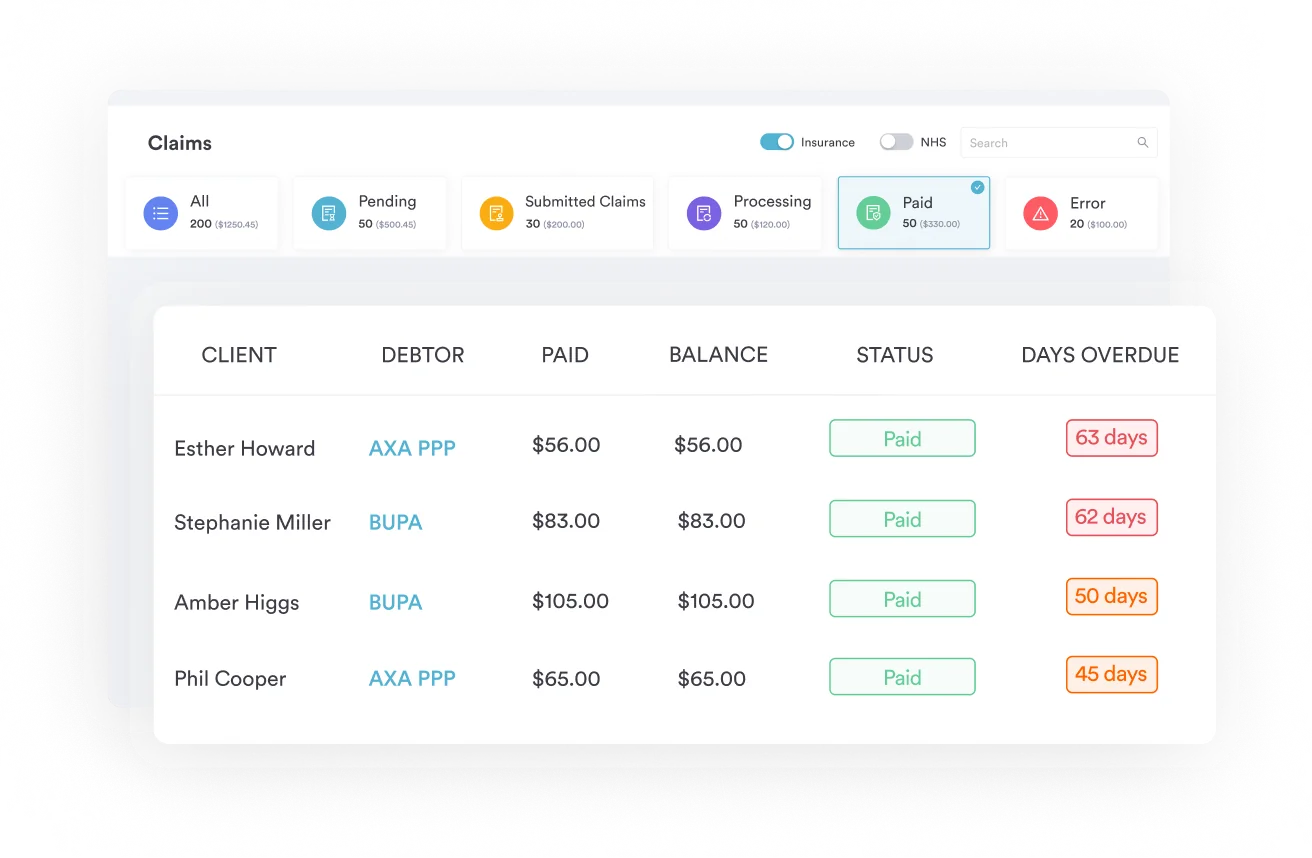
Electronic remittance advice (ERA, or 835 files) then comes back into Pabau and is matched to the claim it settles. A rejected claim is flagged as needing action, which shortens the time between denial and corrected resubmission.
High-volume practices can also set up 32554 claims with sensible defaults. Pre-map the usual diagnosis codes (J90, J91.8), note the 32551 bundling edit, and prompt for modifier 25 on same-date E/M visits. Each claim then starts from the right setup instead of a blank form.

Pabau scrubs every thoracentesis claim for missing or invalid details and checks eligibility in real time through Claim.MD. Denied claims are flagged for rework, so billing staff can act the same day.

CPT 32554 turns on one statement in the procedure note. If the note confirms that no real-time imaging guided the needle, and the diagnosis supports medical necessity, the claim stands. If that statement is missing, query the physician before choosing between 32554 and 32555.
Two habits prevent most rework on this code. Build the imaging statement into the procedure note template, and check modifier 25 and NCCI pairs before transmission. Book a demo to see how Pabau helps your billing team submit cleaner thoracentesis claims and fix denials the same day.

Want to understand how clearinghouse submission works end to end? Medical claims clearinghouse explains how payer routing, claim scrubbing, and ERA retrieval work together in a single pipeline.
Ready to see how Pabau handles revenue cycle workflows? Revenue cycle management outlines the eight workflow stages from eligibility check through final payment posting.
CPT code 32554 is the billing code for thoracentesis, needle or catheter, aspiration of the pleural space, without imaging guidance. It covers draining fluid or air from the pleural cavity when no real-time ultrasound or fluoroscopy guides the needle.
CPT 32554 covers thoracentesis without imaging guidance, while CPT 32555 covers the same procedure with real-time ultrasound or fluoroscopic guidance. Bill 32554 when the physician uses anatomical landmarks only. Bill 32555 when live imaging guides the needle during insertion.
In 2026, the national Medicare rate for CPT code 32554 is approximately $260 in the office (non-facility) setting and approximately $79 in a facility. The work RVU is 1.77. Local rates vary by GPCI, so check the CMS MPFS lookup before submitting claims.
The procedure note needs the procedure name and technique, the side and intercostal level, and the instrument used. It also needs an explicit statement that no imaging guided the needle and the clinical indication with a linked ICD-10 code. Record the volume and character of the fluid too. The imaging statement is the element most often left out.
No, not for the same pleural drainage encounter. NCCI edits bundle 32554 (thoracentesis) and 32551 (tube thoracostomy) for the same-session pleural procedure. 32554 uses a needle or catheter that is removed, while 32551 leaves a chest tube in for continuous drainage. If both are performed at distinct sites in the same session, modifier 59 or XS may apply with separate documentation for each.
The most frequent denial is coding 32554 when imaging guidance was used, which calls for 32555. Others include a same-date E/M without modifier 25, a missing or mismatched ICD-10 code, and thin documentation of medical necessity. Repeat procedures without modifier 76 and NCCI bundling conflicts with 32551 or 32556 also cause denials.